

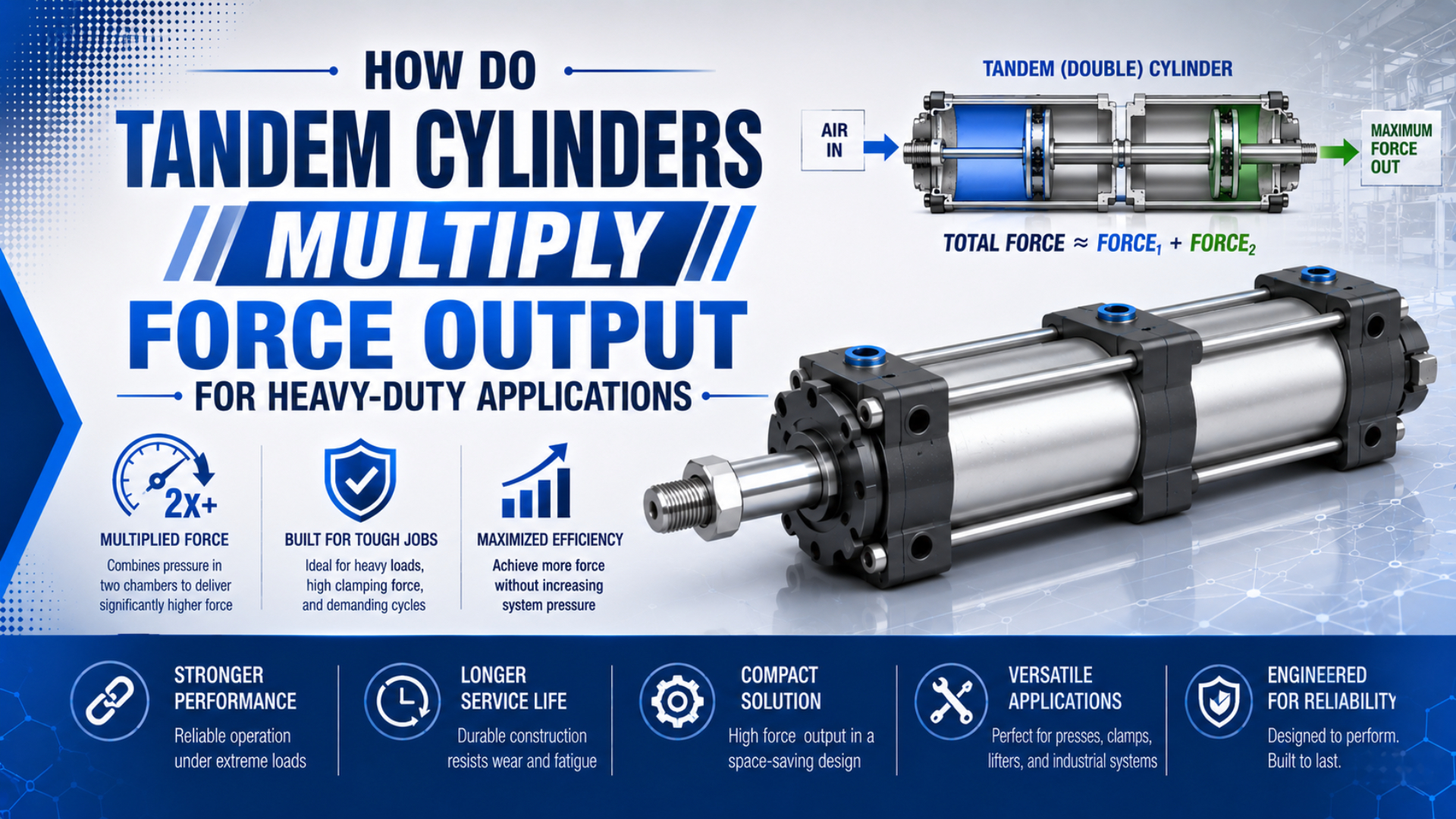
Tandemzylinder erhöhen die Kraft, indem zwei pneumatische Kraftstufen hintereinander angeordnet werden und beide Kolbenkräfte über eine gemeinsame Kolbenstange übertragen. Werden beide Arbeitskammern mit Druck beaufschlagt, addieren sich ihre wirksamen Flächen. Der Antrieb kann daher nahezu die doppelte Kraft eines Einzelzylinders mit gleicher Bohrung liefern, ohne dass eine größere Bohrung erforderlich ist.
Dieser Vorteil hat Grenzen. Eine Tandemeinheit ist meist schmaler als ein für dieselbe Kraft ausgelegter Einzelzylinder, jedoch länger, verbraucht mehr Druckluft, benötigt einen höheren Durchfluss und leitet die gesamte Reaktionskraft in eine Kolbenstange, Befestigung und Maschinenstruktur ein. „Doppelte Kraft“ ist eine erste Näherung, kein vollständiges Auslegungsergebnis.
Das Wichtigste in Kürze
- SMC beschreibt ein Doppel-Tandem als zwei fluchtend angeordnete Zylinder, die bei Druckbeaufschlagung beider Arbeitsanschlüsse die Ausgangskraft verdoppeln.
- Addieren Sie die wirksamen Flächen der druckbeaufschlagten Stufen; multiplizieren Sie keinen ungeprüften Katalogwert.
- Ein Doppel-Tandem mit 63 mm bei 6 bar ergibt nach idealer Flächenberechnung etwa 3,74 kN; das ausgewählte Katalogmodell kann davon abweichen.
- Prüfen Sie vor der Auswahl Luftbedarf, Ventildurchfluss, axiale Länge, Befestigungsreaktion, Kolbenstangenstabilität, Dämpfung und Maschinensicherheit.
Wie vervielfacht ein Tandemzylinder die Kraft?
SMC defines its tandem option as two air cylinders arranged in line and states that output doubles when both corresponding ports are pressurized (SMC Made-to-Order Tandem Cylinder, 2024). The shared rod adds the forces mechanically, so no separate motion-synchronization controller is needed inside the integrated actuator.
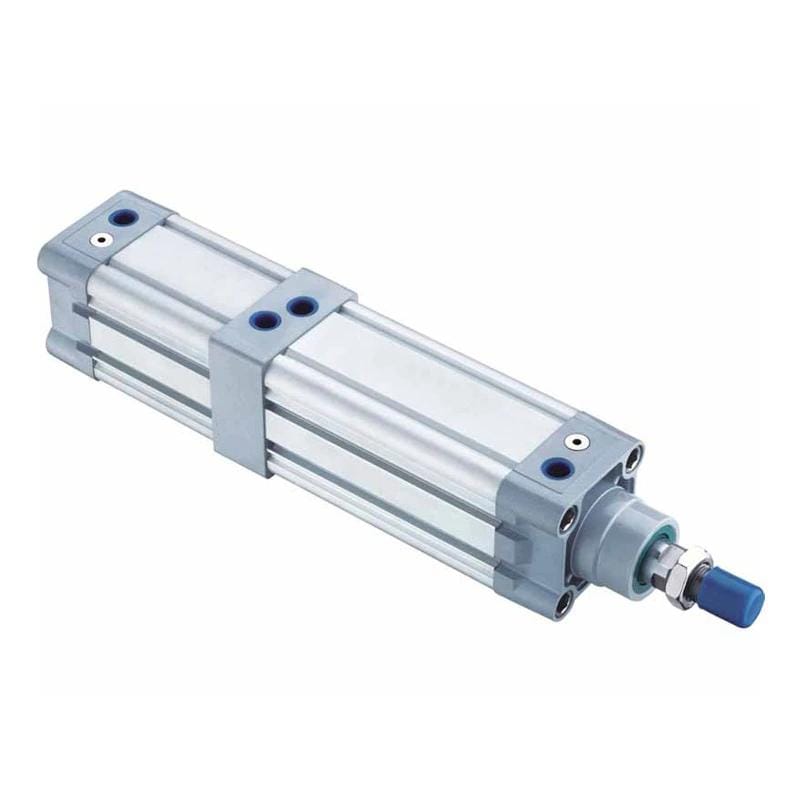
Ein Tandemzylinder is an integrated linear actuator with two cylinders connected in series and a common piston rod. For extension, pressure is supplied to the advance chamber of each stage. For retraction, pressure is supplied to the return chamber of each stage. The output rod carries the sum of the stage forces to one load.
Davon sind drei ähnliche Konzepte zu unterscheiden:
| Anordnung | Was verbunden ist | Hauptzweck | Zentrale Steuerungsfrage |
|---|---|---|---|
| Tandemzylinder | zwei Kraftstufen an einer gemeinsamen Stange | mehr Kraft bei gleicher Nennbohrung | alle Arbeitskammern korrekt be- und entlüften |
| Gestapelter Hochkraftzylinder | two to four compact pistons in series | scalable force in a limited radial envelope | model-specific force, length, sensing, and cushioning |
| Mehrstellungszylinder | separate strokes or cylinder sections | three or more discrete positions | stop sequence and position logic |
| Separate parallele Zylinder | independent rods acting on one mechanism | distributed force or load support | synchronization, load sharing, guidance, and binding |
Festo describes tandem cylinders as two identical profile-barrel cylinders connected in series to double thrust in both directions. Its separate high-force family can use as many as four pistons in series (Festo Tandem and High-Force Cylinders, 2026). Do not assume every tandem product supports three or four stages; check the actual series.
[UNIQUE INSIGHT] Tandem force is not “pneumatic synchronization.” The pistons are mechanically tied to one rod, so their positions cannot drift apart like two independent cylinders. The engineering problem moves elsewhere: each chamber still needs adequate pressure and exhaust flow at the same point in the stroke.
Wie lautet die richtige Kraftgleichung für Tandemzylinder?
Parker defines theoretical cylinder force as pressure multiplied by effective piston area (Parker Pneumatic Application Engineering Data, 2025). A tandem calculation applies that rule to every stage and sums the results. Use the pressure differential at the cylinder ports, not only the regulator or compressor-room gauge.
Theoretische Tandemkraft is the sum of the pressure-area force generated by every active stage before application load allowance. It is a calculation ceiling, not a guarantee of force at the machine tooling.
Für einen ausfahrenden Tandemzylinder lautet die vollständige Druckbilanz:
Here, is theoretical extension force in newtons, is the number of powered stages, is the pressure in each advancing chamber, is its effective piston area, is opposing rod-side pressure, and is the corresponding annular area. Use consistent pressure and area units.
Wenn alle Stufen die gleiche Bohrung haben, denselben Druck erhalten und mit vernachlässigbarem Gegendruck entlüften, ergibt sich als erste Näherung:
In this simplified expression, is working gauge pressure at the actuator, is bore diameter, and is the count of equal effective piston areas. With pressure in megapascals and area in square millimeters, the result is in newtons because 1 MPa equals 1 N/mm².
For example, two equal stages use , but only when both stages expose the assumed area and receive the assumed pressure. A model with different effective areas must be calculated stage by stage.
Beim Einfahren verringert die Kolbenstangenfläche die druckbeaufschlagte Fläche:
The exact rod-side geometry can differ by construction. Use the manufacturer’s advance and return force ratings when available. The rod-area calculation guide explains why retraction area is smaller, while the pressure-and-area force worksheet covers the base unit conversions.
Theoretische Kraft ist nicht gleich zulässiger Last. Lastverhältnis is the required application load divided by theoretical cylinder force. A useful selection expression is:
Here, is load ratio, is the worst credible required force, and is theoretical force in the applicable direction. SMC’s selection guide lists 0.7 or below for static work and 0.5 or below for specified dynamic load cases, with lower ratios for high speed (SMC Air Cylinder Model Selection, 2026). Apply the selected product’s method rather than treating those values as universal constants.
Rechenbeispiel: Doppel-Tandem mit 63 mm bei 6 bar
Parker’s metric force table gives a 63 mm piston area of 31.2 cm² and about 1,870 N theoretical extension force at 6 bar (Parker P1D Cylinder Catalog, 2025). Two ideal full-bore stages therefore produce about 3,740 N before back pressure and application allowances.
Beginnen Sie mit der Fläche eines 63-mm-Kolbens:
Bei 6 bar beträgt der Druck 0,6 N/mm². Die ideale Kraft einer Stufe mit voller Bohrungsfläche beträgt:
Für zwei gleiche Stufen mit voller Bohrungsfläche:
This result is an ideal geometry check, not a purchase specification. Festo’s current DNCT-63 tandem data lists 3,552 N theoretical advance force and 3,364 N theoretical return force at 6 bar (Festo DNCT-63 Technical Data, 2026). The catalog values reflect the selected product’s actual force areas and construction.
The same area rule exposes an important comparison. Two 100 mm pistons have half the total area of one 200 mm piston, not the same area. At equal pressure, four 100 mm full-bore stages would be required to match the theoretical area of one 200 mm bore. Envelope, cost, flow, stroke, and product availability still decide whether that arrangement makes sense.
[PERSONAL EXPERIENCE] In our experience, we found that the most common tandem-cylinder worksheet error is not the circle formula. It is multiplying a force number without recording whether it is extension or retraction, which pressure produced it, and whether it is theoretical, effective, or catalog-rated force. From our work, naming those conditions is the fastest correction.
Warum liegt die Katalogkraft meist unter dem einfachen Vielfachen?
Parker describes its P1D tandem as providing “almost twice” the force of one cylinder, while SMC describes its made-to-order dual arrangement as doubling output when the correct port pairs are pressurized (Parker P1D, 2024; SMC, 2024). Both statements require the exact product circuit and rating context.
Mehrere Einflüsse trennen die Flächenberechnung von der an der Last verfügbaren Kraft:
- Tatsächliche wirksame Flächen: a common rod, internal interfaces, or product construction can change the pressurized area in one or both directions.
- Dynamischer Druckverlust: valve, manifold, tubing, fittings, and shared supply passages can reduce chamber pressure while the actuator moves.
- Abluftgegendruck: restricted exhaust, silencers, meter-out controls, and undersized valves oppose the driving chambers.
- Dichtungs- und Lagerwiderstand: more stages add sealing interfaces and internal friction.
- Beschleunigung und Schwerkraft: the cylinder must accelerate moving mass and may have to support a vertical load before useful process force remains.
- Externe Führungsreibung oder Fehlausrichtung: the output rod can show adequate calculated force while the machine consumes it in a poor load path.
Measure pressure close to the actuator ports during the difficult part of the stroke. A regulator set to 6 bar does not prove every advancing chamber remains at 6 bar while all tandem volumes fill. If the actuator stalls or slows only under motion, compare chamber pressure, exhaust pressure, and valve flow before changing bore.
[UNIQUE INSIGHT] Adding pistons increases static area immediately, but useful force appears only after every active chamber reaches pressure. Ein Tandemzylinder can pass a static force calculation and still miss cycle time because its shared valve and tubing cannot fill the added volume fast enough.
Welche Nachteile bei Durchfluss und Luftverbrauch bringt mehr Kraft mit sich?
Parker states that cylinder air requirement is determined from cylinder volume and strokes per minute (Parker Application Engineering Data, 2025). For equal bores and strokes, adding a second powered stage approximately doubles swept chamber volume, so the valve and supply must fill and exhaust roughly twice the volume per cycle.
Das geometrische Volumen einer Kammer mit voller Bohrungsfläche beträgt:
Here, is swept volume, is effective chamber area, is bore, and is stroke. For a tandem unit, sum the actual advance and return chamber volumes from the product drawing. Then convert displaced volume to free-air consumption using absolute pressure and the site’s reference conditions.
Eine größere Kolbenfläche hat vier praktische Folgen:
- Höherer Luftverbrauch pro Zyklus. A dual same-bore tandem does not create extra force for free. Its second power stage consumes additional compressed air on extension and retraction.
- Höherer erforderlicher Ventildurchfluss. Keeping the same stroke time requires enough flow to fill the combined chamber volume without excessive dynamic pressure drop.
- Höhere Abluftkapazität. Every opposing chamber must vent. A small silencer or meter-out valve can create back pressure that subtracts from output force.
- Möglicherweise langsamere Bewegung. Reusing a valve and tube selected for one cylinder can make the tandem unit slower even though its static force is higher.
What happens if the added piston area is connected to the original valve and tubing? Static force may eventually reach the target, but filling time grows and pressure can collapse during motion. Treat force and cycle time as two separate acceptance tests.
Use the Luftverbrauchsrechner to estimate demand from bore, stroke, pressure, and cycle rate. For a cycle-time target, the Rechner für den erforderlichen Zylinderdurchfluss provides a separate flow check. These are secondary checks; the force calculator remains the primary tool for this article.
Do not size the valve from port thread alone. Compare required flow with the valve’s rated flow method, allowable pressure drop, tubing inside diameter, fitting restrictions, and simultaneous demand from every powered chamber. If the tandem cylinder must build clamping force before a process starts, also define the permitted pressure-rise time.
Mechanische und sicherheitstechnische Prüfungen vor der Auswahl
ISO 4414:2010 addresses significant hazards in pneumatic systems and applies to system design, construction, modification, installation, adjustment, maintenance, and intended operation (ISO 4414:2010, bestätigt 2021). A tandem actuator concentrates the combined output in one load path, so the rod connection, mount, frame, guarding, and control circuit must all withstand that result.
Prüfen Sie folgende Punkte, bevor Sie den Antrieb freigeben:
| Prüfpunkt | Warum die Tandemkraft relevant ist | Erforderlicher Nachweis |
|---|---|---|
| Befestigungsreaktion | the mount transfers the combined stage force | manufacturer mounting limits and frame calculation |
| Druckbeanspruchung der Kolbenstange | higher push force can reduce buckling margin | rod diameter, unsupported length, end conditions, stroke, load |
| Querlast und Ausrichtung | tandem force does not create guidance | guide capacity, alignment tolerance, moment and side-load data |
| Endlagenenergie | added piston mass and machine speed affect stopping energy | moving mass, speed, cushion rating, external stop or shock absorber data |
| Halten einer vertikalen Last | compressed air is not a positive mechanical restraint | risk assessment, load-holding device, safe exhaust strategy |
| Gespeicherte Energie | several chambers can remain pressurized | isolation, pressure release, verification, and lockout procedure |
| Maschinenstruktur | a smaller bore does not reduce output reaction | load-path drawing, fastener checks, deflection and fatigue review |
Parker notes that mounting style, stroke, rod diameter, and the way the load connects to the rod all affect cylinder application (Parker Engineering Data, 2025). The full tandem force should act on the cylinder centerline. Use external guides for side loads rather than asking the piston rod and seals to guide the machine.
For a compression stroke, check the rod with the Knickrechner für Pneumatikzylinder-Kolbenstangen. That calculation needs unsupported rod length and end conditions, not only bore and force. The separate Leitfaden zu Querlasten explains why a larger force reserve cannot correct poor alignment.
Review cushioning independently. The tandem cylinder’s higher force rating does not mean its internal cushion can stop any attached mass at any speed. Compare the product’s permitted impact energy with the moving mass and velocity, then add an external stop or shock absorber when the manufacturer requires it.
Wann sollten Sie einen Tandemzylinder wählen?
Festo offers DNCT tandem cylinders from 32 mm to 125 mm bore and describes them as two ISO-profile cylinders connected in series for double thrust in both directions (Festo Tandem Cylinder Range, 2026). The arrangement fits best when radial space is restricted but added axial length, flow, and air use are acceptable.
Which dimension is actually constrained, diameter or length? Answer that before choosing tandem construction. A machine with spare axial room may benefit from the narrower bore envelope, while a shallow fixture may be better served by a larger single bore or another force technology.
Wählen Sie einen Tandemzylinder, wenn:
- the required force exceeds a practical single-bore option;
- machine width or cylinder diameter is the dominant envelope constraint;
- a catalog tandem product meets stroke, pressure, temperature, cushioning, and mounting requirements;
- the plant air system and valve can supply the combined chamber volume within the cycle time;
- the rod, guides, mounting hardware, and machine frame can carry the combined load;
- clean pneumatic operation is required and the necessary force remains within a realistic pneumatic range.
Compare alternatives before committing. For instance, a larger single-bore cylinder may simplify plumbing when radial space is available, while tandem construction can protect a narrow machine envelope when extra axial length is acceptable.
| Alternative | Bevorzugen, wenn | Zu prüfender Nachteil |
|---|---|---|
| Größerer Einzelzylinder | radial space is available and simpler plumbing is valuable | larger diameter, mount size, and moving mass |
| Tandemzylinder | radial envelope is tight but axial length is available | added air use, ports, length, and flow demand |
| Gestapelter Hochkraftzylinder | a supported product offers more than two stages | model-specific stroke, force, sensing, and length |
| Mechanischer Kniehebel oder Gestänge | peak force is needed near one position | changing force ratio, geometry, pinch points, and control |
| Hydraulikzylinder | very high force, stiffness, or controlled load holding dominates | hydraulic power unit, leakage control, heat, and maintenance |
| Servoelektrischer Antrieb | programmable position, force profile, and repeatability dominate | peak-force sizing, duty cycle, thermal limit, and cost |
Ein Tandemzylinder is not automatically more compact in total volume. It trades diameter for length. SMC’s made-to-order dimensions show tandem overall length terms that include two stroke lengths, which makes the axial penalty explicit (SMC Tandem Dimensions, 2024).
It is also not automatically cheaper or easier to maintain. Compare the exact actuator, valve, fittings, tubing, mounts, guides, air consumption, spare-parts strategy, and installation access. Supplier lead time and lifecycle cost belong in the project quotation, not in a universal percentage claim.
Welche Angaben gehören in eine Anfrage für einen Tandemzylinder?
Festo’s current DNCT-100 data specifies bore, stroke range, operating pressure, theoretical advance and return force, cushioning, temperature, media, ports, and mounting interfaces (Festo DNCT-100 Data Sheet, 2025). An RFQ should provide the application-side values needed to compare against the same catalog fields.
Geben Sie Folgendes an:
- required process force and whether it applies during extension, retraction, or both;
- load ratio or safety method required by the machine design;
- bore, stroke, rod diameter, number of stages, and preferred cylinder standard;
- pressure measured at the actuator during motion and expected exhaust back pressure;
- target extend time, retract time, dwell time, and cycles per minute;
- valve model, rated flow method, tubing inside diameter, tube length, and fitting arrangement;
- available radial envelope, allowable overall length, and port-access restrictions;
- load direction, moving mass, guide arrangement, side load, moment, and rod connection;
- mounting style, frame stiffness, fastener details, and expected reaction load;
- minimum and maximum ambient temperature, air quality, washdown, dust, chemicals, and corrosion exposure;
- position sensing, cushioning, external stops, shock absorbers, and required impact-energy capacity;
- safety functions, vertical-load controls, trapped-pressure release, and applicable machine standards;
- photos, layout drawing, current model number, failure history, and any approved alternative technologies.
Ask suppliers to identify whether quoted force is theoretical, effective, or measured, and at what pressure it applies. Advance and return force should be listed separately. If a supplier proposes “two times force,” request the exact chamber areas or the manufacturer’s force table so the number can be reproduced.
For application review, send the load case, pressure, stroke, cycle time, envelope drawing, guide arrangement, and safety requirements through the technische Kontaktseite.
Häufige Fragen zu Tandemzylindern
SMC documents a dual inline tandem that doubles output when both working port pairs receive pressure, while Parker describes its tandem product as providing almost twice the force (SMC, 2024; Parker, 2024). These FAQs explain where the ideal multiplier stops and product-specific selection begins.
Erzeugt ein Doppel-Tandemzylinder immer genau die doppelte Kraft?
No. Two equal ideal piston areas at equal pressure produce twice the theoretical area-force result. Actual catalog force can differ because effective areas, rod geometry, seals, internal construction, dynamic pressure drop, and exhaust back pressure vary. Use the exact model’s advance and return force ratings for final selection.
Ist ein Tandemzylinder kürzer als ein einzelner Zylinder mit größerer Bohrung?
In der Regel nicht. Die Tandembauweise tauscht radialen Bauraum gegen axiale Länge, indem die Kraftstufen hintereinander angeordnet werden. Sie kann in einen schmalen Maschinenraum passen und dennoch länger als ein Einzelzylinder sein. Vergleichen Sie die vollständige Maßzeichnung einschließlich hubabhängiger Länge, Befestigungen, Kolbenstangenzubehör, Anschlüsse und Wartungsfreiräume.
Verdoppelt sich mit der Tandemkraft auch der Luftverbrauch?
Bei zwei gleichen Bohrungen und Hüben verdoppelt sich das verdrängte Kammervolumen annähernd, sodass auch der Luftverbrauch pro Zyklus deutlich steigt. Das genaue Ergebnis hängt von Ausfahr- und Einfahrvolumen, Druck, Totvolumen und Bezugsbedingungen ab. Bei unveränderter Hubzeit müssen auch Ventildurchfluss und Abluftkapazität steigen.
Können zwei separate Zylinder wie ein Tandemzylinder behandelt werden?
Nicht ohne Weiteres. Ein integriertes Tandem besitzt eine gemeinsame Kolbenstange, sodass sich seine Kolben mechanisch gemeinsam bewegen. Zwei unabhängige Zylinder an einem Mechanismus können bei unterschiedlichem Durchfluss, Reibung, Ausrichtung oder Lastverteilung gegeneinander arbeiten. Diese Anordnung erfordert eine gesonderte Synchronisations-, Führungs- und Strukturanalyse.
Kann ein pneumatischer Tandemzylinder einen Hydraulikzylinder ersetzen?
Mitunter, wenn erforderliche Kraft, Einschaltdauer, Steifigkeit, Geschwindigkeit, Haltemethode und Bauraum für Druckluft praxisgerecht bleiben. Ein universeller Ersatz ist er nicht. Hohe statische Kräfte, kontrolliertes Lasthalten, geringe Nachgiebigkeit oder starke Stöße können nach einer risikobasierten Bewertung für hydraulische, mechanische oder servoelektrische Lösungen sprechen.
Woher stammen die technischen Grenzwerte?
The calculation and selection boundaries above use five primary references: SMC’s tandem construction and load-ratio guidance, Parker’s force and air-volume engineering data, Festo’s current tandem product range and catalog forces, and ISO 4414 safety requirements. The worked values are labeled as either calculated geometry or manufacturer data so they are not interchangeable.
- SMC Made-to-Order Tandem Cylinder. Port pairs, double-output description, applicable series, and dimensions. Abgerufen am 2026-07-19.
- SMC Air Cylinder Model Selection. Load-ratio and operating-pressure selection guidance. Abgerufen am 2026-07-19.
- Parker Pneumatic Actuator Application Engineering Data. Force equation, piston area, mounting, and air-requirement methods. Abgerufen am 2026-07-19.
- Parker P1D Pneumatic Cylinder Catalog. Tandem construction and “almost twice” force description. Abgerufen am 2026-07-19.
- Festo Tandem, High-Force, and Multi-Position Cylinders. Product-family distinctions and tandem range. Abgerufen am 2026-07-19.
- Festo DNCT-63 Technical Data. Current 63 mm advance and return force values at 6 bar. Abgerufen am 2026-07-19.
- ISO 4414:2010. General rules and safety requirements for pneumatic systems and components. Abgerufen am 2026-07-19.
- YouTube: So wählen Sie einen Pneumatikzylinder aus. Supplemental force and bore-selection walkthrough. Abgerufen am 2026-07-19.