Įvadas
Are you tired of paying middleman markups that eat 40-60% of your pneumatic component budget while your competitors somehow secure better pricing? 😤 Every dollar you overspend on cylinders, valves, and actuators directly reduces your profit margin or makes your quotes less competitive. The difference between thriving and barely surviving often comes down to your supply chain—and most distributors and OEMs1 are leaving massive savings on the table simply because they don’t know how to access factory-direct pricing.
Didmeninės prekybos šaltiniai - tiesioginių pneumatinių pasiūlymų paieška.
Last quarter, I spoke with Jennifer, a procurement manager for a machine builder in Milwaukee, Wisconsin. She was frustrated because her company’s pneumatic cylinder costs had increased 28% over two years while their selling prices remained flat due to competitive pressure. She’d been buying through a regional distributor who was reliable but expensive. When Jennifer finally connected directly with us at Bepto Pneumatics, she discovered she’d been paying $340 for rodless cylinders that we could supply at $195—same quality, faster delivery, and with customization options her distributor couldn’t offer. That single sourcing decision added $87,000 to her company’s bottom line in the first year alone. Her story isn’t unique, and it’s exactly why understanding factory-direct sourcing matters more than ever. 💰
Turinys
- What Are the Real Benefits of Factory-Direct Pneumatic Sourcing?
- How Can You Verify a Pneumatic Factory’s Quality and Reliability?
- What Minimum Order Quantities Should You Expect from Pneumatic Manufacturers?
- How Do You Negotiate Better Terms with Direct Pneumatic Suppliers?
- Išvada
- FAQs About Wholesale Factory-Direct Pneumatic Sourcing
What Are the Real Benefits of Factory-Direct Pneumatic Sourcing?
Moving beyond traditional distribution channels sounds appealing, but understanding the specific advantages helps you make informed sourcing decisions. 🎯
Factory-direct pneumatic sourcing delivers five measurable benefits: (1) cost reduction of 30-55% by eliminating distributor markups, (2) customization capabilities including non-standard strokes, mounting configurations, and port locations without premium charges, (3) faster lead times for volume orders (typically 15-25 days vs. 6-12 weeks for OEM), (4) direct technical support from engineers who designed the products, and (5) supply chain transparency with visibility into production schedules and inventory availability. These advantages compound over time, creating sustainable competitive advantages for buyers who establish strong factory relationships.
The Cost Structure Reality
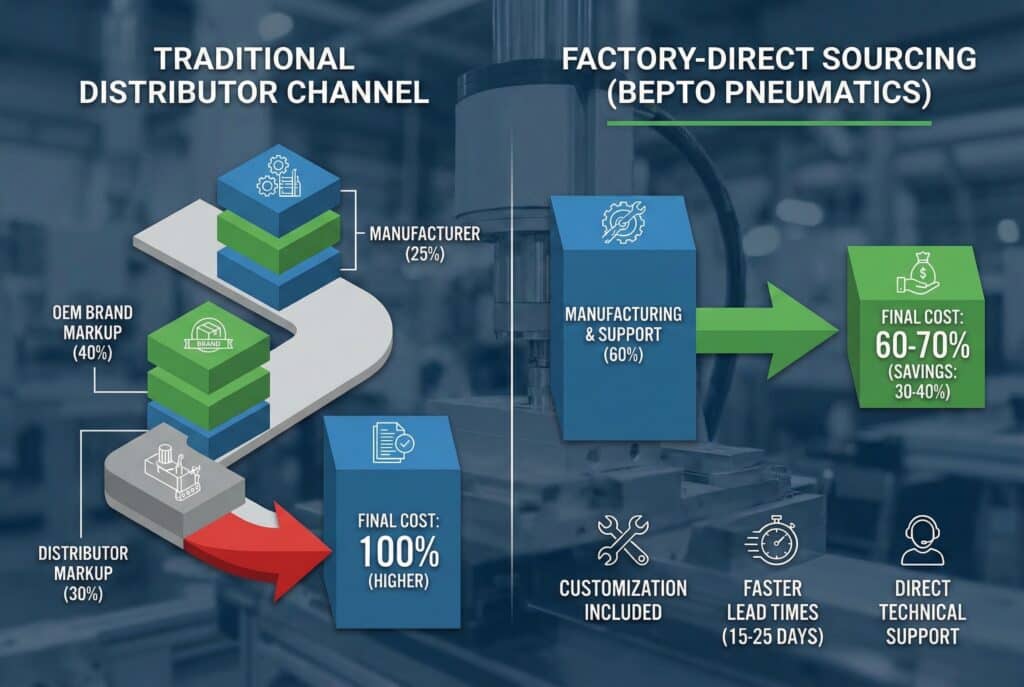
Let me break down the typical pricing structure for pneumatic components. When you buy a rodless cylinder from a major OEM brand through their distribution network, here’s where your money goes:
- Manufacturing cost: 22-28%
- OEM brand markup: 35-45%
- Distributor markup: 25-35%
- Your cost: 100%
When you source factory-direct from manufacturers like Bepto Pneumatics, the structure looks completely different:
- Manufacturing cost: 35-42%
- Factory margin: 25-30%
- Logistics and support: 15-20%
- Your cost: 70-85% savings vs. OEM channel
This isn’t about cutting corners—it’s about eliminating unnecessary intermediaries who add cost without adding value.
Beyond Price: The Customization Advantage
One of the most underappreciated benefits of factory-direct sourcing is customization flexibility. Traditional distributors stock standard configurations and charge premium prices (often 40-60% extra) for custom specifications. Factory-direct suppliers can incorporate custom requirements into production runs at minimal additional cost.
At Bepto Pneumatics, we regularly provide custom stroke lengths, special mounting brackets, unique port configurations, and application-specific sealing materials at prices comparable to standard units—because we’re building them anyway. This flexibility allows our customers to optimize their designs rather than compromising based on available catalog items.
Value Comparison Framework
| Išmokų kategorija | Traditional Distribution | Factory-Direct Sourcing | Advantage Magnitude |
|---|---|---|---|
| Unit Cost | Bazinis lygis (100%) | 45-70% of baseline | 30-55% savings |
| Pritaikymas | Limited, expensive | Flexible, minimal upcharge | 40-60% sąnaudų mažinimas |
| Lead Time (volume) | 6-12 savaičių | 15-25 dienos | 60-75% faster |
| Techninis palaikymas | Sales-focused | Engineering-direct | Significantly superior |
| MOQ Flexibility | Fixed catalog items | Negotiable | Vidutinis-aukštas |
How Can You Verify a Pneumatic Factory’s Quality and Reliability?
The biggest concern about factory-direct sourcing is quality assurance—and it’s a legitimate concern that requires systematic verification. 🔍
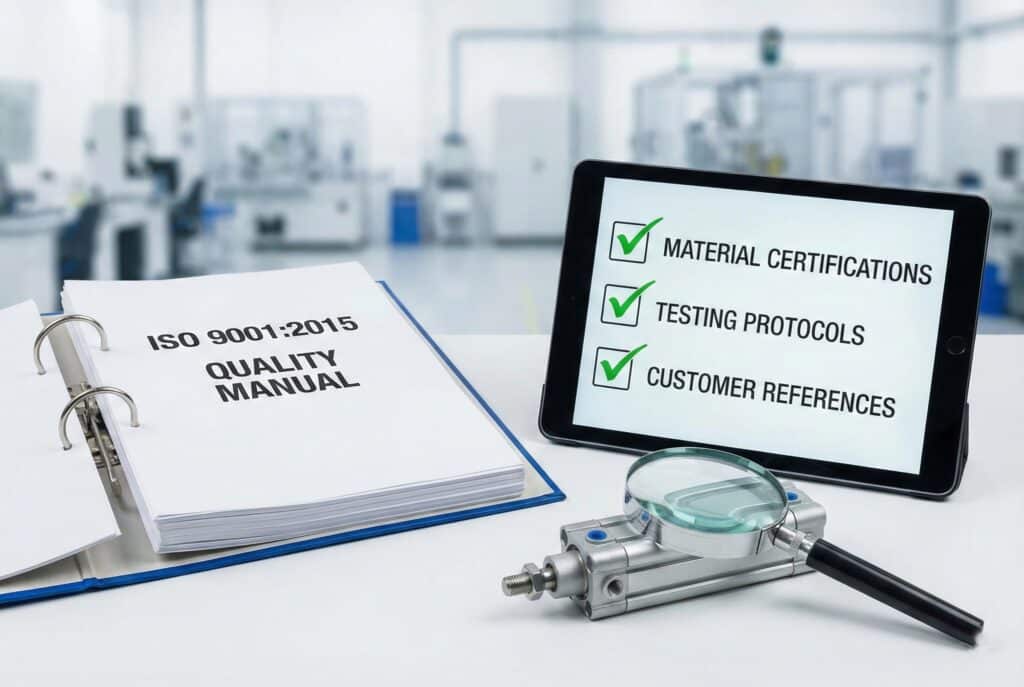
Verifying pneumatic factory quality requires examining five critical factors: (1) ISO 90012 certification and manufacturing process documentation, (2) testing capabilities including pressure testing, cycle testing, and dimensional inspection, (3) material certifications and traceability3 for critical components like seals and bearings, (4) customer references from established companies in your industry, and (5) sample testing programs that allow you to validate performance before committing to volume orders. Reputable factory-direct suppliers welcome this scrutiny and provide transparent documentation because their business model depends on long-term relationships, not one-time transactions.
The Certification Foundation
Start with the basics: ISO 9001 certification demonstrates that a manufacturer has implemented quality management systems with documented processes, regular audits, and continuous improvement protocols. This isn’t a guarantee of perfection, but it’s a minimum threshold for serious consideration.
At Bepto Pneumatics, we maintain ISO 9001:2015 certification and conduct quarterly internal audits plus annual third-party audits. We’re happy to share our certification documents and audit reports with prospective customers—and you should be skeptical of any factory that won’t provide this documentation.
The Testing Protocol Question
Ask potential suppliers about their testing procedures. Quality pneumatic manufacturers conduct multiple tests on every production batch:
- Slėgio bandymas: Verifying seal integrity at 1.5x rated pressure
- Ciklo testavimas: Confirming performance over thousands of cycles
- Matmenų tikrinimas: Ensuring critical tolerances are maintained
- Funkcijų testavimas: Validating smooth operation and positional accuracy
Request test reports for products you’re considering. Legitimate manufacturers generate these reports routinely and can provide them immediately.
Rekomendacijų tikrinimo procesas
This is where many buyers get lazy—don’t skip reference checks. Ask for contact information for 3-5 customers who’ve been buying similar products for at least 12 months. When you contact references, ask specific questions:
- “What percentage of shipments arrived defect-free?”
- “How does the factory handle quality issues when they occur?”
- “Have lead times been consistent and reliable?”
- “How responsive is technical support when you have application questions?”
I’ll share a real example: Last year, a packaging equipment manufacturer in Toronto, Canada—let’s call him David—was evaluating Bepto Pneumatics as a potential supplier. He asked for references, and we connected him with three existing customers including a automotive parts manufacturer in Ohio. David spent 45 minutes on the phone with their engineering manager, who detailed their 18-month experience with our rodless cylinders. That conversation convinced David to place a trial order, which has now grown into a partnership worth over $200,000 annually. Due diligence pays off. ✅
Quality Verification Checklist
- ✅ ISO 9001 certification (request certificate copy)
- ✅ Documented testing procedures (request test reports)
- ✅ Material certifications (especially for seals, bearings, tubes)
- ✅ Customer references (minimum 3, actually contact them)
- ✅ Sample testing program (order samples before volume commitment)
- ✅ Warranty terms (clear, written warranty covering defects)
- ✅ Quality issue resolution process (documented procedure)
What Minimum Order Quantities Should You Expect from Pneumatic Manufacturers?
MOQ requirements often determine whether factory-direct sourcing is practical for your business—but these numbers are more flexible than most buyers realize. 📦
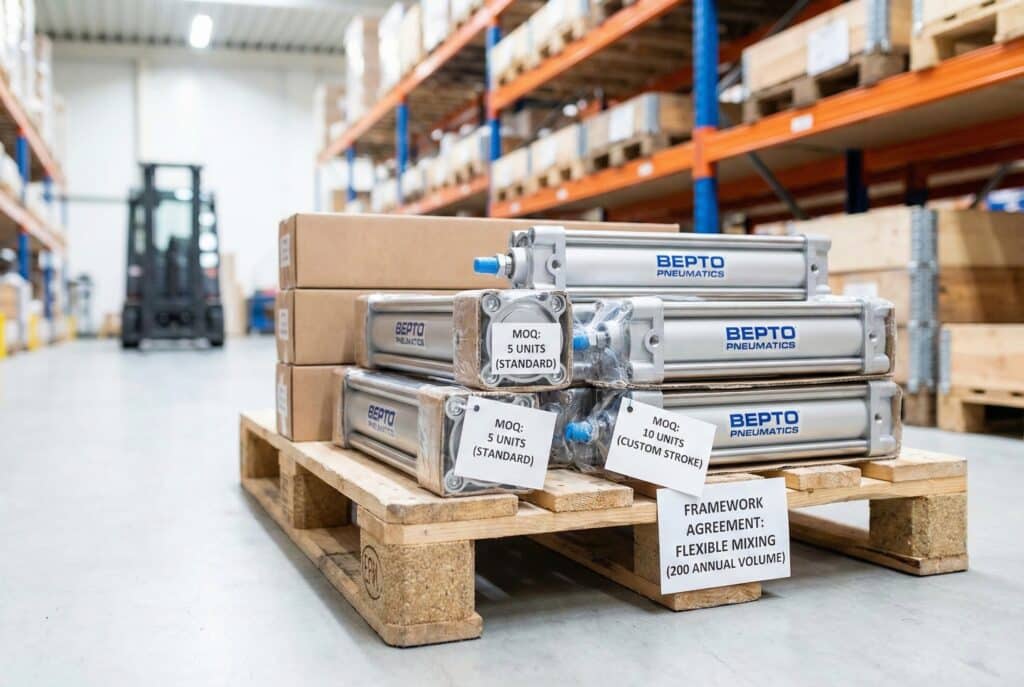
Minimum order quantities for factory-direct pneumatic sourcing vary significantly based on product complexity and customization level. Standard rodless cylinders typically require MOQs of 5-10 units per specification, while highly customized products may require 20-50 units. However, many manufacturers offer mixed-specification orders where you can combine different stroke lengths or mounting styles to reach minimum thresholds. Smart buyers negotiate framework agreements that commit to annual volumes while allowing flexible order timing and specification mixing, reducing working capital requirements while securing factory-direct pricing.
Understanding MOQ Economics
Manufacturers set MOQs based on production setup costs and efficiency. When we switch production from one cylinder specification to another, there’s tooling changeover time, calibration, and first-article inspection4. For standard products, this setup cost is relatively low, allowing smaller MOQs. For custom products, setup costs are higher, requiring larger batches to maintain efficiency.
At Bepto Pneumatics, our standard rodless cylinder MOQs are:
- Standard catalog specifications: 5 units per model
- Custom stroke lengths (standard bore): 10 units per specification
- Custom mounting or porting: 20 units per specification
- Fully custom designs: 50 units (negotiable based on annual volume commitment)
The Framework Agreement Strategy
Here’s a sourcing strategy that works exceptionally well: Instead of placing individual orders, negotiate a framework agreement that commits to annual volume across multiple specifications. For example, commit to purchasing 200 rodless cylinders annually, but maintain flexibility to order different strokes, bores, and configurations as needed throughout the year.
This approach gives the manufacturer volume certainty (allowing better pricing) while giving you flexibility to respond to actual customer demand without carrying excessive inventory. We use this model with approximately 60% of our wholesale customers, and it’s proven highly effective for both parties.
MOQ Comparison by Product Category
| Produkto tipas | Typical OEM Distributor | Bepto Factory-Direct | Flexibility Options |
|---|---|---|---|
| Standard Rodless Cylinders | 1 unit (high price) | Tai nėra griežtos pakopos - tai pradiniai derybų taškai. Svarbiausia parodyti rimtą įsipareigojimą, paremtą realiomis prognozėmis. | Mix strokes to reach MOQ |
| Custom Stroke Rodless | Often unavailable | 10 units | Framework agreement option |
| Specialized Sealing | Often unavailable | 20 units | Annual volume commitment |
| Fully Custom Design | 100 ir daugiau vienetų | 50 units | Negotiable with partnership |
Practical MOQ Management
If MOQs seem challenging for your volume levels, consider these strategies:
- Standardize where possible: Reduce the number of unique specifications you stock
- Partner with complementary buyers: Share orders with non-competing companies
- Negotiate konsignacinis inventorius5: Some manufacturers will stock inventory on consignment
- Commit to annual volumes: Framework agreements reduce per-order MOQs
- Start with samples: Validate performance before committing to volume
How Do You Negotiate Better Terms with Direct Pneumatic Suppliers?
Successful factory-direct relationships require negotiation skills beyond simply asking for lower prices—it’s about creating mutual value. 🤝
Negotiating effectively with pneumatic manufacturers requires focusing on total relationship value rather than individual transaction prices. The most successful negotiations address five key areas: (1) volume commitments that provide the manufacturer with production planning certainty, (2) payment terms that balance your cash flow needs with their working capital requirements, (3) quality standards and acceptance criteria defined upfront to prevent disputes, (4) technical support expectations including response times and engineering assistance, and (5) continuous improvement commitments where both parties work to reduce costs and improve performance over time. This approach builds partnerships that deliver compounding benefits rather than transactional relationships that optimize single purchases.

Beyond Price: The Total Value Negotiation
Most buyers approach negotiations focused exclusively on unit price. Smart buyers negotiate comprehensive terms that create value across multiple dimensions:
Kaina: Obviously important, but not the only factor
Mokėjimo sąlygos: Net 30, 60, or 90 days significantly impacts your cash flow
Parengiamieji terminai: Faster delivery may be worth paying slightly more
Techninė pagalba: Engineering assistance during design and troubleshooting
Customization flexibility: Ability to modify specifications without penalties
Garantija: What’s covered, for how long, and what’s the resolution process
Kiekio nuolaidos: Tiered pricing that rewards growth
Inventory support: Will the manufacturer stock commonly-used items for you
The Volume Commitment Leverage
Manufacturers value predictability. If you can commit to specific volumes over defined timeframes, you gain significant negotiating leverage. Here’s what we typically offer at Bepto Pneumatics based on annual commitment levels:
- $25,000-50,000 annual: 5% discount vs. standard pricing, standard lead times
- $50,000-100,000 annual: 12% discount, priority production scheduling
- $100,000-250,000 annual: 18% discount, dedicated account manager, custom inventory stocking
- $250,000+ annual: 25% discount, co-development support, consignment inventory options
These aren’t rigid tiers—they’re starting points for negotiation. The key is demonstrating serious commitment backed by realistic projections.
Platintojams ir didmenininkams
Payment terms significantly impact both parties’ cash flow. Standard terms in pneumatic manufacturing are Net 30 days. However, many buyers need longer terms, and many manufacturers would prefer shorter terms. This creates negotiation opportunities:
- Pay within 10 days: Additional 2-3% discount
- Standard Net 30: No adjustment
- Net 60: Possible with established relationship, may reduce discount by 2-3%
- Net 90: Requires strong credit history, may reduce discount by 4-5%
- Prepayment: Additional 5-7% discount, priority production
Building Long-Term Partnerships
The most successful factory-direct relationships evolve into genuine partnerships. I’ll share one final story: Three years ago, a material handling equipment manufacturer in Pennsylvania—we’ll call him Robert—started buying rodless cylinders from Bepto Pneumatics. His initial order was modest: 20 cylinders worth about $3,800.
Robert was transparent about his business goals and growth projections. We worked with him to standardize his cylinder specifications, reducing his unique SKU count from 17 to 7 without compromising his product performance. This standardization allowed better pricing and reduced his inventory carrying costs.
As his business grew, we grew with him. We now stock his most common specifications in our warehouse, providing same-day shipping for replenishment orders. We’ve collaborated on three custom cylinder designs specifically optimized for his applications. Last year, his pneumatic component purchases from us exceeded $180,000—and his costs per unit are 38% lower than when he started, despite inflation and material cost increases. That’s what partnership looks like. 🌟
Negotiation Preparation Checklist
Before entering negotiations with a factory-direct supplier:
- ✅ Calculate your realistic annual volume (be honest, not optimistic)
- ✅ Identify your top 3 priorities (price, lead time, customization, etc.)
- ✅ Understand your cash flow constraints for payment terms
- ✅ Research market pricing to establish reasonable expectations
- ✅ Prepare to share your business growth plans and projections
- ✅ Identify opportunities for specification standardization
- ✅ Determine your decision timeline and approval process
Išvada
Factory-direct pneumatic sourcing isn’t just about saving money—it’s about building strategic supply chain relationships that provide cost advantages, customization flexibility, and competitive differentiation that compound over time. The buyers who invest effort in finding, vetting, and partnering with the right manufacturers gain sustainable advantages that transaction-focused competitors simply cannot replicate. 🚀
FAQs About Wholesale Factory-Direct Pneumatic Sourcing
K: Kiek realiai galiu sutaupyti pirkdamas pneumatinius komponentus tiesiogiai iš gamyklos?
Dauguma pirkėjų pasiekia 30-55% sąnaudų sumažėjimą, palyginti su tradiciniais OEM platinimo kanalais, priklausomai nuo gaminio sudėtingumo ir apimties lygio. Pavyzdžiui, cilindras be strypų, kuris per OEM platintoją kainuoja $340, paprastai kainuoja $180-220 tiesiogiai gamykloje. Tačiau sutaupymai skiriasi priklausomai nuo jūsų sutartų sąlygų, užsakymų apimties ir pritaikymo reikalavimų. Daugiausia sutaupoma standartizuojant specifikacijas ir įsipareigojant metinėms apimtims, kurios leidžia gamintojams optimizuoti gamybos efektyvumą.
K: Kokia rizika kyla dėl tiesioginio tiekimo iš gamyklos ir kaip ją sumažinti?
Pagrindiniai pavojai yra šie: kokybės nenuoseklumas, bendravimo sunkumai, ilgesnis pradinis parengimo laikas ir galimos intelektinės nuosavybės problemos. Šias rizikas sumažinkite: (1) kruopščiai patikrinti tiekėjus, naudojant sertifikatus, rekomendacijas ir pavyzdžių bandymus, (2) raštu nustatyti aiškius kokybės standartus ir tikrinimo kriterijus, (3) pradėti nuo mažesnių bandomųjų užsakymų prieš įsipareigojant dideliam kiekiui, (4) naudoti išsamius techninius brėžinius ir specifikacijas, kad būtų išvengta nesusipratimų, ir (5) įgyvendinti pradinių siuntų įvežimo tikrinimo procedūras. "Bepto Pneumatics" teikiame angliškai kalbančią techninę pagalbą ir laikomės kokybės standartų, lygiaverčių pagrindiniams OEM prekės ženklams, specialiai siekdami spręsti šias problemas.
K.: Kiek laiko užtrunka užmegzti patikimus tiesioginio tiekimo iš gamyklos santykius?
Tikėkitės 3-6 mėnesių, kol bus visiškai užmegzti produktyvūs tiesioginiai santykiai su gamykla. Įprastinis grafikas apima: pirminį kontaktą ir galimybių įvertinimą (2-3 savaitės), pavyzdžių užsakymą ir bandymą (3-4 savaitės), pirmąjį gamybos užsakymą ir įvertinimą (4-6 savaitės), specifikacijų ir procesų tobulinimą (4-8 savaitės) ir įprastų užsakymų modelių nustatymą (nuolat). Šios investicijos atsiperka per daugelį patikimo ir ekonomiško tiekimo metų. Pirkėjai, kurie skubina šį procesą, dažnai susiduria su problemomis, o tie, kurie iš anksto investuoja laiko, užmezga partnerystę, kuri teikia vis didesnę vertę.
Klausimas: Ar mažieji pirkėjai, kurių apimtys ribotos, gali naudotis tiesioginėmis gamyklinėmis kainomis?
Yes, but with realistic expectations. Many manufacturers, including Bepto Pneumatics, work with smaller buyers who demonstrate growth potential and commitment. Start by focusing on standard products with lower MOQs, be flexible on lead times (allowing the manufacturer to batch your order with others), consider framework agreements that commit to annual volumes even if individual orders are small, and demonstrate professionalism in your communication and technical requirements. A buyer purchasing $15,000 annually can often access factory-direct pricing that’s 25-35% below distributor pricing, even if they don’t receive the deepest volume discounts.
K: Kaip spręsti techninio palaikymo ir garantijos klausimus, susijusius su gamykloje dirbančiais tiekėjais?
Prieš pateikdami užsakymus nustatykite aiškias techninės pagalbos ir garantijos sąlygas. Gerai žinomi tiesioginiai gamyklos tiekėjai teikia visapusišką paramą, įskaitant: prieš pardavimą teikiamą inžinerinę pagalbą, išsamią techninę dokumentaciją ir CAD modelius, operatyvų bendravimą ("Bepto" garantuoja 24 valandų atsakymo laiką), aiškias garantijos sąlygas (paprastai 12-18 mėnesių, apimančias gamybos defektus) ir apibrėžtus kokybės problemų sprendimo procesus, įskaitant keitimo procedūras ir grąžinimo logistiką. Reikalaukite raštiškų šių taisyklių dokumentų ir vertinimo etape patikrinkite, kaip reaguojama, užduodami techninius klausimus ir stebėdami atsakymų kokybę bei greitį. 💼
-
Understand the role of Original Equipment Manufacturers (OEMs) in the industrial supply chain. ↩
-
Learn about the international standard for quality management systems in manufacturing. ↩
-
Read why material traceability is critical for quality assurance and safety in industrial components. ↩
-
Understand the verification process used to ensure manufacturing production meets design specifications. ↩
-
Explore how consignment inventory models can reduce working capital and inventory risks. ↩