

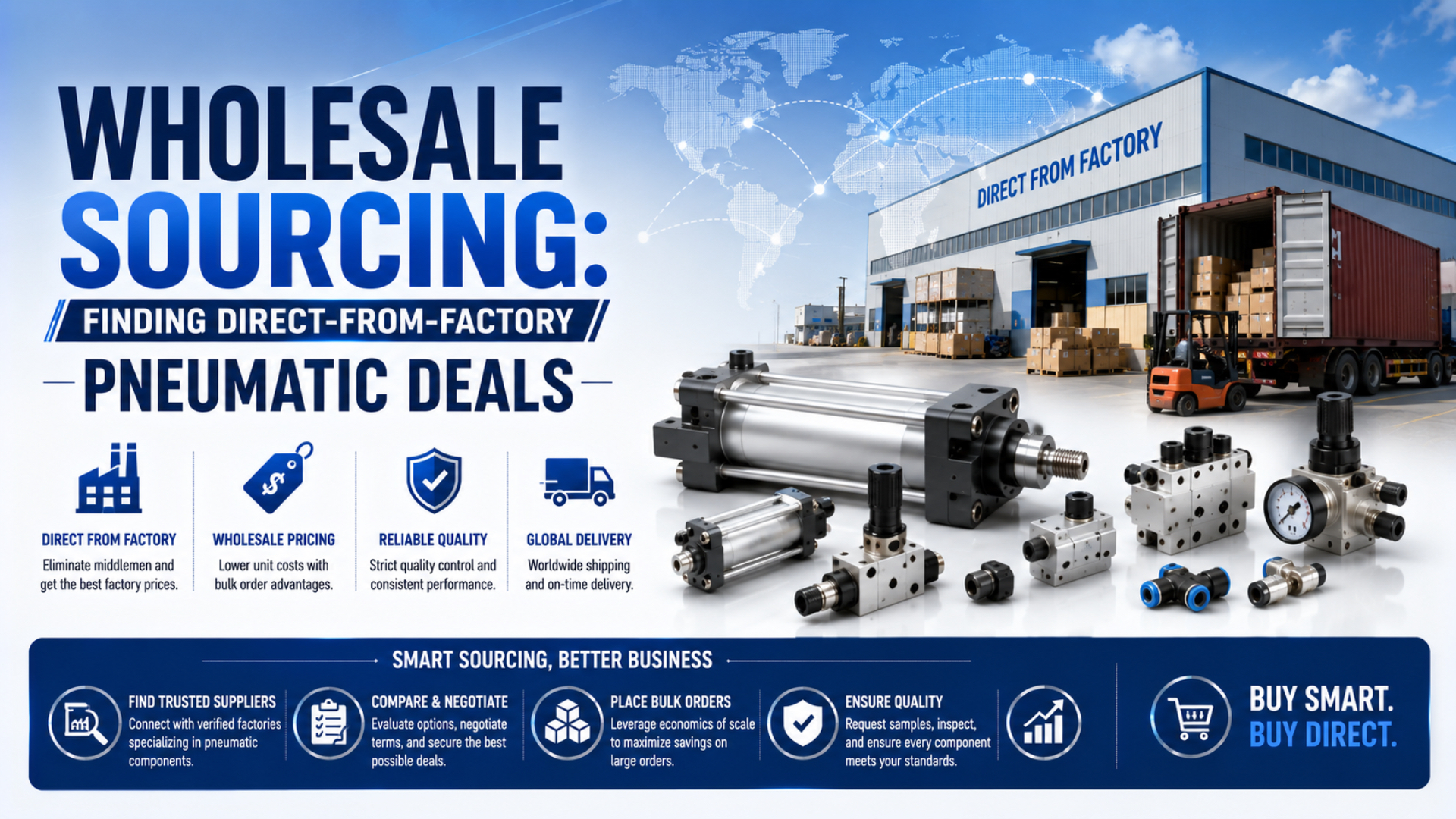
Factory-direct pneumatic sourcing is a purchasing relationship in which the buyer contracts with the manufacturer or its disclosed export entity instead of a local stockholding distributor. It can improve specification control and remove a channel layer, but the quoted unit price is not proof of lower total cost, product conformity, or dependable supply.
A sound direct purchase must pass four gates: commercial comparability, supplier identity, technical evidence, and controlled validation. If one gate remains open, the apparent deal is still an assumption.
Key Takeaways
- Incoterms 2020 contains 11 rules, so every international quote needs a rule and named place.
- ISO 9001 certifies a management system, not an individual cylinder.
- Compare landed cost and operational exposure, not unit price alone.
- Release volume only after a documented trial order passes.
What Does Factory-Direct Pneumatic Sourcing Actually Mean?
ISO 15552 defines a dimensional family covering 32 mm to 320 mm bores at a maximum rated pressure of 1,000 kPa, yet it does not define who must sell the cylinder (ISO, 2018). “Factory-direct” therefore describes the commercial route, not a pneumatic performance class.
The seller may be the legal owner of the production site, a group export company, or a contracted trading entity. Any of those arrangements can work when the roles are disclosed. The risk begins when the quotation, factory, invoice, bank account, certificate, and warranty provider identify different organizations without explaining their relationship.
Ask the supplier to map five roles before discussing volume:
| Role | Evidence to request | Why it matters |
|---|---|---|
| Contracting seller | Legal name, address, registration number | Identifies the party bound by the purchase contract |
| Manufacturer | Production-site name and address | Shows where machining, assembly, and testing occur |
| Exporter of record | Export entity and shipping documents | Prevents document and customs surprises |
| Payee | Bank beneficiary in the same approved entity chain | Reduces payment-diversion and fraud exposure |
| Warranty provider | Written claim and replacement responsibility | Identifies who must resolve a nonconforming shipment |
The useful distinction is not “factory versus middleman.” It is controlled versus uncontrolled supply. A disclosed export company tied to a qualified plant can be safer than an alleged factory that hides its legal, production, or payment roles.
For country-specific entity checks, use the separate guide to evaluating pneumatic cylinder suppliers in China.
When Does a Factory-Direct Deal Make Economic Sense?
Incoterms 2020 contains 11 trade rules that allocate delivery obligations, costs, and risk between seller and buyer (International Chamber of Commerce, 2020). A factory quote cannot be compared with a distributor quote until both offers cover the same transport boundary, insurance responsibility, documentation, and delivery point.
Factory-direct purchasing is usually worth evaluating when demand is repeatable, specifications are stable, engineering can qualify an alternate product, and the buyer can manage freight, inspection, inventory, and claims. A distributor may still be the better channel for emergency replacement, one-off quantities, local credit, consolidated deliveries, or immediate application support.
Compare the following cost boundary for the expected ordering period:
| Cost layer | Questions for the buyer |
|---|---|
| Product | Is the quoted configuration technically identical? |
| Tooling and setup | Is the charge one-time, recurring, refundable, or buyer-owned? |
| Inspection | Who pays for samples, third-party checks, gauges, and retesting? |
| Logistics | Which party pays for origin handling, freight, insurance, and destination charges? |
| Import | Who is responsible for classification, duties, taxes, and customs brokerage? |
| Inventory | How much stock is required because of batch size and replenishment time? |
| Failure response | Who pays for containment, sorting, replacement, freight, and machine downtime? |
In our experience, the most expensive quotation ambiguity often sits outside the unit-price column. Tooling ownership, excluded mounting kits, freight boundaries, inspection charges, or replacement shipping can reverse a comparison that initially looked straightforward.
Use the pneumatic supplier negotiation guide when converting these items into comparable quotation fields.
How Can You Verify That the Supplier Is the Manufacturer?
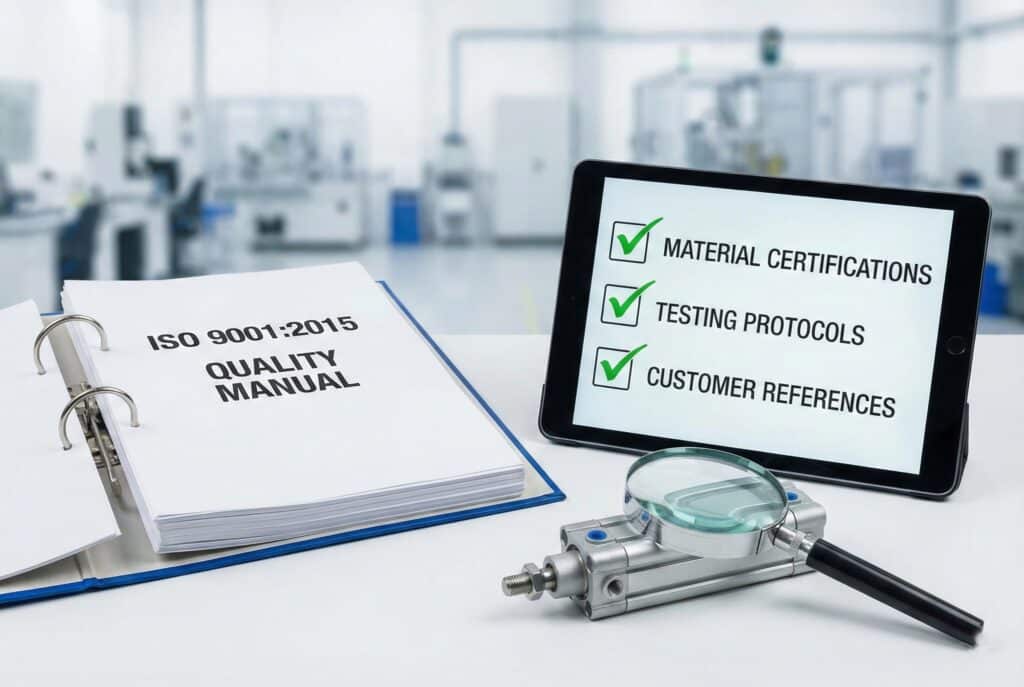
ISO and IAF guidance states two important limits: ISO 9001 certification does not guarantee 100% product conformity, and it does not mean the product itself is certified or superior (ISO/IAF). Treat the certificate as one evidence item, not the final factory verdict.
First, match the legal name, certified site, standard edition, certification scope, certificate number, issuing body, and validity dates. IAF CertSearch can verify accredited management-system certificates by organization or certificate details, but the database result still needs to match the plant and activity relevant to your order (IAF CertSearch).
Then ask for process-specific evidence:
- A production flow showing incoming material, machining, surface treatment, assembly, testing, and packing
- An equipment list tied to the offered product family
- Recent calibration status for gauges used on critical dimensions and pressure tests
- A sample traveler, inspection record, or test report with drawing revision and lot identification
- Subcontracted-process disclosure for anodizing, plating, heat treatment, seals, or special machining
- A written change-notification rule covering materials, drawings, processes, sites, and sub-suppliers
ISO/IEC 17025:2017 sets competence, impartiality, and consistent-operation requirements for testing and calibration laboratories (ISO, confirmed 2023). Do not assume every factory laboratory is accredited. Instead, identify which measurements are internal, which are outsourced, and whether the laboratory’s accredited scope actually covers the cited method.
For a deeper certificate review, follow the pneumatic supplier certification verification guide.
What Technical Evidence Should Accompany the Quote?
ISO 15552:2018 covers basic, mounting, and accessory dimensions for detachable-mount cylinders from 32 mm through 320 mm bore and up to 1,000 kPa rated pressure (ISO). Those dimensions support interchangeability checks, but they do not establish seal life, leakage, cushioning performance, sensor behavior, or application suitability.
Send a controlled requirement sheet rather than a model number alone. At minimum, define:
- Cylinder family and applicable dimensional standard
- Bore, stroke, rod arrangement, and motion direction
- Working pressure range and available point-of-use pressure
- Load, speed, cycle rate, duty profile, and mounting orientation
- Mounting, rod-end thread, ports, fittings, sensors, and cable requirements
- Cushioning method and moving mass at each end of stroke
- Medium quality, lubrication policy, ambient temperature, and contaminants
- Required materials, seal compounds, surface treatments, and restricted substances
- Drawing revision, critical dimensions, labeling, packaging, and documentation
- Acceptance tests, sampling plan, nonconformity response, and change control
A supplier should return a line-by-line compliance matrix. “Comply” without a drawing, data sheet, test method, or exception note is not evidence.
ISO 10099:2001 specifies final examination functional tests and acceptance criteria for double-acting, single-rod pneumatic cylinders (ISO, confirmed 2023). ISO 19973-3:2015 addresses reliability testing for piston-rod cylinders and reports life in cycles or kilometres rather than vague claims such as “long life” (ISO).
A standard number narrows only the attributes inside that standard’s scope. The buyer must still control every application-specific feature outside that scope. For ISO-style cylinders, the ISO 15552 procurement checklist provides a more detailed dimensional review.
How Should You Qualify a Trial Order?
ISO 2859-1:2026 defines single, double, and multiple sampling schemes for lot-by-lot inspection by attributes (ISO, 2026). A sampling plan is useful only after the buyer has defined the inspection unit, defect classes, lot, inspection level, acceptance limit, and switching rules.
Do not let a visually acceptable sample become automatic approval for unrestricted production. A controlled trial should prove the offered configuration, the supplier’s records, and the complete transaction path.
Use this release sequence:
- Freeze the drawing, specification, quotation revision, and approved deviations.
- Confirm the sample was made at the declared production site using the intended materials and processes.
- Record dimensions, appearance, leakage, function, cushioning, sensing, labeling, and packaging against written criteria.
- Run the component in the actual machine across the relevant pressure, speed, load, alignment, and environment.
- Close every deviation and approve the final record set before authorizing the production quantity.
- Apply enhanced incoming inspection to early lots, then adjust inspection only through a documented rule.
Our team found that an approved sample is most useful when it becomes the first controlled record, not a showroom object. Its drawing revision, deviations, materials, test results, and packing details should remain traceable to later production orders.
MOQ, Forecasts, and Release Orders Need Separate Terms
ISO 2859-1:2026 includes switching rules between inspection states, showing why ongoing lot history matters more than a single accepted batch (ISO, 2026). MOQ, annual forecast, firm commitment, production batch, and shipment release are likewise different controls and should never be represented by one number.
Ask the supplier to define each term:
| Commercial term | Required definition |
|---|---|
| Sample quantity | Units used for technical qualification |
| MOQ | Minimum quantity accepted on one purchase order or line item |
| Production batch | Quantity made under one setup and material lot |
| Shipment release | Quantity shipped on one date |
| Annual forecast | Nonbinding demand signal unless the contract says otherwise |
| Firm commitment | Quantity and date the buyer is legally required to accept |
| Safety stock | Owner, location, replenishment trigger, aging rule, and exit terms |
A blanket agreement can separate production economics from delivery timing, but it also creates liability if forecast, cancellation, excess stock, obsolete revisions, or raw-material ownership is vague. Put those terms in writing before calling the arrangement flexible.
There is no universal “correct” pneumatic-cylinder MOQ. It depends on setup, material procurement, testing, packaging, customization, and the supplier’s production model. Treat an unexplained MOQ as a negotiation input, not a technical law.
Compare the Whole Commercial Boundary
Incoterms 2020 provides 11 rules, but the rule alone does not set product price, payment timing, title transfer, warranty, inspection, or breach remedies (ICC, 2020). A complete comparison therefore needs the Incoterm plus the named place, contract terms, and explicit quotation inclusions.
Normalize every offer in one worksheet:
- Identical part revision, options, accessories, and packaging
- Same sample and production quantities
- Tooling, engineering, inspection, certificate, and documentation charges
- Incoterm and exact named place
- Freight mode, insurance, brokerage, duties, taxes, and destination handling
- Payment schedule, currency, bank fees, and price-validity period
- Production lead time, transit assumption, and release schedule
- Warranty scope, claim evidence, response route, and replacement freight
- Spare-parts availability and end-of-life notification
- Change-notification period and approval requirement
Do not convert a preliminary quotation into an annual saving claim. Use purchase history, an approved configuration, and a realistic shipment plan. If the product is an alternative to an incumbent brand, the branded versus unbranded pneumatics guide explains where substitution requires additional validation.
What Red Flags Should Stop a Factory-Direct Purchase?
ISO/IAF guidance identifies two claims that ISO 9001 certification does not support: guaranteed 100% conformity and inherent product superiority (ISO/IAF). A supplier making either claim is overstating what its management-system certificate proves.
Pause the purchase when any of these conditions remains unresolved:
- The payee changes after approval without a verified contractual explanation.
- The certificate name, address, scope, or site does not match the declared manufacturer.
- The supplier refuses to identify subcontracted critical processes.
- The quote omits drawing revision, exceptions, accessories, or delivery boundary.
- Test reports have no part number, lot, method, acceptance limit, or traceable result.
- A sample is said to be “equivalent” without a compliance matrix.
- Production starts before deviations and acceptance criteria are signed.
- The supplier promises universal savings, zero defects, or fixed service life without comparable evidence.
- Warranty language excludes the likely failure or leaves return freight undefined.
- Material, process, tooling, or site changes can occur without buyer approval.
One warning is not always disqualifying. Evasion is. From our work, a capable supplier should be able to replace a vague promise with a document, record, measurement, named responsibility, or clearly stated exception.
For continuity planning after approval, build an alternate-source strategy using the dual-sourcing guide for pneumatic components.
A Good Deal Survives Verification
Four gates determine whether a direct pneumatic offer is ready for volume release: comparable commercial scope, verified supplier roles, product-specific technical evidence, and a passed trial order. These gates draw on the 11-rule Incoterms framework and ISO methods for certification, cylinder acceptance, reliability, and lot inspection.
The lowest quoted price can still be the wrong purchase. The best direct-from-factory deal is the offer that remains attractive after freight, inspection, inventory, documentation, failure response, and change risk are visible. That is a procurement decision an engineering and quality team can defend.
Factory-Direct Pneumatic Sourcing FAQs
ISO 2859-1 was revised in January 2026, while Incoterms 2020 still contains 11 trade rules (ISO; ICC). These references address different risks, so buyers must combine product acceptance, supplier evidence, and commercial terms rather than relying on one certificate or quotation.
Is factory-direct pneumatic sourcing always cheaper?
No. Direct purchasing may remove a distribution layer, but the buyer may assume freight, import, inspection, inventory, technical-support, and failure-response costs. Compare technically identical configurations across the same delivery boundary. A lower unit price becomes a genuine saving only when the total delivered and operational exposure is lower.
How can I tell whether a pneumatic supplier owns the factory?
Match the contracting entity, production address, certificate scope, exporter, payee, and warranty provider. Request a process flow, equipment list, traceable inspection record, and live or third-party factory verification. A business registration or ISO 9001 certificate can support the review, but neither document alone proves that the seller manufactures the offered component.
Does ISO 9001 certification prove that a pneumatic cylinder is compliant?
No. ISO 9001 addresses the organization’s quality management system. ISO and IAF explicitly state that certification does not mean every product is conforming or that the product itself is ISO-certified. Buyers still need a controlled specification, applicable product standards, test evidence, inspection records, and application validation.
What should a pneumatic-cylinder trial order include?
A trial order should identify the approved drawing and quotation revisions, manufacturing site, materials, deviations, tests, acceptance limits, packaging, and records. Inspect the received units, then test them in the actual machine across relevant pressure, speed, load, alignment, sensing, and environmental conditions before releasing volume production.
Which Incoterm is best for a factory-direct pneumatic order?
There is no universally best rule. Select the Incoterm according to each party’s ability to manage carriage, insurance, export and import clearance, risk, and destination handling. State the rule, the version “Incoterms 2020,” and an exact named place. Define payment, title, inspection, and warranty separately in the contract.