

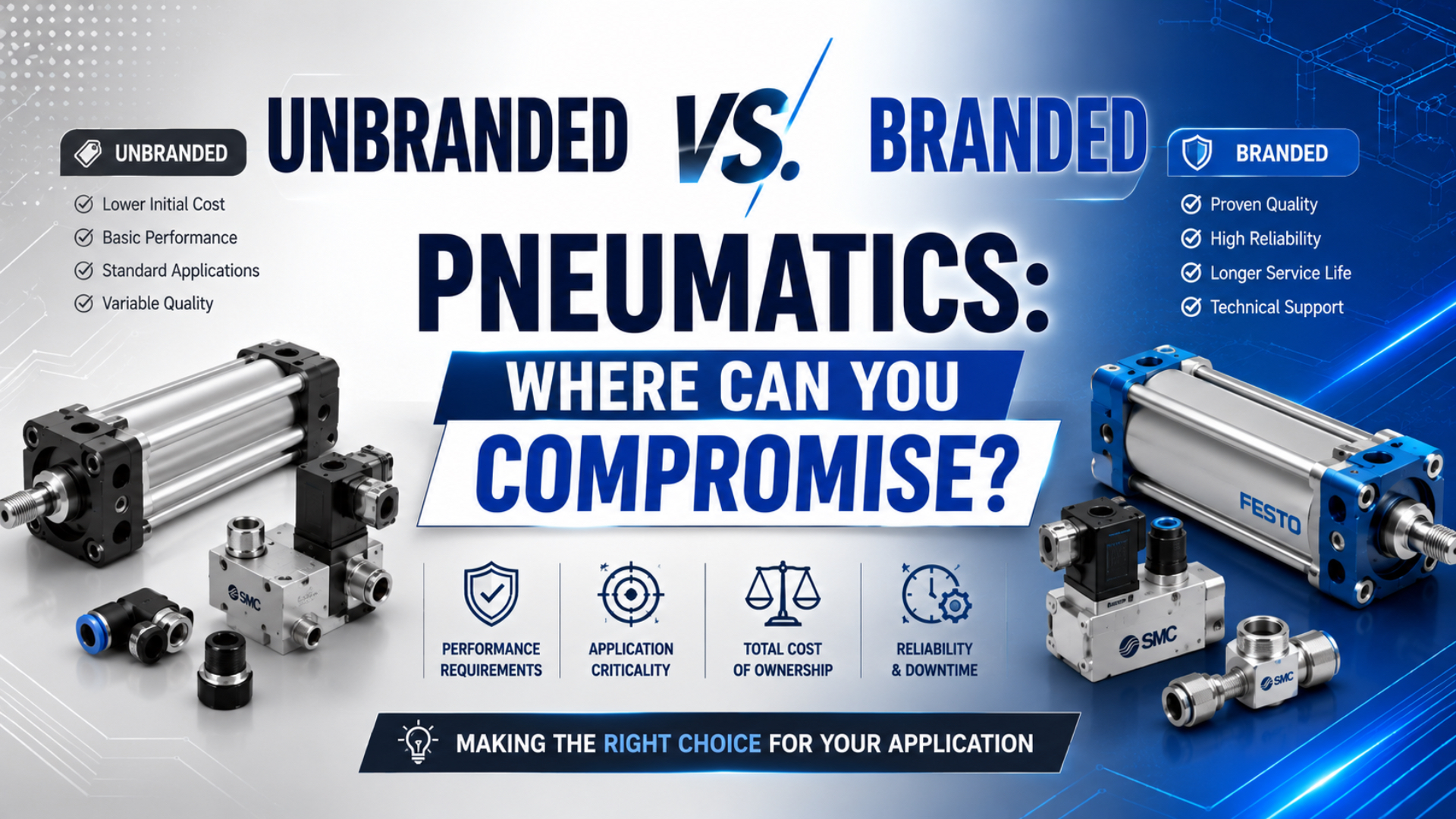
Unbranded vs branded pneumatics is a procurement comparison, not an engineering quality classification. The safe compromise is the name on the component, not the requirement behind it. A buyer can consider an alternative cylinder, valve, FRL unit, fitting, or accessory when the specification is complete, substitution is permitted, evidence is relevant, and validation covers the actual application.
Price and brand recognition don’t prove engineering equivalence. Neither does a familiar profile, an ISO 9001 certificate, or a cross-reference table. A replacement must preserve the required interface, function, environment, service life evidence, safety role, documentation, and change control. If one of those conditions is missing, the apparent saving is only an unpriced risk.
Key Takeaways
- ISO/IAF identifies 2 limits of ISO 9001 certification: it doesn’t guarantee 100% conformity or certify a superior product.
- ISO dimensional conformity supports defined interfaces, not universal performance equivalence.
- Safety, customer, warranty, and regulatory requirements can prohibit an otherwise plausible substitute.
- Approve alternatives through specification, evidence, validation, and controlled release.
What Actually Differentiates Branded from Unbranded Pneumatics?
ISO and IAF identify two important limits of accredited ISO 9001 certification: it doesn’t guarantee 100% product conformity, and it doesn’t imply that a product is superior or itself certified to an ISO product specification. The same caution applies to brand reputation. Both are useful signals, but neither closes an application review (ISO/IAF, 2016).
“Branded” and “unbranded” are commercial labels. They don’t describe a consistent technical class.
A well-known manufacturer may provide a broad catalog, mature configuration tools, local stock, application support, long product continuity, and published test data. An independent manufacturer may provide the same type of component with a narrower range, different documentation, another service network, or a lower price. A white-label product may be fully controlled by the seller, or it may come from a changing source. An unknown-origin part may provide no traceable manufacturer at all.
Use language that exposes those differences:
| Commercial description | What it may mean | What the buyer still has to verify |
|---|---|---|
| OEM or machine-specified component | Named part on the approved machine definition | Current revision, permitted successors, warranty and change rules |
| Established pneumatic brand | Recognizable manufacturer and product family | Exact configuration, ratings, evidence and local support |
| Independent manufacturer | Supplier sells under its own name outside the incumbent ecosystem | Factory identity, controlled drawing, process scope and product evidence |
| Private-label component | Seller controls a product made by another organization | Actual manufacturing site, change control, traceability and warranty responsibility |
| White-label or generic component | Common product sold under several labels | Whether the source is fixed and whether batches remain equivalent |
| Unknown-origin component | Manufacturer or configuration cannot be established | Usually unsuitable where traceability or controlled replacement matters |
The useful dividing line is therefore controlled versus uncontrolled supply, not famous versus unfamiliar logos. A controlled alternative has a stable manufacturer, frozen configuration, defined acceptance criteria, traceable changes, and an accountable commercial party. An uncontrolled part may look identical while its material, seal, lubricant, machining, or test process changes without notice.
Which Requirements Can Never Be Compromised?
ISO 4414:2010 is a 38-page safety standard covering significant hazards in pneumatic systems and components. Its scope includes design, construction, modification, assembly, installation, adjustment, intended operation, maintenance, cleaning, reliability, energy efficiency, and environmental considerations. That breadth shows why a substitute must preserve system requirements, not merely fit the mounting holes (ISO 4414, 2010).
Do not compromise a requirement that protects people, legal conformity, contractual acceptance, machine function, or a validated process. The original manufacturer name may or may not be part of that requirement.
The no-compromise list normally includes:
- required safety function and failure behavior;
- maximum and minimum pressure;
- proof or test pressure where specified;
- force, flow, response time, cushioning, and motion limits;
- bore, stroke, rod, thread, port, mounting, sensor, and connector interfaces;
- ambient and media temperature;
- corrosion, washdown, cleanroom, explosive-atmosphere, or material restrictions;
- air-quality and lubrication conditions;
- leakage and holding requirements;
- customer-approved part numbers and contractual brands;
- regulatory evidence and machine technical-file obligations;
- warranty, service agreement, and spare-parts conditions.
An OEM drawing that names a particular model can make the brand part of the approved configuration. A general plant spare specification may instead permit any component that passes defined evidence and validation gates. Purchasing cannot infer that permission. Engineering or the responsible machine owner must document it.
The same rule applies in reverse. Specifying a premium brand doesn’t rescue an incomplete design. The selected model still needs the correct voltage, port function, pressure range, environmental rating, flow capacity, mounting, and safe-state behavior.
When Is an Alternative Pneumatic Component a Plausible Match?
ISO 15552:2018 establishes interchangeability dimensions for detachable-mount cylinders with bores from 32 mm to 320 mm and a maximum rated pressure of 1,000 kPa, or 10 bar. It addresses basic, mounting, and accessory dimensions. It does not state that every conforming cylinder has equal leakage, friction, cushioning, durability, or sensor behavior (ISO 15552, 2018).
A plausible match has to pass three different comparisons.
1. Interface equivalence
Can the component be installed without an uncontrolled mechanical, pneumatic, electrical, or software change?
- envelope and mounting dimensions;
- rod-end, clevis, flange, trunnion, or carriage interface;
- port thread, port position, and flow path;
- connector, voltage, current, wiring, and suppression;
- sensor type, groove, switching logic, and cable;
- accessory compatibility and adjustment access.
For cylinders in the ISO 15552 family, use an ISO 15552 interchangeability review rather than relying on bore and stroke alone. Compact ISO 21287 cylinders need a different dimensional check.
2. Functional equivalence
Will it deliver the required output under the machine’s real conditions?
- usable force after pressure loss and friction;
- required flow and cycle time;
- breakaway and low-speed behavior;
- end-of-stroke energy management;
- permissible side load and moment;
- leakage, holding, exhaust, and restart behavior;
- expected response after temperature or pressure changes.
3. Application equivalence
Does the evidence cover the installed environment and consequence of failure?
Material compatibility, seal compound, grease, surface treatment, air cleanliness, duty cycle, vibration, washdown, contamination, and maintenance access can turn a dimensional match into an application mismatch.
In our experience, the most expensive substitution errors come from a correct catalog cross-reference applied to the wrong operating context. The part bolts in, but the new seal, cushion, sensor, lubricant, or exhaust behavior doesn’t match the machine. A comparison sheet should therefore include both catalog data and application data.
Where Should You Refuse an Unapproved Substitution?
ISO 13849-1:2023 is the fourth edition of the machinery-safety design standard for safety-related control-system parts. It applies across electrical, hydraulic, pneumatic, and mechanical technologies, but it doesn’t select the required safety function or performance level for a particular machine. Those decisions belong to the machine’s risk assessment and applicable Type-C requirements (ISO 13849-1, 2023).
Refuse an unapproved substitution when any of these conditions applies:
- Safety-related function: the component contributes to isolation, safe venting, clamping, guarding, load holding, or another risk-reduction measure.
- Customer-controlled configuration: the purchase order, drawing, validation package, or approved-parts list names a manufacturer or model.
- Regulated process: the component is part of a validated medical, pharmaceutical, food-contact, hazardous-location, or other controlled installation.
- Warranty or service restriction: replacement terms require the named component or prior authorization.
- Hidden failure consequence: failure can create injury, uncontrolled movement, product escape, tooling damage, contamination, or a difficult recovery.
- Missing evidence: no stable drawing, material declaration, rating, test method, traceability, or change-notification commitment is available.
“Use a premium brand” is not a sufficient safety instruction. Use the component and configuration supported by the safety design. If another supplier is proposed, the responsible engineer must determine what must be recalculated, verified, validated, documented, and approved before release.
An alternative may still be possible in a high-consequence application, but the validation burden rises with the risk. Savings alone cannot waive that burden.
How Do You Evaluate an Alternative Supplier?
ISO 9001 is based on seven quality-management principles, including evidence-based decision making and relationship management. Certification can support supplier qualification, yet ISO states that it certifies a quality-management system through an external body, not an individual product. Verify the certificate, then evaluate the process and evidence relevant to the pneumatic component (ISO, 2026; ISO Certification, 2026).
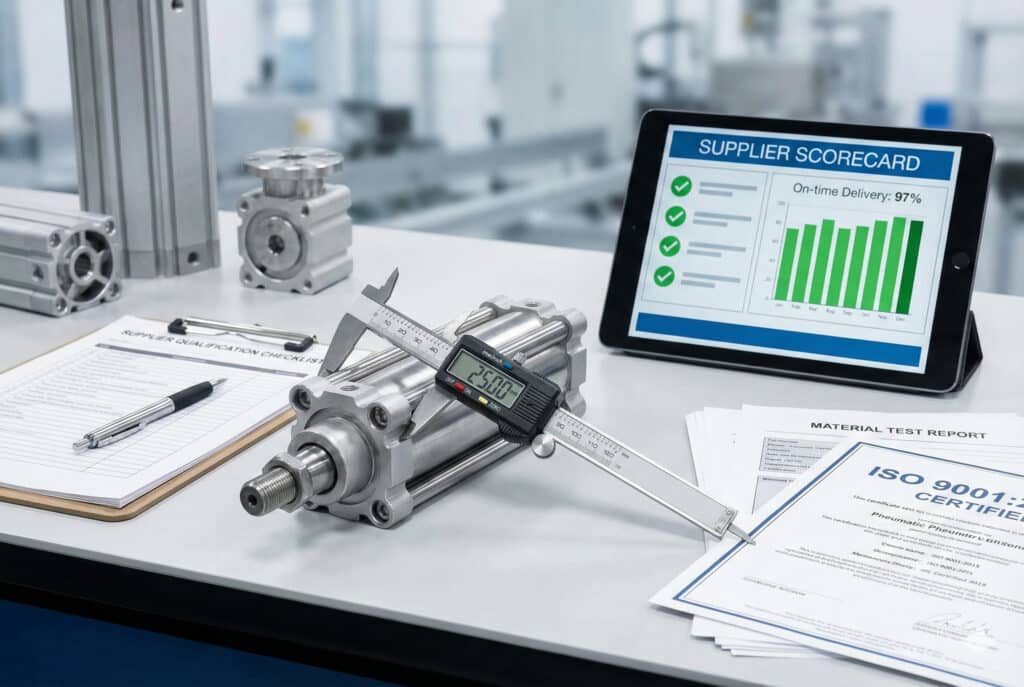
Start with identity and scope:
- legal company name and manufacturing-site address;
- whether the seller is the manufacturer, private-label owner, or distributor;
- certificate standard, status, scope, sites, certification body, and accreditation chain;
- which site machines, treats, assembles, tests, and releases the product;
- who owns the drawing and approves material or process changes.
IAF CertSearch exposes certificate status, scope, sectors, issuing certification body, accreditation body, and related recognition status. Those fields are more useful than a certificate image with no verification trail (IAF CertSearch, retrieved 2026-07-26).
Next, request a configuration-specific evidence pack:
| Evidence | What to check |
|---|---|
| Controlled drawing | Revision, dimensions, tolerances, ports, mounting, sensor and accessory interfaces |
| Product specification | Pressure, temperature, media, speed, load, cushioning and environmental limits |
| Bill-of-material definition | Metal grades, seal family, lubricant, coatings and critical purchased parts |
| Inspection plan | Characteristics measured, instruments, sampling, limits and release authority |
| Functional-test record | Test pressure, leakage criteria, stroke operation and result traceability |
| Reliability evidence | Test population, duty, load, pressure, environment, failure definition and reporting method |
| Compliance evidence | Exact product and site covered, applicable edition, exclusions and expiry |
| Change control | Notice period, approval route and treatment of existing stock |
| Nonconformance process | Containment, root-cause response, replacement and corrective action |
| Commercial support | Lead time, minimum quantity, warranty, returns, service stock and discontinuation notice |
If the supplier claims equivalence to another model, ask for the evidence behind each mapped field. A marketing cross-reference is a search aid, not an engineering approval.
For a more detailed manufacturing review, use the private-label pneumatic cylinder qualification guide and the ISO 15552 procurement specification checklist.
How Should a Replacement Be Validated?
ISO 19973-3:2015 uses a three-point moving-average method for first-failure reliability assessment and reports cylinder life in cycles or kilometres. ISO 10099:2001 separately defines functional final-examination tests and acceptance criteria for double-acting single-rod cylinders. A sample that moves once proves neither production acceptance nor long-term reliability (ISO 19973-3, 2015; ISO 10099, 2001).
Build the validation plan from the application’s failure modes.
Incoming and dimensional review
Confirm the exact ordered configuration, drawing revision, marking, packaging, visible workmanship, mounting interfaces, ports, rod end, sensors, accessories, and documentation. Record the measuring equipment and acceptance limits.
Functional bench test
Test only with a written method. Define pressure, load, speed, orientation, air quality, temperature, dwell, measurement points, leakage method, repetitions, and pass criteria. If a safety function is involved, use its separate verification and validation process.
Controlled machine trial
Install the alternative where a failure can be detected and recovered safely. Keep the incumbent spare available. Record the initial condition, machine settings, cycle count, leakage, cycle time, temperature, maintenance observations, alarms, and any product-quality effect.
Production release
Approve the manufacturer, site, product family, configuration revision, evidence pack, and application scope. “Supplier approved” is too broad if the same supplier makes several quality levels or uses several factories.
Validation should also define what would invalidate the approval. A seal compound change, different assembly site, new sub-supplier, revised lubricant, altered test limit, or manufacturing transfer may require notification, review, or requalification even when the sales part number remains unchanged.
When decisive measurements come from an external laboratory, ISO/IEC 17025:2017 provides requirements for competence, impartiality, and consistent laboratory operation. Check that the lab’s accredited scope actually covers the method and measurement involved (ISO/IEC 17025, 2017).
Total Cost Without Generic Savings Claims
ISO’s seven quality-management principles include evidence-based decision making, which is the right basis for a replacement business case. There is no transferable percentage for branded markup, safe application share, or procurement savings. Compare the two approved supply options using the same application scope, period, and cost definitions (ISO Quality Management, 2026).
Include:
- purchase price and inbound freight;
- engineering review and validation labor;
- adapters, mounts, wiring, programming, or documentation changes;
- spare stock and minimum-order effects;
- expected lead time and recovery options;
- receiving inspection and ongoing quality-control effort;
- planned maintenance and repair-kit availability;
- downtime exposure and safe recovery time;
- warranty, returns, failure analysis, and corrective-action support;
- obsolescence, redesign, and supplier-change risk.
Don’t record released cash and recurring savings as the same benefit. Don’t assume a lower-priced component produces a lower lifetime cost. Conversely, don’t assign a familiar brand an automatic reliability advantage without relevant evidence.
For rodless cylinders, the adjacent OEM versus aftermarket total-cost guide addresses long-axis alignment, guidance, sealing, carriage interface, and repair considerations in more detail. When the existing unit is worn rather than merely expensive, start with the repair-versus-replace decision.
Use a sensitivity review. Ask what happens if the alternative requires another inspection step, arrives later than planned, fails the pilot, changes revision, or needs a larger spare stock. A business case that works only under its most optimistic assumptions isn’t ready for release.
A Controlled Substitution Workflow
ISO/IEC 17025:2017 is the third edition of the laboratory-competence standard and was confirmed current in 2023. Its focus on competent methods and valid results captures one part of a broader substitution rule: evidence must be fit for the decision. A certificate, sample, or test report is useful only within its stated scope (ISO/IEC 17025, 2017).
Use four release gates:
- Specification gate: freeze the incumbent configuration, application conditions, interfaces, outputs, and acceptance limits.
- Permission gate: confirm safety, customer, regulatory, warranty, and internal change-control permission.
- Evidence gate: qualify the manufacturer, site, product, documentation, test methods, traceability, and change commitments.
- Validation gate: complete the required inspection, bench test, machine trial, review, and signed release.
The workflow can be short for a non-critical fitting with a frozen specification and known manufacturer. It will be longer for a cylinder affecting product quality, a valve controlling a hazardous motion, or a part embedded in customer-approved machinery. Scale the evidence to the consequence, not to the brand name.
We’ve found that the best pilot outcome isn’t “the alternative worked.” It is a reusable approval record that states where it worked, which revision was tested, what evidence was accepted, who approved it, and which changes trigger review. That record keeps purchasing flexibility from becoming uncontrolled variation.
Pneumatic Brand and Substitution FAQs
ISO 21287 defines a specific compact-cylinder family with 20 mm to 100 mm bores and a maximum working pressure of 1,000 kPa, or 10 bar. Even within that dimensional family, adjustable cushioning isn’t included. This illustrates why buyers must compare the exact standard scope and product function instead of treating “ISO cylinder” as a universal equivalence claim (ISO 21287, 2004).
Are unbranded pneumatic components automatically lower quality?
No. “Unbranded” doesn’t identify a manufacturing process, material set, quality system, or performance class. Evaluate the actual manufacturer, configuration, evidence, traceability, test method, and application fit. An unfamiliar but controlled supplier may qualify, while a recognizable label or ISO 9001 certificate still doesn’t guarantee product-level equivalence.
Does ISO 15552 make cylinders from different suppliers interchangeable?
It supports interchangeability of specified basic, mounting, and accessory dimensions for the covered cylinder family. It does not establish equal friction, leakage, cushioning, corrosion resistance, sensor behavior, side-load capacity, or reliability. Compare those requirements separately and validate the replacement under the machine’s operating conditions.
Can an alternative component be used in a safety-related pneumatic circuit?
Only through the machinery’s safety change process. Confirm the safety function, required performance, architecture, component evidence, failure behavior, verification, validation, and documentation. A premium brand isn’t an automatic approval, and a dimensional match isn’t enough. Unauthorized substitution can invalidate the assumptions behind the original safety design.
Is ISO 9001 certification enough to approve a pneumatic supplier?
No. Verify the certificate’s entity, site, scope, status, certification body, and accreditation chain. Then review the processes and evidence for the specific component. ISO and IAF state that ISO 9001 certification concerns the quality-management system and doesn’t certify a superior product or guarantee 100% product conformity.
How should buyers compare branded and alternative pneumatic costs?
Compare approved configurations over the same period. Include price, freight, engineering review, validation, adapters, inspection, spare stock, lead time, maintenance, downtime exposure, warranty, corrective action, and change risk. Avoid universal savings percentages. The right choice depends on the application’s consequence of failure and the evidence each supply option provides.
Sources and technical references
- ISO/IAF: Expected Outcomes for Accredited Certification to ISO 9001, limits of QMS certification claims; retrieved 2026-07-26.
- ISO 4414:2010, pneumatic-system safety requirements and lifecycle scope; retrieved 2026-07-26.
- ISO 15552:2018, detachable-mount cylinder dimensions for the 32 mm to 320 mm, 10 bar series; retrieved 2026-07-26.
- ISO 13849-1:2023, safety-related control-system design methodology; retrieved 2026-07-26.
- ISO 9001 explained, QMS certification roles and limits; retrieved 2026-07-26.
- IAF CertSearch, certificate status, scope, certification and accreditation fields; retrieved 2026-07-26.
- ISO 19973-3:2015, piston-rod cylinder reliability assessment and reporting; retrieved 2026-07-26.
- ISO 10099:2001, final examination and acceptance criteria for double-acting single-rod cylinders; retrieved 2026-07-26.
- ISO/IEC 17025:2017, testing and calibration laboratory competence; retrieved 2026-07-26.
- ISO 21287:2004, compact-cylinder dimensional family and scope limits; retrieved 2026-07-26.