

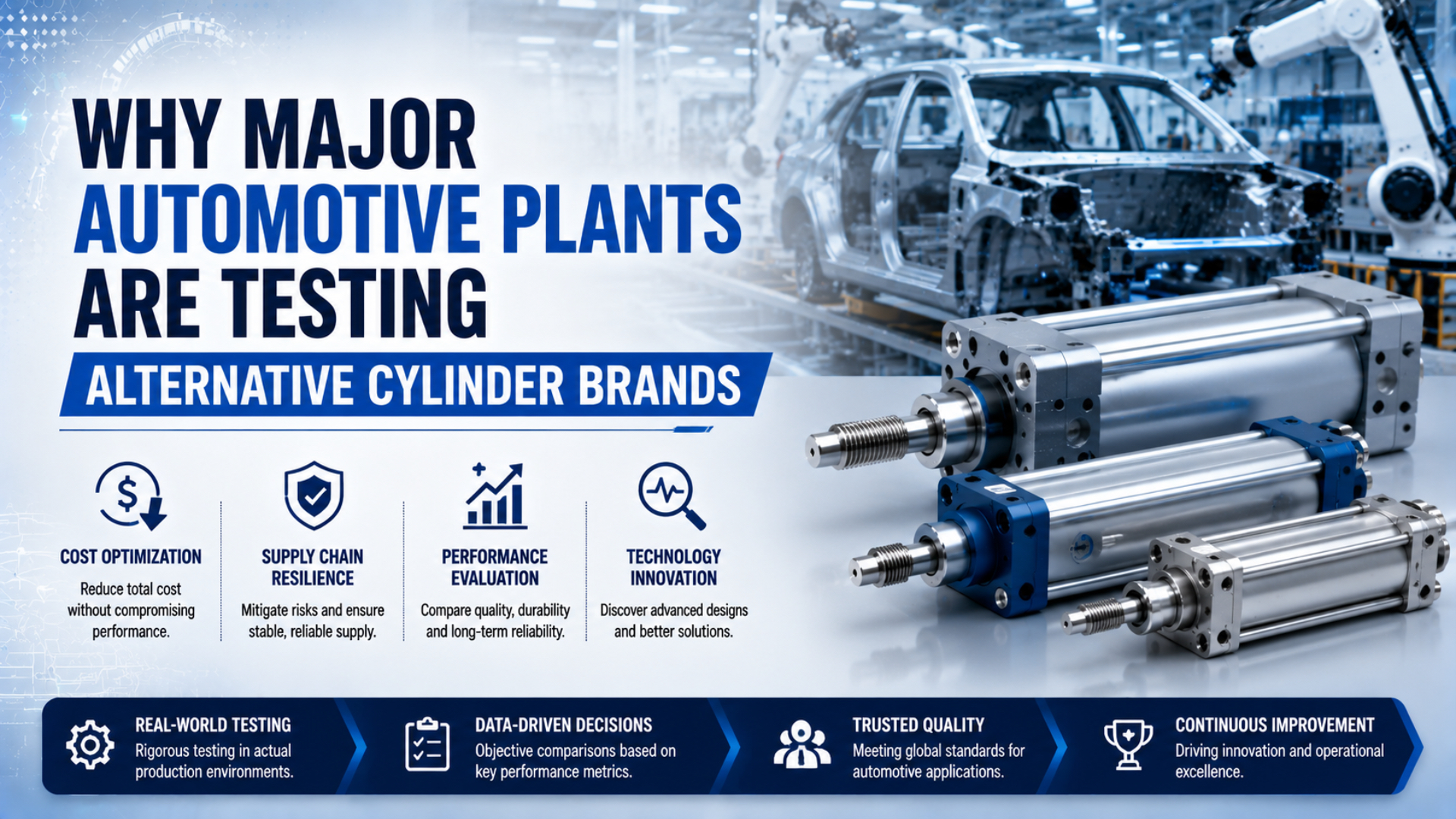
Automotive plants test alternative cylinder brands to reduce single-source exposure, recover from uncertain supply routes and create a qualified second source for maintenance parts. Testing does not establish that every alternative is equivalent. Instead, a controlled program determines whether one specified cylinder can satisfy the machine interface plus application duty plus plant quality process. That distinction matters. Familiar bore and mounting patterns can simplify installation. They cannot prove leakage performance, cushion behavior, seal compatibility or service life. Plants need a technical baseline plus supplier evidence. An application trial and controlled production release complete the decision. Alternative-brand qualification is the documented process that connects all four evidence sets to one approved configuration. NIST MEP treats secondary-supplier identification as a supply-chain risk response (NIST MEP, accessed 2026).
Key Takeaways
- NIST reports that more than half of a manufacturer’s spending occurs in its supply chain, making sourcing control a material operating issue.
- ISO 15552 defines dimensions, not complete product equivalence.
- A 4-gate validation process connects one sample result to an approved manufacturing route.
- Customer-specific automotive requirements can override generic interchangeability claims and hold release until the plant has written approval.
Why Are Automotive Plants Testing Alternative Cylinder Brands?
More than half of a manufacturer’s total spending occurs in the supply chain, according to NIST MEP, which also identifies secondary suppliers as a supply-chain risk response (NIST MEP, accessed 2026). Automotive plants therefore test alternatives to create evidence before a shortage, price change or obsolete part turns into an emergency.
Purchase price is not always the trigger. One plant may need a second source because the installed cylinder has an unpredictable replenishment time. Some original series also become obsolete. Elsewhere, a new machine program may require local support or a different documentation package. Each trigger creates a different qualification job.
| Trigger | What the plant is trying to control | Evidence needed before approval |
|---|---|---|
| Long or variable replenishment | Duration of exposure after a failure | Quoted lead-time basis, stocked configuration and replenishment route |
| Single-source dependency | Loss of one supplier, site or transport route | Independent manufacturing path plus approved alternate materials |
| Obsolescence | Inability to replace an installed series | Controlled cross-reference, interface drawing and accessory review |
| New machine program | Standardization across new equipment | Approved component list plus machine-builder and end-customer requirements |
| Cost review | Purchase price without added operational risk | Comparable quotation, validation cost and expected exposure model |
NIST MEP describes supplier scouting as a capability search, not a price contest. Its process starts with technical requirements plus the business case. A national search typically returns results in 30 to 45 days (NIST MEP, 2026). Plants can apply the same discipline internally: define the exact item before comparing manufacturers.
Strategic second sources also differ from emergency substitutes. Qualified alternatives pass documented gates while the machine is stable. Emergency substitutes are often assessed under time pressure with incomplete evidence. Testing early protects the maintenance team from making an unreviewed engineering change during a breakdown.
What Does ISO Interchangeability Actually Prove?
ISO 15552:2018 covers detachable-mounting pneumatic cylinders from 32 mm to 320 mm bore at a maximum rated pressure of 1,000 kPa, or 10 bar (ISO, 2018). Within that scope, the standard establishes basic plus mounting plus accessory dimensions required for interchangeability. Complete performance equivalence remains outside the standard.
Dimensional interchangeability is compatibility at the interfaces defined by the applicable dimensional specification. Defined mounting dimensions can therefore be confirmed against the candidate drawing. Nothing in the scope states that two products use the same tube finish, bearing design, seal compound or lubricant. Equal cushion capacity plus low-speed behavior plus leakage plus installed life still require separate testing. The candidate still needs an application-specific performance baseline.
Compact-cylinder standard ISO 21287:2004 has a different scope. Its metric series covers single-rod cylinders from 20 mm to 100 mm bore. Magnetic function is optional. Applications requiring adjustable cushioning sit outside its stated series (ISO, 2004). Rodless-cylinder interchangeability also sits outside this scope.
| Evidence | ISO dimensional standard can support it | Separate verification still required |
|---|---|---|
| Defined bore and mounting series | Yes | Confirm exact configuration |
| Selected accessory interfaces | Yes | Check sensor and bracket compatibility |
| Port thread form or orientation | Sometimes configuration-dependent | Yes |
| Available force at the machine | No | Yes |
| Cushion energy and cycle behavior | No | Yes |
| Seal chemistry and washdown suitability | No | Yes |
| Reliability under the duty cycle | No | Yes |
For a standard-profile cylinder, compare the candidate drawing with both the standard and the installed interface. The ISO 15552 interchangeability guide explains why the standard profile is only the beginning of a cross-reference. Compact cylinders need a separate comparison against the ISO 15552 and ISO 21287 boundary.
Rodless cylinders require even more configuration-specific evidence. Carriage geometry, guidance capacity, sealing bands, moment ratings and end cushioning depend on the product design. Supplier drawings plus an application review must carry that decision.
Build a Controlled Alternative-Brand Program
AIAG’s third APQP edition added a dedicated change-management section plus a checklist. Its scope includes review of sub-tier supplier APQP activity (AIAG, 2024). Alternative-cylinder programs should use the same principle: treat brand substitution as a controlled product and process change with named evidence owners.
Four evidence gates keep the program understandable:
- Requirement gate: freeze the requirement.
- Supplier gate: verify the legal manufacturing entity plus every relevant site plus the quality-system scope plus the real production route for the proposed cylinder family.
- Validation gate: compare samples with the approved baseline.
- Release gate: approve only the tested configuration, supplier site, drawing revision and control plan. Every later material or process substitution re-enters the applicable gate.
Pilot work is not merely a cheaper-cylinder trial. Specification maturity is the real test. If the plant cannot state the decisive dimensions plus loads plus environmental exposures, a successful sample may hide an incomplete requirement rather than prove equivalence.
IATF’s customer-specific requirements directory shows that automotive expectations vary by OEM (IATF, accessed 2026). Each plant should identify customer, machine-builder and internal approval obligations before testing. Maintenance cross-references cannot override a drawing-mandated brand or customer-controlled component because the approved bill of materials remains the governing technical baseline until an authorized change record replaces it.
Which Applications Should Enter the Pilot First?
A 4-class application screen is safer than a universal percentage rollout because IATF publishes separate customer-specific requirements by OEM (IATF, accessed 2026). Start where failure consequences are containable and the technical baseline is measurable. Defer any station whose safety, legal or customer approval path remains unresolved.
Classify the application before choosing the sample:
| Application class | Typical consequence of cylinder failure | Pilot decision |
|---|---|---|
| Safety-related or legally controlled | Injury risk or loss of a protective function | Do not pilot without the applicable functional-safety and legal review |
| Customer-specified | Contract, drawing or approval violation | Obtain written approval before substitution |
| Quality-critical | Scrap, missed process position or undetected product defect | Pilot only with measurement-system and product-quality controls |
| Containable support motion | Local stop with controlled recovery and no product escape | Best starting point after normal engineering review |
Application classification should consider more than whether a station is called “critical.” Record the moving load, mounting, alignment, stroke rate, available pressure, exhaust restriction, ambient temperature, contamination, washdown chemicals and nearby welding exposure. One cylinder can be low risk on a guarded fixture and unacceptable on a quality-verification station.
Ask a practical question: if the candidate fails during the trial, can the plant detect the failure before a person, product or downstream process is exposed? If not, move the application into a higher review class.
Use the cylinder construction comparison to identify service differences between tie-rod, profile and crimped designs. Consult the repair-versus-replace guide before a sourcing project becomes a substitute for correcting alignment or contamination.
How Should Supplier and Product Evidence Be Audited?
ISO 19011 reached its fourth edition in May 2026 and provides guidance for management-system audit programs, audit conduct and auditor competence (ISO, 2026). Use those principles to trace one proposed cylinder through the actual supplier site. A certificate review alone cannot establish product conformity.
Begin with the legal entity and manufacturing address. Confirm which site machines the heads, prepares the tube, finishes the rod, assembles the seals and performs final testing. Outsourced surface treatment or purchased seal kits should appear in the approved supply route. The quotation entity must connect to the party responsible for quality plus warranty decisions. As of July 2026, ISO 9001:2015 remains the published edition while its replacement is expected in September 2026 (ISO, 2015; ISO, 2026). Record the certificate edition plus current status. Confirm that its scope and sites cover the relevant manufacturing activities.
Trace evidence in both directions:
- Begin with one finished cylinder. Follow its serial or lot identity backward through final testing, assembly, machining, incoming inspection and the approved purchased-component records for the exact configuration.
- Choose one drawing characteristic. Follow its current revision to the recorded result.
- Select one nonconforming result. Verify containment plus technical disposition plus the method used to identify every affected inventory location or shipment.
Measurement evidence needs more than a calibration sticker. ISO 10012:2026 defines a measurement-management system intended to support valid and reliable results (ISO, 2026). Request the record for a gage used on the candidate part. Check its equipment identity, range, status and action after an out-of-tolerance result.
Commercial identity should remain checkable outside a presentation. Compare the quotation with a stable company profile plus a named contact channel. Then use the private-label cylinder manufacturer qualification guide for certificate entities, production routes, tooling control and lot traceability. These checks do not turn a quality-system certificate into a product certificate.
How Should Samples and Pilot Lots Be Tested?
ISO 10099:2001 specifies final functional examination for double-acting single-rod pneumatic cylinders, while ISO 19973-3:2015 addresses reliability assessment for cylinders with piston rods (ISO 10099, 2001; ISO 19973-3, 2015). Neither creates one universal automotive pilot duration or cycle target.
Compare the candidate with an approved baseline under the same documented conditions. New cylinders tested on clean bench air cannot be compared fairly with an installed unit exposed to side load, pressure loss or weld spatter. Record the baseline condition before interpreting any difference.
Use a staged plan:
- Document review: confirm the exact drawing, materials, ratings, markings and proposed manufacturing site.
- Incoming inspection: measure decisive interfaces with controlled equipment. Record actual values rather than a simple pass mark.
- Bench function: check movement, leakage, sensing and cushioning against written methods plus limits.
- Machine pilot: operate under representative load, speed, pressure, air quality and environmental exposure.
- Production release review: compare results with the baseline. Close deviations before approving a routine lot.
For example, a fixture pilot can place the candidate beside an approved baseline on equivalent stations. Shared pressure traces plus cycle counts plus inspection results create a comparable record without claiming that one short trial predicts lifetime.
Meaningful comparison is not new alternative versus worn incumbent. Use a known acceptable baseline under shared conditions. Otherwise normal wear, poor alignment or a restricted exhaust can be misread as a brand difference.
Reliability evidence must name the tested configuration, operating class, failure definition and result-reporting method. A cycle number without those conditions is not transferable. For lot release, define the pressure and leakage method plus stabilized conditions. Include equipment resolution, observed result and responsible inspector.
Compare Total Cost Without Inventing Savings
NIST reports that more than half of manufacturing spend occurs in the supply chain and lists total cost of ownership among supplier-management activities (NIST MEP, accessed 2026). Compare alternative brands with plant-specific inputs. A universal percentage saving cannot represent different inventories, qualification burdens or failure consequences.
Use an expected-cost model:
Here, is the comparable delivered purchase cost. Engineering plus testing make up . Carrying cost and obsolescence exposure form . Documentation plus training plus approved tooling belong in . The final term combines the estimated event probability with its consequence.
Do not hide uncertainty inside a precise total. Use a range or scenario for inputs that the plant cannot observe directly. Keep purchase savings separate from avoided downtime. A faster quotation does not prove a shorter recovery time unless the exact approved configuration is stocked or can be reproduced within the stated route.
| Input | Evidence source | Common mistake |
|---|---|---|
| Delivered component cost | Comparable quotation with quantity, Incoterm and validity | Comparing catalog list price with a project quote |
| Qualification effort | Logged engineering, test and machine time | Treating approval work as free |
| Inventory exposure | Stock policy, consumption and obsolescence history | Assuming every spare prevents the same downtime |
| Change cost | Drawing, training, software and fixture updates | Excluding internal labor |
| Event consequence | Plant recovery record plus production impact model | Multiplying worst-case downtime by every replacement |
For the narrower rodless-cylinder cost question, use the OEM versus aftermarket TCO article. Keep the present decision focused on automotive validation and release evidence.
Supplier-switching TCO has no matching Bepto calculator because available engineering tools calculate pneumatic behavior rather than procurement exposure plus approval cost plus recovery consequence. The compressed-air energy tool estimates operating energy, not procurement or downtime exposure. A spreadsheet controlled by the plant’s finance plus engineering teams is more appropriate for this decision.
What Change-Control Rules Protect Production?
AIAG’s APQP third edition added a change-management section and checklist, while the companion Control Plan was issued as a separate first edition (AIAG, 2024). An approved alternative cylinder therefore needs a frozen baseline plus notification rules. Approval of a brand name alone leaves too much uncontrolled.
The approved record should identify:
- manufacturer plus production site;
- complete part number, with every approved drawing and specification revision named;
- decisive interfaces;
- approved tube, rod, bearing, seal, lubricant and surface-treatment specifications for the released configuration;
- manufacturing route plus every named outsourced special process;
- inspection plan, functional test method, acceptance limits, equipment requirements and production-lot record format;
- label, packaging, storage and shelf-life requirements where relevant, including receiving identification, controlled storage locations, obsolete branded inventory segregation and documented disposal authorization.
Require written review before a supplier changes a seal compound, lubricant, coating, tube source, machining location, test method or subcontractor. The change request should state affected inventory plus open orders. It should also define validation evidence and the first controlled lot after approval.
Two approved brands do not create true resilience when both rely on the same uncontrolled sub-tier seal source or surface-treatment line. Map the constrained sub-tier process during qualification. Otherwise the plant may pay for dual sourcing while retaining one hidden point of failure. Traceability should support containment: a suspect seal lot must lead to affected cylinders without recalling unrelated production. Installation records should link each cylinder to its station plus trial status plus approval scope. The unbranded versus branded pneumatics guide helps separate low-consequence accessories from components needing deeper validation. Brand familiarity can support a review, but it cannot replace configuration control. Reassess the source after any site transfer or major sub-tier change because the original validation record cannot prove equivalence for a different process location or newly substituted critical component.
Final Decision Rule for Automotive Plants
ISO 2859-1 moved to its third edition in January 2026 and provides AQL-indexed single, double and multiple sampling schemes for lot-by-lot attribute inspection (ISO, 2026). Sampling can support routine lot control after qualification. It cannot replace application validation or justify one universal acceptance plan.
Production release is the documented authorization for one controlled configuration plus process route to enter routine supply.
Apply knockout criteria before price scoring. Stop approval when the proposed part lacks a controlled drawing. Do the same when the manufacturing site is unclear, decisive tests have no limits or the supplier refuses change notification. Customer-specified and safety-related applications need their own authorization path.
| Evidence gate | Minimum release evidence | Decision when incomplete |
|---|---|---|
| Requirement | Approved interface plus application duty | Return to engineering definition |
| Supplier | Verified entity, site, scope and process route | Hold supplier qualification |
| Validation | Baseline comparison plus closed deviations | Continue test or reject |
| Release | Configuration, lot plan, traceability and change rules | Do not place routine orders |
Score commercial factors only after the gates close. Compare delivered cost, replenishment model, service capability and inventory consequence on the same approved configuration. Record the final scope by plant, line, machine, cylinder family and revision.
Alternative brands can strengthen sourcing resilience when they create an independently controlled route. They increase risk when a dimensional cross-reference is treated as complete validation. The practical target is not the cheapest cylinder. It is a second source whose evidence remains retrievable after the pilot team has moved on.
Alternative Cylinder Brand FAQs: What Should Automotive Plants Ask?
Covering 32 mm to 320 mm bores, ISO 15552:2018 defines a series (ISO 15552, 2018). Compact cylinders from 20 mm to 100 mm fall under ISO 21287:2004 (ISO 21287, 2004). These answers separate scope from supplier qualification plus application validation plus customer approval.
Does ISO 15552 make an alternative cylinder a drop-in replacement?
Not by itself. ISO 15552 supports interchangeability for defined basic plus mounting plus accessory dimensions within its scope. Verify the complete drawing with port details plus sensor provisions plus installed envelope. Separate tests must establish force plus leakage plus cushioning plus environmental compatibility under the intended duty cycle. A matching bore plus mounting pattern does not prove equal service performance.
Does an automotive cylinder supplier need IATF 16949 certification?
Requirements depend on the customer plus the supplier’s role. IATF publishes customer-specific documents by OEM. Supplier quality-system development can also follow a risk-based path. Verify the applicable customer document plus required certification scope plus manufacturing site. IATF 16949 concerns a management system. It does not certify the cylinder itself.
How long should an alternative cylinder pilot run?
Pilot duration has no universal value. Define completion through operating exposure plus test conditions plus failure-detection capability plus required confidence. Low-cycle fixtures may need calendar exposure. Rapid-cycle stations accumulate duty faster. Close every deviation before release. Report actual cycles plus loads plus pressures plus environment plus every maintenance intervention.
Should the lowest quoted cylinder price win?
Lowest price should not win by itself. Close the four evidence gates first. Then compare delivered purchase cost with qualification work plus inventory exposure plus change cost plus event consequence. A lower price is useful only for the approved configuration. Unsupported downtime savings or generic percentage claims should never decide an automotive production change.
Sources and technical references
- NIST MEP, Supply Chain Management, the official framework covering supply-chain mapping, risk assessment, supplier segmentation, alternative sourcing, supplier evaluation, total cost of ownership and strategic supplier relationships for manufacturers; retrieved 2026-07-26.
- NIST MEP, Supplier Scouting, capability-based supplier search; retrieved 2026-07-26.
- NIST MEP, Supplier Scouting process, technical and business-case inputs plus the reported 30 to 45 day search process; updated 2026-01-05 and retrieved 2026-07-26.
- ISO 15552:2018, basic, mounting and accessory dimensions for detachable-mounting cylinders; confirmed current in 2025 and retrieved 2026-07-26.
- ISO 21287:2004, compact single-rod cylinder scope; confirmed current in 2023 and retrieved 2026-07-26.
- ISO 9001:2015, current published quality-management-system edition; retrieved 2026-07-26.
- ISO 9001 edition 6 publication status, expected September 2026 replacement; retrieved 2026-07-26.
- ISO 19011:2026, management-system audit guidance, edition 4; retrieved 2026-07-26.
- ISO 10012:2026, measurement-management-system requirements, edition 2; retrieved 2026-07-26.
- ISO 10099:2001, final examination and acceptance criteria for double-acting single-rod pneumatic cylinders; retrieved 2026-07-26.
- ISO 19973-3:2015, reliability assessment procedures for cylinders with piston rods; retrieved 2026-07-26.
- ISO 2859-1:2026, AQL-indexed lot-by-lot acceptance sampling, edition 3; retrieved 2026-07-26.
- IATF Customer-Specific Requirements, OEM-specific automotive quality requirements; retrieved 2026-07-26.
- AIAG APQP 3rd Edition and Control Plan 1st Edition FAQs, change-management and sub-tier APQP updates; retrieved 2026-07-26.