

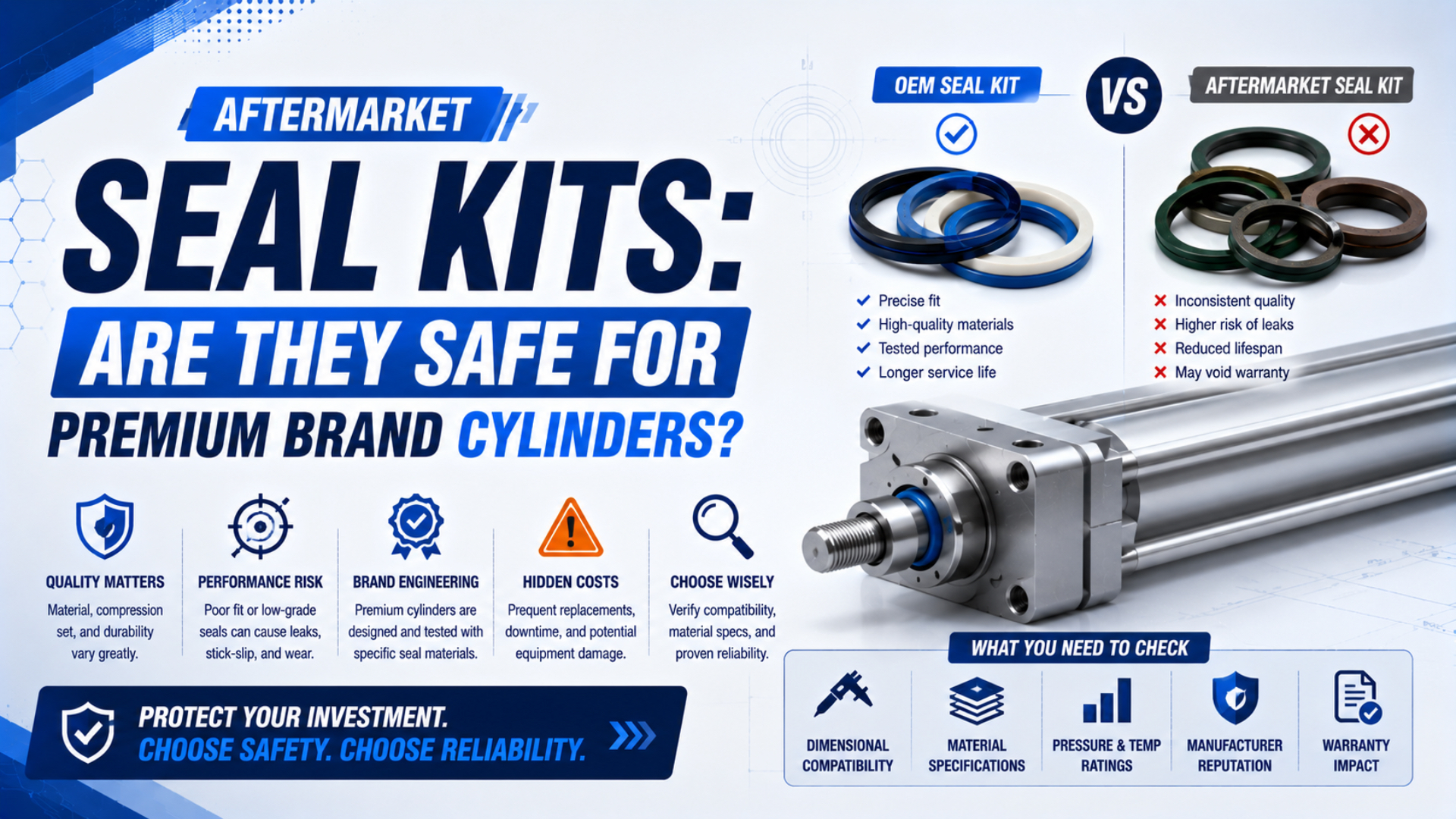
Aftermarket seal kits can be safe for premium-brand pneumatic cylinders, but only after the exact kit and the used cylinder pass an engineering acceptance process. Bore size and polymer family aren’t enough. Neither is a photograph or cross-reference entry. Any replacement must fit the cylinder’s model and revision. It must reproduce every required seal function while leaving a serviceable pressure boundary.
Instead of asking whether OEM or aftermarket parts are universally better, ask whether one identified kit can restore one identified cylinder to an approved condition. That distinction separates a controlled repair from a parts gamble.
Key Takeaways
- Approve the exact cylinder model, variant, and seal position before comparing kits.
- ISO 3601 covers O-rings within defined scopes, not complete pneumatic cylinder seal-kit equivalence.
- Inspect rods, barrels, grooves, guides, and cushions before installing new seals.
- Treat warranty, food-contact, and machine approvals as contract- and application-specific requirements.
Aftermarket seal kit means a service-parts set supplied outside the original cylinder manufacturer’s sales channel.
Technical equivalence means that the replacement has documented compatibility with every relevant seal position, geometry, compound, operating condition, mating surface, and assembly requirement. It does not mean that two bags contain black rings of similar size.
For whole-component fit and functional release, use the broader compatible pneumatic-parts guide.
This article narrows that method to service parts inside an installed cylinder.
Are Aftermarket Seal Kits Safe for Premium Brand Cylinders?
Yes, conditionally. One Festo DSBC-100 spare-parts entry identifies separate wiper, cushion and O-ring items, a guide band, plus specified grease and adhesive. That bill of materials shows why a credible assessment must cover the complete service configuration rather than one O-ring dimension (Festo Spare Parts Catalogue, retrieved 2026-07-26).
A safe substitution has to pass five gates:
- Identity: identify the exact cylinder and its repair route.
- Kit content: every pressure seal, dynamic seal, wiper, guide element, cushion part, lubricant, and single-use item required by the service instructions is accounted for.
- Seal equivalence: document profile, dimensions, compound, hardness, direction, and application limits.
- Hardware condition: confirm the rod, barrel, grooves, bearings, guide bands, fasteners, and pressure-containing parts remain serviceable after cleaning and inspection.
- Controlled restart: installation, leakage, motion, sensing, cushioning, and loaded operation are verified under the machine’s approved procedure.
Passing one gate doesn’t compensate for failing another.
A correctly molded rod seal cannot repair scored metal, and the right O-ring cannot replace a missing wear ring. Good paperwork cannot make an unsupported cylinder variant repairable.
This is the useful distinction: kit equivalence and repair acceptance are separate decisions.
Kit equivalence concerns the replacement parts, while repair acceptance covers the cylinder, machine, technician, procedure, and restart evidence. Both must be positive before returning the actuator to production.
Start With the Exact Cylinder Identity and Seal Bill of Materials
SMC doesn’t use bore alone. Its maintenance-parts system selects seal kits by series, rod size, and made-to-order specification; the CY3 example produces a different part number for a clean-series variant and includes a named grease pack. Three identity fields can therefore change the kit (SMC Maintenance Parts List, retrieved 2026-07-26).
Record the complete nameplate and configuration before removing the actuator.
Useful identity evidence includes:
- complete order code;
- product series, bore, stroke, and rod diameter where applicable;
- serial number, product key, date code, or revision, including photographs that preserve the original nameplate;
- standard, cleanroom, heat-resistant, low-temperature, food-zone, corrosion-resistant, low-friction, or other variant;
- rodless sealing-band type, cushion option, port position, sensors, lock, guide, or brake option, with the complete suffix that identifies each choice;
- machine position, failure symptom, previous repair date, and maintenance history.
Bore is not identity. Don’t infer the kit from it alone. For example, two same-bore cylinders can use different rod seals or piston profiles. Cushion parts and lubricants may also differ. Festo’s catalogue asks for a part number, order code, type, and product key before displaying repair parts. Some searches also require the series number (Festo Spare Parts Catalogue, retrieved 2026-07-26).
Next, build a position-by-position bill of materials:
| Position | Function to verify | Evidence needed |
|---|---|---|
| Static O-ring or gasket | Seals a fixed cap, port, or internal joint | Position, size, compound, squeeze/gland definition |
| Piston seal | Separates the two working chambers | Profile, direction, bore fit, compound, friction behavior |
| Rod seal | Retains pressure around a moving rod | Profile, rod fit, direction, extrusion clearance |
| Wiper or scraper | Limits dirt entry at the exposed rod | Lip form, material, housing fit, environmental duty |
| Guide or wear ring | Supports the moving member and controls contact | Thickness, width, gap, material, installation position |
| Cushion or buffer seal | Controls end-of-stroke pneumatic cushioning | Exact profile, direction, matching sleeve or spear |
| Rodless sealing band | Seals the longitudinal slot | Model-specific band, scraper, tension and installation route |
| Lubricant or adhesive | Supports assembly and service behavior | Product designation, amount, compatibility, application point |
The industrial cylinder seal-types guide explains what each position does.
Use that functional map before comparing dimensions or materials.
What Does Equivalent Actually Mean for a Seal Kit?
ISO 3601-1 specifies O-ring inside diameters, cross-sections, tolerances, and designation codes. ISO 3601-3 addresses quality acceptance criteria for O-rings standardized by Part 1. Neither document certifies a complete pneumatic cylinder kit. That boundary matters. Lip seals, wipers, wear rings and cushion elements remain outside that blanket claim (ISO 3601-1; ISO 3601-3).
For every seal position, compare these attributes:
| Attribute | Why it matters | Weak evidence that should not approve the kit |
|---|---|---|
| Profile and sealing direction | Controls pressure activation, wiping, friction, and assembly orientation | Similar photograph or generic U-cup description |
| Working dimensions | Determine fit with rod, bore, and groove | Bore size alone |
| Tolerances and inspection method | Determine whether the molded part stays within the approved fit window | Unspecified “OEM tolerance” claim |
| Exact compound | Controls thermal, chemical, compression-set, wear, and lubrication behavior | NBR, FKM, PU, or PTFE family name alone |
| Hardness and test basis | Affect deformation, friction, and extrusion resistance | Color or hand-flex test |
| Media and lubricant compatibility | Prevent swelling, hardening, cracking, or loss of lubricating film | Generic compatibility chart without compound identity |
| Traceability and change control | Connect delivered parts to approved evidence | Unidentified loose seals |
ISO 3601-5 covers selected elastomeric materials for industrial O-rings, yet it still states that required physical properties and test methods should be agreed between the equipment user and supplier. That is a compound-level requirement, not proof that all parts labeled NBR are interchangeable (ISO 3601-5, 2015).
Surface finish needs the same discipline. For example, Parker’s O-ring handbook provides different guidance for contact and groove surfaces. It also distinguishes dynamic from static conditions. No universal bore-finish number can approve every piston seal or cylinder construction (Parker O-Ring Handbook, accessed 2026-07-26).
Do not accept ISO 6194 as general proof for a pneumatic cylinder seal kit.
ISO 6194-1 covers rotary shaft lip-type seals with elastomeric sealing elements, not backup rings or complete reciprocating-cylinder kits (ISO 6194-1, 2007).
For a deeper compound review, use the pneumatic cylinder seal-material guide.
It separates polymer family, exact compound, temperature cycle, media, motion, and regulatory duty.
Inspect the Cylinder Before Ordering New Seals
Parker’s OSP-P instructions set a model-specific maintenance point from 8,000 km of travel and require cleaning plus worn-part replacement when indicated. The same manual forbids field repair of its cleanroom version. Those two rules show why repairability and inspection limits must come from the exact product documentation (Parker OSP-P Maintenance Instructions).
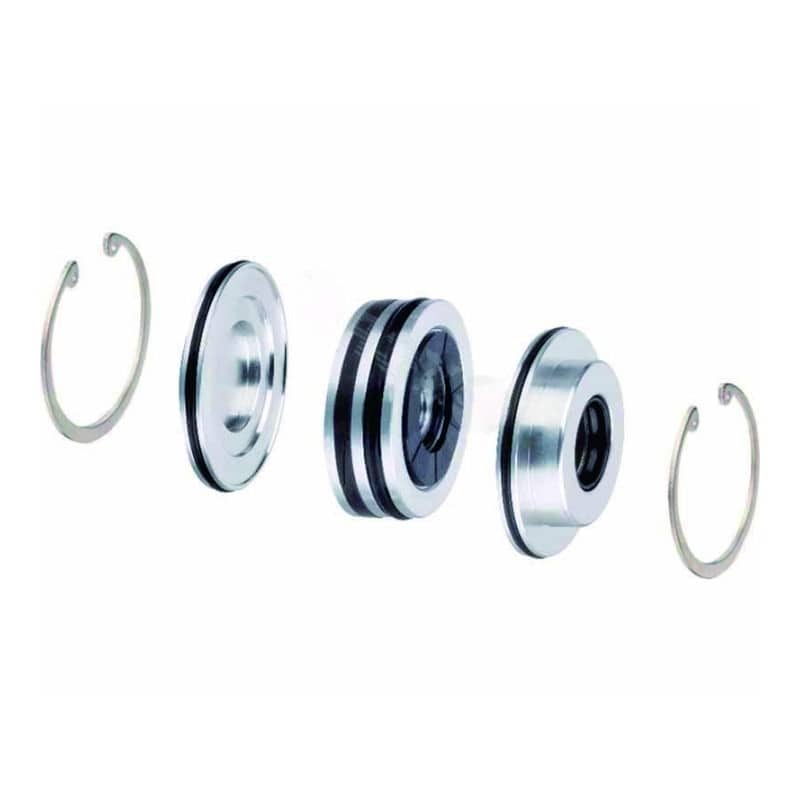
Clean the exterior before opening the actuator, then preserve evidence from the failed seal and its position. Photograph orientation and wear patterns. Keep parts separated by location. A torn lip, one-sided polishing, extrusion, hardening, swelling, embedded debris, or repeated failure can point to different root causes.
Inspect at least:
- Piston rod: inspect the full working surface.
- Cylinder bore or tube: scratches, corrosion, embedded debris, abnormal wear, and damaged lead-in features.
- Grooves and edges: find burrs, dents, deformed lands, corrosion, incorrect chamfers, or sharp threads. Trace the whole installation path because a new seal can be cut before it reaches the groove.
- Bearings and guides: check clearance and missing sections. Uneven wear, cracking, or one-sided contact can expose side load or misalignment.
- Cushion parts: sleeve or spear damage, adjuster condition, seals, flow paths, and end-cap impact marks.
- Fasteners and pressure boundary: reject stripped threads or cracked caps. Escalate distorted retaining features and unauthorized modifications.
- Air and environment: record water, incompatible oil, cleaning chemicals, heat, abrasive dust, washdown exposure, and any contamination found inside the failed seal.
A new seal can mask a guidance problem for a short period.
Repeated one-sided rod-seal wear should trigger the rod-bearing and external-guidance review.
Embedded particles or scratches call for the cylinder contamination-analysis method.
Stop the repair when the documentation prohibits overhaul, the pressure boundary is damaged, the necessary dimensions cannot be verified, or the machine owner has no approved test route. Parts availability is not proof of repairability.
What Supplier Evidence Should You Require?
ISO and IAF guidance gives two important limits: ISO 9001 certifies a management system rather than the supplier’s products, and accredited certification does not imply a superior product or 100% conformity. A certificate can support supplier review, but it cannot approve one seal kit (ISO/IAF Expected Outcomes).
Request evidence tied to the quoted kit and production source:
- kit part number and revision;
- exact cylinder models and variants covered by the cross-reference;
- complete position-by-position contents list;
- a controlled drawing for each seal profile, including the dimensions and tolerances that drive fit rather than only a nominal bore reference;
- compound designation, hardness requirement, test methods, and application limits. The declaration should identify the finished part instead of naming only a polymer family;
- lot or batch traceability on packaging and records;
- delivered-lot inspection results;
- storage conditions, manufacture or cure date where controlled, and shelf-life basis;
- approved lubricant and adhesive, with the application point, quantity or method, and any curing or cleanliness restriction stated in the service procedure;
- nonconformance, return, and corrective-action route;
- advance notification before any profile, compound, production site, tooling, sub-supplier, or inspection-method change affects an approved kit.
Check what the document actually certifies. Evidence must connect. A generic material declaration may describe a polymer family without identifying the molded part or delivered lot. A dimensional report may cover O-rings while omitting lip seals. A cylinder compatibility list may omit suffixes that change the seal set. Trace the chain from cylinder configuration to kit revision and delivered batch.
ISO 2230:2026 covers inspection, records, packaging, and controlled storage of vulcanized or thermoplastic rubber products before they enter service. Labels matter. Packaging is part of the storage procedure and also provides material identification (ISO 2230:2026). Unlabeled seals stored loose in a maintenance drawer lose much of that control.
Supplier qualification and kit approval should have separate statuses. Keep both current. Supplier qualification asks whether an organization can control production and records. Kit approval asks whether one defined set is technically suitable for one cylinder configuration. A strong supplier can still quote the wrong kit; a correct sample doesn’t prove repeat-production control.
Install and Recommission the Cylinder Under Control
OSHA 29 CFR 1910.147 explicitly includes pneumatic energy. During covered servicing, hazardous stored or residual energy must be relieved, disconnected, restrained, or otherwise made safe. Pressure can return. ISO 4414 also addresses pneumatic-system assembly and installation, including maintenance, cleaning, and reliable operation (OSHA 1910.147; ISO 4414).
Follow the machine’s energy-control procedure and the exact cylinder service instructions. Isolate every energy source that can create motion or trapped pressure, including sources that can recharge through a connected circuit after the local valve is vented. Block or support gravity loads. Verify the safe state before disassembly, and control reaccumulation where it can occur. Only trained and authorized personnel should perform the work.
During seal installation:
- start clean;
- preserve the specified seal orientation and order;
- cover sharp threads and edges. Use the specified installation sleeve when the seal must cross a feature that can cut or overstretch it;
- remove chips, burrs, old adhesive, and foreign particles;
- avoid twisting or permanently stretching sealing elements;
- use only the specified compatible lubricant. Control its amount and application point instead of coating every surface indiscriminately;
- replace single-use fasteners, retainers, adhesives, or locking elements when required;
- follow model-specific tightening, curing, and adjustment instructions.
Trelleborg’s 2025 sealing instructions call for clean components, protected sharp edges, compatible lubricant, no sharp-edged installation tools, and control of seal twisting.
These are useful principles, but the cylinder manufacturer’s procedure remains the controlling assembly route for the selected product (Trelleborg Sealing Solutions).
Recommission in stages defined by the machine owner:
- Check assembly completeness.
- Restore guarding and confirm fasteners, ports, sensors, adjustments, tools, and loose items before energy is reintroduced.
- Introduce pressure using the approved procedure. At a safe state, examine every opened joint and dynamic sealing location for external leakage.
- Operate at reduced energy or controlled speed where the machine design permits it.
- Check full stroke, smooth motion, end cushioning, sensing, abnormal sound, and binding. Repeat the relevant test under working load and normal controls.
- Record the kit lot, technician, measurements, deviations, test result, and authorized production release.
There is no universal observation period or leakage threshold for every cylinder.
Use the OEM manual, machine risk assessment, site procedure, and application acceptance criteria.
How Should Warranty and Compliance Affect the Decision?
The U.S. Magnuson-Moss Warranty Act defines consumer products around personal, family, or household use. The FTC’s business guide says the Act does not apply to products sold for resale or commercial purposes. It therefore isn’t a universal industrial-cylinder warranty rule (15 U.S.C. §2301; FTC Warranty Guide).
For an industrial pneumatic cylinder, review:
- written OEM warranty;
- purchase contract, applicable exclusions, and governing law;
- extended service, maintenance, rental, or machine-builder agreements;
- customer approval and regulated-process obligations;
- instructions that limit repair to named parts, trained personnel, an authorized facility, or a defined service procedure;
- the effect of a component change on machine validation, safety functions, cleanliness, product quality, and any customer approval already attached to the machine.
The European Consumer Rights Directive concerns contracts between consumers and traders; it should not be presented as a general B2B industrial-equipment protection (European Commission).
Where warranty value or contractual liability is material, obtain written clarification from the responsible party and qualified legal advice.
Food and pharmaceutical claims need the same discipline. U.S. 21 CFR 177.2600 addresses rubber articles intended for repeated food-contact use, subject to specified substances, limitations, and extraction requirements. A base-polymer label such as NBR or FKM does not establish compliance for the finished seal and intended conditions (21 CFR 177.2600).
Ask for an application-specific declaration that identifies the finished part and regulatory basis. Application names prove nothing. The declaration should state the process media and contact conditions, then address cleaning chemicals, temperature, and traceability. For cleanroom or oxygen duty, verify the exact controlling requirements. Apply the same discipline to semiconductor, paint, medical, or pharmaceutical service instead of accepting a generic “FDA-grade” statement.
Choose OEM, Qualified Aftermarket, or Cylinder Replacement
Parker’s OSP-P instructions define 2 model-dependent outcomes: standard versions have a documented maintenance route, while the cleanroom version must not be maintained or repaired in the field. Model suffixes matter. The buyer’s decision then has 3 practical routes, chosen by the exact model and failure evidence rather than the premium-brand label (Parker OSP-P Maintenance Instructions).
| Decision | Prefer it when | Stop or escalate when |
|---|---|---|
| OEM service kit | The unit is under an applicable service agreement; the exact kit and instructions are available; approval burden is high; or the application requires OEM-controlled repair | Hardware damage, prohibited overhaul, obsolete support, or no acceptable restart route |
| Qualified aftermarket kit | Exact model coverage, complete BOM, compound and dimensions, traceable lot, installation route, hardware condition, and machine validation are all acceptable | Any suffix, seal profile, material, guide element, lubricant, or approval remains unresolved |
| Replace or factory-overhaul the cylinder | Pressure boundary or critical surface is damaged; guidance has failed; repair is prohibited; repeat failures persist; or validation effort outweighs a controlled replacement | The proposed replacement still lacks functional, dimensional, control, and application verification |
Price belongs after technical acceptance. Compare the OEM kit, qualified alternative, factory overhaul, and cylinder replacement using the same logistics, labor, downtime, validation, repeat-failure, inventory, and warranty assumptions. The related OEM-versus-aftermarket rodless-cylinder guide owns that broader total-cost decision.
Aftermarket Pneumatic Seal Kit FAQs
ISO 2230:2026 treats inspection, records, packaging, storage, and product identification as connected controls for rubber products before use. That principle answers many practical seal-kit questions: safety depends on a traceable part and preserved condition, not merely a familiar material label or an unopened-looking bag (ISO 2230:2026).
Are aftermarket seal kits safe for premium-brand pneumatic cylinders?
They can be, but only for a defined cylinder and application. No shortcut works. Confirm the full model, variant, and complete kit contents. Then check seal profiles, dimensions, exact compounds, lubricant, cylinder condition, installation procedure, and restart tests. Stop the substitution if any pressure seal, guide element, cushion part, or approval remains uncertain.
Is matching the O-ring size enough to approve a seal kit?
No. ISO 3601 dimensions can help identify an O-ring, but a cylinder kit may contain many other parts. Directional rod or piston seals, wipers, guide rings and cushion elements need separate verification. Even the O-ring requires the correct compound and hardness, plus suitable gland fit, media compatibility, tolerances, and traceability.
What evidence should an aftermarket seal-kit supplier provide?
Ask for a controlled kit number, cylinder cross-reference including suffixes, complete contents list, seal drawings or dimensions, compound and hardness requirements, inspection method, delivered-lot records, storage controls, compatible lubricant, installation instructions, and change notification. An ISO 9001 certificate supports supplier review but does not certify the kit.
Can an aftermarket seal kit affect an industrial cylinder warranty?
It can affect coverage depending on the written warranty and purchase contract. Contracts control. Service agreements, repair instructions, governing law, and the cause of failure may also matter. Don’t rely on consumer-warranty summaries for commercial equipment. Preserve installation and test records, then obtain written OEM or legal clarification when the exposure matters.
When should a cylinder be replaced instead of resealed?
Replace or obtain factory service when overhaul is prohibited, the pressure boundary is damaged, the rod or bore cannot be restored within approved limits, guides or mounting have compromised the load path, parts cannot be identified, or the machine lacks a defensible validation route. Repeated seal failure also warrants root-cause review.
Sources and technical references
- ISO 3601-1:2012. O-ring inside diameters, cross-sections, tolerances, and designation codes. ISO.
- ISO 3601-3:2005. Quality acceptance criteria for O-rings standardized under ISO 3601-1. ISO.
- ISO 3601-5:2015. Specification of selected elastomeric materials for industrial O-rings. ISO.
- ISO 6194-1:2007. Nominal dimensions and tolerances for rotary shaft lip-type seals. ISO.
- ISO 2230:2026. Inspection, records, packaging, and storage guidance for rubber products. ISO.
- ISO 4414:2010. General rules and safety requirements for pneumatic fluid-power systems and components. ISO.
- OSHA 29 CFR 1910.147. Control of hazardous energy during servicing and maintenance. OSHA.
- Festo Spare Parts Catalogue. Model-specific DSBC-100 wearing parts, O-rings, guide band, grease, and adhesive. Festo.
- SMC Maintenance Parts List. Series-, size-, and made-to-order-specific seal-kit lookup. SMC.
- Parker O-Ring Handbook. O-ring compound, gland, surface, and application guidance. Parker Hannifin.
- Parker OSP-P Maintenance Instructions. Model-specific isolation, cleaning, service-kit, and overhaul instructions. Parker Hannifin.
- Trelleborg Sealing Solutions. Seal-installation guidance covering cleanliness, edge protection, lubrication, tools, and twist control. Trelleborg.
- ISO/IAF Expected Outcomes for ISO 9001 Certification. Limits of management-system certification as product evidence. ISO and IAF.
- Businessperson’s Guide to Federal Warranty Law. Commercial-use scope limitations of Magnuson-Moss. Federal Trade Commission.
- 15 U.S.C. §2301. Definitions governing Magnuson-Moss warranty coverage. Cornell Legal Information Institute.
- Consumer Rights Directive. Scope of EU consumer-to-trader contract protections. European Commission.
- 21 CFR 177.2600. Requirements for rubber articles intended for repeated food-contact use. eCFR.
- Parker OSP-P service video. Model-specific service-pack walkthrough, published 2022-07-05. Parker Hannifin on YouTube.