

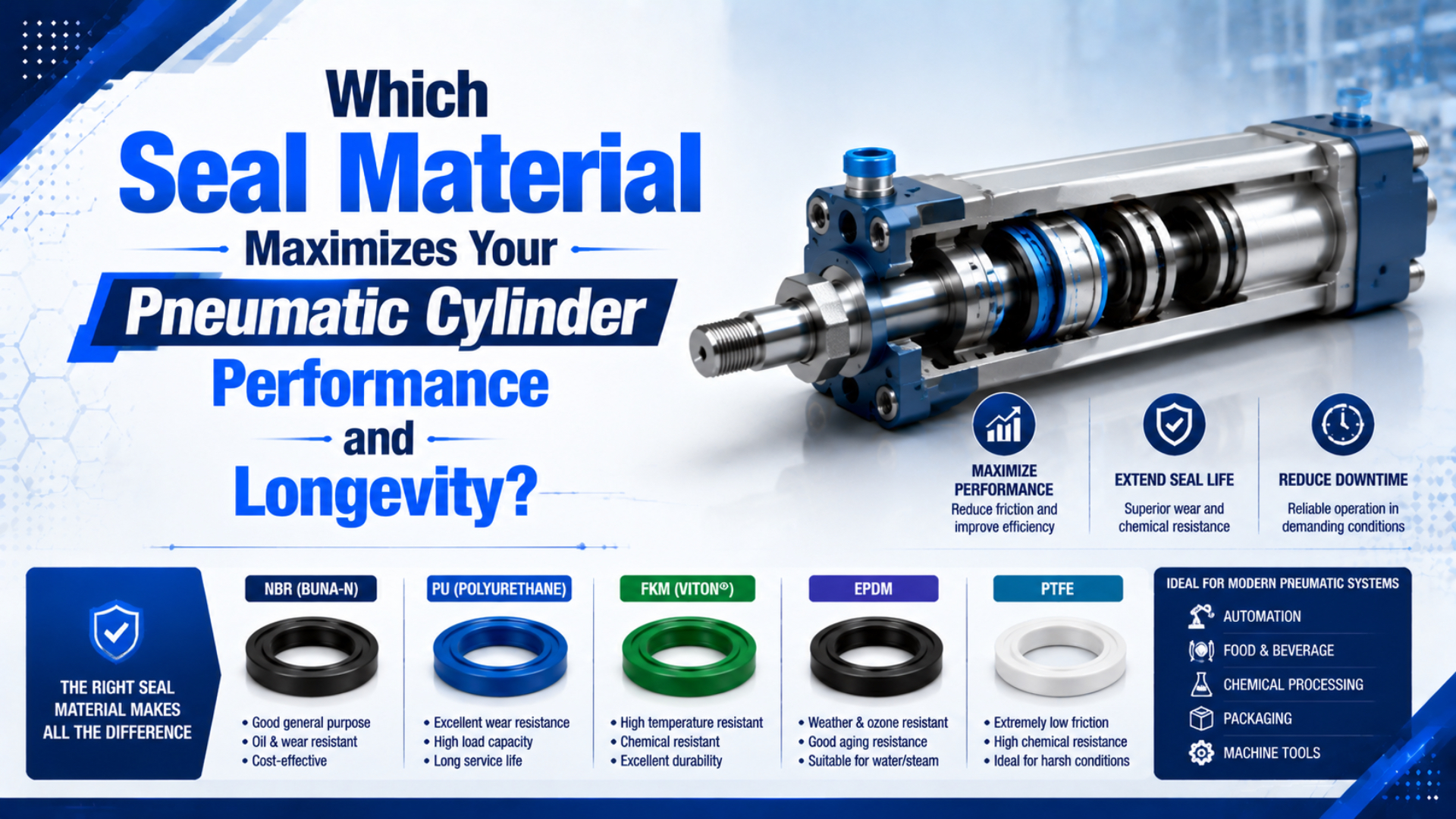
No single seal material maximizes every pneumatic cylinder’s performance or service life. The best choice is the documented compound and seal profile that matches the exact seal position, temperature cycle, chemicals, lubricant, speed, pressure, surface condition, and compliance duty. A generic choice between Buna-N and Viton leaves too many failure mechanisms unchecked.
That distinction matters. Buna-N is a common trade name for nitrile rubber, or NBR. Viton is a Chemours trademark covering several FKM product families, not a synonym for every fluoroelastomer compound. Two seals with the same polymer-family label can have different cure systems, fillers, hardness values, low-temperature behavior, and chemical resistance.
Pneumatic cylinder seal material is the specified polymer compound and sealing profile used at one defined position in an actuator. Seal compound is the supplier-controlled formulation, including its base polymer, fillers, cure system, additives, and hardness.
Seal color is not a reliable material specification.
Key Takeaways
- Screen at least six material families, then approve the exact compound and profile.
- ISO 3601-5 requires users and suppliers to agree on physical properties and test methods.
- Temperature tables and chemical charts create a shortlist; they do not predict installed seal life.
- Dynamic seals also depend on friction, surface finish, alignment, lubrication, and extrusion clearance.
This article focuses on material selection. If you first need to identify the failed component, use the industrial cylinder seal types guide. For a complete replacement review, the related seal compatibility method covers media, motion, hardware, and acceptance testing as separate gates.
What Does the Best Pneumatic Cylinder Seal Material Actually Mean?
ISO 3601-5:2015 is a 13-page specification for selected industrial O-ring materials, yet it still says the required physical properties and test methods should be agreed between the equipment user and seal supplier. The standard therefore supports a compound-level decision, not a universal polymer winner (ISO 3601-5, 2015; retrieved 2026-07-19).
The best material is the one that retains enough sealing force and mechanical integrity for the required maintenance interval without creating excessive friction, wear, contamination risk, or cost. That definition includes the whole installed seal. It does not stop at NBR, FKM, EPDM, polyurethane, or PTFE.
No polymer family earns an unconditional approval in service.
A useful selection record has four levels of identity:
- Polymer family: NBR, HNBR, FKM, EPDM, polyurethane, PTFE, or another family.
- Compound: the supplier’s formulation, including fillers, cure system, additives, colorants, and hardness.
- Seal profile: O-ring, U-cup, lip seal, scraper, energized PTFE profile, or molded combination seal.
- Cylinder configuration: groove, mating surface, lubricant, pressure direction, speed, stroke, guides, and assembly method.
If a quotation identifies only “black NBR” or “green Viton,” which of those four levels has actually been approved? Only the first, and even that conclusion may be based on color rather than traceable documentation.
The temperature and cylinder seal guide explains thermal behavior in depth. Here, temperature is one screening input inside the wider material decision.
Why Should Seal Position and Motion Come First?
Trelleborg’s December 2025 product range lists pneumatic piston seals for bores from 4 to 250 mm, pressures up to 1.6 MPa, and speeds up to 1 m/s. The same catalog uses different profiles and materials for rod seals, scrapers, piston seals, and wear rings because those positions do different work (Trelleborg Product Range, 2025; retrieved 2026-07-19).
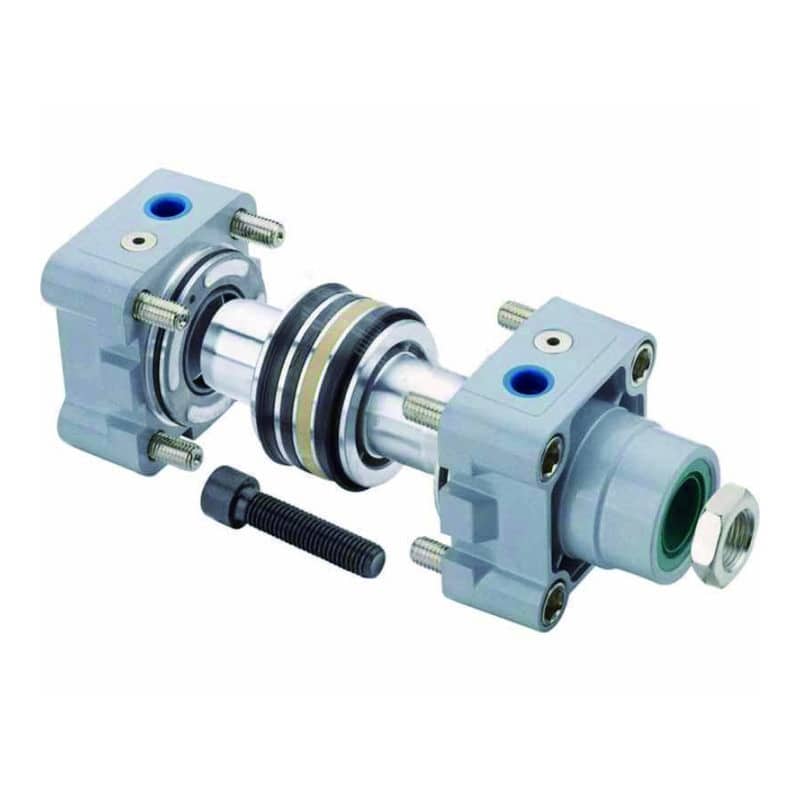
An exploded cylinder shows why one material cannot be chosen for every sealing position. Static joints, moving lips, wipers, guides, and cushion components face different loads.
A static end-cap O-ring mainly needs compatible compression, fluid resistance, and long-term elastic recovery. A piston or rod seal slides on every stroke, so friction, wear, lubrication film, speed, and surface finish enter the decision. A wiper sees external chips, water, coolant, or cleaning chemicals before the pressure seal does.
Motion changes the material decision and its evidence requirements.
| Seal position | Primary duty | Material questions that matter first |
|---|---|---|
| Static O-ring | Seal a fixed joint | Chemical exposure, temperature, compression set, groove fill |
| Piston seal | Separate the two pressure chambers | Friction, wear, bore finish, dry-running ability, pressure direction |
| Rod seal | Retain air around the moving rod | Rod finish, lubrication, side load, speed, extrusion gap |
| Wiper or scraper | Exclude external contamination | Abrasion, cutting resistance, hydrolysis, cleaner exposure |
| Cushion seal | Control end-of-stroke flow | Impact frequency, temperature, lubricant, local pressure |
| Rodless sealing band | Close the cylinder slot | Bending, surface damage, contamination, band tension, profile geometry |
In our experience, repeat failures are often misclassified as material problems. A harder compound will not repair a scored rod. FKM will not correct a worn guide ring. A high-abrasion polyurethane lip can still fail quickly if its edge is cut during installation.
The SI Series cylinder assembly kit illustrates this component boundary for an ISO 15552 style actuator.
How Do the Main Seal Material Families Compare?
Parker’s O-Ring Handbook lists approximate ranges from -34°C to 121°C for general-service NBR, -32°C to 149°C for HNBR, -26°C to 205°C for FKM, and -40°C to 82°C for polyurethane. Media can narrow them, so these are screening values, not cylinder ratings (Parker O-Ring Handbook, retrieved 2026-07-19).
Use the comparison below to build a shortlist. Then request the supplier’s data for the exact compound, hardness, profile, and operating conditions.
| Elastomer family | Strong candidate when | Limits to verify |
|---|---|---|
| NBR or Buna-N | Mineral oil and ordinary industrial air service | Heat, ozone, polar solvents, cold flexibility |
| HNBR | More heat and aging resistance than standard NBR | Exact media, cost, low-temperature behavior |
| Polyurethane | Abrasion resistance and compact dynamic profiles | Hydrolysis, heat, cleaner compatibility, friction |
| FKM | Heat, oil, fuel, ozone, many non-polar chemicals | Ketones, amines, caustics, steam, low temperature |
| EPDM | Hot water, steam, weather, selected polar cleaners | Mineral oils, petroleum lubricants, fatty products |
PTFE-based energized seals form a separate engineered option. They can provide low friction, broad chemical resistance, and useful dry-running behavior, but they have limited elastic recovery. Their energizer, groove, installation method, and allowable leakage must be designed as one system. Polymer names hide similar tradeoffs. Chemours identifies four major Viton families, A, B, F, and ETP, and notes that increasing fluorine content can improve fluid resistance while reducing low-temperature flexibility (Viton Product Selection Guide, retrieved 2026-07-19). “FKM” alone is therefore not a complete purchase specification. Polyurethane has the same problem. Parker describes thermoplastic polyurethane as a leading dynamic-seal material class, but individual grades are engineered for different temperature, hydrolysis, wear, and fluid requirements (Parker Resilon Polyurethane Materials, retrieved 2026-07-19). Ask for the compound code and application limits.
Why Can Chemical Exposure Override the Temperature Rating?
ASTM D471 evaluates at least six groups of changes after rubber contacts liquids, including mass, volume, dimensions, tensile strength, elongation, and hardness. The standard explicitly says accelerated immersion data may not correlate directly with installed part performance because service conditions vary widely (ASTM D471, 2021; retrieved 2026-07-19).
A seal can be inside its published temperature range and still swell, shrink, soften, harden, crack, or lose strength in the actual medium. The exposure list must include more than the compressed air. Record compressor lubricant, assembly grease, thread compounds, process vapor, washdown chemicals, product residue, coolant, and every cleaner used during maintenance.
Chemical charts should be used as rejection filters, not service-life calculators. Parker rates standard FKM as unsatisfactory in acetone, while EPDM is rated satisfactory in the same handbook. That single example disproves the rule that FKM is automatically the best choice for an “aggressive chemical” (Parker O-Ring Handbook, retrieved 2026-07-19).
The chart is only the first compatibility gate.
Trelleborg’s CIP and SIP testing reaches a similar conclusion from another direction. Its selected EPDM materials performed well in acetone and MEK, while standard FKM exposure to steam had to be limited. The supplier also found large performance differences among compounds within the same polymer family (Trelleborg CIP and SIP, retrieved 2026-07-19).
For every chemical, record:
- exact product or chemical name and safety data sheet;
- concentration and whether it changes during evaporation or cleaning;
- continuous, intermittent, splash, vapor, or accidental contact;
- normal and peak temperature during exposure;
- sequence, because one cleaner can remove lubricant before the next chemical arrives;
- expected swelling, hardness change, strength loss, and acceptance limits.
Would you accept a compatibility result measured at room temperature if the actual seal sees concentrated cleaner at 130°C? The material family may be identical, but the exposure is not.
How Should Temperature, Pressure, and Speed Be Reviewed Together?
ASTM D573-04(2025) assesses rubber deterioration under accelerated hot-air aging, but it warns that laboratory results may not correlate exactly with service because operating conditions vary. A cylinder adds friction, pressure, media, thermal cycling, and hardware constraints that an air-oven specimen does not reproduce (ASTM D573, 2025; retrieved 2026-07-19).
High temperature can accelerate compression set, oxidation, lubricant breakdown, and permanent deformation. Cold can reduce elastic response and increase breakaway friction. Cycling between the two may be more demanding than a stable midpoint because the seal and hardware expand, contract, and redistribute contact stress repeatedly.
Pressure and speed change the picture again. A soft lip may seal well at low pressure but extrude through excessive clearance. A hard material can resist extrusion yet create higher friction or fail to follow a damaged surface. Fast motion raises frictional heat and can strip away a thin lubricant film. Long dwell periods can increase breakaway resistance.
Check at least these values before approving the material:
| Operating input | Minimum record | Why it changes material selection |
|---|---|---|
| Temperature | Startup, steady cycle, local peak, cleaning, shutdown | Controls elasticity, aging, lubricant, and dimensional change |
| Pressure | Normal supply, trapped pressure, exhaust restriction, test pressure | Changes contact stress and extrusion risk |
| Speed | Peak rod or piston speed, acceleration, cycle rate | Changes friction, heat, wear, and lubrication film |
| Dwell | Time parked pressurized or depressurized | Affects compression set and breakaway friction |
| Air quality | Particle, water, oil, and lubricant condition | Changes abrasion, corrosion, swelling, and dry-running behavior |
For ovens, freezers, or severe thermal cycling, review the whole actuator with the high-temperature pneumatic cylinder guide. A seal upgrade does not automatically upgrade grease, sensors, magnets, tubing, guides, or cushion components.
Hardware Can Defeat a Chemically Compatible Material
ISO 3601-2:2025 devotes 55 pages to O-ring housing dimensions for general hydraulic and pneumatic applications. It addresses grooves, mating surfaces, tolerances, and anti-extrusion rings, showing why material compatibility alone cannot approve an installed seal (ISO 3601-2, 2025; retrieved 2026-07-19).
Inspect the failed seal and every mating part before choosing a harder or more expensive compound. Look for rod scoring, bore wear, one-sided guide wear, corrosion, sharp groove edges, wrong squeeze, excessive clearance, twisted O-rings, cut lips, and assembly contamination.
A material upgrade cannot correct a geometric mismatch.
The failure pattern often narrows the next question:
| Observed condition | Likely mechanism to investigate | Material decision consequence |
|---|---|---|
| Flat, permanently compressed seal | Heat aging, compression set, wrong squeeze | Review compound recovery and groove dimensions |
| Soft, swollen, sticky surface | Chemical or lubricant incompatibility | Identify every medium; test the exact compound |
| Hard, cracked surface | Heat, oxidation, ozone, incompatible chemical | Review peak exposure and aging evidence |
| Feathered or nibbled edge | Extrusion through clearance, pressure spike | Correct hardware support before changing polymer |
| One-sided wear | Side load, misalignment, worn guide | Repair alignment and guidance first |
| Polished or glazed lip | Friction, dry running, excessive speed | Review profile, lubrication, finish, and material friction |
| Clean slice or installation nick | Sharp edge or poor assembly tool | Fix installation control; a premium compound can still be cut |
Hardness is only one property. ASTM D2240 measures indentation hardness and states that no simple relationship exists between durometer hardness and a fundamental material property. A higher Shore A value does not prove better wear resistance, tensile strength, chemical compatibility, or service life (ASTM D2240, 2021; retrieved 2026-07-19).
Low-friction or self-lubricating compounds can help in the right profile, but they do not remove the need for clean air and suitable surfaces. The related self-lubricating seal guide explains that narrower design question.
What Should Food, Beverage, and Washdown Buyers Verify?
For repeated aqueous-food contact, 21 CFR 177.2600 limits finished-rubber extractives to 20 mg per square inch during the first 7 hours and 1 mg per square inch during the next 2 hours. Those conditions apply to the finished article and intended use, not to every seal sharing the same polymer name (eCFR 21 CFR 177.2600, retrieved 2026-07-19).
Do not ask only whether NBR, EPDM, FKM, or PTFE is “FDA approved.” Ask the supplier to identify the exact compound and finished part, the applicable regulation, intended food type, contact condition, temperature, cleaning sequence, and supporting declaration or test evidence.
Compliance evidence belongs to the finished, traceable seal part.
Washdown creates a second engineering track. The seal may need to resist alkaline cleaner, acid rinse, hypochlorite, peroxide, steam, hot water, and food residue in one cycle. External rod seals and wipers can see these media even when the compressed-air chambers never contact food.
Trelleborg reports that CIP temperature, chemical concentration, exposure time, seal design, and material choice all affect seal life. Its testing also shows why a broad family label is insufficient: selected EPDM and premium FKM compounds can behave differently from standard grades under the same cleaning regime (Trelleborg CIP and SIP, retrieved 2026-07-19).
Request these compliance items with the quotation:
- supplier and exact compound code;
- finished seal part number and manufacturing site when traceability is required;
- applicable food-contact declaration and limitations;
- extraction or migration evidence for the intended contact condition;
- cleaning-agent and steam compatibility data;
- change-control and lot-traceability expectations.
A compliant static O-ring is not automatically a compliant or durable dynamic rod seal. The profile, wear debris, lubricant path, and machine’s hygienic design still need their own review.
Build the Selection Around Evidence, Not Material Price
Parker’s selector asks for minimum and maximum operating temperature, polymer group, hardness, and fluid compatibility before it recommends an O-ring. That sequence shows why a price comparison is meaningful only after the duty and acceptable compounds have been defined (Parker O-Ring Selector, retrieved 2026-07-19).
The practical purchasing unit is not “one NBR seal” or “one FKM seal.” It is a qualified seal position with an agreed compound, profile, dimensions, exposure limits, inspection evidence, and acceptance test. Compare cost only between candidates that pass the same technical gates.
Price comparison comes after technical qualification, not before it.
Use this RFQ sequence:
- Identify the cylinder manufacturer, series, full model code, bore, stroke, rod diameter, and mounting.
- Mark the exact failed position and whether it is static, reciprocating, wiping, cushioning, or a rodless sealing band.
- Record normal and peak pressure, speed, cycles, dwell, side load, and any exhaust restriction.
- List every medium, cleaner, lubricant, concentration, temperature, and exposure duration.
- Provide groove dimensions, rod and bore condition, surface finish data, and clear photographs.
- State compliance, traceability, color, contamination, and documentation requirements.
- Agree leak, motion, breakaway, temperature, and inspection acceptance criteria before production use.
Once those fields are complete, ask suppliers to state the exact compound code and why it fits. A vague “Viton upgrade” is not enough. Neither is a lower-priced NBR kit with no chemical or temperature evidence.
Pneumatic Cylinder Seal Material FAQs
ISO 3601-5 specifies selected industrial O-ring materials but still requires the user and supplier to agree on physical properties and test methods. These five FAQs close the most common purchasing gaps before a pneumatic cylinder seal compound or replacement kit is approved (ISO 3601-5, 2015; retrieved 2026-07-19).
Is FKM always better than NBR for pneumatic cylinders?
No. FKM can offer better heat, ozone, oil, and hydrocarbon resistance, but standard grades may be unsuitable for acetone, amines, caustics, steam, or low-temperature motion. NBR can be the better qualified and more economical option in compatible ordinary service. Compare exact compounds, not polymer reputation.
Which material is best for dry-running pneumatic cylinders?
There is no material-only answer. Polyurethane and PTFE-based profiles are common candidates, but dry-running performance depends on seal geometry, surface finish, speed, pressure, air cleanliness, and permitted lubricant. Request dynamic test evidence for the exact profile and cylinder conditions instead of relying on a generic low-friction claim.
Can one seal material cover both production and CIP cleaning?
Sometimes, but qualification must include both exposure cycles. A seal may tolerate the production medium and fail in hot alkaline cleaner, acid rinse, peroxide, or steam. Record concentration, temperature, sequence, and duration for every step. Selected EPDM, FKM, FFKM, or PTFE compounds may be candidates after testing.
Does a higher Shore A hardness guarantee longer seal life?
No. ASTM D2240 measures indentation hardness and does not establish a simple relationship with wear, tensile strength, chemical resistance, or installed life. Higher hardness can improve extrusion resistance in one design while increasing friction or reducing surface conformity in another. Groove support and pressure must be reviewed with the compound.
What information should an RFQ include for a replacement seal kit?
Include the full cylinder code, bore, stroke, rod diameter, seal position, groove dimensions, pressure, speed, cycle rate, temperature profile, every medium and cleaner, lubricant, surface condition, failure photographs, compliance requirements, and acceptance criteria. Ask the supplier to identify the exact compound and profile, not just NBR or FKM.