

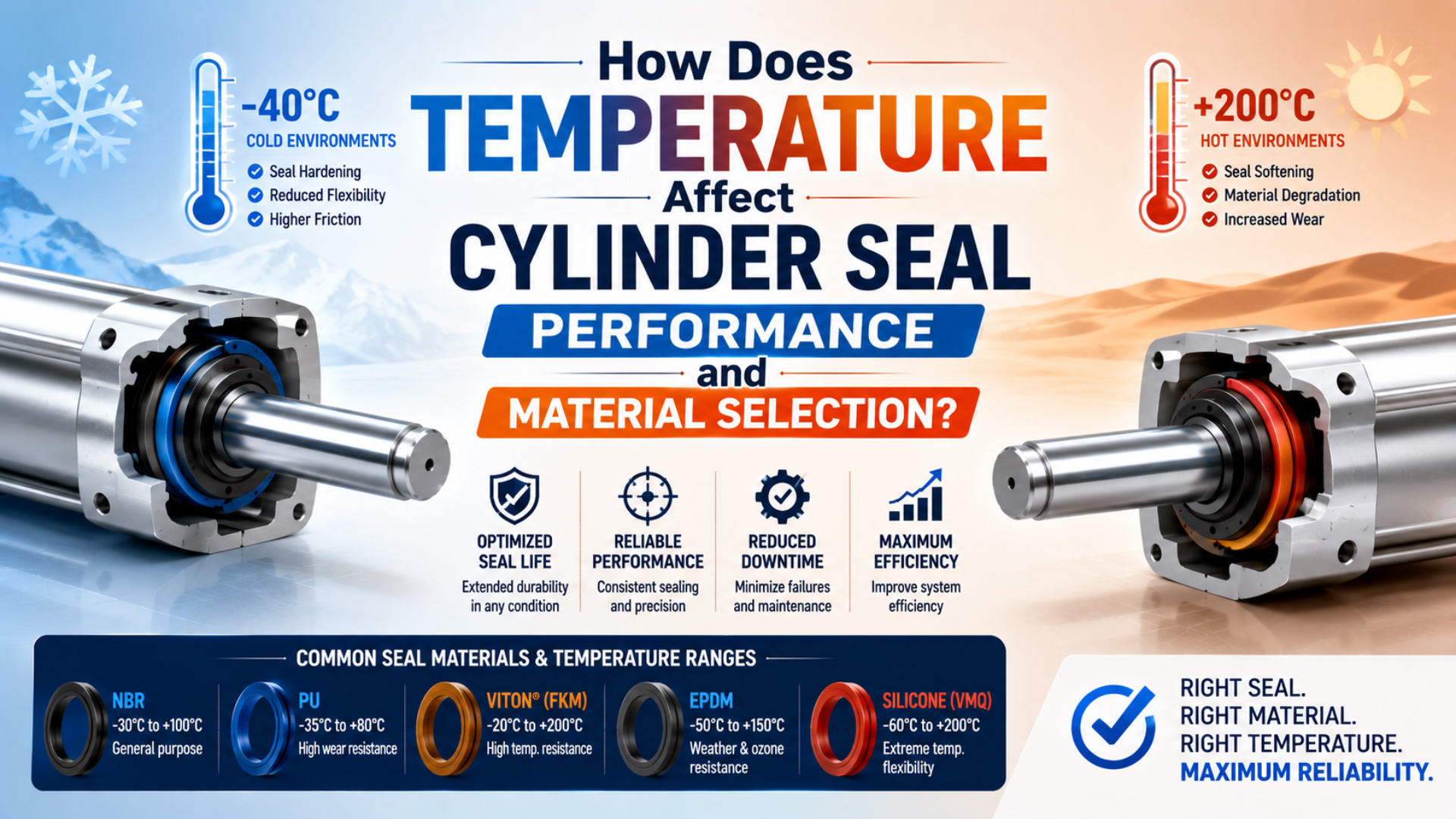
Temperature changes a cylinder seal’s elastic recovery, hardness, friction, compression set, wear rate, and fit in the groove. Cold can reduce flexibility and increase breakaway friction. Heat can accelerate permanent deformation and lubricant deterioration. Thermal cycling can move a seal repeatedly between these conditions. The correct material is therefore the exact qualified compound and seal profile that suits the measured temperature, motion, pressure, medium, lubricant, and cylinder assembly.
Cylinder seal temperature rating is the approved operating range of a finished seal or cylinder configuration under stated service conditions. It is not the broad temperature capability of the base polymer alone.
A material table can help create a shortlist. It cannot prove that an NBR, HNBR, FKM, EPDM, polyurethane, or PTFE part will work in an existing groove. The finished compound, rod or bore surface, energizer, grease, speed, pressure, exposure duration, and other cylinder components still have to be checked.
Key Takeaways
- Measure the cylinder body and seal area during production. Ambient room temperature may miss radiant heat, cold air jets, washdown peaks, and heat generated by friction.
- Separate continuous temperature, short peaks, startup temperature, and thermal cycling. They do not impose the same material or lubrication requirement.
- Use polymer-family ranges only for screening. Approve the exact seal compound, profile, groove, lubricant, and cylinder model from supplier data.
- A high-temperature seal kit does not automatically upgrade the magnet, sensor, wear ring, grease, cushioning seal, tubing, or wiper.
- In cold service, check compressed-air dryness as well as the seal. Condensed water or ice can damage the rod surface and sealing lip.
- Treat removed seals as evidence. Hardness, cracks, swelling, glazing, one-sided wear, and installation cuts point to different causes.
Which Temperature Actually Controls Seal Selection?
The controlling temperature is the most severe temperature at the seal interface during the real operating cycle, provided every other cylinder component remains within its own rating. A single ambient reading is rarely enough for an exposed or fast-cycling actuator.
Record these temperatures separately:
| Temperature record | Why it matters | Practical measurement point |
|---|---|---|
| Ambient temperature | Establishes the surrounding environment | Shaded air near the actuator, away from a hot surface |
| Cylinder-body temperature | Shows heat conducted into the assembly | Barrel, end cap, gland, and rodless carriage area |
| Local peak temperature | Captures oven opening, hot washdown, defrost, or cold-air events | Closest exposed seal housing or metal surface |
| Startup temperature | Reveals cold grease and high breakaway resistance | Body and air supply before the first commanded stroke |
| Steady-cycle temperature | Includes friction and repeated compression | Seal housing after the machine reaches normal output |
| Shutdown and cleaning temperature | Captures thermal shock and chemical exposure | Gland, end cap, wiper, tubing, and nearby fittings |
Also distinguish duration. A short, controlled peak may be allowed by a specific product datasheet even when the continuous rating is lower. Repeating that peak every cycle is not the same condition. Do not convert a supplier’s short-duration material limit into a continuous cylinder rating.
Product examples show why the assembly rating matters. Festo describes low-temperature cylinder versions rated from -40°C to +80°C using special sealing and lubrication, while its named high-temperature versions are rated up to +120°C or +150°C. SMC separately lists made-to-order cold-resistant and heat-resistant cylinder options with ranges such as -40°C to +70°C and -10°C to +150°C (Festo, 2026 retrieval; SMC, 2026 retrieval). These are ratings for identified configurations, not universal limits for their seal polymer names.
For example, a cylinder beside an oven may stay within range while the door is closed and exceed its gland-temperature limit during each loading event. In our replacement reviews, we found that ambient temperature was often recorded while the stabilized seal-housing temperature was missing.
For whole-actuator decisions involving grease, sensors, fittings, mounting, and radiant heat, use the related high-temperature pneumatic cylinder guide. This article stays focused on the seal behavior and material-selection boundary.
Seal Behavior at Low Temperature
Low temperature reduces elastomer elasticity and can raise seal and lubricant resistance, causing leakage, slow motion, stick-slip, or a sudden breakaway stroke. The first functional problem can occur before a material reaches a published brittle point.
Parker’s O-Ring Handbook explains that cooled elastomers lose elasticity and become hard and glass-like at very low temperature. It also distinguishes functional low-temperature behavior from a simple brittle-point result and discusses the temperature-retraction test, commonly reported as TR10 (Parker O-Ring Handbook, 2025). ISO 2921:2019 defines the temperature-retraction test for stretched vulcanized rubber and remains current after its 2024 confirmation (ISO 2921:2019, confirmed 2024).
In a pneumatic cylinder, cold can produce several linked effects:
- The dynamic sealing lip recovers more slowly as it passes surface variation or changes direction.
- Grease viscosity rises, increasing the force required to start motion.
- The pressure behind the piston continues to build while static friction holds the load.
- Once friction is overcome, the piston may accelerate more sharply than expected.
- Moisture can condense or freeze on cold surfaces, creating corrosion, ice crystals, or abrasive debris at the wiper and rod seal.
Do not diagnose every cold leak as a polymer glass-transition failure. A seal may be intact but unable to follow the moving surface quickly enough. The groove may provide inadequate cold squeeze. The lubricant may be unsuitable. The air may contain too much water. Rod contamination can also cut a cold, less-compliant lip.
In our experience, comparing cold-start and warm-state breakaway behavior is more useful than judging the material from one leak observation. The comparison helps separate a temperature-sensitive friction problem from persistent surface or seal damage.
Parker operating instructions for one OSP-P configuration specify a pressure dew point at least 5°C below the minimum operating temperature. That is a product-specific requirement, but it illustrates the correct engineering relationship: the supplied air must remain dry enough for the coldest point of use (Parker OSP-P operating instructions, 2026 retrieval). ISO 8573-1 classifies compressed-air contamination by particles, water, and oil; the applicable purity target still has to come from the cylinder and machine requirements (ISO 8573-1, 2010).
Seal Behavior at High Temperature and During Thermal Cycling
High temperature accelerates changes in the seal compound and lubricant, while thermal cycling repeatedly changes squeeze, friction, and alignment. A seal may fail from the combined exposure even when no single temperature reading looks extreme.
Compression set is one important mechanism. It describes the portion of deformation that a rubber specimen does not recover after a defined compression and conditioning cycle. ASTM D395 covers compression-set testing and notes that the methods apply mainly to service involving static compressive stress, although tests are often run at elevated temperature (ASTM D395-18(2025), 2025). The result is useful material evidence, but it is not a direct prediction of dynamic pneumatic seal life.
Heat can also:
- reduce grease viscosity or accelerate oxidation and migration;
- change hardness, tensile properties, and elastic recovery;
- increase frictional heat when the lubricant film becomes inadequate;
- promote swelling, extraction, or chemical attack when cleaners or process media are present;
- change the dimensions of the seal, groove, rod, tube, and guide materials at different rates;
- shorten the life of nearby wipers, cushion seals, magnet carriers, switches, cable jackets, and plastic fittings.
Thermal cycling deserves its own record. A cylinder may start cold, warm through repeated strokes, receive hot washdown, and cool again before the next shift. The seal, metal gland, rod, grease, and guide rings do not respond at the same rate. That changing fit can create intermittent leakage or binding that disappears during a room-temperature bench test.
NASA-sponsored elastomer work also evaluated force-displacement behavior as a function of temperature, frequency, and geometry. That evidence supports treating dynamic response as an operating-condition problem rather than a fixed polymer property (NASA Contractor Report 134939, 1975).
A useful temperature rating has two envelopes: the seal compound must remain functional, and the complete cylinder must remain mechanically and chemically compatible. The smaller envelope controls.
A Material-Selection Workflow for Common Seal Families
Compare material families by their strengths and failure risks, then qualify a specific compound and seal profile from supplier data. The same polymer name can cover formulations with meaningfully different cold flexibility, heat resistance, hardness, fillers, cure systems, and chemical compatibility.
The ranges below are supplier examples, not universal pneumatic-cylinder ratings.
| Material family | What can make it useful | Important limitations | Example supplier indication |
|---|---|---|---|
| NBR | General pneumatic service, oil and grease resistance, availability | Heat, ozone, weathering, and low-temperature behavior depend on ACN content and formulation | Trelleborg lists general NBR from about -30°C to +100°C, with special formulations extending lower |
| HNBR | Better heat, ozone, and mechanical resistance than general NBR | Compound, oil swelling, low-temperature grade, and cost still require confirmation | Trelleborg lists -30°C to +140°C with mineral oils and greases, with special types down to -40°C |
| FKM | Heat, oils, fuels, weathering, and selected aggressive media | Ordinary grades can have limited cold flexibility; bases, amines, steam, and specific additives require a compatibility check | Trelleborg lists a general automotive indication of -20°C to +200°C, with special grades extending lower |
| EPDM | Water, steam, weathering, ozone, and low-temperature flexibility | Generally unsuitable for petroleum oils and many mineral-oil greases | Trelleborg lists -45°C to +150°C for the cited application family, with cure-system and short-duration qualifications |
| Polyurethane or PUR | Dynamic wear, tear, and extrusion resistance in suitable pneumatic profiles | Heat, hydrolysis, grease compatibility, hardness, and grade vary substantially | Parker lists different polyurethane compounds with different ranges, including standard pneumatic and higher-temperature grades |
| PTFE or filled PTFE | Low friction, broad chemical options, and reduced stick-slip in engineered profiles | PTFE is not elastomeric; the seal may require an O-ring or spring energizer, correct groove support, finish, and installation | Trelleborg lists specific pneumatic PTFE compounds and profiles rather than one generic PTFE approval |
The NBR, HNBR, FKM, and EPDM examples come from Trelleborg’s material guidance, which also explains that composition and cure system change performance (Trelleborg material guidance, 2026 retrieval). Parker’s fluid-power seal catalog illustrates the same point for polyurethane: different named compounds have different temperature, hydrolysis, media, and dynamic-service notes (Parker Fluid Power Seals, 2026 retrieval).
Trelleborg describes pneumatic seals as dynamic components that often work at high speed and identifies optimized polyurethane and PTFE-based materials for rod, piston, static, scraper, wear-ring, and cushioning positions (Trelleborg pneumatic seals, 2026 retrieval). This position-specific approach is more reliable than ordering every part in one material.
For a broader explanation of piston seals, rod seals, wipers, wear rings, and static O-rings, see the industrial cylinder seal types guide.
Why Is FKM Not an Automatic Temperature Upgrade?
FKM can solve selected high-temperature and chemical exposures, but it can also introduce cold-flexibility, friction, contamination, lubricant, and compatibility problems. Replacing an NBR or polyurethane part with an FKM part solely because the family table shows a higher maximum temperature is incomplete engineering.
Check at least six points:
- Minimum operating temperature: Standard FKM grades can lose flexibility sooner than a qualified low-temperature NBR, HNBR, EPDM, or special polyurethane compound.
- Chemical exposure: FKM resistance varies with fluorine content and cure system. Confirm every cleaner, process vapor, lubricant, thread compound, and residual fluid.
- Dynamic seal geometry: A material with an acceptable static O-ring rating may not provide the friction, lip recovery, or wear behavior required for a fast rod or piston seal.
- Lubrication: The grease must suit the seal and the complete temperature profile. A high-temperature elastomer does not protect an unsuitable grease.
- Counterface and contamination: Dust, rust, ice, scale, and poor rod finish can damage the lip regardless of its thermal rating.
- Complete seal kit: Static O-rings, piston seals, rod seals, wipers, cushioning seals, energizers, and rodless sealing elements may require different materials.
Festo’s published cylinder examples make the interaction visible. Its low-temperature versions use special PUR sealing and cold-temperature grease, while named high-temperature versions combine heat-resistant seals with special grease. The selection is a configured package, not a material swap (Festo, 2026 retrieval).
Steam and hot washdown are common traps. EPDM may be a better screening family for hot water or steam, but it conflicts with petroleum oils. FKM may suit oils and heat, yet the exact compound can be unsuitable for a cleaning chemical or low-temperature startup. Food equipment adds cleanability, lubricant, and regulatory requirements that a polymer name cannot prove.
What Data Should Be Collected Before Selecting a Seal Compound?
A seal supplier needs a temperature profile, seal position, motion duty, pressure, media, lubricant, geometry, and failure record before approving a compound. A request for “a -40°C seal” or “a 200°C FKM kit” omits the conditions that determine whether the part can seal dynamically.
Send this information with the RFQ or engineering review:
| Required input | Details to record |
|---|---|
| Cylinder identity | Manufacturer, complete model code, bore, stroke, revision, and current seal-kit number |
| Seal function | Piston seal, rod seal, wiper, static O-ring, cushion seal, wear ring, energizer, or rodless sealing strip |
| Temperature profile | Minimum startup, continuous body temperature, peak, peak duration, cycle frequency, and cleaning exposure |
| Motion duty | Speed, strokes per minute, dwell, reversal frequency, stroke length, and expected service pattern |
| Pressure | Supply, measured pressure during motion, exhaust restriction, and pressure differential across the seal |
| Media | Compressed air, lubricant, oil carryover, water, steam, cleaning chemicals, process vapor, and dust |
| Air quality | Filtration, water class or pressure dew point, oil condition, and point-of-use measurements |
| Geometry and surfaces | Groove drawing, seal profile, rod or bore material, coating, finish, damage, and measured wear |
| Failure evidence | Photos, orientation marks, hardness or dimensional change, leakage location, and time to symptom |
| Other component ratings | Grease, magnet, sensor, guide ring, fitting, tubing, cable, coating, and mounting hardware |
Measure the body near the relevant seal after the machine reaches stable production. An infrared reading can be useful for comparison, but emissivity, reflective metal, distance, and angle affect it. Where accuracy is critical, use an appropriate contact sensor or validated measurement method and record the location.
Air preparation belongs in the same review. The ISO compressed-air quality guide explains particle, water, and oil classes. The related seal material and air lubrication guide covers the risk of mixing grease, oil mist, and seal compounds without compatibility confirmation.
Failure Appearance as Diagnostic Evidence
Failure appearance can narrow the cause, but temperature should be confirmed with measurements and material evidence before it is named as the root cause. Similar damage can result from age, chemicals, side load, contamination, wrong groove dimensions, or installation.
| Finding | Temperature-related mechanism to investigate | Other causes that can look similar | Next check |
|---|---|---|---|
| Hard, cracked, or brittle lip | Cold loss of flexibility or heat aging | Ozone, chemical attack, old stock, incompatible cleaner | Confirm compound, temperature history, and crack location |
| Flattened seal with poor recovery | Heat-accelerated compression set | Excessive squeeze, wrong cross-section, long static dwell | Measure the seal and groove; review compound test data |
| Swollen or softened seal | Temperature-assisted absorption or chemical incompatibility | Wrong grease, oil carryover, cleaning chemical | Identify all media and compare mass or dimensions with a retained sample |
| Glazing, smearing, or discoloration | Interface heat, poor lubrication, excessive speed | Rough surface, side load, contamination | Inspect rod or bore finish, guides, alignment, and duty |
| Leakage only during cold startup | Slow lip recovery, viscous grease, reduced cold squeeze | Low supply pressure, valve restriction, ice, damaged rod | Trend temperature, breakaway pressure, speed, and dew point |
| Leakage only after warmup | Heat-related fit change, grease loss, compound softening or set | Thermal misalignment, tube distortion, loose mounting | Measure body temperature and alignment through warmup |
| Wear concentrated on one side | Thermal growth causing misalignment | Persistent side load, bent rod, worn bearing | Inspect the load path and guides before replacing the seal |
| Repeated cuts on a new seal | Less-compliant cold installation or hot-softened lip crossing an edge | Sharp chamfer, wrong tool, burr, debris | Inspect groove edges and follow the model assembly procedure |
One-sided seal wear is particularly important. It often points to guidance or alignment rather than a material-temperature limit. The rod-bearing and rod-seal failure guide explains how side load transfers into the gland and sealing lip.
Our team found that returned-seal evidence is easier to interpret when technicians mark the installed orientation before removal and photograph the rod, gland, groove, and seal together. That record helps distinguish one-sided loading from uniform thermal or chemical damage.
When the symptom is internal bypass or loss of thrust, verify the leakage path before opening the cylinder. Valve leakage, tubing, piston-seal bypass, and rodless sealing-band leakage require different tests. Use the pneumatic cylinder internal leakage guide for that diagnostic boundary.
Can an Existing Cylinder Be Upgraded With Temperature-Resistant Seals?
An existing cylinder can be upgraded only when the manufacturer or responsible engineer confirms the seal profile, groove, lubricant, surfaces, accessories, and complete operating envelope. A dimensionally similar seal in a higher-temperature material is not automatically interchangeable.
Prefer an approved high- or low-temperature variant or service kit for the exact cylinder series. If no approved option exists, the review may require:
- a different seal profile or energizer;
- changed groove dimensions or edge radii;
- compatible grease and assembly lubricant;
- different wipers, wear rings, cushion seals, or static O-rings;
- relocation of switches, valves, and plastic fittings;
- heat shielding, insulation, standoff mounting, or forced cooling;
- drier compressed air for cold service;
- a different actuator location or technology when the thermal exposure cannot be controlled.
After assembly, test from the worst expected startup condition through steady production. Verify leakage, breakaway behavior, full-stroke speed, cushioning, sensor operation, loaded alignment, and condition after the thermal cycle. Do not validate the upgrade only with a few unloaded strokes at room temperature.
FAQs About Temperature and Cylinder Seals
What temperature range can standard pneumatic cylinder seals handle?
There is no universal standard range. Each cylinder family combines specific seals, grease, guides, magnets, sensors, and accessories. Use the exact model datasheet. Generic NBR, polyurethane, or FKM material ranges are screening information, not the rating of an assembled pneumatic cylinder.
Does cold permanently damage an elastomer seal?
Not always. Some low-temperature hardening is reversible when the material warms, but a cold, less-flexible seal can still leak, crack under impact, or be cut by ice and contamination. Repeated cycling, incompatible media, and mechanical damage can make the failure permanent.
Is FKM always the best material for high-temperature cylinder seals?
No. FKM can provide useful heat and chemical resistance, but low-temperature flexibility, dynamic friction, cleaner compatibility, grease, dust, and the exact compound still matter. A configured high-temperature cylinder may use special seals and lubricant together rather than a simple FKM substitution.
Which seal material is suitable for steam or hot washdown?
The answer depends on water temperature, steam condition, cleaning chemicals, grease, food or hygiene requirements, and whether the seal is static or dynamic. EPDM is often screened for water and steam, while FKM may suit oils and selected chemicals, but only an approved compound and seal profile should be specified.
What measurements should I send for a temperature-resistant seal quotation?
Send the cylinder model, seal position, minimum and maximum measured temperatures, peak duration, speed, pressure, cycle rate, compressed-air quality, lubricant, all contacted media, groove or seal-kit data, and photos of the failure. Include the ratings of sensors, guides, fittings, and other parts that share the thermal exposure.
Cylinder Seal Temperature Selection: Final Checks
Temperature affects cylinder seals through material behavior, lubrication, fit, chemistry, contamination, and the surrounding actuator components. The safe selection sequence is to measure the real exposure, identify the seal position and failure mechanism, shortlist suitable material families, and then approve the exact compound, profile, groove, lubricant, and cylinder configuration from product data.
Jason Tan prepared this guide from a sealing-interface, material, and assembly perspective. The Jason Tan author page provides the engineering background behind this technical library.
Source Notes and Retrieval Dates
- Parker O-Ring Handbook, temperature effects, compression set, low-temperature behavior, TR10, and material/media limits. Retrieved 2026-07-19.
- ISO 2921:2019, temperature-retraction test for vulcanized rubber; confirmed current in 2024. Retrieved 2026-07-19.
- ASTM D395-18(2025), compression-set test scope and service-correlation limitations. Retrieved 2026-07-19.
- Trelleborg Material Guidance, supplier examples for NBR, HNBR, FKM, EPDM, and formulation-dependent behavior. Retrieved 2026-07-19.
- Trelleborg Pneumatic Seals, dynamic pneumatic seal positions and optimized polyurethane and PTFE-based materials. Retrieved 2026-07-19.
- Parker Fluid Power Seals, compound-specific polyurethane ranges and application notes. Retrieved 2026-07-19.
- Festo Pneumatic Cylinders and Extreme Temperatures, configured cold- and high-temperature cylinder examples. Retrieved 2026-07-19.
- SMC Heat-Resistant and Cold-Resistant Cylinders, made-to-order cylinder temperature ranges. Retrieved 2026-07-19.
- ISO 8573-1:2010, compressed-air purity classes for particles, water, and oil. Retrieved 2026-07-19.
- Parker OSP-P ATEX Operating Instructions, product-specific pressure-dew-point requirement relative to minimum operating temperature. Retrieved 2026-07-19.
- NASA Contractor Report 134939, temperature, frequency, geometry, and dynamic elastomer behavior. Retrieved 2026-07-19.