

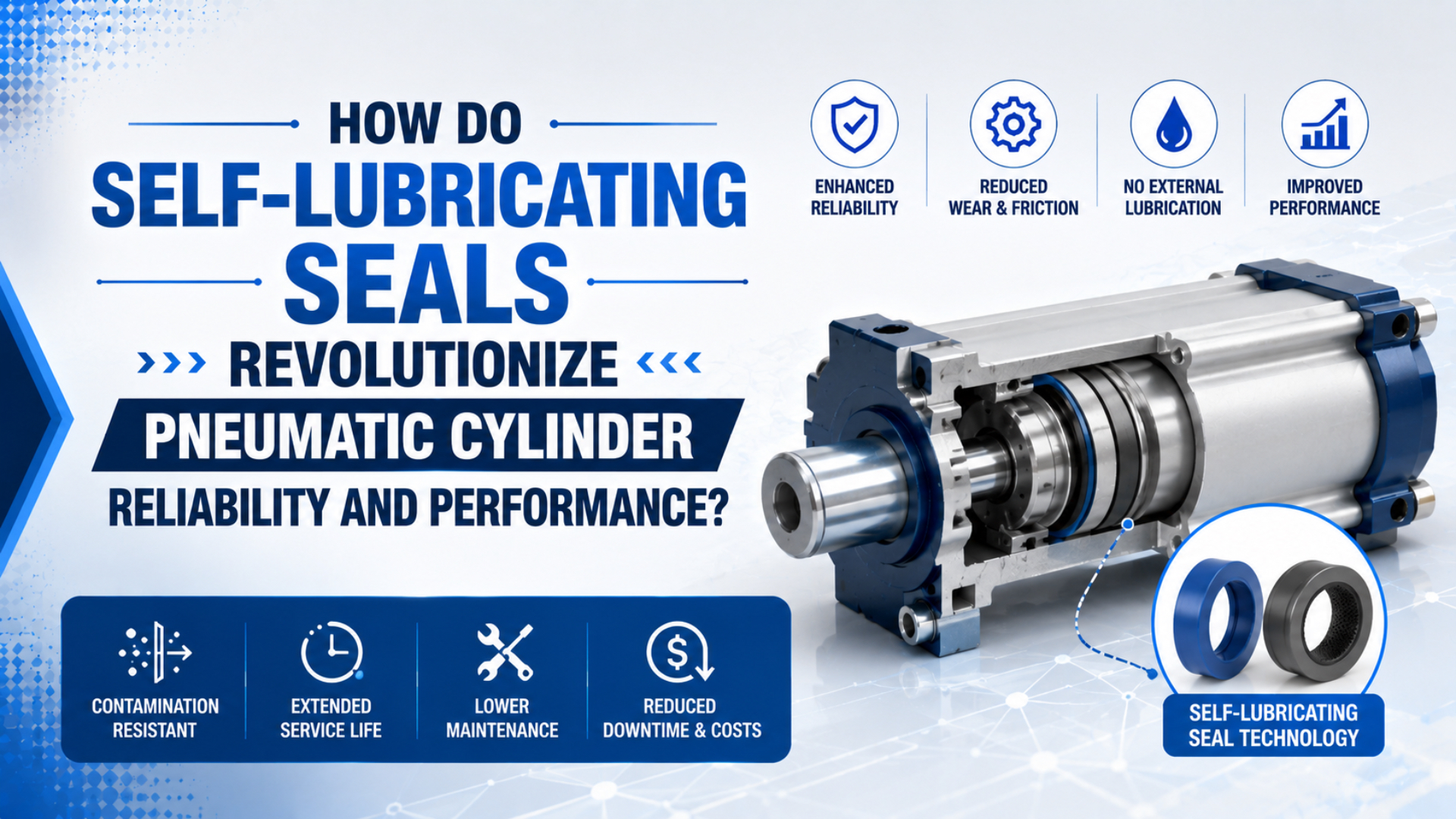
Self-lubricating pneumatic cylinder seals are sealing elements designed to control friction through their compound, lubricant-retaining geometry, an initial grease film, or a combination of these features. They can improve reliability, but they do not make every cylinder maintenance-free. Performance still depends on the specified profile, counterface, pressure, speed, temperature, air quality, alignment, and test conditions.
That distinction changes the maintenance decision. A cylinder sold as non-lube may need no routine oil supply, yet its seals and sliding surfaces can still rely on grease installed at the factory. Adding an airline lubricator later may displace that grease and create a continuing lubrication requirement.
Key Takeaways
- Non-lube does not mean lubricant-free because many cylinders receive grease during assembly, then operate without routine airline oil under their stated conditions.
- Added oil can create a continuing maintenance obligation.
- Tie every seal-life claim to a model, duty profile, failure threshold, and test method.
- Clean applications need product-specific grease and contamination rules.
What Does Self-Lubricating Mean in a Pneumatic Cylinder?
In pneumatic service, self-lubricating usually describes a seal compound, lubricant-retaining geometry, factory-applied grease, or a combination of these features. Parker’s E5 pneumatic rod seal is rated to 16 bar and is suitable for oil-free air only after initial assembly lubrication, showing why the label cannot mean completely lubricant-free operation (Parker E5, accessed 2026).
The term is used loosely across catalogs, so start with the product documentation. A filled PTFE element may obtain low friction from its compound, while a polyurethane or NBR lip seal may depend more on geometry and retained grease. Parker lists profiles for lubricated and oil-free compressed air but still specifies initial greasing during fitting, then separates rod seals, piston seals, wipers, guides, materials, pressures, temperatures, and speeds (Parker Pneumatic Seals, accessed 2026). A NASA review also describes transfer-film lubrication as dependent on the composite and sliding conditions. It is useful tribology evidence, but it is not pneumatic-cylinder life data (NASA TM-102492, 1990). The pneumatic datasheet must still identify the qualified profile, counterface, grease, duty, and acceptance limit.
The useful engineering question is therefore not, “Does this seal contain PTFE?” It is, “Which surfaces receive lubrication, how is that film retained, and what operating conditions were used to qualify the complete cylinder?” Material names alone do not reveal the groove design, lip loading, surface finish, guide condition, or lubricant compatibility.
For a broader map of pressure seals, wipers, static seals, and guide elements, see the guide to industrial cylinder seal types and applications. The related pneumatic cylinder sealing-system guide explains how those parts work together to control leakage and contamination. They answer different questions.
| Catalog wording | What it may mean | What still needs confirmation |
|---|---|---|
| Self-lubricating material | The compound contains a low-friction constituent | Filler type, counterface, wear data, pressure and temperature range |
| Lubrication-free or non-lube cylinder | No routine airline oil is required under stated conditions | Factory grease, approved air quality, speed, duty and relubrication rule |
| Oil-free air compatible | The seal can run without oil mist after correct assembly | Initial grease, dry-air limit, surface finish and test duration |
| Food-compatible grease | A specified lubricant is used for a hygienic product | Certification, incidental-contact category and approved replacement grease |
Why Can a Non-Lube Cylinder Still Need Grease?
SMC states that its non-lube cylinders are lubricated for life at the factory and can operate without further oil supply. If additional lubrication is introduced, SMC specifies ISO VG32 turbine oil and warns that stopping later can cause malfunction because the new oil displaces the original lubricant (SMC Handling Precautions, accessed 2026).
Factory lubrication is the controlled grease applied to seal and guide surfaces during assembly. It reduces dry-installation damage, supports break-in, and places the approved lubricant where the designer expects it, allowing the cylinder to run without an airline lubricator under stated conditions. That is different from running with no lubricant. Removing visible grease during service, washing parts with an incompatible solvent, assembling a seal dry, or using an unapproved grease can change friction and wear immediately. SMC’s hygienic-cylinder precautions say not to wipe grease from sliding parts and warn that out-of-specification grease can cause malfunction (SMC Hygienic Design Cylinder, accessed 2026). Preserving this controlled starting state is part of the repair specification, not an optional housekeeping detail.
In our experience, “dry cylinder” is an ambiguous maintenance note. It can mean no oil mist was supplied, the rod looked dry, the original grease was removed, or the seals actually ran without an adequate film. Those conditions need different corrective actions. Record what was cleaned, which lubricant was used, and whether the component was originally approved for non-lube operation.
Use the manufacturer’s assembly instruction whenever a seal kit is installed. The correct quantity is not “as much as possible.” Excess grease can migrate into valves, exhaust paths, sensors, or a clean process, while too little may leave a lip or guide surface unprotected during initial strokes.
When Does Added Oil Create a New Maintenance Obligation?
Adding oil changes the lubrication regime when the new oil washes away or dilutes the factory-applied grease. SMC therefore requires continuous lubrication after oil is introduced to a non-lube product and specifies ISO VG32 turbine oil for the applicable product families. That change matters. A lubricator is a system commitment, not a temporary cure for sticking (SMC Lubricant Guidance, accessed 2026).
Before fitting a lubricator, diagnose why the cylinder is slow or erratic. Low dynamic pressure, restricted flow, misalignment, side load, a scored rod, contaminated air, incorrect speed-control adjustment, or a damaged seal can all resemble a lubrication problem. Oil may briefly change friction without correcting the failure path.
Use this sequence:
- Confirm the exact model and manual.
- Measure pressure at the valve inlet and both cylinder ports throughout the failing machine cycle, recording minimum and stable values.
- Inspect the rod, bore, guides, wiper, old seals, and grease condition.
- Check whether the replacement seal material and lubricant are compatible.
- Add external oil only when the product documentation permits it and the maintenance team accepts the resulting inspection, refill, and continuity requirements.
- If oil is added, document the oil grade, lubricator setting, inspection point, and continuous service requirement.
A continuing lubrication obligation means the machine’s approved operation now depends on a maintained oil supply. The boundary is operational rather than chemical: once acceptable motion depends on continuously supplied oil, removing that supply becomes a controlled maintenance change. The team should not turn the lubricator off during an energy-saving trial or delete it during a redesign without revalidating the cylinder. If the fault also includes leakage, pressure decay, or unstable force, use the pneumatic troubleshooting guide before changing the lubrication strategy. Lubricant cannot repair a damaged counterface, restore a worn guide, correct side load, or recover pressure lost through a valve or damaged seal. Record the decision in the machine’s lubrication schedule, spare-parts record, and maintenance handover. Document it.
Operating Conditions Set the Seal’s Real Service Life
Parker lists one E5 pneumatic rod-seal variant with a 16 bar maximum pressure, up to 1 m/s surface speed, and compound-dependent temperature limits. Those are product-specific boundaries, not a universal self-lubricating-seal rating. Service life changes when pressure, speed, stroke, side load, air quality, surface finish, or lubricant departs from the tested condition (Parker E5, accessed 2026).
Material and lubricant must be evaluated together
NBR, polyurethane, FKM, PTFE, and filled PTFE solve different combinations of sealing, friction, wear, temperature, and media resistance. Trelleborg’s pneumatic range includes polyurethane and PTFE-based materials but still separates rod, piston, static, scraper, wear-ring, and cushioning functions (Trelleborg Pneumatic Seals, accessed 2026). A low-friction compound is not automatically the longest-lived option. It can still fail if the lip is cut during assembly, the rod is scratched, the groove is wrong, or the guide lets the piston run off-axis. The seal compatibility guide provides a five-gate review for media, temperature, motion, hardware, and testing, keeping a promising material from being approved for the wrong interface. Ask the supplier to identify the compound and lubricant together, including any prohibited oils or cleaners.
Air quality can preserve or strip the lubrication film
ISO 8573-1 classifies compressed-air purity by particles, water, and oil. It does not prescribe one universal purity class for every cylinder, seal compound, duty profile, factory environment, or contamination-sensitive process (ISO 8573-1, 2010). The target should match the actuator manual and process risk. Measure it at the machine.
Particles can abrade the rod, bore, lip, and guide. Condensation can corrode surfaces or disturb grease. Oil carryover can change an elastomer or mix with the original lubricant. Extremely dry air can also matter: SMC warns in a rodless-cylinder manual that low-dew-point air may reduce internal lubrication properties and service life unless a compatible product is selected (SMC CY Series Manual, accessed 2026).
Review the actual point of use, not only the compressor room. The ISO air-quality guide explains particle, water, and oil classes, while the pressure dew point guide covers moisture behavior separately.
Clean and hygienic service needs its own instructions
“No airline oil” is not proof of contamination-free operation. A clean cylinder may restrict external lubrication because the factory grease, materials, exhaust arrangement, and particle-generation target were qualified as a system. SMC’s CYP clean rodless cylinder, for example, has a 0.3 MPa maximum operating pressure and says turbine-oil lubrication will not satisfy the product specification (SMC Clean Rodless Cylinder, accessed 2026).
For food, pharmaceutical, semiconductor, or cleanroom service, request the exact grease specification, material declarations, cleanroom or particle data, allowable cleaning agents, replacement procedure, and exhaust requirements. Do not infer those properties from a purple seal, a PTFE label, or the words “maintenance-free.”
How Should Engineers Compare and Validate Seal Life?
ISO 19973-3 defines reliability test and reporting procedures for piston-rod pneumatic cylinders and treats life in cycles or kilometres, not as an unsupported calendar promise. It also connects the reported result to test equipment and failure thresholds. A credible life claim therefore needs a defined cylinder, duty profile, sample plan, and failure criterion (ISO 19973-3, 2015).
Do not compare “five million cycles” from one catalog with “ten million cycles” from another until the test boundaries are known. Cycle count alone omits stroke length, so it hides total sliding distance. It also says nothing about speed, pressure, load, dwell, temperature, air quality, leakage threshold, or excluded samples. A seal-life comparison becomes useful only when it predicts the machine’s failure mode. If the application rejects a cylinder when leakage exceeds a limit, that threshold belongs in the test. If the machine fails first from stick-slip, particle generation, or guide wear, a cycle count based only on catastrophic seal rupture answers the wrong question. Test the failure mode the machine actually cares about. Report accumulated travel as well as cycles whenever the compared cylinders use different stroke lengths.
RFQ and datasheet checklist
Send enough information for the supplier to match both the seal and its lubrication regime:
Application data
| Input | Why it changes the answer |
|---|---|
| Cylinder manufacturer and full model code | Identifies the original profile, grease, groove and repair instructions |
| Seal position and dimensions | Separates rod, piston, wiper, static and cushioning functions |
| Pressure at both ports during motion | Shows actual differential and pressure peaks |
| Stroke, cycles per minute and annual cycles | Defines sliding distance, reversal frequency and duty |
| Maximum speed and dwell time | Affects film retention, heating and breakaway behavior |
| Rod and bore material, finish and condition | Controls friction, wear and lip damage |
Environment and acceptance data
| Input | Why it changes the answer |
|---|---|
| Air purity, pressure dew point and existing oil | Defines particles, water and lubricant exposure |
| Ambient and process temperature | Screens compound and grease limits |
| Side load, guides and mounting alignment | Separates seal wear from mechanical overload |
| Cleanliness or food-contact requirement | Identifies approved materials, grease and service controls |
| Failure criterion | Defines acceptable leakage, friction, motion or particle generation |
Validate the replacement on the machine
Start with an incoming inspection and a controlled installation record. Confirm the part number, lot, material, lip direction, groove condition, lubricant, and assembly tool. Run the cylinder at reduced speed where the manufacturer’s procedure permits, then check external leakage, stroke time, breakaway behavior, temperature, sound, and visible lubricant migration.
Set an observation interval based on duty rather than an arbitrary date. Keep the baseline. Record cycles or accumulated travel, dynamic pressure, leakage, failed direction, rod condition, maintenance action, and environmental changes. That record will show whether the new seal improved the original failure mode without inventing a universal percentage or payback period.
FAQs: Self-Lubricating Pneumatic Seals
ISO 19973-3 reports pneumatic-cylinder life in cycles or kilometres and ties reliability to defined test conditions and thresholds. The following answers therefore avoid universal lifetime multipliers. They focus on the product instructions and operating evidence engineers need before changing a seal material or lubrication method (ISO 19973-3, 2015).
Do self-lubricating seals eliminate all cylinder lubrication?
No. A seal compound may reduce friction, yet the assembled cylinder can still rely on factory grease at the seal lips, guides, bore, or rod. Parker describes pneumatic profiles for oil-free air after initial assembly lubrication. Check the complete cylinder manual before describing the system as lubricant-free.
Can I add an airline lubricator to a non-lube cylinder?
Only when the cylinder manufacturer permits it. SMC allows additional oil for some non-lube products but warns that the oil can displace the original lubricant. Once that happens, lubrication must continue. Other clean, low-speed, or hygienic products may prohibit external oil, so the model-specific instruction controls.
Does PTFE automatically give the longest seal life?
No. PTFE-based compounds can offer low friction and useful media resistance, but service life also depends on the seal profile, counterface, pressure, speed, temperature, leakage limit, installation, and guide condition. Polyurethane, NBR, FKM, or another compound may be better for a particular groove and duty.
How should pneumatic cylinder seal life be compared?
Compare results only after aligning the cylinder model, stroke, speed, pressure, load, temperature, air quality, lubricant, sample plan, and failure threshold. ISO 19973-3 provides a test and reporting framework for piston-rod cylinders. A cycle number without those boundaries is not a transferable service-life guarantee.
Are non-lube seals automatically suitable for cleanrooms or food equipment?
No. Non-lube operation addresses routine oil supply, not every contamination or compliance requirement. Verify the factory grease, seal materials, particle-generation data, cleaning-agent resistance, exhaust arrangement, replacement method, and required declarations. Clean and hygienic cylinder manuals may also prohibit otherwise common turbine-oil lubrication. Ask for proof.
Sources and technical references
-
ISO 19973-3:2015, Pneumatic fluid power, assessment of cylinder reliability by testing. Retrieved 2026-07-18.
-
ISO 8573-1:2010, Compressed air contaminants and purity classes. Retrieved 2026-07-18.
-
Parker Pradifa E5 pneumatic rod seal product data. Retrieved 2026-07-18.
-
Parker Pneumatic Seals Catalog PTD3351. Retrieved 2026-07-18.
-
SMC Handling Precautions for Pneumatic Products. Retrieved 2026-07-18.
-
SMC Lubricants Used to Supply Lubrication. Retrieved 2026-07-18.
-
SMC Hygienic Design Cylinder Series HY. Retrieved 2026-07-18.
-
SMC Clean Rodless Cylinder Series CYP. Retrieved 2026-07-18.
-
SMC CY Series Rodless Cylinder Operation Manual. Retrieved 2026-07-18.
-
Trelleborg Pneumatic Seals. Retrieved 2026-07-18.
-
NASA TM-102492, Self-Lubricating Polymer Composites and Polymer Transfer Film Lubrication. Retrieved 2026-07-18.