

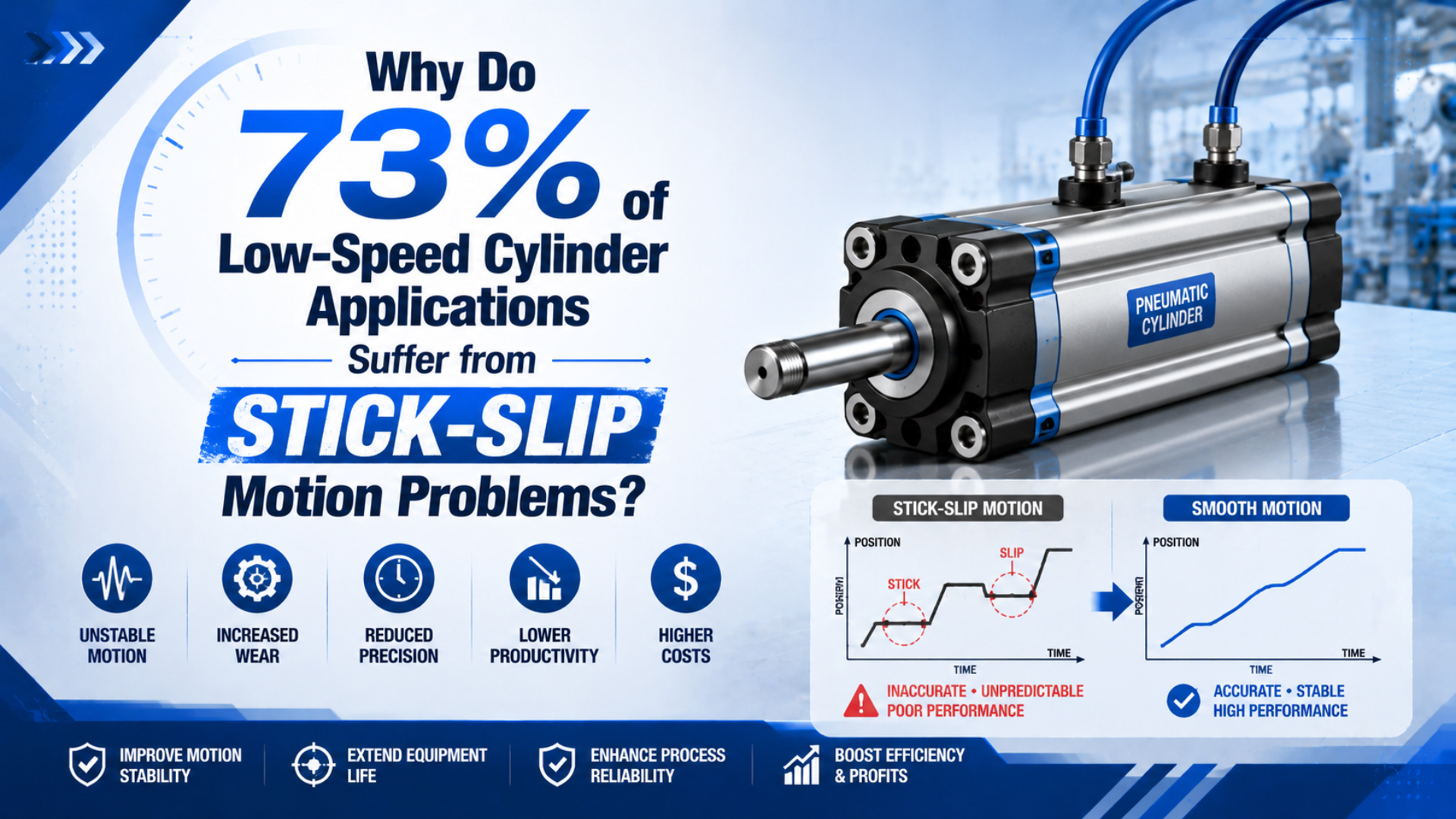
There is no defensible industry-wide study showing that 73% of low-speed pneumatic cylinder applications suffer from stick-slip. What is well established is the failure mechanism: at low commanded velocity, pressure can build while the piston remains stationary, then stored pneumatic energy releases in a short jump when net force exceeds breakaway resistance.
A 2026 experimental study measured this behavior in three different pneumatic cylinders. It found that stick-slip results from the interaction of chamber pressure, airflow, air compressibility, piston motion, external load, and friction rather than one seal coefficient alone (Ngoc, Pham, and Xuan, 2026).
Key Takeaways
- No published source supports a universal 73% failure rate.
- Diagnose repeated sticking with synchronized position and two-port pressure data.
- Minimum stable speed is model-specific: SMC lists 0.5 mm/s for selected low-speed cylinders, not every cylinder (SMC).
What Actually Causes Stick-Slip in a Low-Speed Pneumatic Cylinder?
Tests on three pneumatic cylinders found repeated stationary periods followed by short slips, with airflow, supply pressure, external load, and starting position changing the pattern. The researchers concluded that air compressibility and chamber-pressure evolution are part of the mechanism, so static-versus-kinetic friction alone is an incomplete explanation (Actuators, 2026).
During the stick phase, the directional valve continues to feed the driving chamber or the control valve continues to demand motion. The piston barely moves, so pressure rises. The opposite chamber, tubing, valve, silencer, and flow control determine how quickly opposing pressure changes. At the same time, seals, guides, side load, and the driven mechanism resist motion.
Motion begins when the available pressure force exceeds the instantaneous resistance. Once the piston moves, friction can fall, chamber volumes change, and the pressure balance shifts. It accelerates, loses its force margin, slows, and may stick again. That repeating cycle is stick-slip. One difficult start after a long dwell is breakaway behavior; repeated stop-jump motion during a commanded low-speed stroke is the diagnostic distinction.
Use this two-chamber force balance:
Here, and are the measured gauge pressures in the driving and opposing chambers, and are their effective piston areas, includes gravity and process resistance, and includes cylinder, guide, and machine friction. Sustained motion requires a positive, sufficiently stable net force throughout the stroke.
This equation explains why a regulator setting isn’t enough. Two machines can show the same supply pressure while producing different motion because their exhaust pressure, tube volume, load path, dwell time, and friction history differ. The useful evidence is pressure at both cylinder ports at the moment motion stops and restarts.
How Can You Confirm That Jerky Motion Is Really Stick-Slip?
Researchers in the 2026 cylinder study recorded four signals together: piston position, piston velocity, both chamber pressures, and calculated friction force. That synchronized approach is more reliable than watching the rod or reading an upstream gauge because it shows whether pressure accumulates during each stop and changes abruptly during each slip (Actuators, 2026).
Start with a repeatable test condition. Use the real payload and production orientation, disable unrelated machine changes, and command a constant low speed over the same part of the stroke. Record at least five cycles after warm-up, plus the first stroke after a defined dwell. If the problem appears only after sitting, seal adhesion or grease redistribution deserves attention.
Look for this pattern:
- Commanded motion remains active while measured velocity approaches zero.
- Pressure difference across the piston continues to increase.
- Position changes abruptly when the stored force overcomes resistance.
- Pressure difference falls or reverses as the piston accelerates.
- The pattern repeats before the end cushion zone.
Not every jerky stroke is stick-slip. A directional valve that switches intermittently creates a different trace. So does an unstable regulator, an undersized tube, a blocked silencer, a tight end cushion, or mechanical binding at one position. If the jump always occurs at the same physical location, disconnect the load where safe and check guide parallelism, mounting, barrel damage, and cable drag before changing the speed controller.
In our experience, the fastest isolation step is to compare the loaded axis with a safe disconnected-load test. Our team has found that a fault tied to one stroke location usually points toward the mechanics, while pauses that move with dwell, pressure, or flow settings point back toward the pneumatic-friction loop.
For a one-time start problem, use the separate breakaway-force diagnostic. For supply variation that affects several actuators at once, compare the trace with the air-pressure fluctuation guide.
Which Mechanical Conditions Make Stick-Slip More Likely?
Festo publishes model-specific slow-motion data rather than a universal threshold: its DSNU S10 option lists stick-slip-free operation from 8 to 100 mm/s for several bores and 5 to 100 mm/s for a 63 mm bore under stated horizontal, no-load, 6 bar conditions (Festo DSNU).
Those conditions matter. A standard cylinder that moves smoothly on a bench can crawl on the machine after a side load, guide preload, rod misalignment, or gravity load is added. The cylinder seal is only one sliding interface. External linear bearings, scrapers, joints, fixtures, and the process itself all contribute to the resistance term.
Check the mechanical path in this order:
| Check | Evidence to collect | Corrective direction |
|---|---|---|
| Alignment | Force needed to move the disconnected load through the full stroke | Realign mounts and guides; remove constraint |
| Side load | Rod wear pattern, bushing marks, guide moments | Add an external guide or move the load reaction off the rod |
| Position dependence | Exact stroke location of each pause | Inspect guide joints, barrel, cables, hoses, and cushion entry |
| Dwell dependence | Breakaway pressure after 1, 10, and 60 minutes | Review seal condition, grease, contamination, and model choice |
| Temperature | Cold-start and warm-state pressure traces | Confirm seal and lubricant ratings; stabilize the environment |
| Load direction | Compare extension, retraction, horizontal, and vertical behavior | Recalculate force margin for each direction |
What if loosening a mounting bolt makes the motion smoother? That isn’t a tuning success. It is evidence that the installed axis is constrained. Correct the mounting surfaces, coupling, and guide geometry instead of operating with loose fasteners. The mounting and alignment guide explains how to keep side load out of the cylinder.
Oversizing the bore can hide binding by producing more force, but it doesn’t remove the cause. Extra piston area can also increase air demand and the energy released during each slip. Fix the load path first, then verify that the selected bore still has enough dynamic force after opposing pressure and friction are included.
How Should Pressure, Flow Controls, and Tubing Be Adjusted?
SMC lists a 0.5 mm/s minimum piston speed for selected CM2X, CQSX, CQ2X, and CUX low-speed cylinders, while some smaller bores are rated at 1 mm/s. These are series-specific boundaries, showing why a standard cylinder shouldn’t be expected to match a dedicated low-speed design through needle adjustment alone (SMC).
Begin with force margin, not needle position. Measure both port pressures during cylinder movement. A meter-out valve raises pressure in the exhausting chamber, which can stabilize velocity but also subtracts from driving force. Closing the needle too far may move the axis closer to the point where friction repeatedly stops it.
Use this adjustment sequence:
- Confirm that the directional valve, fittings, tubing, and silencer can pass the required flow.
- Install one-way flow controls close to both cylinder ports, oriented for free inlet flow and restricted exhaust flow.
- Open both controls, then reduce speed gradually with the production load attached.
- Tune extension and retraction separately because their effective areas and loads differ.
- Keep end cushioning separate from whole-stroke speed control.
- Record both chamber pressures at the slowest accepted setting and after repressurization.
Shorter tubing reduces delay and unwanted chamber volume. Increasing tube diameter can reduce pressure drop, but it also increases air volume, so “larger is always stiffer” is not a safe rule. Select the path from required flow, pressure loss, response time, and valve location. The meter-out circuit guide covers the pressure-flow tradeoff in detail.
Supply pressure also needs restraint. Raising it may create more force margin and change the stick-slip cycle, but it increases clamp force and stored energy. Lowering it may reduce seal loading on some designs, yet it can leave too little force to sustain motion. Make one change at a time and verify the pressure trace instead of applying a universal 2-to-4-bar “safe range.”
When Should You Change the Cylinder, Seal, or Control Architecture?
Parker lists one modified-PTFE pneumatic seal for pressures up to 16 bar and temperatures from -30°C to +80°C, describing minimal breakaway and dynamic friction without giving a universal friction coefficient. This illustrates the correct selection method: match a documented seal and geometry to the application rather than ranking materials by invented coefficient tables (Parker Pneumatic Seals).
Choose a dedicated low-speed or low-friction cylinder when alignment is correct, the load is within limits, pressure and exhaust paths are stable, but the standard cylinder still cannot meet the verified minimum-speed requirement. Compare the exact model’s bore, stroke, mounting, pressure range, speed range, leakage, cushioning, guide limits, switch compatibility, and maintenance instructions.
Don’t add oil mist automatically. SMC says its non-lube cylinders are factory lubricated and that once external lubrication is introduced, it must continue because the added oil can displace the original lubricant (SMC handling precautions). Follow the exact cylinder manual, especially in clean, food, medical, or paint-sensitive environments.
Change the control architecture when the requirement goes beyond stable end-to-end motion. A manual flow control does not provide intermediate-position feedback, load compensation, or programmable motion profiles. Consider a proportional or servo-pneumatic system when the application needs commanded positions and can support sensors, tuned control, and commissioning. The proportional-valve guide outlines that boundary.
An electric actuator may be the better choice when the machine needs multiple repeatable positions, low-speed travel over most of the stroke, long dwell at position without air consumption, or position verification independent of end switches. The decision should follow the motion requirement, not a promise that one seal package will “eliminate” friction.
A Practical Low-Speed Acceptance Test
SMC states that its selected low-speed cylinder values reach 0.5 mm/s, while Festo’s documented slow-motion options span different minimum speeds under named test conditions. A credible machine specification should therefore state the model, load, orientation, pressure, stroke zone, dwell, temperature, and measurement method instead of claiming “smooth at low speed” without boundaries (SMC; Festo).
Write the acceptance criteria before tuning. A useful protocol includes:
- Target mean speed and allowable peak-to-peak velocity variation
- Maximum permitted stop duration during a commanded stroke
- Endpoint repeatability, if end position matters
- Payload, orientation, and external guide configuration
- Supply pressure and both chamber-pressure traces
- Cold start, warm state, and defined dwell intervals
- Extension and retraction results
- First stroke after repressurization
- At least one slow-speed and one normal-speed control condition
Run the test across the full intended stroke, but evaluate cushion entry separately. Save the raw position and pressure traces with the cylinder model and circuit revision. If maintenance later changes a seal, valve, tube, silencer, grease, guide, or load, repeat the same test. That creates a comparable baseline instead of relying on an operator’s impression of “jerky.”
Average speed is often the wrong acceptance metric by itself. A cylinder can hit the correct average while alternating between zero velocity and short peaks. Limit stop duration, velocity variation, and slip distance as well. Those measures expose stick-slip that a stopwatch across the full stroke would hide.
Low-Speed Cylinder Stick-Slip FAQs
Published low-speed limits vary by cylinder family: SMC lists 0.5 or 1 mm/s for selected models, while Festo publishes other option-specific values and conditions. These answers therefore use diagnostic boundaries rather than one universal speed, pressure, friction ratio, or positioning tolerance (SMC; Festo).
At what speed does stick-slip become a problem?
There is no universal threshold. It depends on the cylinder series, bore, seal design, load, orientation, pressure, valve, tubing, guides, temperature, and dwell. Use the manufacturer’s minimum-speed data as a model boundary, then validate the complete installed axis at the required speed with position and two-port pressure measurements.
Is high breakaway pressure the same as stick-slip?
No. Breakaway pressure describes the threshold for starting after rest. Stick-slip is a repeating stop-and-release cycle during commanded motion. A cylinder may have a high first-motion threshold without repeatedly sticking, or it may start normally and then develop stick-slip as chamber pressures, load, and friction change along the stroke.
Can a meter-out valve eliminate stick-slip?
It can stabilize motion by controlling exhaust and maintaining opposing pressure, but it can also consume too much force when nearly closed. If adjustment causes pauses or stalling, measure both chamber pressures and review the load margin. Dedicated low-speed hardware or closed-loop control may be necessary below the standard cylinder’s stable range.
Should I lubricate a non-lube cylinder to make it smoother?
Only if the exact manufacturer instructions allow it. SMC warns that added oil can displace factory lubricant and that lubrication must continue once started. First check alignment, contamination, pressure, flow controls, and seal condition. Avoid introducing oil into clean, food, medical, or paint processes without an approved compatibility review.
When is an electric actuator a better solution?
Consider electric actuation when the process needs several programmable positions, very low continuous speed, encoder-based verification, controlled acceleration, or long position holds without continuous air use. Pneumatics remain effective for simple end-to-end motion, but a flow control and low-friction seal do not create a complete positioning servo.
Conclusion: Diagnose the Cycle, Not the Headline Percentage
Controlled tests provide stronger evidence than a universal 73% prevalence claim. A 2026 study of three pneumatic cylinders showed that stick-slip changes with airflow, supply pressure, external load, initial position, chamber dynamics, and dwell-dependent friction, so reliable correction requires system measurements rather than a seal-only explanation (Actuators, 2026).
Start by confirming the repeating pressure-and-motion signature. Remove binding and side load, preserve adequate dynamic force, tune meter-out controls with measured chamber pressure, follow the cylinder’s lubrication instructions, and compare the required speed with model-specific data. If the installed axis still cannot pass a written acceptance test, select a dedicated low-speed cylinder or change the control architecture.
Sources and Technical References
These references separate experimentally observed system behavior from manufacturer-specific operating boundaries. The 2026 study tested three cylinders and does not establish an industry prevalence rate. Catalog speeds, pressures, temperatures, and lubrication instructions apply only to the named products and stated conditions, not to every pneumatic cylinder.
- Ngoc, H. N., Pham, P. P., and Xuan, B. T., “Experimental and System-Level Simulation Study of Stick-Slip Characteristics in Pneumatic Cylinders”, Actuators 15(5), 243, 2026. Used for measured stick-slip behavior, chamber dynamics, airflow, pressure, external-load, initial-position, and dwell-time effects.
- Tokashiki, L. R., Fujita, T., and Kagawa, T., “Stick-Slip Motion in Pneumatic Cylinders Driven by Meter-Out Circuit”, Transactions of the Japan Hydraulics & Pneumatics Society 30(4), 110-117, 1999. Used for meter-out circuit and low-velocity stick-slip context.
- SMC, Low Speed Cylinder CJ2X/CM2X/CQSX/CQ2X/CUX, retrieved 2026-07-18. Used for model-specific 0.5 and 1 mm/s minimum piston speeds.
- Festo, Round Cylinders DSNU Technical Data, retrieved 2026-07-18. Used for option-specific stick-slip-free and slow-motion speed conditions.
- Parker Hannifin, Pneumatic Seals, retrieved 2026-07-18. Used for product-specific low-friction seal construction, pressure, temperature, and installation boundaries.
- SMC, Handling Precautions for SMC Products, retrieved 2026-07-18. Used for oil grade and continuous-lubrication precautions after external oil is introduced.