

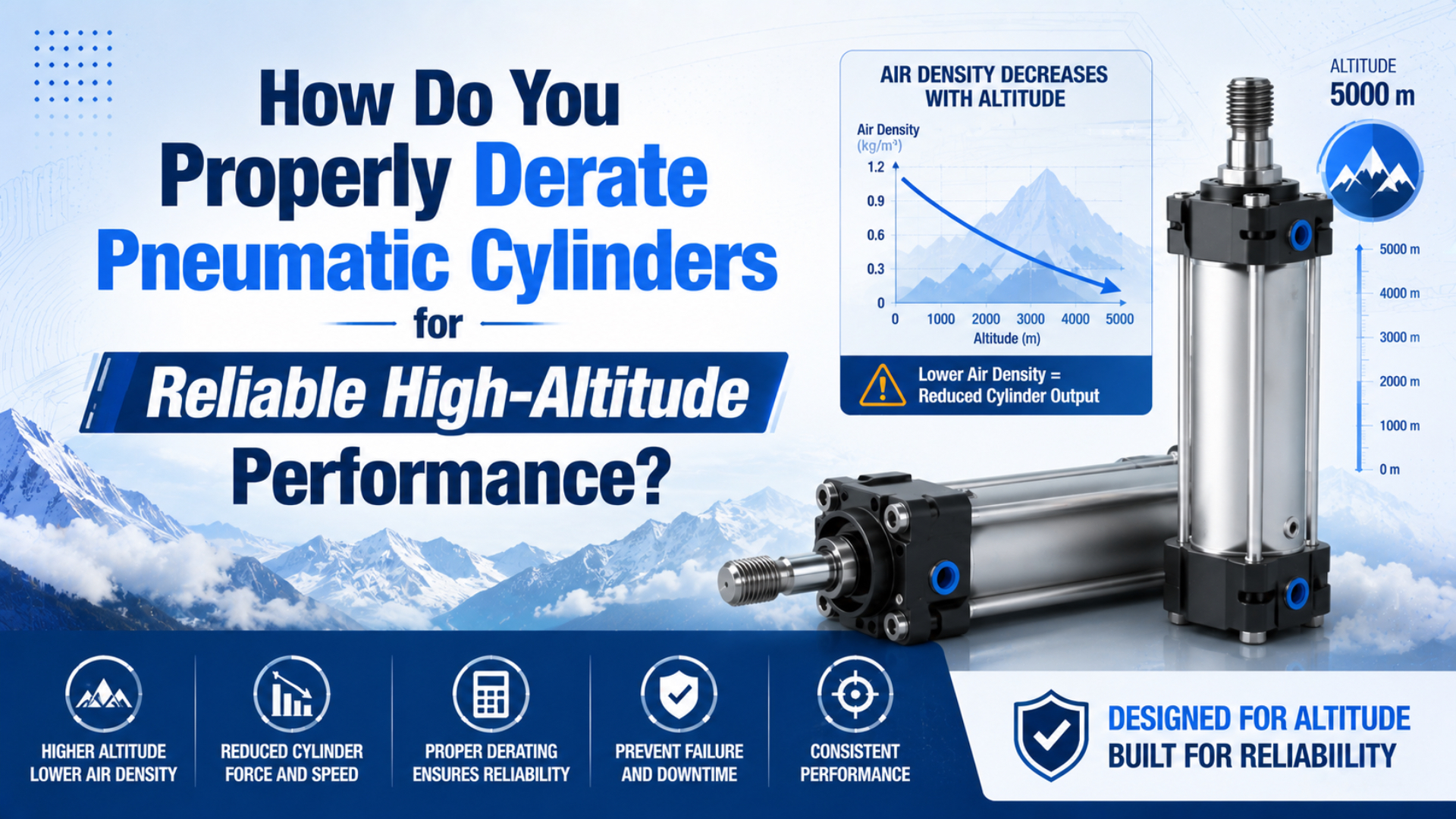
A pneumatic cylinder does not need a universal force derating factor just because it is installed above sea level. If the same effective gauge-pressure difference is maintained across the piston, its theoretical force remains the same. High altitude primarily changes compressor intake conditions, absolute pressure ratio, available mass flow, cooling, and the time needed to refill the system.
Pneumatic cylinder altitude derating means correcting verified force, flow, cycle-time, or temperature margins for the actual site conditions, not multiplying catalog force by an elevation percentage.
Therefore, a larger bore may help when measured pressure or force margin is inadequate, but it cannot repair an undersized compressor, restrictive valve, frozen exhaust, or incorrect pressure reference.
Key Takeaways
- SMC calculates theoretical cylinder force from operating pressure and piston area, not elevation.
- NASA’s model gives about 11.8 psia at 6,000 ft versus 14.7 psia at sea level.
- Derate compressor capacity from local inlet conditions, then verify dynamic pressure at both cylinder ports.
- Increase bore only when the measured force margin requires it.
Does Altitude Directly Reduce Pneumatic Cylinder Force?
No universal altitude multiplier belongs in a basic cylinder-force calculation. SMC defines theoretical output as operating pressure multiplied by piston area and recommends a load ratio of 0.7 or less for stationary work and 0.5 or less for dynamic work (SMC Air Cylinder Model Selection). Neither relationship contains elevation.
The reason is pressure differential. A local gauge reads pressure relative to the surrounding atmosphere. If the cap end of a cylinder is held at 6 bar gauge while the rod end exhausts freely to the same local atmosphere, the ideal driving pressure difference remains close to 6 bar whether the machine is near the coast or in a mountain plant.
Gauge pressure is pressure measured relative to the local atmosphere. Therefore, a regulator showing 6 bar gauge already represents approximately 6 bar of useful pressure difference above the air surrounding the machine. For example, the absolute pressure inside the supplied chamber changes with altitude, but the gauge difference does not change when the regulator can hold its setting.
For a double-acting, single-rod cylinder extending under load, use the net-force relationship:
Here, is the measured drive-side gauge pressure at the cylinder port, is the full piston area, is exhaust-side back pressure, is the opposing effective area, and covers seal and guide resistance. Dynamic acceleration and a project safety factor still need separate allowances.
In particular, ask whether the installed air system can maintain the required pressure difference while the actuator moves. Static regulator pressure alone cannot answer that.
For a fuller treatment of the force balance, see how pressure differential creates pneumatic force.
What Changes in a Pneumatic System as Altitude Increases?
NASA’s standard-atmosphere equations put ambient pressure near 14.7 psia at sea level, about 12.2 psia at 5,000 ft, and about 11.8 psia at 6,000 ft (NASA Earth Atmosphere Model). The lower inlet pressure affects the compressor and gas calculations before it affects a properly regulated cylinder’s static force.
Similarly, several system variables change together:
| Variable | What altitude changes | What the engineer should check |
|---|---|---|
| Compressor inlet | Lower absolute pressure and air density | Manufacturer capacity, pressure, power, and cooling corrections |
| Compression ratio | Lower suction absolute pressure raises the ratio for the same discharge gauge pressure | Maximum allowable ratio and discharge temperature |
| Delivered mass flow | The same inlet volume contains less dry-air mass | Required SCFM versus compressor ACFM at site conditions |
| Receiver storage | The same vessel and gauge-pressure band may represent a different standardized air quantity | Usable storage over the real cut-in and cut-out band |
| Valve and tube flow | Absolute upstream/downstream pressure ratios change | Dynamic port pressure, fill time, and exhaust back pressure |
| Cylinder force | Changes only if effective port pressure, back pressure, friction, or load changes | Pressure at both ports during the working stroke |
CAGI states that elevation affects compressor delivery because atmospheric pressure changes inlet density. It also separates SCFM, a standardized mass-flow reference, from ACFM, the inlet volume at local conditions (CAGI Compressed Air System Design). In other words, the compressor may reach gauge pressure yet deliver insufficient standardized air mass. In our experience, separating supply capacity from cylinder force resolves many apparent altitude problems before a larger actuator is ordered.
Which Calculations Need Absolute Pressure?
At 6,000 ft, NASA’s model gives roughly 11.8 psia ambient pressure. A line regulated to 6 bar gauge, about 87 psi gauge, is therefore about 98.8 psia absolute instead of 101.7 psia at standard sea-level pressure. The gauge differential can stay unchanged while the compressor’s absolute-pressure ratio increases.
Convert the pressure reference before using gas relationships:
Absolute pressure is pressure measured from a perfect vacuum. In contrast, gauge pressure uses the atmosphere surrounding the instrument as its zero reference. Mixing the two produces incorrect compressor ratios and gas quantities even when the individual pressure numbers appear plausible.
is absolute pressure, is local gauge pressure, and is measured or conservatively specified local atmospheric pressure. Do not add a fixed 14.7 psi at every site.
The compressor pressure ratio is:
At 6 bar gauge discharge, the idealized ratio is about 6.92 at 14.696 psia ambient and 8.38 at 11.8 psia ambient. Atlas Copco gives the same design warning: holding application pressure constant as inlet pressure falls increases the pressure ratio and changes capacity, power, cooling requirements, and maximum working pressure (Atlas Copco High-Altitude Compressor Sizing).
Specifically, use absolute pressure for:
- compressor and booster pressure ratios;
- SCFM-to-ACFM conversion;
- receiver air-mass and recovery calculations;
- choked-flow or critical-pressure-ratio checks;
- density and temperature relationships;
- vacuum systems, where local atmosphere supplies the maximum available pressure difference.
Use local gauge pressure for a first-pass cylinder-force calculation when the opposite chamber vents to the same atmosphere. If the exhaust is restricted, measure both ports and use the net-force equation instead. The companion guide to absolute pressure in pneumatic systems covers the reference conversion in more detail.
How Should You Derate a High-Altitude Installation?
CAGI’s design handbook works through a compressor requirement of 1,000 SCFM at 5,000 ft, 100°F, and 50% relative humidity, converting the standardized demand into the ACFM required at the actual inlet (CAGI). That is the right pattern: correct the supply from site conditions, then verify the actuator.
1. Define the worst credible site condition
Additionally, record elevation, minimum atmospheric pressure, maximum compressor-inlet temperature, humidity range, cooling-medium temperature, and enclosure ventilation. Standard-atmosphere data is useful for preliminary work, but NASA notes that real atmospheric properties vary with location, season, and weather. Use project site data when available.
2. Express demand in one reference condition
Therefore, list every demand in SCFM, Nm³/h, or another defined standard condition. Convert it to the ACFM the compressor must ingest at the site, and state the pressure, temperature, and humidity behind that standard unit.
3. Obtain the compressor correction from its supplier
That said, do not apply one plant-wide percentage. Compressor type, cooling, drive motor, controls, maximum pressure, and duty all matter. Ask for corrected capacity, allowable pressure, power, discharge temperature, cooling requirement, and motor derating at the worst inlet condition.
For instance, two compressors with the same sea-level rating can have different altitude limits because their air ends, cooling systems, motors, and controls differ. Consequently, a generic percentage cannot establish safe capacity. Ask whether maximum pressure must be reduced, whether power or cooling becomes limiting, and whether the correction covers the full temperature range. Fix any compressor shortfall before increasing cylinder volume.
4. Calculate force from pressure at the cylinder
Meanwhile, estimate piston force from minimum dynamic pressure, not the compressor nameplate or unloaded regulator reading. Include rod area, exhaust back pressure, seal friction, acceleration, mounting geometry, and a documented load ratio. For a simple full-bore extension estimate:
is the preliminary bore, is force after load and safety allowances, and is the minimum usable pressure difference. This shortcut does not cover retract-side rod area, back pressure, side load, or guide friction.
5. Validate the complete cycle
Finally, measure both cylinder ports during acceleration and at the highest-load part of the stroke. Record stroke time, receiver pressure swing, compressor state, exhaust back pressure, and recovery. What if the first cycle passes but the twentieth slows down? That pattern points to supply and storage capacity, not an altitude force coefficient.
Worked Example: A 50 mm Cylinder at 6,000 ft
NASA’s atmosphere model gives approximately 11.8 psia at 6,000 ft. A 50 mm bore has a piston area near 1,963 mm², so 6 bar gauge produces about 1,178 N theoretical extension force before back pressure and friction, the same pressure-area result used at sea level (NASA; SMC).
Compare two commissioning results:
| Check | Sea-level design assumption | 6,000 ft result | Decision |
|---|---|---|---|
| Ambient pressure | 14.696 psia | 11.8 psia | Recalculate compressor absolute-pressure ratio |
| Regulated pressure at rest | 6.0 bar gauge | 6.0 bar gauge | Static cylinder force is unchanged |
| Pressure at cap port during motion | 6.0 bar gauge assumed | 5.2 bar gauge measured | Recalculate force from 5.2 bar |
| Rod-side back pressure | Not included | 0.4 bar gauge measured | Subtract opposing pressure-area force |
| Compressor pressure ratio at 6 bar gauge | About 6.92 | About 8.38 | Confirm supplier’s altitude rating |
The measured 5.2 bar drive pressure, not the 6,000 ft elevation by itself, reduces available cylinder force. Before choosing a larger bore, inspect compressor capacity, receiver recovery, valve flow, tube inside diameter, filters, silencers, and meter-out settings. If the system can maintain only 5.2 bar during the required cycle, size the cylinder from that verified minimum.
Accordingly, correct the compressor from local absolute inlet conditions and check the cylinder from measured port-pressure differential. One combined factor would conceal which component lacks margin.
For the supply side, use the Compression Ratio Calculator with absolute inlet and discharge pressure. The Pressure Converter can align bar, psi, MPa, and kPa values before the design review.
Which Design Change Solves Each Failure Mode?
SMC recommends a load ratio of 0.5 or less for dynamic cylinder operation, leaving more force for resistance and acceleration (SMC Air Cylinder Model Selection). However, a machine that loses this margin at altitude needs a cause-specific correction. Increasing bore is only one option and can worsen a supply problem by increasing air demand.
| Observed result | Likely cause to confirm | Appropriate response |
|---|---|---|
| Correct static force, slow repeated cycles | Compressor capacity or receiver recovery | Correct compressor for site ACFM, add storage only after demand analysis |
| Normal header pressure, low pressure at cylinder during motion | Valve, tube, fitting, filter, or regulator restriction | Increase effective flow capacity and shorten restrictive runs |
| Adequate drive pressure, high opposing pressure | Exhaust silencer or meter-out restriction | Clean or resize the exhaust path and retune speed control |
| Required pressure difference is present, force margin is still low | Bore or load factor is inadequate | Select a larger bore or reduce mechanical load |
| Good force, excessive end impact | Speed or cushion energy problem | Reduce speed, tune cushions, or add an external shock absorber |
| Cold-start sticking or ice | Seal temperature limit, water, or freezing | Verify cylinder specification, drying, drains, and low-temperature materials |
| Unstable force through the day | Pressure control, compressor sequencing, or variable demand | Log dynamic pressure and correct the control strategy |
In our experience, the fastest diagnostic uses temporary pressure sensors at both cylinder ports. One upstream gauge can look healthy while the valve and exhaust path remove usable differential during motion. Meanwhile, the receiver may not recover before the next command. Record both ports, receiver pressure, and cycle time together. A larger cylinder can hide the restriction during one trial while consuming more air in production.
See working pressure of an air cylinder before increasing the regulator setting. Higher pressure must remain inside the ratings of the cylinder, valve, tubing, fittings, receiver, and safety devices.
What Should Be Verified Before High-Altitude Commissioning?
SMC’s current CM2 specifications list a maximum operating pressure of 1.0 MPa and an ambient/fluid range of −10°C to 70°C without an auto switch, with a no-freezing condition (SMC CM2 Catalog). Those are model-specific limits, not universal values, so verify every selected component’s own datasheet.
Additionally, use this commissioning record:
- site elevation plus minimum recorded atmospheric pressure;
- compressor inlet temperature, humidity, ventilation, and cooling conditions;
- supplier-confirmed altitude capacity, maximum pressure, power, and thermal limits;
- declared SCFM, Nm³/h, or ACFM reference conditions;
- minimum receiver pressure during the highest-demand cycle;
- drive-side and exhaust-side pressure traces at the cylinder ports;
- cylinder bore, rod diameter, stroke, orientation, load, speed, and load ratio;
- valve flow rating, tube inside diameter, line length, fittings, and silencer condition;
- low-temperature seal, grease, switch, cable, condensate, dryer, and freeze protection;
- proof that the machine meets force, cycle-time, stopping, and restart requirements under worst-case conditions.
Cold weather deserves separate attention. Lower temperature does not justify an arbitrary extra force percentage, but it can change seal friction, lubricant behavior, condensate, ice risk, sensor limits, and material response. Use the component’s specified temperature range and a site freeze-control plan rather than assuming every high-altitude installation is cold.
In our experience, a timed cold-start cycle with port-pressure traces is useful. That said, testing must remain within every component’s temperature and no-freezing limits.
The same caution applies to aviation. A cylinder proven in a mountain factory is not automatically suitable for aircraft service. Certification, environment, materials, fire behavior, and redundancy fall outside ordinary industrial selection.
High-Altitude Pneumatic Cylinder FAQs
CAGI’s 5,000 ft compressor example includes pressure, 100°F inlet temperature, and 50% relative humidity, demonstrating why elevation alone cannot define one safe derating percentage (CAGI). These answers separate the cylinder’s pressure-area calculation from the site-specific air-supply corrections that keep it repeatable.
At what altitude should a pneumatic system be reviewed for derating?
There is no universal threshold for the cylinder itself. Review the installation whenever site inlet conditions differ materially from the compressor’s rated conditions or when force, flow, cooling, motor, or temperature margin is small. Even a moderate elevation can matter to a fully loaded compressor, while a generously sized system may retain adequate margin.
Does a cylinder lose force at altitude if its gauge pressure stays constant?
Not in the basic vented-cylinder calculation. If the drive-side gauge pressure, exhaust-side back pressure, effective area, and friction remain the same, theoretical net force remains the same. Altitude can still cause an indirect loss when the compressor, valve, or piping cannot maintain that pressure differential during the working stroke.
Should I select a larger cylinder bore for a high-altitude machine?
Select a larger bore only when the required load, minimum measured pressure differential, friction, dynamics, and safety factor show that the current bore lacks margin. Do not increase bore from elevation alone. A larger cylinder consumes more air per cycle and can make an already flow-limited supply recover more slowly.
What data should a compressor supplier receive for a high-altitude project?
Provide elevation or minimum atmospheric pressure, inlet temperature and humidity range, required standardized flow, discharge pressure, duty profile, cooling conditions, motor supply, and allowable pressure variation. Request corrected capacity, maximum working pressure, power, discharge temperature, cooling requirement, and any motor or control limitations for the stated site conditions.