

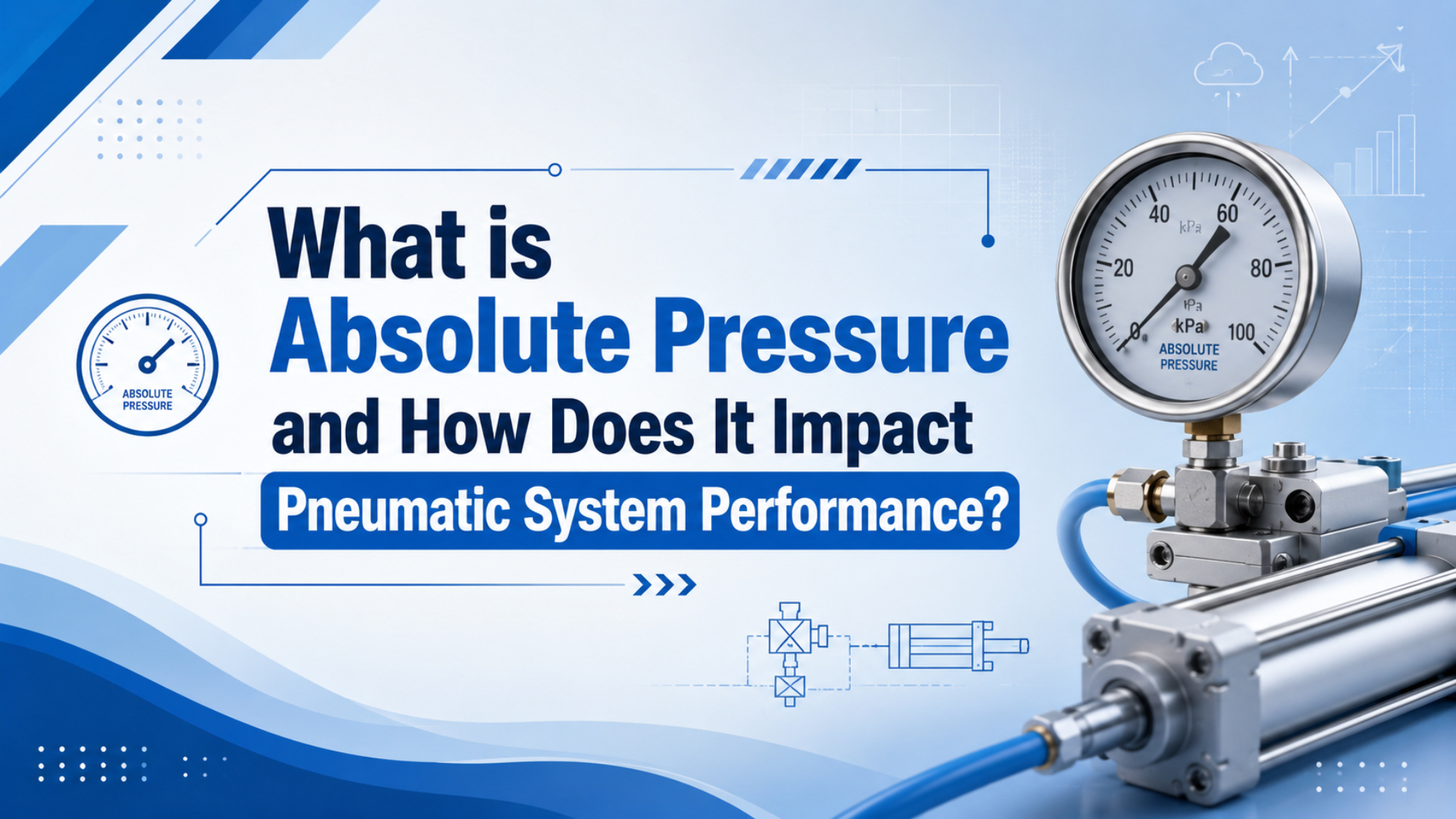
Absolute pressure is pressure measured from a perfect vacuum, while gauge pressure is measured from the local atmosphere. In pneumatic work, the distinction matters most when you calculate gas mass, compressor ratios, vacuum level, air density, flow through restrictions, or altitude effects. For simple cylinder force against a vented exhaust side, gauge pressure is usually still the right working pressure.
At sea level, standard atmospheric pressure is about 14.696 psi, 101.325 kPa, or 1.01325 bar (NOAA NDBC). That means an 80 PSIG plant air header is not 80 PSIA. It is about 94.7 PSIA. That extra 14.7 psi is invisible on a normal shop gauge, but it is still part of the gas calculation.
Key Takeaways
- Absolute pressure equals gauge pressure plus local atmospheric pressure, so 80 PSIG at sea level is 94.7 PSIA (NOAA NDBC).
- Use gauge pressure for basic cylinder force, but use absolute pressure for gas laws, compressor ratios, vacuum, altitude, and mass-flow work.
- Always write PSIA, PSIG, bara, or barg. Ambiguous “psi” causes preventable sizing errors.
Table of Contents
- What Is Absolute Pressure and How Is It Different from Gauge Pressure?
- Pressure References Used in Pneumatic Systems
- Why Do Pneumatic Gas Laws and Compressor Ratios Need Absolute Pressure?
- How Does Altitude Change Absolute Pressure in Pneumatic Systems?
- Absolute Pressure Conversion Checks
- What Mistakes Cause Absolute Pressure Calculation Errors?
- FAQ
What Is Absolute Pressure and How Is It Different from Gauge Pressure?
Absolute pressure is measured from zero pressure, while gauge pressure is measured from local atmospheric pressure. The U.S. Department of Energy defines absolute pressure as total pressure measured from zero in its compressed-air sourcebook glossary (DOE Sourcebook, 2022). In shop terms, PSIA = PSIG + local atmospheric pressure.
The easiest way to avoid mistakes is to ask one question before doing the math: “Does this formula compare pressure to the atmosphere, or does it compare one gas state to another gas state?” If it compares gas states, use absolute pressure. If it is simple actuator force from plant air against a vented exhaust side, gauge pressure is usually correct.
| Reference | Zero point | Common unit labels | Typical pneumatic use |
|---|---|---|---|
| Absolute pressure | Perfect vacuum | PSIA, bara, kPa absolute | Gas laws, compressor ratios, vacuum, air density |
| Gauge pressure | Local atmosphere | PSIG, barg, kPa gauge | Regulator settings, cylinder thrust, line pressure |
| Differential pressure | Another process point | PSID, bar dP, kPa dP | Filter drop, valve drop, flow measurement |
| Vacuum gauge reading | Local atmosphere downward | inHg vacuum, negative PSIG | Vacuum cups, evacuation, leak checks |
So what does that look like at a machine? A regulator set to 6 bar gauge in a factory near sea level is about 7.013 bar absolute, because local atmosphere adds roughly 1.013 bar. A pressure transducer configured for absolute pressure will show that full value. A normal pneumatic gauge will show the useful pressure above the room around it.
Pressure References Used in Pneumatic Systems
Most pneumatic gauges report pressure above local atmosphere, not total gas pressure. NOAA explains that air pressure comes from the weight of the air above a location, with sea-level standard pressure near 14.7 psi (NOAA NDBC). That local reference is why PSIG and PSIA must never be mixed without conversion.
A gauge mounted on a regulator is deliberately referenced to the room, because that is what the actuator “feels” when the other side exhausts to the same room. That is why the basic force equation for a double-acting cylinder is normally:
Force = gauge pressure x effective piston areaFor a bore-side extension stroke, use the bore area. For a rod-side retraction stroke on a standard rod cylinder, subtract the rod area first. For a rodless cylinder, the useful area depends on the sealing band and piston design, so use the catalog effective area rather than guessing from only the body size.
Where does absolute pressure enter? It enters when the air itself is the object of the calculation. Need to know how much air mass sits in a receiver? Use absolute pressure. Need to estimate compressor discharge temperature from a pressure ratio? Use absolute pressure. Need to compare vacuum cup performance between a sea-level factory and a mountain facility? Use absolute pressure again.
In our experience, most field errors start with an unlabeled number. A drawing says “pressure: 6 bar,” a supplier reads it as barg, a simulation model reads it as bara, and the result is a quiet 1 bar reference error. The component may still move in a trial. The energy model, fill-time estimate, or vacuum calculation will not be trustworthy.
Why Do Pneumatic Gas Laws and Compressor Ratios Need Absolute Pressure?
Gas equations use absolute pressure because they describe physical gas state, not instrument offset. NASA Glenn presents the ideal gas relation as pressure times volume equals gas constant times temperature, with pressure tied to gas density and absolute temperature (NASA Glenn). For pneumatics, that means PSIG must be converted before using PV = nRT.
The same rule applies to compressor pressure ratio:
Compression ratio = discharge absolute pressure / suction absolute pressureAt sea level, a compressor discharging to 80 PSIG with atmospheric suction has:
Discharge absolute pressure = 80 + 14.7 = 94.7 PSIA
Suction absolute pressure = 14.7 PSIA
Compression ratio = 94.7 / 14.7 = 6.44:1
If someone divides 80 by 0, or 80 by 14.7, the ratio is wrong before the discussion even starts. This is not a small spreadsheet detail. Compressor ratio affects heat, staging, volumetric efficiency, receiver recovery, and whether a published compressor curve applies to the installation.
The Department of Energy notes that many industrial plants treat compressed air as a vital utility, with compressor systems ranging from small 5 hp units to systems above 50,000 hp (DOE Sourcebook, 2022). On that scale, a pressure-reference mistake can waste energy long before it causes a visible motion failure.
This also affects flow through restrictions, valves, and orifices. When you size a valve for a pneumatic control system, pressure ratio should use absolute pressure. If the upstream side is 6 barg, the upstream absolute pressure is about 7.013 bara, not 6 bar.
How Does Altitude Change Absolute Pressure in Pneumatic Systems?
Atmospheric pressure falls as elevation rises. NASA’s standard atmosphere model shows pressure decreasing from 14.7 psi at sea level to about 12.2 psi near 5,000 ft and about 10.1 psi near 10,000 ft (NASA Glenn). At the same 80 PSIG gauge setting, total absolute pressure is lower at altitude.
Here is the practical split. If a cylinder extends against the same local atmosphere on its exhaust side, its basic thrust is still based on gauge pressure. An 80 PSIG regulator still provides 80 psi of pressure difference across the active piston area, assuming the exhaust path is free and back pressure is small.
Absolute-pressure effects show up elsewhere:
- A receiver at altitude stores less air mass at the same PSIG and volume.
- A compressor at altitude has lower suction pressure and density.
- A vacuum cup has less atmospheric pressure available to push the workpiece against the cup.
- Flow models and pressure-ratio checks change because both sides must be absolute.
- Leak-rate and pressure-decay tests become more sensitive to local barometric changes.
That nuance matters. Saying “altitude reduces cylinder force by 3 percent per 1,000 ft” is too broad. The more defensible statement is: altitude reduces local atmospheric pressure, which changes absolute-pressure calculations for air mass, compressor intake, vacuum force, and pressure ratios. Cylinder thrust from a gauge-regulated, vented actuator is usually still calculated from gauge differential pressure.
For a mountain facility, document local atmospheric pressure in the design file. A machine built at sea level and installed around 5,000 ft may still pass actuator force checks, but the compressor intake, vacuum cups, fill-time estimate, and pressure-decay thresholds should be reviewed.
Absolute Pressure Conversion Checks
Pressure conversion is a two-step process: convert the reference, then convert the unit. Standard atmosphere is 101.325 kPa, 1.01325 bar, or 14.696 psi (NOAA NDBC). For international pneumatic projects, this means 5 barg is 6.013 bara before you convert it to psi or kPa.
Use these formulas first:
PSIA = PSIG + local atmospheric pressure
PSIG = PSIA - local atmospheric pressure
bara = barg + local atmospheric pressure in bar
barg = bara - local atmospheric pressure in bar
absolute vacuum pressure = local atmosphere - vacuum gauge pressure
Then convert units:
| Conversion | Factor |
|---|---|
| psi to kPa | 6.89476 |
| kPa to psi | 0.145038 |
| psi to bar | 0.0689476 |
| bar to psi | 14.5038 |
| inHg to psi | 0.491154 |
| psi to inHg | 2.03602 |
Worked examples:
| Given | Local atmosphere | Correct result | Notes |
|---|---|---|---|
| 80 PSIG | 14.7 PSIA | 94.7 PSIA | Sea-level plant air |
| 80 PSIG | 12.2 PSIA | 92.2 PSIA | About 5,000 ft standard atmosphere |
| 5 barg | 1.013 bar | 6.013 bara | Common European specification |
| 25 inHg vacuum | 14.696 PSIA | 2.42 PSIA | 14.696 - (25 x 0.491154) |
| 600 kPa gauge | 101.325 kPa | 701.325 kPa absolute | Standard-atmosphere assumption |
I use a simple review rule in design checks: if a calculation includes volume, temperature, density, mass, compressor ratio, or vacuum, every pressure value on that line must carry an “a” or “g” suffix. No suffix, no approval. It sounds fussy until one unlabeled value changes a compressor selection.
What Mistakes Cause Absolute Pressure Calculation Errors?
The most common error is using gauge pressure inside formulas that need absolute pressure. NIST lists absolute and differential pressure calibration ranges from 0.1 Pa to 360 kPa for low-pressure manometry (NIST). That distinction exists because pressure reference is part of the measurement, not a formatting detail.
Mistake one: using PSIG in gas laws. If you put 80 into PV = nRT when the condition is actually 80 PSIG at sea level, you are ignoring 14.7 psi of atmospheric pressure. The corrected input is 94.7 PSIA. The relative error is not small when pressures are near normal plant-air ranges.
Mistake two: using gauge pressure for compressor ratio. Compressor suction is not zero just because the inlet is open to atmosphere. At sea level, atmospheric suction is about 14.7 PSIA. A discharge of 80 PSIG is about 94.7 PSIA, so the ratio is 6.44:1.
Mistake three: treating vacuum inches as absolute pressure. A 25 inHg vacuum reading means 25 inches of mercury below local atmosphere. It does not mean 25 PSIA, and it does not mean negative absolute pressure. At sea level, 25 inHg vacuum is about 2.42 PSIA.
Mistake four: mixing barg and bara across supplier documents. This happens often when a European datasheet, a North American compressor package, and an Asian machine drawing meet in the same project folder. Spell out the reference in the RFQ and in the acceptance test.
Mistake five: using Celsius or Fahrenheit directly in gas-law calculations. Absolute pressure belongs with absolute temperature: Kelvin for metric work, Rankine for inch-pound work. NASA’s ideal gas equation links pressure, density, gas constant, and temperature, so pressure and temperature references both need to be absolute (NASA Glenn).
For actuator sizing, keep the distinction clean. A pneumatic cylinder force calculation normally uses gauge pressure because the opposite side vents to local atmosphere. A compressor, vacuum cup, receiver storage, mass-flow model, or leak test may need absolute pressure. Same system, different question.
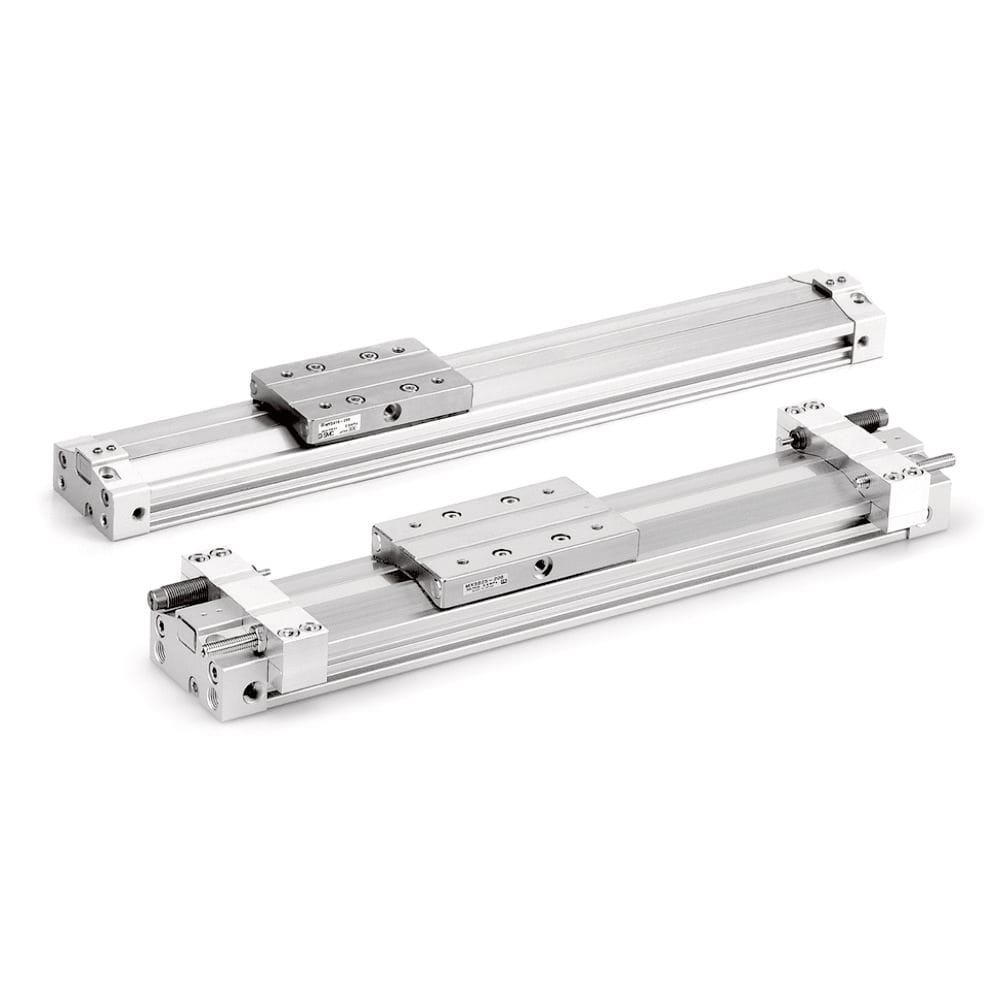
If the project involves rodless pneumatic cylinders, rodless air slides, valves, FRL units, or long tubing runs, document pressure type in every calculation sheet. It keeps the motion calculation, air-consumption estimate, and compressor sizing model from quietly drifting apart.
FAQ
What is absolute pressure in pneumatics?
Absolute pressure is total pressure measured from a perfect vacuum. At sea level, a line at 80 PSIG is about 94.7 PSIA because standard atmosphere adds about 14.7 psi (NOAA NDBC). Use PSIA or bara when calculations involve gas mass, density, compressor ratio, vacuum, or temperature.
Is pneumatic cylinder force calculated with absolute pressure or gauge pressure?
Basic pneumatic cylinder force is usually calculated with gauge pressure: force equals PSIG times effective piston area. That works because the exhaust side normally vents to the same local atmosphere. Use absolute pressure when the question changes to air mass, receiver storage, vacuum force, compressor ratio, flow ratio, or temperature correction.
How do I convert PSIG to PSIA?
Add local atmospheric pressure to the gauge pressure. At sea level, 80 PSIG plus 14.7 psi equals 94.7 PSIA. At about 5,000 ft standard altitude, local atmosphere is closer to 12.2 PSIA (NASA Glenn), so 80 PSIG is about 92.2 PSIA.
Why does compressor pressure ratio use absolute pressure?
Compressor pressure ratio compares gas state at discharge with gas state at suction, so both values must be absolute. For 80 PSIG discharge at sea-level atmospheric suction, the ratio is 94.7 divided by 14.7, or 6.44:1. Using gauge pressure hides the real inlet pressure and misstates compressor work.
How does altitude affect vacuum cups?
Vacuum cups depend on atmospheric pressure pushing the part against the cup. Near sea level, standard atmosphere is about 14.7 PSIA; near 5,000 ft it is about 12.2 PSIA (NASA Glenn). The same gauge vacuum can therefore create less absolute pressure difference at altitude.
Sources
- NOAA NDBC: What is air pressure?
- NASA Glenn: Earth Atmosphere Model
- NASA Glenn: Equation of State, Ideal Gas
- U.S. Department of Energy: Improving Compressed Air System Performance, Sourcebook for Industry, Third Edition
- NIST: Pressure/Vacuum Calibrations
- YouTube: Absolute Pressure vs Gauge Pressure - Fluid Mechanics - Physics Problems