

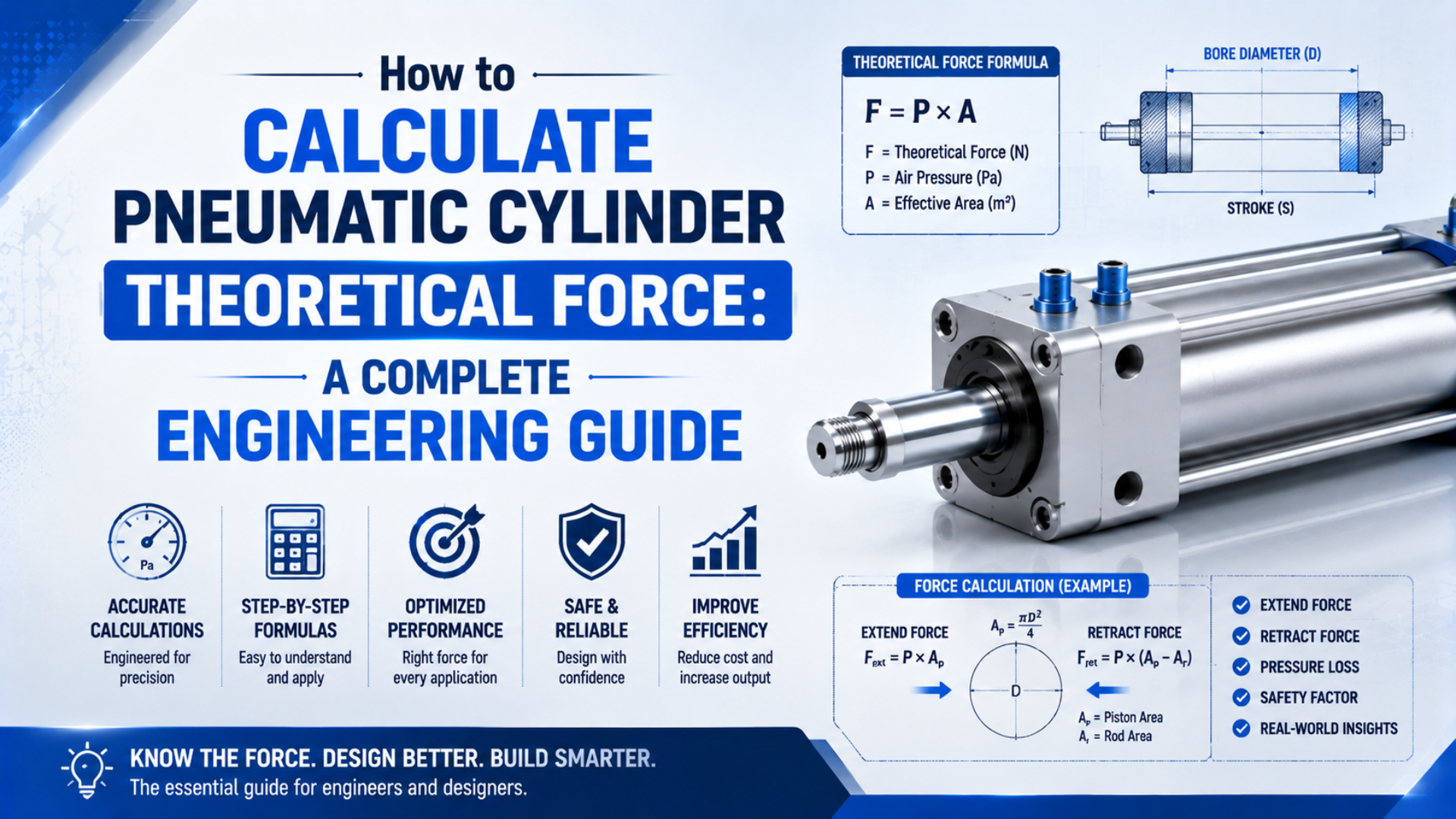
Pneumatic cylinder theoretical force is pressure multiplied by the area exposed to that pressure. For a simple extension calculation, a 2 inch bore at 80 psi produces about 251 lbf because its piston area is 3.14 in². That result is correct only when 80 psi reaches the cap end and opposing pressure is negligible.
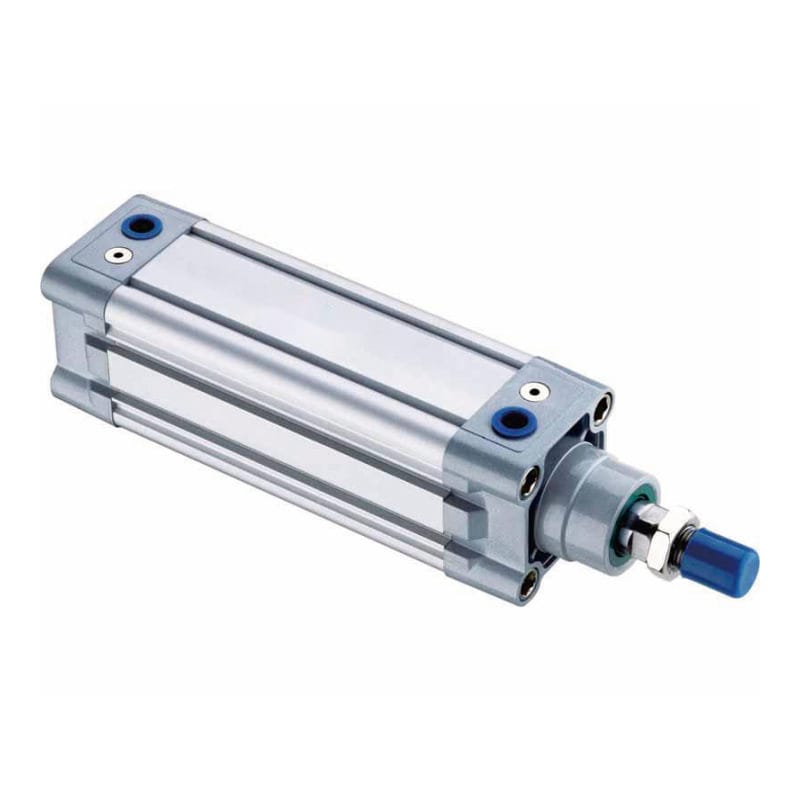
The full engineering check must identify the cylinder geometry, direction of motion, pressure at both ports, and the meaning of the catalog rating. A single-rod cylinder has different extension and retraction areas. A double-rod cylinder can have equal annular areas. Rodless and tandem designs bring their own product limits.
This article focuses on theoretical-force verification. For load-ratio selection and usable-force margins, use the separate guide to force factors in pneumatic cylinder selection. For a broader pressure-area sizing workflow, see calculating force from pressure and area.
Key Takeaways
- A 2 inch bore at 80 psi produces 251 lbf of ideal extension force.
- Single-rod retraction uses piston area minus rod area.
- Back pressure must act on the opposite effective area, not be hidden inside a fixed efficiency factor.
- Catalog verification starts by recovering area from the listed force and pressure.
What Does Pneumatic Cylinder Theoretical Force Mean?
Theoretical cylinder force is the pressure-produced force before seal friction, guide drag, acceleration, and external loads are deducted. Parker lists 3.14 in² piston area for a 2 inch bore and 251 lbf push force at 80 psi, the direct result of pressure multiplied by area (Parker, retrieved 2026).
The familiar relationship is:
Here, is theoretical force, is the pressure acting across the relevant surface, and is effective area. When pressure is in psi and area is in square inches, force is in lbf. When pressure is in MPa and area is in mm², force is in newtons.
That short equation needs one important qualification. A piston normally has pressure on both sides. The pressure-only extension force of a double-acting single-rod cylinder is therefore:
is cap-end pressure, is rod-end pressure, is full piston area, and is the rod-side annular area. All pressure values must use the same reference, usually gauge pressure measured at the ports. Friction is still excluded.
For retraction, write the force magnitude in the retracting direction as:
If the opposite chamber exhausts freely, its gauge pressure approaches zero and the basic calculation is recovered. During a fast stroke or with a restricted exhaust, that assumption may not hold. The guide to back pressure in pneumatic systems explains how exhaust-side pressure develops.
The word “theoretical” should identify what has been omitted, not merely signal that the number is optimistic. Record the two port pressures, two effective areas, and motion direction beside every force value. That notation makes a catalog number, calculation sheet, and machine test directly comparable.
How Should You Calculate Force for Each Cylinder Geometry?
Cylinder geometry determines effective area before any safety margin is considered. ISO 15552 covers interchangeable single-rod and double-rod pneumatic cylinders with bores from 32 to 320 mm and a maximum rated pressure of 1,000 kPa, or 10 bar (ISO 15552:2018, confirmed 2025).
Start with the piston, rod, and annular areas:
Effective area is the surface area that contributes pressure force in the selected direction. Here, is cylinder bore, is rod diameter, is full piston area, is rod cross-sectional area, and is the remaining annular area. Use catalog bore and rod dimensions, not outside tube diameter.
| Cylinder geometry | Ideal extension force | Ideal retraction force | Verification note |
|---|---|---|---|
| Single-rod, double acting | Retraction is lower because the rod removes area. | ||
| Double-rod, equal rods | Equal rod diameters give equal annular areas. | ||
| Mechanically coupled rodless | Check seal friction, guide limits, and catalog thrust. | ||
| Magnetically coupled rodless | Magnetic coupling force may be lower than pressure force. | ||
| Tandem with active stages | Confirm which chambers are pressurized and sum their effective areas. | ||
| Single acting with spring | Product-specific | Include spring force at the actual stroke position. |
These are ideal, one-pressure equations with the opposite chamber treated as vented. Use the two-pressure equations from the previous section when back pressure is measurable.
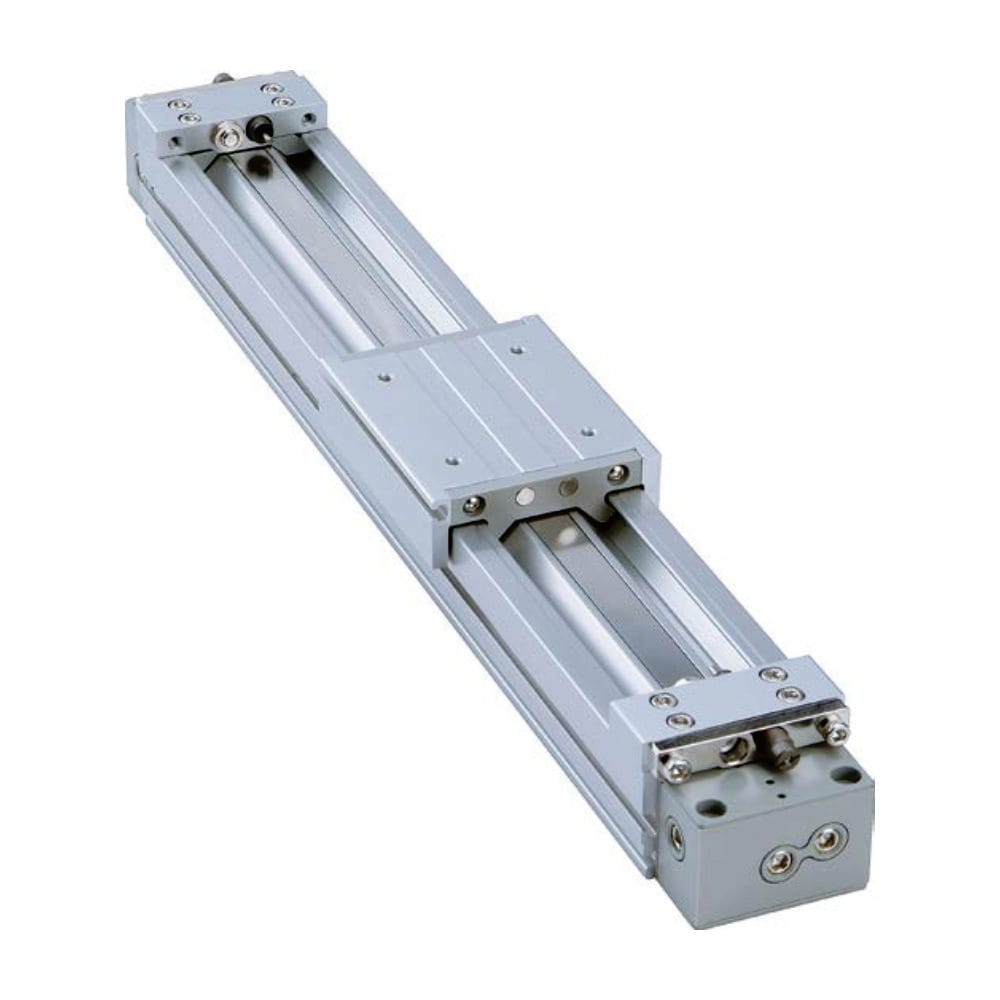
SMC states that theoretical output for its MY3 mechanically jointed rodless cylinder equals pressure in MPa multiplied by piston area in mm² (SMC MY3 catalog, retrieved 2026). That confirms the pressure-area calculation, but the same catalog must still be checked for load mass, moments, speed, and cushioning.
For tandem cylinders, the sum is physical rather than promotional. SMC describes its XC12 as two air cylinders in line and states that supplying both corresponding chambers doubles output force (SMC, retrieved 2026). Parker similarly describes two cylinders connected in series as providing almost twice the force (Parker, retrieved 2026). For the full selection implications, see the guide to tandem cylinder force multiplication.
How Do You Calculate Force Without a Unit Error?
Unit consistency turns the same physical relationship into a reliable answer across supplier catalogs. NIST lists 1 psi as 6,894.757 Pa, while its SI guide defines 1 bar as 100 kPa (NIST pressure conversions, retrieved 2026; NIST SI Guide, retrieved 2026).
Use either of these matched unit systems:
| Pressure | Area | Force result |
|---|---|---|
| psi | in² | lbf |
| MPa | mm² | N |
| bar | mm² | N after multiplying by 0.1 |
The metric shortcuts follow from exact unit relationships:
Because 1 MPa equals 1 N/mm², the numerical multiplication needs no extra conversion factor.
When pressure is given in bar:
The grouped leading factor is part of the formula: 1 bar equals 0.1 N/mm². A 10-times error appears when bar is treated as though it were MPa.
For mixed supplier documentation, convert every pressure to one unit before comparing force. The Pressure Converter handles bar, psi, MPa, and kPa, but keep the unrounded pressure in the worksheet until the final result.
Worked Calculations for Three Common Verification Checks
Worked checks should reproduce a catalog result before they are used to challenge one. Parker’s theoretical-force table reports 251 lbf for a 2 inch bore at 80 psi and lists separate push and pull values by effective area (Parker, retrieved 2026).
Example 1: 2 Inch Bore at 80 psi
For a 2 inch bore, piston area is:
The ideal extension force is:
The result agrees with Parker’s rounded 251 lbf table value. It assumes the cap-end pressure is 80 psig at the cylinder, rod-end back pressure is negligible, and friction is excluded.
Example 2: 63 mm Bore, 20 mm Rod at 0.6 MPa
The full piston and rod areas are:
The annular area is 2803.0 mm². At 0.6 MPa, theoretical forces are:
Retraction is about 188.5 N lower because the 20 mm rod removes 314.2 mm² from the pressure-acting surface. The related guide to effective piston area develops this geometry in more detail.
Example 3: Include Rod-End Back Pressure
Suppose the 2 inch cylinder has a 0.625 inch rod, 80 psig at the cap end, and 8 psig at the rod end during extension. The annular area is 2.8348 in². Pressure-only extension force becomes:
Ignoring the 8 psi back pressure would overstate pressure force by 22.7 lbf, or about 9.9% relative to the corrected result. That percentage belongs to this measured condition. It is not a universal cylinder-efficiency factor.
A defensible worked example carries its assumptions into the answer. “251 lbf theoretical extension force at 80 psig with negligible rod-end pressure” is useful. “This cylinder makes 251 lbf” is incomplete because it hides the pressure location, direction, and loss boundary.
How Can You Audit a Manufacturer’s Force Table?
A force table can be checked by reversing its own numbers. Parker’s 2 inch, 80 psi entry gives 251 lbf; dividing force by pressure recovers 3.1375 in², and converting that area back to diameter gives approximately 2.00 inches (Parker, retrieved 2026).
In our application reviews, we found that writing the implied area beside each supplier force value exposes mismatched directions and units quickly. The check takes less time than debating a rounded force number, and it gives both engineering and purchasing teams a common value to compare before dimensions or pricing are reviewed.
Use this reverse check:
is catalog force, is the stated pressure, is the implied effective area, and is the equivalent full-bore diameter. For pull-force entries, compare the recovered area with annular area instead of full piston area.
Check these six items before accepting the table:
- Force type: Is it theoretical force, permissible load, stall force, breakaway force, or a tested minimum?
- Direction: Does the entry apply to extension, retraction, or both?
- Pressure reference: Is pressure measured at the cylinder port, regulator outlet, or nominal supply?
- Area basis: Does the table use full piston area, annular area, multiple pistons, or another mechanism?
- Mechanical limit: Is a magnetic coupling, guide, rod, mount, or lock rated below pressure force?
- Rounding: Was force rounded from area, or was area rounded from nominal dimensions?
ISO 15552 establishes mounting and dimensional interchangeability, not a universal guarantee of identical thrust among every cylinder that fits the interface. Its scope includes single-rod and double-rod cylinders up to 10 bar, but seal design, rod diameter, allowable side load, cushioning, and product ratings remain manufacturer-specific (ISO 15552:2018, confirmed 2025).
For an RFQ or replacement review, record bore, rod diameter, stroke, motion direction, pressure at both ports, required load, speed, mounting, and the exact force label from the source catalog. That data is enough to expose most area or unit mismatches before a sample is ordered.
From Theoretical Force to Allowable Design Load
Net pressure force is the result after both piston-face pressures are included, while theoretical catalog force often assumes one stated pressure and a vented opposite chamber. Parker’s P1S catalog advises selecting theoretical force 50% to 100% above required force for that series, while SMC applies load factors by motion type (Parker, retrieved 2026; SMC, retrieved 2026).
Keep four terms separate:
| Term | What it includes | Appropriate use |
|---|---|---|
| Theoretical force | Stated pressure multiplied by geometry area | Formula and catalog-table check |
| Net pressure force | Pressure on both sides acting on their respective areas | Dynamic pressure diagnosis |
| Estimated available force | Net pressure force minus measured or documented friction | Application estimate |
| Allowable design load | Manufacturer limits, load factor, dynamics, mounting, and safety requirements | Final selection |
There is no universal equation that turns every cylinder’s theoretical force into actual force by multiplying by 0.85. Seal friction changes with construction, lubrication, pressure, speed, temperature, wear, and the difference between breakaway and running motion. Pressure loss belongs in the measured port pressures. Side loading belongs in the mechanical design.
A manufacturer may publish a sizing allowance for a specific family. Parker’s P1S catalog, for example, tells users to select a theoretical force 50% to 100% larger than required for that product context (Parker P1S catalog, retrieved 2026). Apply the documented rule once. Do not multiply by a generic efficiency factor and then add another unexplained safety factor for the same uncertainty.
Margins are clearer when each one has an owner. The pneumatic designer owns port pressure and valve flow. The mechanical designer owns load, alignment, acceleration, and mounting. The product catalog owns allowable limits. A single unexplained percentage hides which assumption needs to be tested.
When Does Theoretical Force Stop Being the Selection Limit?
Force is only one product limit. SMC’s current guided-cylinder selection software evaluates operating pressure, piston speed, load mass, mounting position, moment, and kinetic energy before judging whether a selection is allowable (SMC, retrieved 2026). A passing pressure-area calculation can still fail those checks.
Review these limits before increasing bore or pressure:
- Side load and moment: A cylinder piston bearing is not a substitute for an external linear guide. Misalignment raises friction and shortens seal and bearing life. See the guide to side loading on linear actuators.
- Rod buckling: Long compression strokes may reach a rod stability limit before theoretical push force is usable.
- Cushion energy: Higher bore and pressure can accelerate the same mass harder, increasing energy that must be absorbed near end of stroke.
- Valve and tube flow: A static regulator setting does not prove that target pressure reaches the chamber during motion.
- Rodless coupling and guide ratings: A magnetic coupling or carriage moment limit may be lower than calculated piston force.
- Tandem synchronization and porting: Both stages must receive the intended pressure for summed force to be available.
- Maximum rated pressure: Never raise pressure beyond the lowest rating among the cylinder, valve, regulator, fittings, tubing, and accessories.
Temperature deserves a precise interpretation. At the same measured chamber pressure, theoretical static force remains pressure times area. Temperature can still change seal friction, lubricant behavior, material limits, supply pressure, and transient filling. Use the product’s temperature range and measured operating pressure rather than applying a fixed density-based force penalty.
A Defensible Force Verification Workflow
One page of traceable inputs is more useful than a long chain of allowances. NIST gives 6,894.757 Pa per psi, Parker publishes direction-specific theoretical tables, and ISO 15552 defines a 32 to 320 mm interchangeable cylinder series rated to 10 bar (NIST, retrieved 2026; Parker, retrieved 2026; ISO, confirmed 2025).
Use this sequence:
- Identify cylinder geometry and motion direction.
- Record bore, rod diameter, and the number of active piston stages.
- Convert all dimensions and pressures into one matched unit system.
- Calculate full piston, rod, and annular areas.
- Calculate theoretical force from the catalog pressure assumption.
- Repeat with both measured port pressures if back pressure is relevant.
- Reverse-check the catalog entry by recovering implied effective area.
- Apply only the manufacturer’s documented load factor or application method.
- Verify rod, guide, coupling, mount, speed, cushioning, and pressure ratings.
- Put the assumptions beside the result before releasing the RFQ or design.
This workflow deliberately stops before bore optimization. If the verified force is too low, a separate cylinder-sizing calculation can connect required area to bore, speed, and air consumption. Keeping the tasks separate prevents a rounded catalog value from silently becoming a final machine-load rating. For an unresolved replacement table, the technical contact page provides a place to send the model, pressure, and dimensional data together.
Pneumatic Cylinder Force FAQs: What Should Engineers Verify?
Common questions come back to pressure reference, area, and rating type. Parker’s table lists 251 lbf for a 2 inch bore at 80 psi and separates push from pull values, while SMC uses application-specific load factors instead of one universal efficiency percentage (Parker, retrieved 2026; SMC, retrieved 2026).
What is the basic formula for pneumatic cylinder theoretical force?
The basic formula is , where pressure acts on the effective piston area for the selected direction. Use full piston area for ideal single-rod extension and annular area for ideal retraction. If the opposite chamber has back pressure, calculate its opposing force on its own effective area and subtract it.
Should cylinder force use gauge pressure or absolute pressure?
For a vented pneumatic cylinder, use gauge pressures measured from the same atmospheric reference, preferably at both cylinder ports during the relevant motion. Absolute pressure is needed for gas-state and air-consumption calculations, but adding atmospheric pressure to one side of a basic force equation would overstate the available pressure difference.
Why is single-rod cylinder retraction force lower than extension force?
The rod occupies part of the piston face during retraction, so pressure acts on annular area rather than the full piston area. A 63 mm bore with a 20 mm rod has 3,117.2 mm² full area but only 2,803.0 mm² retract area, reducing ideal force by 188.5 N at 0.6 MPa.
Does temperature directly reduce theoretical cylinder force?
Not when the measured chamber pressure and effective area remain the same. Theoretical static force is still pressure multiplied by area. Temperature can change seal friction, lubricant viscosity, allowable materials, regulator behavior, and filling dynamics, so verify the product temperature range and operating port pressure instead of applying a fixed percentage correction.
How much safety factor should be applied to theoretical force?
There is no universal value for every pneumatic cylinder and application. Use the manufacturer’s load-ratio or sizing method for the specific product, then check gravity, acceleration, pressure variation, friction, alignment, and safety functions separately. Avoid stacking a generic efficiency factor with another margin when both cover the same uncertainty.
Sources and technical references
- Parker Pneumatic Actuator Products, theoretical push and pull areas and force tables. Retrieved 2026-07-19.
- ISO 15552:2018, interchangeable single-rod and double-rod cylinder scope, 32 to 320 mm bores, and 10 bar maximum rated pressure. Confirmed 2025; retrieved 2026-07-19.
- NIST Pressure and Gas Flow Unit Conversions, psi and pascal conversion values. Retrieved 2026-07-19.
- SMC MY3 Mechanically Jointed Rodless Cylinder Catalog, theoretical output relationship and rodless-cylinder selection data. Retrieved 2026-07-19.
- SMC Made to Order Common Specifications, tandem cylinder construction and doubled output-force description. Retrieved 2026-07-19.