

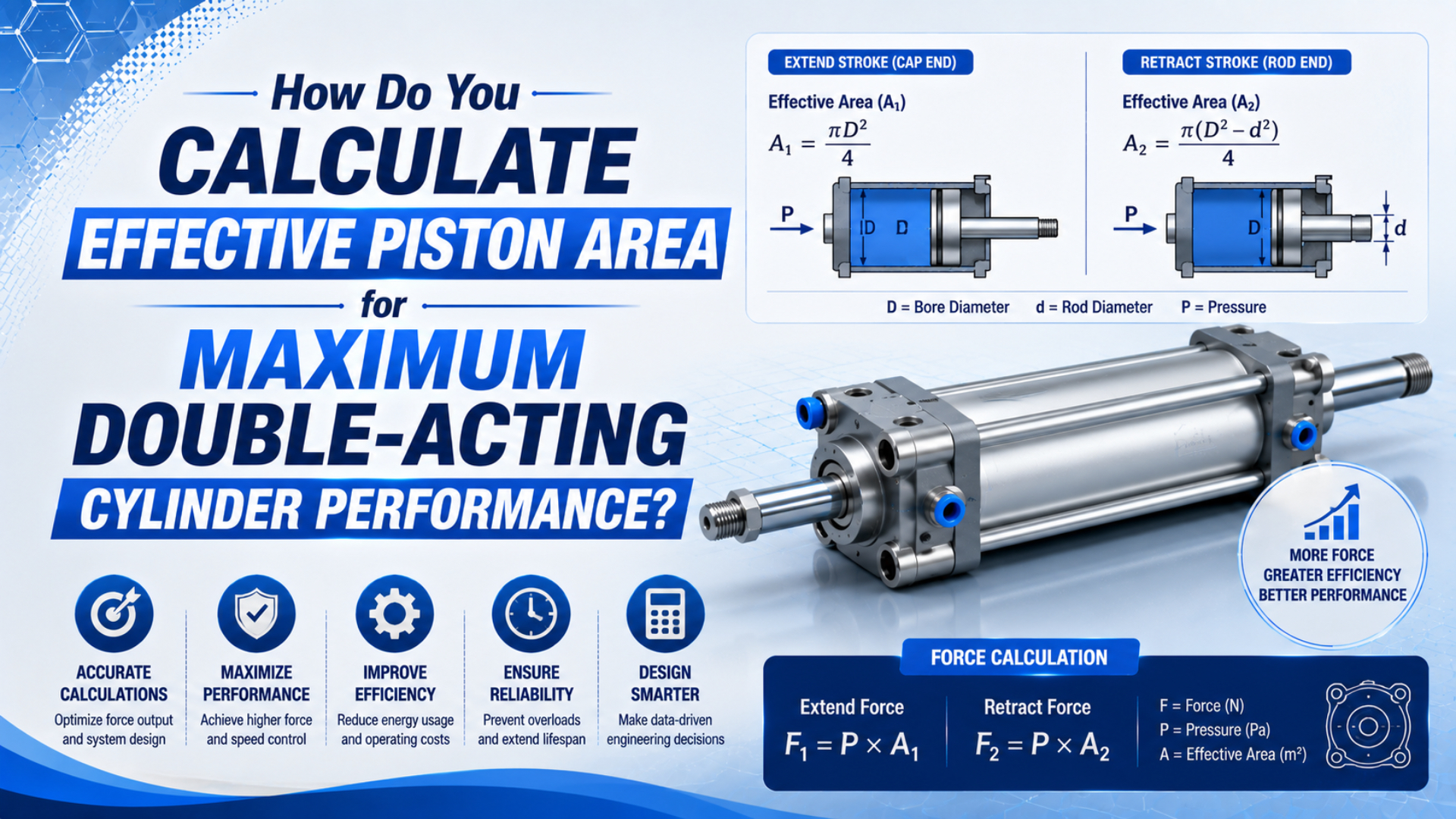
For a conventional single-rod double-acting cylinder, use the full bore area during extension and subtract the rod area during retraction. That gives the two geometric effective areas. To predict real force, apply the pressure difference across the piston and account separately for exhaust back pressure, friction, gravity, acceleration, and the manufacturer’s load-ratio method.
Key Takeaways
- Parker lists a 63/20 mm P1F cylinder at 31.2 cm² extension area and 28.0 cm² retraction area.
- Rod area reduces pull force but can increase retract speed at the same chamber flow.
- Effective area is geometry; pressure loss and friction reduce usable force, not physical area.
This distinction keeps the article separate from the broader pneumatic cylinder formula guide and the general pressure-area-force worksheet. Here, the job is narrower: calculate both pressure-receiving areas, understand their ratio, and carry those values into a defensible bidirectional performance check.
What Does Effective Piston Area Measure?
Parker’s current P1F catalog lists a 63 mm bore with a 20 mm rod at 31.2 cm² on the push stroke and 28.0 cm² on the return stroke. That difference shows what effective piston area measures: the pressure-receiving geometry available in each direction (Parker P1F catalog, 2026).
Effective piston area is the piston surface on which chamber pressure can produce axial force. On the cap side of a single-rod cylinder, pressure acts across the full circular bore. On the rod side, the rod occupies part of that circle, leaving an annulus.
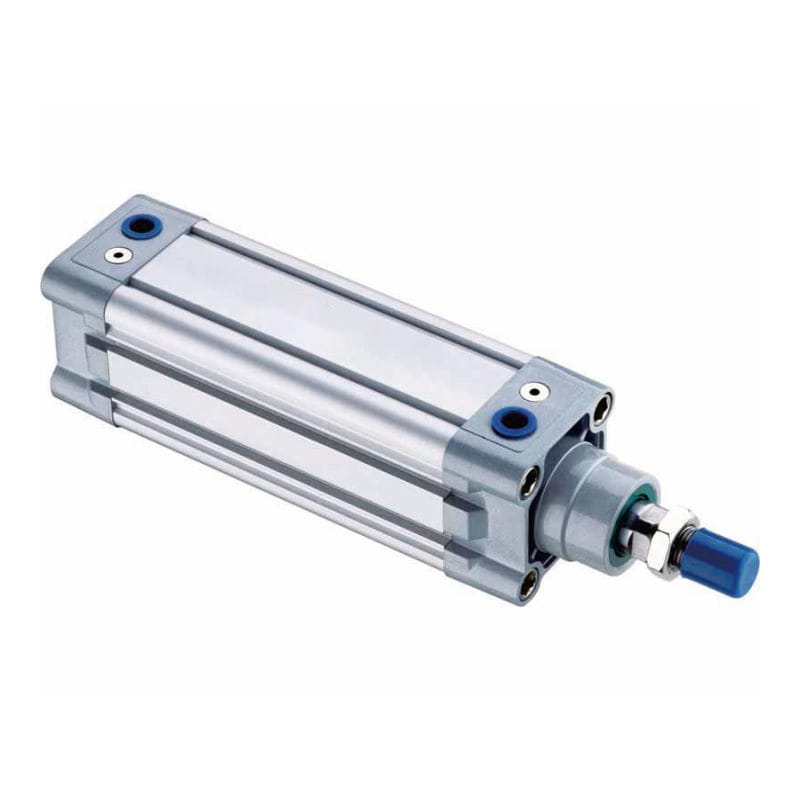
The geometry does not shrink because a valve is restrictive or a seal has friction. Those factors reduce delivered pressure, increase resisting force, or limit flow. Keeping geometry separate from system losses prevents a vague “area efficiency” percentage from hiding the actual cause of poor motion.
How Do You Calculate Extension and Retraction Area?
AutomationDirect lists a 4 inch bore at 12.57 in² and states that retraction area must account for the rod. Its 4 inch bore, 1 inch rod example leaves 11.78 in² on the retract side. The same geometry applies in metric units when all diameters use one unit (AutomationDirect, 2026).
Let be bore diameter and be rod diameter. The full piston area is:
is the extension-side effective area. If is in millimeters, is in square millimeters. Don’t insert the outside barrel diameter; use the published cylinder bore.
The rod cross-sectional area is:
The single-rod retraction area, also called annular area, is:
is the area on the rod side that can receive pressure. The dedicated pneumatic cylinder rod-area guide explains how to check rod measurements and unit conversions.
| Quantity | Formula | Use |
|---|---|---|
| Full piston area | Extension geometry | |
| Rod area | Area removed by the rod | |
| Annular area | Retraction geometry | |
| Area difference | Geometric difference between directions |
Keep the units visible. In SI workshop calculations, 1 MPa acting on 1 mm² produces 1 N. At 6 bar, the equivalent pressure is 0.6 MPa or 0.6 N/mm². NIST’s pressure table gives the formal conversion basis: 1 bar equals 100,000 Pa and 1 psi equals 6,894.757 Pa (NIST, retrieved 2026-07-19).
How Does Rod-to-Bore Ratio Change Retraction Performance?
Festo’s annular-area training sheet defines the retract area as full piston area minus rod area and asks users to compare the two as an area ratio. Because both circles contain the same constant, the ratio depends only on , not on the chosen measurement unit (Festo LabVolt, 2026).
Divide the annular area by the full piston area:
is the retract-to-extend area ratio. At equal pressure differential and before friction, it is also the theoretical retract-to-extend force ratio.
This ratio is the quickest bidirectional screening tool. It exposes why a small change in rod-to-bore ratio can matter more than a minor manufacturing tolerance. The rod ratio is squared, so a rod equal to half the bore leaves only 75% of the extension area for retraction.
| Rod-to-bore ratio | Retraction area ratio | Theoretical pull-force reduction at equal differential pressure |
|---|---|---|
| 0.20 | 96.0% | 4.0% |
| 0.25 | 93.8% | 6.2% |
| 0.30 | 91.0% | 9.0% |
| 0.40 | 84.0% | 16.0% |
| 0.50 | 75.0% | 25.0% |
Rod ratio should come from the actual catalog configuration. A larger rod may be required for buckling resistance, side-load tolerance, mounting, or long stroke. Don’t reduce the rod just to improve retract force without checking structural requirements.
Worked Example: 63 mm Bore, 20 mm Rod, 6 bar
Parker’s P1F force table gives this exact configuration 1,870 N theoretical push force and 1,682 N theoretical return force at 6 bar. Recalculating the published geometry provides a useful independent check and shows where rounding enters catalog values (Parker P1F catalog, 2026).
For :
For :
Therefore:
The geometric area ratio is:
At a 6 bar differential pressure, use :
and are theoretical pressure forces. They are not recommended payloads. The close agreement with Parker’s rounded table values confirms the geometry and unit conversion, but the machine still needs a load-ratio, speed, mounting, and cushioning review.
If the required force is known but the bore is not, use the Cylinder Bore Size Calculator as a secondary reverse-sizing check. The article on choosing a cylinder bore for energy efficiency covers standard-bore selection after the required area is known.
Which Pressure Values Belong in the Real Force Balance?
AutomationDirect states that cylinder force uses differential pressure across the two ports and that its simple force tables assume negligible back pressure. It also warns that line and valve flow losses require separate allowance. Therefore, a regulator setting alone cannot prove the force available during motion (AutomationDirect, 2026).
During extension, cap-side pressure drives the full piston area while rod-side exhaust pressure pushes against the annular area:
During retraction, rod-side pressure drives the annular area while cap-side exhaust pressure opposes it:
Here, and are simultaneous cap-side and rod-side pressures, expressed using the same reference. and are pressure-force balances before seal friction, guide friction, gravity, acceleration, and external process forces.
The symbols describe different operating instants. During extension, is normally the supplied chamber pressure and is exhaust back pressure. During retraction, those roles reverse. Don’t put the supply pressure into both terms or combine readings taken at different points in the cycle.
In our experience reviewing weak-cylinder complaints, two temporary port gauges reveal more than another area calculation. If cap-side pressure collapses while rod-side back pressure rises, the geometry may be correct and the actual restriction may sit in the valve, tubing, muffler, or flow-control path.
For the underlying physics, see how pressure differential creates pneumatic force. If the chamber pressure is lower than expected, use the compressed-air pressure-drop troubleshooting guide before selecting a larger bore.
How Does Effective Area Affect Speed and Air Consumption?
Parker publishes 31.2 cm² extension area and 28.0 cm² return area for its 63/20 mm P1F cylinder, a geometric ratio of about 0.899. With the same chamber volumetric flow, the smaller return area implies roughly 11% higher ideal retract speed, while its swept chamber volume is roughly 10% lower per millimeter of stroke (Parker P1F catalog, 2026).
The first-pass speed relationship is:
is piston speed, is chamber volumetric flow under the stated pressure condition, and is the effective area being filled. For equal , the smaller annular area produces a higher ideal retract speed.
The chamber’s swept volume is:
is swept volume and is stroke. Extension uses ; retraction uses . Compressor-side air consumption then requires the relevant pressure ratio, cycle rate, tubing volume, leakage allowance, and the method defined by the chosen calculator or manufacturer.
The same rod that reduces theoretical pull force also reduces retract-side chamber volume. That is a linked trade-off, not an efficiency bonus. A smaller chamber may fill faster and use less compressed air per stroke, but the valve’s exhaust capacity, meter-out setting, load, and cushioning can prevent the simple area ratio from appearing as the actual speed ratio.
The separate guide to air consumption in double-acting cylinders covers full-cycle volume and compressor-side conversion. It should not be replaced by one piston-area number.
When Is a Different Cylinder Architecture Better?
ISO 15552:2018 covers detachable-mounting pneumatic cylinders with single or double rods, bores from 32 mm to 320 mm, and a maximum rated pressure of 1,000 kPa (10 bar). The standard defines interchangeable dimensions; it does not make every rod arrangement equally suitable for bidirectional force or guidance (ISO 15552, confirmed 2025).
| Architecture | Effective-area behavior | Consider it when |
|---|---|---|
| Single-rod double-acting | Full bore on extension, annulus on retraction | Unequal bidirectional force and speed are acceptable |
| Double-rod double-acting | Rod area is removed on both sides | Similar area, force, and speed are needed in both directions |
| Tandem cylinder | Multiple piston areas contribute force | More force is needed without increasing bore, subject to length and synchronization checks |
| Rodless cylinder | No external piston rod area in the same sense | Stroke length, package space, and carriage guidance drive selection |
A double-rod cylinder can equalize geometric area, but it adds overall length and requires space for both rods. A tandem cylinder changes package length and air demand. A rodless cylinder changes load guidance and mounting questions. Effective area is one selection variable, not permission to ignore buckling, side load, alignment, cushion energy, or available flow.
If the motion needs equal force but only one external rod is acceptable, discuss circuit options with the component manufacturer. Regenerative or differential circuits change pressure and flow paths, so the basic same-pressure force ratio no longer describes the complete system.
Machine Verification Checklist
SMC’s air-cylinder selection guide recommends a load factor of 0.7 or less for stationary work and 0.5 or less for dynamic work in its stated selection method. Those values show why theoretical pressure force is a ceiling rather than a rated machine load (SMC Air Cylinders Model Selection, retrieved 2026-07-19).
Use one documented manufacturer selection method and record what it includes. Don’t subtract back pressure explicitly and then unknowingly deduct it again through a blanket loss factor.
Before approving the cylinder, verify:
- Geometry: catalog bore, rod diameter, single- or double-rod construction, and units.
- Direction: extension, retraction, vertical raise, vertical lower, clamp, or release.
- Pressure: minimum supply-side and maximum exhaust-side pressure during the hardest part of motion.
- Resistance: seals, guides, external friction, gravity, acceleration, process force, and misalignment.
- Flow: valve, tubing, fittings, flow controls, and exhaust path at the target stroke time.
- Structure: rod buckling, side load, mounting reactions, allowable moments, and frame deflection.
- Stopping: moving mass, cushion-entry speed, cushion energy, shock absorbers, and emergency deceleration.
- Acceptance: measured port pressure, force or load result, stroke time, repeatability, and temperature after stabilization.
The RFQ should contain the calculated , , and values, but it should also include the load sketch, orientation, stroke, cycle profile, available dynamic pressure, target speed, mounting, and environmental conditions. That lets a supplier reproduce the result instead of quoting from bore alone.
Accurate effective area calculation doesn’t “maximize” a cylinder by itself. It prevents a geometry error and makes directional performance visible. Maximum useful performance comes from matching that geometry with real chamber pressure, sufficient flow, a documented load ratio, correct mounting, and controlled stopping energy.
Double-Acting Cylinder Effective Area FAQs
Parker’s P1F table shows a 63/20 mm cylinder producing 1,870 N push and 1,682 N return force at 6 bar, before application losses. These FAQs clarify what that 10% directional difference means, when it changes, and which additional measurements are required before the result becomes a machine-selection value (Parker P1F catalog, 2026).
Is effective piston area the same as usable cylinder force?
No. Effective piston area is geometric pressure-receiving area. Theoretical force is pressure differential multiplied by that area. Usable machine force is lower after exhaust back pressure, seal and guide resistance, gravity, acceleration, and other loads are considered through the exact manufacturer’s selection method.
Why is retraction force lower in a single-rod double-acting cylinder?
The rod occupies part of the rod-side piston face, so retraction uses annular area rather than full bore area. At equal differential pressure, theoretical force falls in the same ratio as area. This statement does not apply unchanged to double-rod cylinders, regenerative circuits, or unequal chamber pressures.
Does pressure drop change effective piston area?
No. Pressure drop changes the pressure available to act on the fixed area. A restrictive supply path can lower driving pressure, while a restrictive exhaust path raises opposing back pressure. Measure both cylinder ports during motion before blaming bore or rod geometry for a force shortfall.
Can the retraction stroke be faster even though its force is lower?
Yes. For the same chamber volumetric flow, speed equals flow divided by effective area. The smaller annular area can therefore produce a faster ideal retract stroke. Actual speed also depends on valve flow, exhaust restriction, meter-out adjustment, load, pressure, cushioning, and compressible-air behavior.
Should I apply one universal safety factor to every cylinder calculation?
No. AutomationDirect uses a 25% starting allowance in its sizing method, while SMC publishes operating-case load factors such as 0.7 and 0.5. Use the method for the chosen cylinder and application. State which losses it covers so the same allowance is not counted twice.
Sources and technical references
-
Parker P1F Pneumatic Cylinders catalog - stroke-side surface areas, theoretical force tables, and air-consumption data. Retrieved 2026-07-19.
-
AutomationDirect Cylinder Sizing & Force - bore area, rod-side effective area, differential-pressure assumptions, and its 25% sizing allowance. Retrieved 2026-07-19.
-
SMC Air Cylinders Model Selection - theoretical output and operating-case load-factor guidance. Retrieved 2026-07-19.
-
ISO 15552:2018 - standard scope, 32-320 mm bore range, 1,000 kPa rating, and single/double-rod interchangeability dimensions. Confirmed 2025; retrieved 2026-07-19.
-
ISO 4414:2010 - general safety requirements for pneumatic systems and components. Confirmed 2021; retrieved 2026-07-19.
-
NIST Pressure and Gas Flow Unit Conversions - SI pressure conversion factors. Retrieved 2026-07-19.
-
Festo LabVolt Mechanical Systems: Annular Area Calculation - full piston area, rod area, annular area, and area-ratio calculation. Retrieved 2026-07-19.