

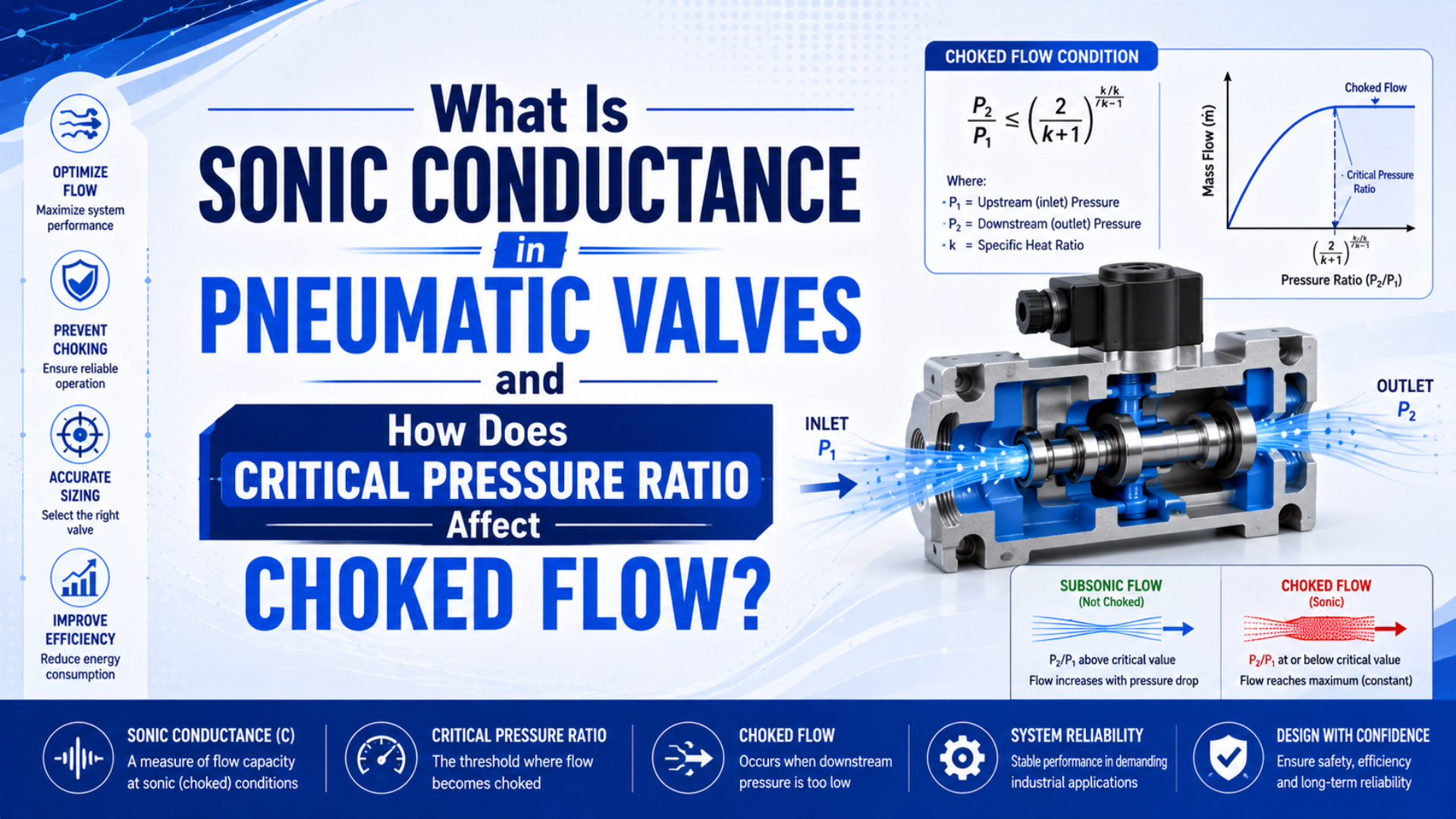
Sonic conductance in pneumatic valves is the flow-capacity value used when compressed air reaches sonic velocity at the smallest internal passage. In that condition, the valve is choked: lowering downstream pressure no longer increases mass flow unless upstream pressure, temperature, or the effective flow area changes.
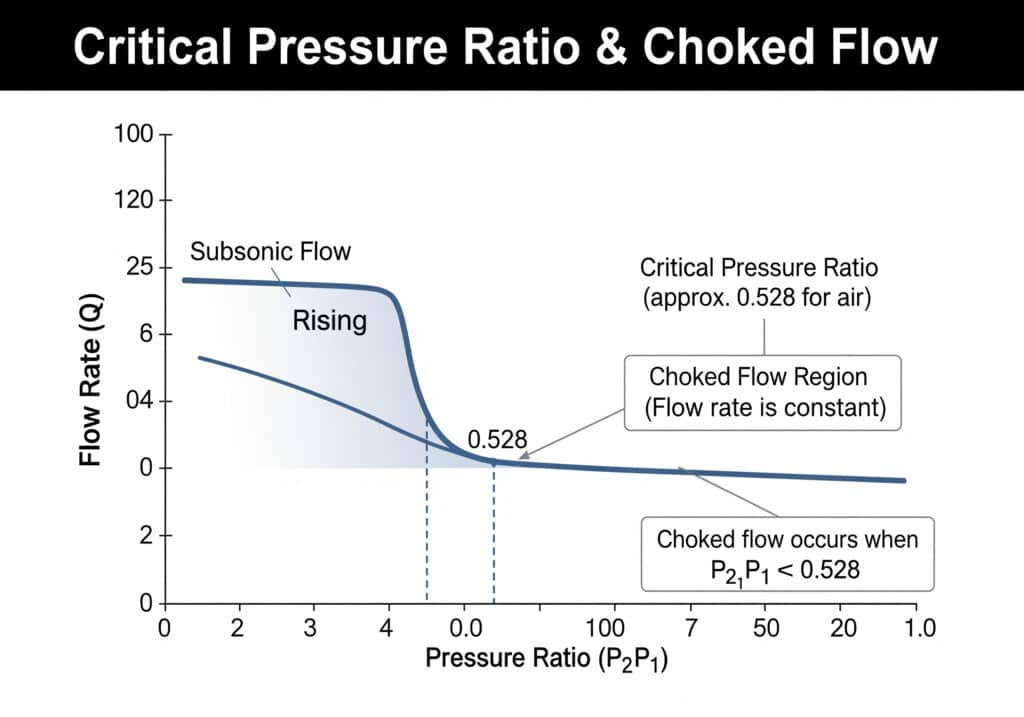
For dry air, the common engineering check is simple: if downstream absolute pressure divided by upstream absolute pressure is about 0.528 or lower, the valve path may be choked. That number comes from the isentropic pressure-ratio relation at Mach 1 using the usual dry-air heat-capacity ratio of 1.4.
Key Takeaways
- Sonic conductance is most useful when a pneumatic valve datasheet follows ISO 6358-style compressible-flow testing.
- For dry air,
p2 / p1 <= 0.528is the quick choked-flow warning point.- Use absolute pressure for pressure-ratio checks. Gauge pressure alone can give the wrong answer.
- Cv is still useful for first screening, but sonic conductance and critical pressure ratio explain why a valve can stop passing more mass flow.
In our experience, the costly mistake is not forgetting a formula. It is measuring only static regulator pressure. A valve can show healthy pressure at rest and still hit a sonic limit during the fast part of the stroke because the real restriction is inside the valve path, manifold, muffler, or tube fitting.
For a valve review, prepare measured P1, P2, flow, and valve model data before contacting the engineering team.
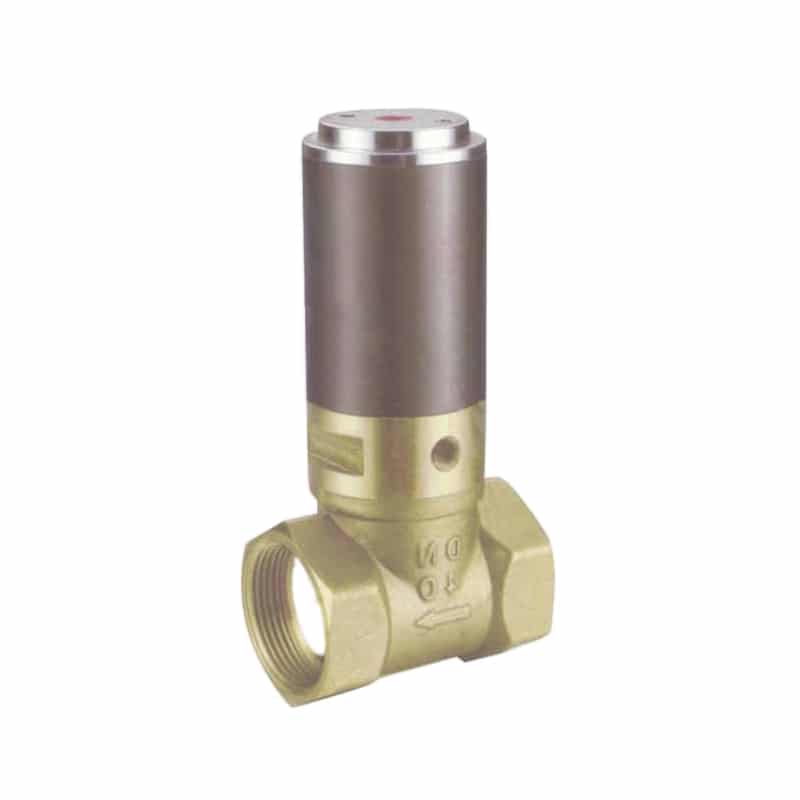
What is sonic conductance in a pneumatic valve?
Sonic conductance is a pneumatic component flow rating measured under compressible-flow conditions. Specifically, ISO 6358-1:2013 specifies steady-state testing for pneumatic components using gases and internal flow paths that can be fixed or variable (ISO 6358-1, 2013, confirmed 2022).
That definition makes sonic conductance different from a simple port size. A 1/4 inch port tells you the thread. It does not tell you the smallest internal throat, spool window, seal gap, elbow, or exhaust passage. Sonic conductance tries to describe the useful gas-flow capacity of that path.
Use the value when a datasheet gives C and b, or similar ISO 6358 flow-rate terms. C describes conductance. b describes the critical pressure ratio. Together, they explain both capacity and the transition into choked flow.
For broader catalog screening, keep the related Cv valve sizing guide nearby. Cv compares capacity. Sonic conductance explains the compressible-air limit behind that comparison.
How does critical pressure ratio decide choked flow?
Critical pressure ratio is the downstream absolute pressure divided by upstream absolute pressure at the sonic boundary. In particular, NASA’s isentropic relation fixes pressure ratio from Mach number, and its mass-flow page shows maximum airflow at Mach 1 (NASA Isentropic Flow Equations, 2021; NASA Mass Flow Choking, 2021).
For a dry-air estimate, use:
critical pressure ratio = (2 / (gamma + 1)) ^ (gamma / (gamma - 1))With gamma = 1.4, the result is:
critical pressure ratio = 0.528That is p2 / p1, not p1 / p2. If the downstream absolute pressure is 52.8 percent of upstream absolute pressure or lower, a clean ideal-gas calculation says the narrowest section has reached the sonic condition. Real valves add friction, geometry, and discharge effects, so use the ratio as a warning point, not a final catalog guarantee.
Choked valve paths change the fix
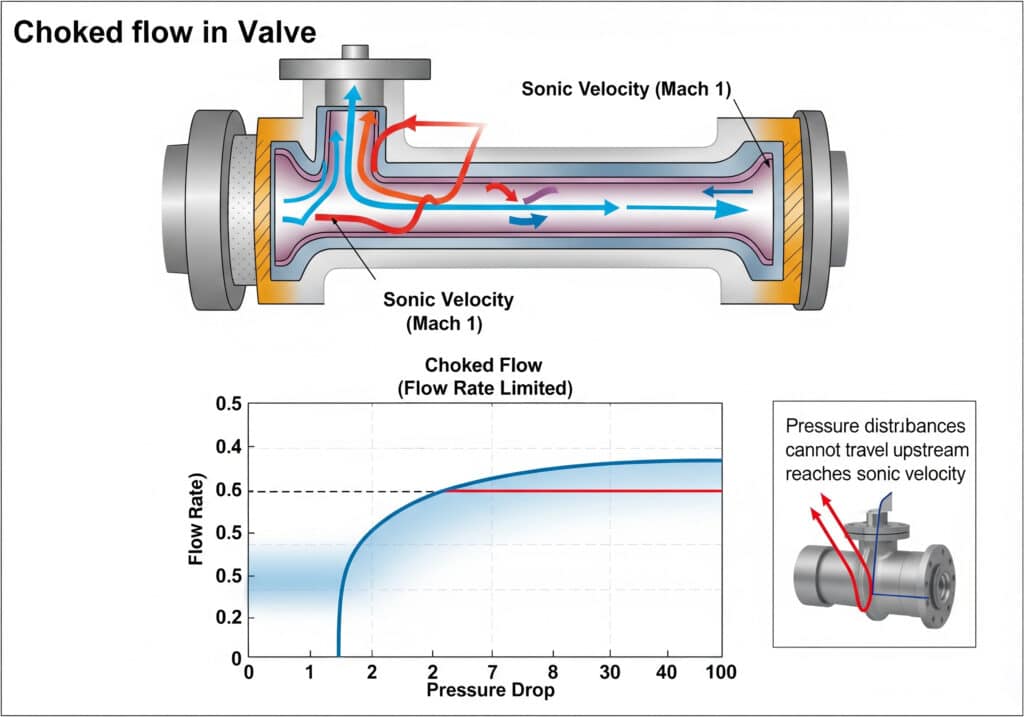
When a valve path is choked, the mass-flow limit is set by upstream total pressure, upstream total temperature, gas properties, and the smallest effective area. Therefore, NASA’s Mach 1 maximum-flow result points to a different fix than ordinary downstream pressure adjustment (NASA Mass Flow Choking, 2021).
This changes how a maintenance team should think. If the path is already choked, opening a downstream speed controller or lowering downstream pressure may not add more supply mass flow. You might only add noise, cooling, unstable exhaust behavior, or harsher motion.
The practical levers are different:
| Lever | Why it can help | Watch point |
|---|---|---|
| Larger effective valve path | raises the throat area | port thread alone may not change the throat |
| Higher upstream absolute pressure | raises available mass flow | may increase compressor energy and force risk |
| Lower upstream temperature | raises density | rarely the first pneumatic fix |
| Shorter tube and cleaner fittings | protects pressure at the valve | does not change the valve’s internal throat |
| Better exhaust path | reduces back pressure on the opposite chamber | supply and exhaust can choke separately |
We usually separate two failures that look similar. A pressure-drop problem means not enough pressure reaches the valve or actuator. A choked valve path means the valve restriction itself has reached a sonic limit. Both can slow a cylinder, but they do not have the same fix.
How do you calculate a quick choked-flow check?
Start with absolute pressures because NIST lists 1 atm = 14.6959 psi and 1 psi = 6894.757 Pa, which means gauge pressure must be converted before a gas-flow ratio is used (NIST Pressure and Gas Flow Unit Conversions, updated 2025).
Use this sequence:
- Measure upstream pressure
p1while the valve is flowing. - Measure downstream pressure
p2during the same motion. - Convert both values to absolute pressure.
- Calculate
pressure ratio = p2 / p1. - Compare the result with the valve datasheet critical ratio, or use
0.528as a dry-air warning point when no datasheet value is available.
Here is the common psi example:
p1 gauge = 80 psig
p2 gauge = 30 psig

p1 absolute = 80 + 14.7 = 94.7 psia
p2 absolute = 30 + 14.7 = 44.7 psia

p2 / p1 = 44.7 / 94.7 = 0.472
Because 0.472 is below 0.528, that valve path is in the choked-flow risk zone for dry air. The next step is not to guess a larger thread. The next step is to compare the actual valve’s ISO 6358 data, manufacturer flow curve, or measured flow.
Dynamic P1 and P2 measurement on a running machine
Measure dynamic pressure at the valve path, not only static pressure at the regulator. For example, CAGI says most well-designed compressed-air systems have no more than 10 percent pressure drop from compressor discharge to point of use and recommends adding taps for pressure monitoring (CAGI Pressure Drop Technical Brief, 2026).
A good check uses two sensors. Put one at the valve inlet and one at the active working port, test outlet, or exhaust path being questioned. Record pressure during the exact motion that fails. Then repeat in the opposite direction.
For a 5-port valve, do not assume one measurement tells the whole story:
| Motion problem | Measure these paths | Why |
|---|---|---|
| Slow extend | pressure port to cap-end working port | supply path may be restricted |
| Slow retract | pressure port to rod-end working port | a different spool path may limit flow |
| Jerky motion | both working ports over time | dynamic pressure may sag during travel |
| Weak clamp | actuator port during the load event | force follows delivered pressure |
| Noisy exhaust | cylinder port to exhaust port | exhaust path can be the choke point |
For one-path pressure-drop math, use the dedicated pneumatic valve pressure drop guide. For system-wide loss, use the pressure drop troubleshooting guide.
ISO 6358 data versus Cv
Use ISO 6358-style data when the valve is near its flow limit, the pressure ratio is low, or the stroke time matters. Notably, ISO states that ISO 6358-1 covers steady-state test methods for pneumatic components with compressible fluids and remains current after confirmation in 2022 (ISO 6358-1, 2013).
Cv is still useful. It lets buyers compare valves quickly and screen obviously small parts. The problem is that Cv alone can hide gas behavior, absolute pressure, temperature, path-specific capacity, and choking.
Ask for ISO 6358 data or a pneumatic flow curve when any of these are true:
- The calculated
p2 / p1is near or below the critical pressure ratio. - The actuator misses stroke time only at high speed.
- The valve feeds a long-stroke rodless cylinder.
- Several valves shift from the same manifold at once.
- The replacement valve has the same port thread but a different internal design.
- The exhaust side controls speed through mufflers or meter-out controls.
- The application is a clamp, stop, lift, or gripper where force loss matters.
Use the pneumatic flow rate calculation guide before final selection. Flow demand tells you what the valve must pass. Sonic conductance tells you whether the valve can keep passing more mass flow as the pressure ratio falls.
Choked flow and rodless cylinder speed
Rodless cylinder speed depends on flow reaching and leaving long chambers during the motion. As a result, CAGI’s 10 percent pressure-drop target is a useful boundary because a long air path, manifold restriction, or valve throat can reduce delivered pressure while the cylinder is moving (CAGI Pressure Drop Technical Brief, 2026).
The symptom is familiar: the carriage moves acceptably at low speed, then loses repeatability when the line accelerates. Sometimes the cylinder is blamed. Often the air path is smaller than the motion requirement.
For a rodless axis, check these items together:
| Check | What it tells you |
|---|---|
| Bore and stroke volume | peak fill and exhaust demand |
| Target stroke time | required flow rate |
| Valve sonic conductance or flow curve | whether the valve path is the limit |
| Tube ID and length | whether line loss hides the valve result |
| Muffler and meter-out settings | whether exhaust back pressure controls speed |
| Point-of-use pressure | whether force is preserved during motion |
If the issue is directional valve routing, review the 4-way 5-port valve path before changing part size. If the issue is coil-commanded switching, separate electrical response from air-flow capacity before blaming sonic conductance.
RFQ data for sonic conductance review
An RFQ should include both pressure ratio and motion demand. In other words, ISO 6358 testing separates component flow-rate characteristics, while NIST pressure tables show why unit consistency matters when converting gauge pressure to absolute pressure (ISO 6358-1, 2013; NIST, 2025).
Send this data before asking whether a valve is large enough:
| RFQ data | Minimum detail |
|---|---|
| Valve model or photo | include port labels and existing flow rating |
| Function | 2/2, 3/2, 5/2, 5/3, normally closed, normally open, center condition |
| Pressures | upstream and downstream dynamic pressure, both converted or clearly marked |
| Air temperature | approximate inlet temperature if flow is high |
| Flow target | SCFM, NL/min, stroke time, or cycle rate |
| Actuator | bore, stroke, load, mounting, and tube length |
| Failure mode | slow extend, slow retract, weak force, noise, heating, or unstable timing |
| Existing restrictions | regulators, fittings, mufflers, manifolds, and speed controls |
The best RFQ note is often a short pressure log. One line showing p1, p2, and stroke time during the failed motion is more useful than five catalog screenshots. It tells the supplier whether to look at valve conductance, tubing pressure drop, exhaust restriction, or actuator load.
Common mistakes with critical pressure ratio
Most mistakes come from using the right formula with the wrong pressure values. In fact, NASA’s equations use pressure ratio and Mach number, while NIST pressure conversion tables show the gap between gauge units and absolute units (NASA Isentropic Flow Equations, 2021; NIST, 2025).
Avoid these errors:
| Mistake | Why it fails | Better check |
|---|---|---|
Using gauge pressure in p2 / p1 |
gas-flow ratios need absolute pressure | add atmospheric pressure first |
| Treating 0.528 as universal | gas properties and valve geometry vary | use the datasheet critical ratio when available |
| Matching port thread only | internal throat may be smaller | compare flow curve, Cv, or ISO 6358 data |
| Ignoring exhaust | return air can choke too | check supply and exhaust paths |
| Raising compressor pressure first | energy cost and force risk rise | find the restriction before changing pressure |
| Reading one static gauge | restrictions hide at rest | measure during the failed cycle |
Conclusion
Sonic conductance tells you how much compressed air a pneumatic valve path can pass when compressibility matters. Critical pressure ratio tells you when that path is approaching the sonic limit. For dry air, p2 / p1 <= 0.528 is the quick warning point, but the final decision should use the manufacturer’s ISO 6358 data or measured flow curve.
The field method is straightforward: measure dynamic p1 and p2, convert both to absolute pressure, calculate the ratio, and compare it with the valve data. If the path is choked, look at valve conductance, manifold capacity, tube ID, and exhaust restriction before raising compressor pressure.
FAQs About Sonic Conductance in Pneumatic Valves
At what pressure ratio does choked flow occur in air valves?
For dry air, the quick warning point is p2 / p1 <= 0.528 when both pressures are absolute. This comes from the isentropic pressure-ratio equation at Mach 1 using gamma = 1.4. Real valve geometry can shift behavior, so use datasheet critical-ratio data when available.
Is sonic conductance the same as Cv?
No. Cv is a practical flow-capacity comparison number, while sonic conductance comes from pneumatic compressible-flow testing. Cv can screen candidate valves, but ISO 6358-style conductance data is better when the pressure ratio is low, the cycle is fast, or the valve path may choke.
Can choked flow damage a pneumatic valve?
Choked flow does not automatically damage a valve. The risk is indirect: noise, cooling, unstable exhaust, excessive pressure strategy, and missed actuator timing. If choking is accidental, fix the restriction or resize the valve path instead of only increasing upstream pressure.
Why must I use absolute pressure for critical pressure ratio?
Critical pressure ratio compares gas states, so both pressures must be absolute. Gauge pressure omits atmospheric pressure. For example, 80 psig is about 94.7 psia, not 80 absolute. Using gauge values can make a non-choked path look choked, or hide a real sonic limit.
Which calculator should I use first?
Use the air orifice flow calculator when you know upstream pressure, downstream pressure, temperature, and an estimated restriction size. Use the Cv calculator when you are comparing catalog valve capacity. If the application is close to the limit, ask for ISO 6358 conductance and critical-ratio data.
Source Notes
-
ISO 6358-1:2013, pneumatic fluid power test method for determining flow-rate characteristics of components using compressible fluids. Retrieved 2026-07-08.
-
NASA Glenn Research Center: Isentropic Flow Equations, Mach number, pressure-ratio, and starred choked-flow relations. Retrieved 2026-07-08.
-
NASA Glenn Research Center: Mass Flow Choking, maximum mass flow at Mach 1 and choked-flow mass-flow equation. Retrieved 2026-07-08.
-
NIST: Pressure and Gas Flow Unit Conversions, pressure and gas-flow conversion tables. Retrieved 2026-07-08.
-
CAGI: Pressure Drop Technical Brief, compressed-air pressure-drop target and monitoring guidance. Retrieved 2026-07-08.
-
AutomationDirect: Understanding Pneumatic Valve Ports and Ways, valve path and port identification video used for the embed. Retrieved 2026-07-08.