

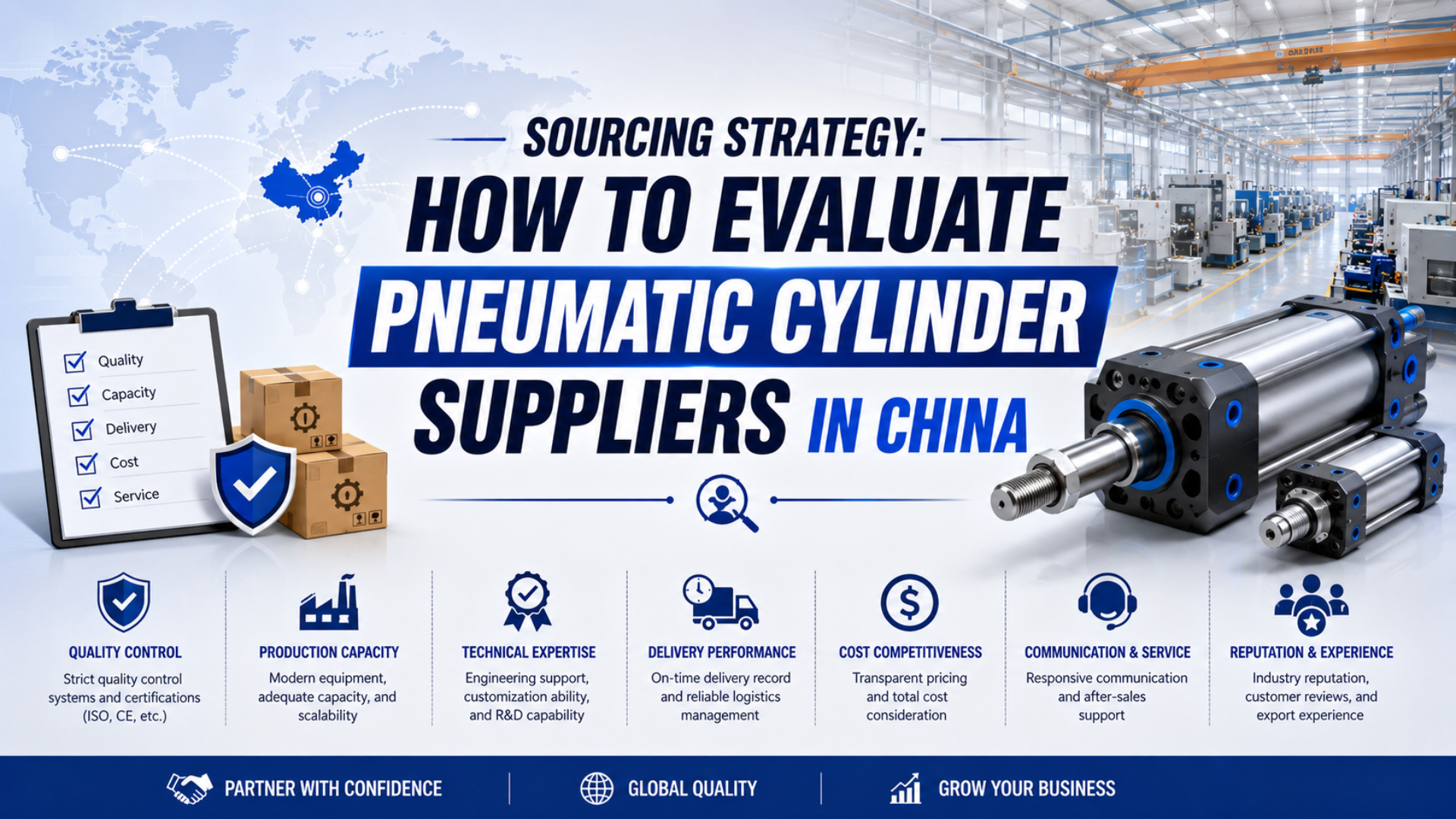
The safest way to evaluate pneumatic cylinder suppliers in China is to approve evidence, not a website or quoted price. Start with the required cylinder, identify every company involved, verify the legal and operational roles, test product evidence, control the contract, and release the first order in stages.
A supplier can be commercially responsive yet technically unsuitable. A capable factory can also become a sourcing risk when its quotation, contract, invoice, payment account, production site, and export arrangement point to different entities. The evaluation must therefore cover both the cylinder and the transaction.
Key Takeaways
- Use 7 evidence gates from requirement definition through routine-supply approval.
- Match the Chinese legal entity to the contracting, production, payment, and export roles.
- Treat certificates, samples, audits, and quotations as separate evidence.
- Release production only after measurable acceptance criteria and change controls are agreed.
In this guide
- What Is the Safest China Sourcing Strategy?
- How Do You Verify the Chinese Legal Entity?
- Map the Factory, Trading, Export, and Payment Roles
- What Technical Evidence Should You Request Before Quotation?
- How Should You Audit and Sample the Supplier?
- Which Commercial and Logistics Controls Belong in the Contract?
- Staged Approval from Candidate to Routine Supply
- China Pneumatic Cylinder Supplier FAQs
What Is the Safest China Sourcing Strategy?
Use 7 evidence gates before granting routine-supply status: requirement, legal identity, operating roles, technical evidence, audit and sample, contract and logistics, then staged release. China’s official enterprise system lets buyers search by 3 identifiers, so identity verification should precede technical comparison (GSXT).
The gates are sequential because later evidence depends on earlier identity. A convincing test report has limited value if the report holder, quoted supplier, factory, and contract counterparty cannot be connected.
| Gate | Approval question | Minimum retained evidence |
|---|---|---|
| 1. Requirement | Is the intended cylinder and duty defined? | Controlled RFQ, drawing, application limits, and acceptance criteria |
| 2. Legal identity | Does the company exist under the stated Chinese name? | Registry record, business license copy, and identity cross-check |
| 3. Operating roles | Who sells, manufactures, exports, and receives payment? | Written role map and evidence for each entity |
| 4. Technical evidence | Can the offered configuration meet the requirement? | Part code, drawing, data, material records, and test plan |
| 5. Audit and sample | Does observed capability support the claims? | Audit findings, sample records, exceptions, and corrective actions |
| 6. Contract and logistics | Are quality, change, payment, and delivery controls enforceable? | Signed contract, named Incoterm, release conditions, and document list |
| 7. Staged release | Has production evidence remained acceptable? | First-article, pilot-lot, inspection, and approved-supplier records |
Do not replace any gate with a weighted score. A high total cannot compensate for an unknown contract entity, an unverified bank beneficiary, or a cylinder that fails a critical safety requirement. Scores are useful only after every mandatory condition has a pass, fail, or formally accepted exception.
The practical sourcing unit is not “the supplier.” It is an entity-evidence chain linking the legal company, sales counterparty, actual factory, payment beneficiary, and logistics role to the same approved transaction.
How Do You Verify the Chinese Legal Entity?
Verify the Chinese legal name first, then search its Unified Social Credit Code or registration number. The National Enterprise Credit Information Publicity System accepts all 3 search routes and publishes enterprise, abnormal-operation, and serious-violation information supplied by authorities and enterprises (GSXT search help).
Ask the supplier for a current business-license copy in Chinese. Record the company name, Unified Social Credit Code, legal representative, registered address, registration status, establishment date, and business scope. Search the official record independently rather than using a screenshot provided by sales.
Then compare that identity with every commercial document:
- Quotation header and company seal
- Pro forma and commercial invoice
- Contract counterparty and signatory
- Bank-account beneficiary
- Email domain and website ownership information
- Factory address shown on drawings, certificates, and audit reports
- Packing-list and export-document issuer
A mismatch is a question to resolve, not automatic proof of fraud. A group may use separate manufacturing and trading entities, or an exporter may act for a factory. The supplier should nevertheless disclose the relationship, responsibilities, and document flow before payment.
Check official status fields at the time of approval and again before a material payment or long production release. A saved PDF or screenshot provides an audit trail, but the live registry remains the source for current status.
Identity review record
Use a controlled table so that procurement, engineering, quality, and finance see the same entities.
| Record | Name or identifier found | Must match |
|---|---|---|
| Official registry | Chinese legal name and Unified Social Credit Code | Business license |
| Quotation and contract | Contracting seller | Authorized entity and seal |
| Bank instruction | Account beneficiary | Contract or approved disclosed payee |
| Factory evidence | Production-site entity and address | Audit scope and product records |
| Export documents | Exporting or declaring entity | Agreed logistics role |
Never approve a late bank-account change from email alone. Verify it through a previously established contact channel, obtain a signed explanation, and repeat the beneficiary-to-contract check.
Map the Factory, Trading, Export, and Payment Roles
Map the manufacturing, selling, exporting, and payment roles before approval. China removed foreign-trade operator registration on December 30, 2022, while customs recordation still matters. Missing legacy registration is therefore not proof of illegal exporting (MOFCOM, China Customs).
A manufacturer may sell directly, use a related trading company, or work through an independent exporter. A trading company can provide consolidation, language support, financing, product aggregation, or export administration. Those services may be useful. The risk comes from an undisclosed or uncontrolled handoff, not from the role label itself.
For each organization, record who owns product design, purchases materials, performs machining and assembly, tests the cylinders, approves changes, handles warranty claims, issues the invoice, receives funds, and supplies customs documents.
Ask a role-specific question: “Which legal entity performs final assembly and leak testing at which address?” It produces more useful evidence than “Are you the manufacturer?”
China Customs provides public enterprise credit information that can include customs registration, credit status, licenses, penalties, and abnormal credit information. Its Advanced Certified Enterprise status is a separate customs-credit certification, not a general certificate that every exporter must hold (GACC enterprise credit measures).
Evaluate role clarity as a control in its own right. If the seller cannot explain which entity is responsible for a defect, an engineering change, or an export document before the order, the same ambiguity will remain after a failure.
What Technical Evidence Should You Request Before Quotation?
Send a controlled technical RFQ before comparing prices. ISO 9001:2015 remains current in July 2026, and ISO lists a successor for September 2026. The certificate covers a management system, not every offered cylinder (ISO 9001:2015).
Define the machine requirement before naming a preferred part. For an ISO 15552 cylinder, the standard covers a dimensional platform from 32 to 320 mm bore with a maximum rated pressure of 10 bar. It does not choose the stroke, port, cushioning, sensing, seals, materials, or operating duty for the buyer (ISO 15552:2018).
Use the ISO 15552 cylinder procurement checklist to control the RFQ fields. At minimum, state:
- Cylinder standard or dimensional interface
- Bore, stroke, rod arrangement, mounting, and accessories
- Port thread and orientation
- Operating and design pressure
- Required force, speed, cycle profile, and load direction
- Cushioning and end-of-stroke energy conditions
- Sensor type, voltage, logic, connector, and cable requirements
- Medium, temperature, contamination, washdown, corrosion, and chemical exposure
- Expected service access and replacement constraints
- Required drawings, declarations, records, and acceptance tests
The supplier response should identify the exact configured part number and every deviation. Request an option-specific drawing, technical data, bill-of-material description at an agreed disclosure level, rated limits, recommended accessories, and test method. A catalog family page is not an adequate substitute for the offered configuration.
Verify certificates by scope, not appearance
Check a management-system certificate for the certified legal entity, covered site, standard edition, activity scope, certification body, accreditation body, status, and dates. IAF CertSearch can display these fields and distinguishes active, suspended, withdrawn, and expired status (IAF CertSearch verification guide).
ISO’s guidance on expected ISO 9001 outcomes states that QMS certification does not mean the organization’s products are certified, superior, or always conforming. The buyer still needs product-specific evidence and acceptance controls (ISO 9001 expected outcomes).
CE marking, RoHS evidence, ATEX documentation, food-contact statements, or market-specific approvals are not interchangeable supplier badges. Request only what the intended product, market, environment, and machine integration require. Verify the named product, applicable legislation or standard, responsible entity, issue date, and supporting technical file.
How Should You Audit and Sample the Supplier?
Use the audit to test the controls that matter to the offered cylinder. ISO 19011:2026 is the 4th edition and provides 46 pages of guidance on audit principles, programs, conduct, and auditor competence. It is a method framework, not a pass certificate for a factory (ISO 19011:2026).
Begin with a remote evidence review. Resolve the entity map, RFQ exceptions, process flow, inspection plan, key outsourced operations, calibration evidence, traceability example, nonconformance process, and change-control process before paying for travel or third-party inspection.
Use an on-site or independent audit when the product risk, order value, customization, regulatory exposure, or evidence gaps justify it. The detailed pneumatic-cylinder factory capability audit explains how to examine machining, measurement, assembly, testing, traceability, capacity, and corrective action without relying on staged factory photos.
An audit should follow one real order or representative batch through the process. Sample records backward from final test to components and forward from incoming material to shipment. Record objective evidence, exceptions, owners, due dates, and closure evidence.
Separate development samples from lot acceptance
A working sample answers only whether those units met the agreed tests. It does not establish routine process stability, future material consistency, or on-time delivery. Keep three decisions separate:
- Engineering sample approval: Does the configuration satisfy fit and functional requirements?
- Pilot-lot approval: Can the supplier repeat the configuration with controlled production records?
- Production-lot acceptance: Does the submitted lot meet the agreed inspection plan?
ISO 2859-1:2026 provides single, double, and multiple acceptance-sampling plans indexed by acceptance quality limit. It does not create one universal sample count for every cylinder order (ISO 2859-1:2026).
Set the sampling plan from lot size, inspection level, defect classification, acceptance criteria, switching rules, and the consequence of escape. Safety-critical or destructive characteristics may need a different method. The buyer’s quality function should approve the plan rather than adopting a supplier’s convenient sample count.
Document every test condition: supply pressure, temperature, mounting, load, instrumentation, stabilization, cycle count, allowable leakage, speed window, cushion setting, sensor logic, and pass limit. A result without its method cannot be compared reliably.
Which Commercial and Logistics Controls Belong in the Contract?
Write quality and delivery controls into the transaction, not only the RFQ. Incoterms 2020 contains 11 rules allocating defined costs, risks, and obligations. The contract should state the chosen rule, named place or port, and 2020 version rather than using a three-letter term alone (ICC Incoterms 2020).
The contract or quality agreement should identify:
- Legal buyer and seller
- Approved manufacturing site and subcontracted critical processes
- Controlled specification, drawing revision, and exact part number
- Order-acknowledgment and deviation-approval process
- Inspection rights, release evidence, and rejection handling
- Packaging, labeling, corrosion protection, and traceability
- No-change requirements for design, material, process, site, and sub-tier source
- Warranty scope, remedy, response path, and return analysis
- Tooling, drawings, intellectual property, and private-label ownership where relevant
- Governing law, dispute process, document language, and precedence
- Named Incoterm, place, mode, shipping documents, and insurance responsibility
There is no universally safest deposit percentage or balance schedule. Tie payment milestones to controllable evidence, such as approved drawings, sample acceptance, completed corrective actions, pre-shipment inspection, and document release. Finance should verify the beneficiary independently and control any account change.
For private-label sourcing, continue with the manufacturer identity and change-control guide. It covers bill-of-material control, tooling, branded documentation, pilot approval, and production release in greater depth.
Calculate landed cost separately from unit price. Include tooling, samples, inspection, inland freight, export handling, international freight, insurance, duty, tax, brokerage, inventory, and likely rework. The pneumatic components landed-cost calculator can normalize commercial options.
Use the pneumatic import duties, taxes, and logistics guide for HS classification, customs-value inputs, Incoterm responsibilities, and shipment planning. Classification and import requirements must be confirmed for the destination and actual product.
Staged Approval from Candidate to Routine Supply
Release the supplier through controlled states, not one “approved” checkbox. ISO 2859-1:2026 includes 3 sampling-plan forms and switching procedures, reinforcing that evidence and inspection intensity can change with supply history. Your approval record should likewise show the current scope, conditions, and next release gate (ISO 2859-1:2026).
Use status labels that identify what the supplier may do:
| Status | Permitted activity | Exit evidence |
|---|---|---|
| Candidate | Exchange controlled RFQ and evidence | Identity and role map accepted |
| Conditionally qualified | Produce engineering samples only | Critical document gaps closed |
| Sample approved | Quote or prepare a pilot lot | Fit, function, and test records accepted |
| Pilot approved | Produce a restricted order | Repeatability, traceability, and corrective actions accepted |
| Routine supply approved | Receive orders within approved scope | Ongoing delivery, quality, and change performance |
| Suspended | No new release without authorization | Containment, root cause, and requalification |
Do not let sample approval silently authorize material substitutions, a different site, or a different sub-tier source. The approved-supplier record should name the legal seller, manufacturing site, product family, configuration or drawing revision, permitted processes, applicable certificates, and unresolved conditions.
Use a two-layer decision record
First, apply non-negotiable gates. Examples include a verified legal counterparty, resolved payment beneficiary, accepted safety requirements, complete critical dimensions, and approved change control. Any failed critical gate blocks release.
Second, compare qualified candidates on commercial and operational preferences. These can include communication, engineering support, tooling approach, lead time, packaging, minimum order, logistics options, and total landed cost. Weightings should reflect the actual program, not a reusable scorecard that hides project-specific risk.
The most defensible sourcing decision states both what is approved and what remains unproven. A pilot may demonstrate dimensional conformity while long-term seal wear, seasonal capacity, or field support remains unverified. Recording residual uncertainty prevents a narrow test result from becoming a broad supplier claim.
Maintain the evidence after approval. Review certificate status, process changes, recurring nonconformities, delivery performance, corrective-action effectiveness, and entity changes. Requalify when the product, site, ownership, tooling, critical material, subcontractor, or regulatory requirement changes.
China Pneumatic Cylinder Supplier FAQs
These answers apply the same evidence sequence to 5 recurring sourcing decisions. The official Chinese enterprise system supports 3 identity search routes, while current international standards separate management-system certification, auditing guidance, and lot sampling. None of those sources replaces a product-specific RFQ and acceptance plan (GSXT, ISO).
Is a Chinese business license enough to approve a cylinder supplier?
No. The license establishes a legal identity, not manufacturing capability or product conformity. Verify the live GSXT record, then connect that entity to the quotation, contract, bank beneficiary, factory, certificates, and export documents. Technical approval still requires a controlled RFQ, product evidence, samples, and appropriate audit findings.
Is a trading company automatically riskier than a direct manufacturer?
No. A trading company may provide useful consolidation, communication, financing, or export support. Evaluate whether it discloses the actual factory and controls specifications, changes, testing, warranty, and corrective action. The key risk is unclear responsibility between entities, not the presence of an intermediary by itself.
How can I verify a supplier’s ISO 9001 certificate?
Match the certificate’s legal entity, site, standard edition, scope, certification body, accreditation body, dates, and status. Search IAF CertSearch where coverage is available, or verify through the issuing and accreditation bodies. Remember that ISO 9001 certifies a quality management system, not the conformity of every cylinder shipped.
What payment terms are safest for a first order?
No fixed percentage is safest in every transaction. Confirm the contracting entity and bank beneficiary, then link payment milestones to evidence you can verify, such as drawing approval, accepted samples, closed audit findings, inspection release, and shipping documents. Control bank changes through an established channel independent of email.
How many pneumatic cylinder samples should I test?
Choose the quantity from the decision being made, the tests, lot size, defect classes, product risk, and applicable sampling plan. Engineering samples, pilot-lot validation, and production-lot acceptance answer different questions. ISO 2859-1 offers structured plans, but it does not prescribe one universal count for all orders.
Sources and technical references
- China National Enterprise Credit Information Publicity System, official enterprise search and public-status records
- MOFCOM notice on the Foreign Trade Law amendment, removal of foreign-trade operator registration
- China Customs enterprise recordation guide, customs recordation and public information
- ISO 9001:2015, current quality-management-system edition
- ISO 19011:2026, management-system auditing guidance
- ISO 2859-1:2026, acceptance sampling by attributes
- ISO 15552:2018, pneumatic cylinder dimensional platform
- IAF CertSearch certificate verification guide, certificate fields and status
- ICC Incoterms 2020, trade-rule scope and responsibilities