

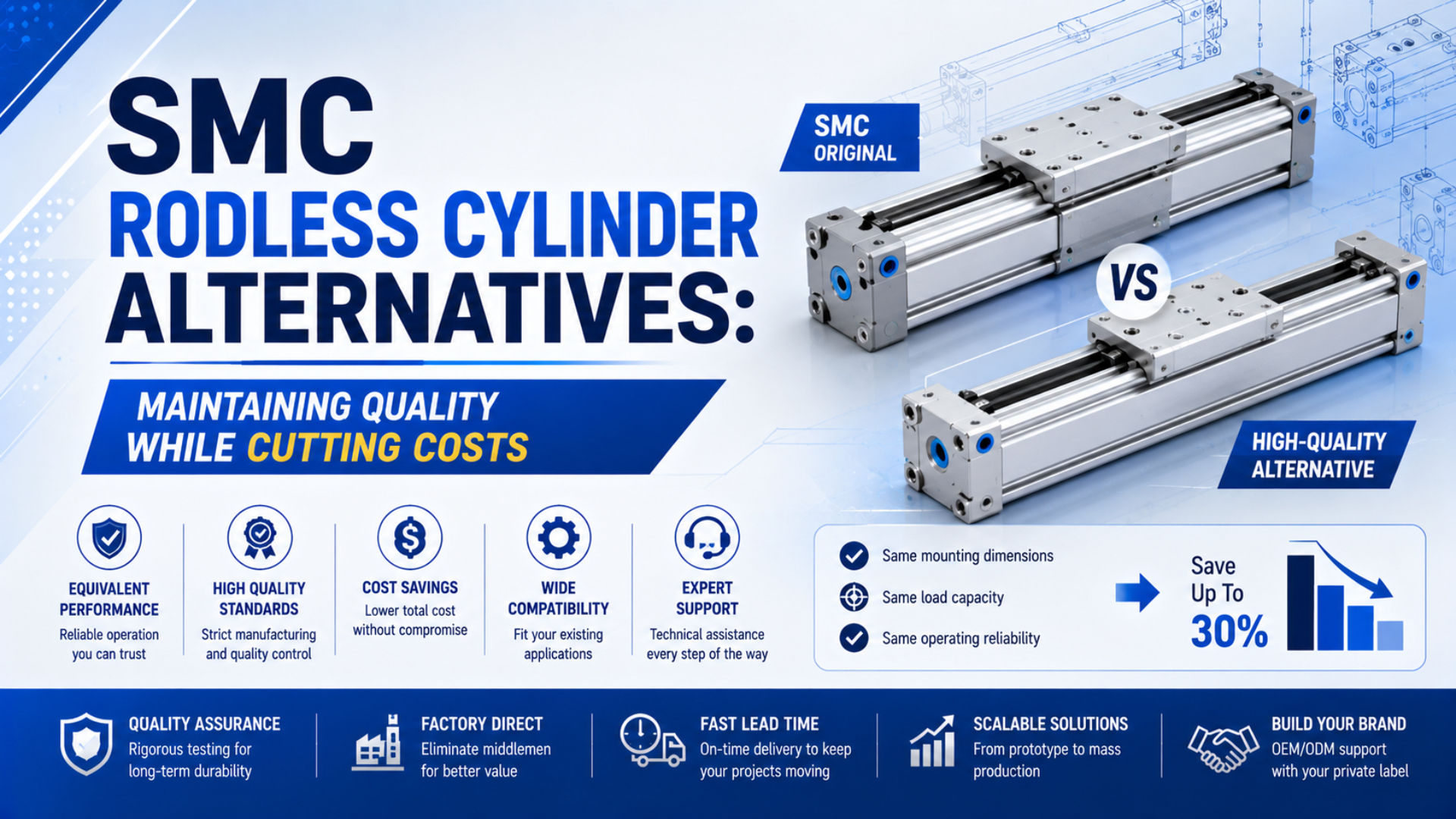
An SMC rodless cylinder alternative can reduce purchasing and recovery costs, but only after the exact replacement passes a configuration-by-configuration review. A matching profile or bolt pattern is not enough. Confirm the coupling architecture, guide type, bore, stroke, ports, sensors, cushioning, load, moments, speed, environment, service parts, and installed acceptance limits before comparing prices.
That caution comes from SMC’s own product history. Its updated MY1B kept the same mounting dimensions as the existing MY1B while increasing maximum load mass and allowable moment by as much as 30% (SMC MY1B new product information, updated July 2025). Same fit, different capability.
Key Takeaways
- SMC’s MY and CY families use different mechanical-joint and magnetic coupling architectures.
- Identical MY1B mounting dimensions can conceal a 30% load or moment difference.
- Compare the full model code, rated envelope, controls, and service requirements.
- Release an alternative only after documented inspection, bench testing, and a controlled machine trial.
Dimensional fit means the candidate occupies the available space and connects to the machine at the required interfaces.
Functional equivalence means the candidate performs the required motion within documented load, moment, speed, cushioning, sensing, environmental, and service limits.
Approved replacement means a named configuration has passed the site’s engineering and change-control process for a defined machine position. It does not imply universal approval for every SMC rodless cylinder.
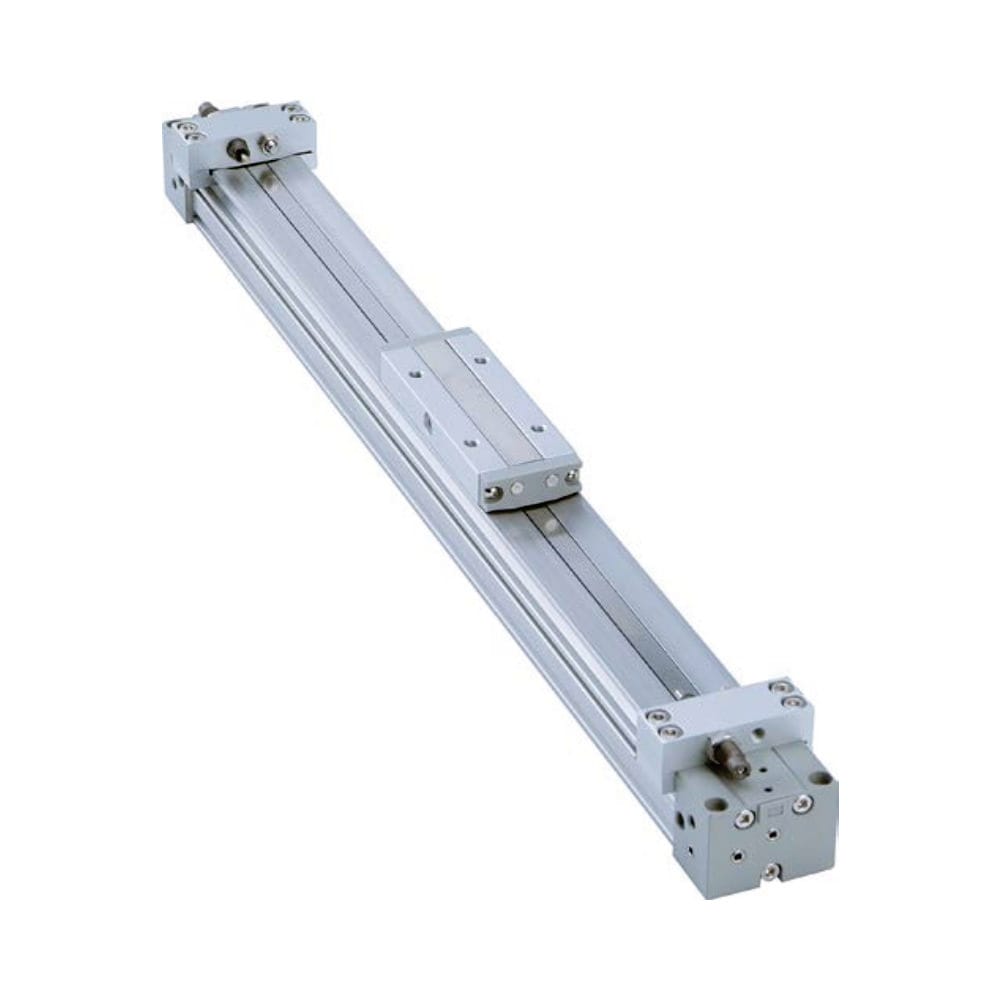
Which SMC Rodless Cylinder Are You Actually Replacing?
SMC separates rodless cylinders into two coupling architectures and offers five guide types within the MY1 mechanical-joint family. Its catalog distinguishes MY1B basic, MY1M slide-bearing, MY1C cam-follower, MY1H linear-guide, and MY1HT high-rigidity linear-guide versions (SMC MY1 selection catalog). Those names describe different load paths, not cosmetic options.
The first decision is mechanical-joint versus magnetically coupled construction. SMC explains that the MY family connects the piston to the external table through a slit in the tube, protected by sealing bands. The CY family moves the external slider through magnetic force and has a different pressure, leakage, speed, and decoupling behavior (SMC rodless-cylinder FAQ).
Do not cross-reference an MY1B with a magnetic cylinder simply because both are called rodless. The machine may depend on the mechanical joint’s thrust transfer, the magnetic design’s sealed tube, or a particular response after overload. The recovery mode matters too. A magnetic carriage can decouple under excessive force; a slotted mechanical-joint design has different sealing-band and contamination risks.
Next, decode the complete installed part number. Record:
- Series and design generation
- Bore and usable stroke
- Guide type or separate external guide
- Standard or centralized piping arrangement
- Port thread and port location
- Stroke-adjustment unit and shock-absorber option
- Auto-switch model, quantity, connector, and cable direction
- Made-to-order suffixes
- Mounting brackets, side supports, and floating connections
Why capture the generation? A family name can survive a redesign. SMC’s 2025 MY1B update covers 25, 32, and 40 mm bores, while earlier MY1 material includes a broader size range. A supplier’s phrase such as “MY1B compatible” is incomplete until it names the exact incumbent code, drawing revision, and candidate code.
The article on rodless-cylinder coupling technologies provides a deeper comparison of mechanical and magnetic designs. Use that architecture decision before beginning a cross-brand dimensional review.
Compatibility Requirements Before Calling an Alternative a Match
SMC reports that its updated MY1B retains the existing mounting dimensions while increasing maximum load mass and allowable moment by up to 30% (SMC MY1B new product information). This is direct evidence that a matching installation interface does not establish equal guidance capacity, cushion behavior, or service life.
Compare the replacement in four evidence layers:
| Evidence layer | What to compare | Evidence that closes the check |
|---|---|---|
| Identity | Full incumbent and candidate codes, revision, manufacturing site | Controlled datasheet, drawing, quotation, and change record |
| Interfaces | Envelope, mounting, carriage, ports, sensors, supports, service access | Dimension-by-dimension marked drawing and physical inspection |
| Rated duty | Pressure, speed, load, three moment axes, cushioning, environment | Exact catalog ratings and application calculation |
| Machine result | Cycle time, end position, pressure, leakage, impact, product result | Baseline record and controlled acceptance trial |
Start with the interfaces that can stop installation: profile height and width, overall length, end-block clearance, carriage height, mounting-hole pattern, locating surfaces, port standard, port direction, sensor groove, and adjustment-unit envelope. Measure the installed assembly rather than relying on a photograph or family name.
Then compare the load path. Record moving mass plus the center-of-gravity offsets in all three axes. Check pitch, roll, and yaw moments at the required speed. The SMC selection material describes MY1B as a basic type generally combined with a separate guide when guaranteed accuracy is not required. Replacing it with another basic cylinder does not transfer the external guide’s alignment, moment capacity, or bearing life to the actuator.
Treat the guide as part of the replacement system even when it is physically separate. A candidate may stroke freely on a bench yet bind after it is bolted to a slightly misaligned rail. The guide-rail parallelism analysis explains how mounting tolerances can become internal side load.
How Should You Compare the Candidate With the Installed MY1B?
The current 25, 32, and 40 mm MY1B catalog lists a 0.1 to 0.8 MPa operating-pressure range, 5 to 60°C ambient and fluid temperature, and 100 to 1,000 mm/s piston speed without a stroke-adjustment unit (SMC MY1B catalog). These are model-specific boundaries, not universal targets for every alternative.
Build a comparison sheet with one row per decisive requirement:
| Requirement | Installed baseline | Candidate evidence | Acceptance method |
|---|---|---|---|
| Bore and stroke | Nameplate, code, measured travel | Candidate code and drawing | Incoming inspection |
| Mounting and envelope | Machine drawing and measurements | Marked interchange drawing | Fit check before piping |
| Port arrangement | Thread, location, orientation | Port detail and option code | Thread gauge and visual check |
| Moving load | Mass and center-of-gravity offsets | Allowable load and moment curves | Engineering review |
| Speed and cycle | Normal and worst-case cycle data | Rated range and duty conditions | Timed representative run |
| Cushioning | Approach speed, mass, stop method | Air-cushion or absorber capacity | Deceleration and impact review |
| Position sensing | Switch, voltage, logic, connector | Compatible sensor list | Electrical and PLC test |
| Environment | Temperature, dust, washdown, chemicals | Materials and limits | Application review |
| Service | Seal band, wear items, tools, access | Parts list and instructions | Maintenance sign-off |
Use dynamic pressure at the cylinder, not only the regulator setting. A restricted valve, long tube, undersized fitting, or exhaust restriction can change speed and cushion entry even when the nominal supply pressure matches. The site guides on pressure drop at cylinder ports and fittings and cushioning energy limits cover those separate calculations.
What about positioning accuracy? The SMC MY1 selection catalog describes MY1B as a basic model for applications where guaranteed accuracy is not required. It gives different reference values for guided MY1M, MY1C, MY1H, and MY1HT designs, tied to defined loading conditions. Do not copy a repeatability number from a guided model into a basic MY1B comparison.
Sensor compatibility also needs more than groove fit. Verify switch technology, supply voltage, PNP or NPN logic, two-wire or three-wire connection, connector, current rating, mounting range, hysteresis, cable direction, and PLC timing. A switch that can be clamped to the profile may still change the confirmed position or input behavior. See the reed-switch and Hall-effect sensor guide for the electrical distinctions.
Supplier Evidence for an SMC Rodless Cylinder Replacement
ISO 19973-1 provides general reliability-test procedures, calculation methods, conditions, and reporting rules, while ISO 19973-3 specifically addresses cylinders with piston rods (ISO 19973-1; ISO 19973-3). Neither establishes a universal cycle-life value for MY1B-style rodless cylinders. Any life claim needs its own configuration and test conditions.
Request an evidence package before ordering a production quantity:
- Full candidate part number and controlled technical datasheet
- Dimensioned drawing with deviations from the incumbent marked
- Bore, stroke, pressure, speed, temperature, load, and moment ratings
- Cushion or shock-absorber selection method
- Compatible auto-switch and accessory list
- Materials for sealing bands, primary seals, wear elements, lubricant, and exposed parts
- Pressure and leakage test method with acceptance limits
- Reliability report identifying sample count, duty cycle, load, speed, pressure, environment, failure definition, adjustments, and result
- Manufacturing-site identity, inspection plan, lot traceability, and change-notification commitment
- Service instructions, spare-part list, warranty terms, exclusions, and return process
Do not accept ISO 6358 as proof that the cylinder itself passed a leakage or life test. ISO 6358-1 covers steady-state flow characteristics of pneumatic components with internal flow paths and expressly excludes components that exchange energy with the fluid during measurement, including cylinders (ISO 6358-1).
ISO 15552 is another common shortcut. It establishes dimensions for specified detachable-mount single- or double-rod cylinders from 32 to 320 mm bore. It does not certify an MY1B replacement or define rodless carriage moments, sealing bands, cushion capacity, or positioning behavior (ISO 15552).
The most useful supplier statement is not “100% compatible.” It is a signed deviation list. A zero-deviation claim should still identify every characteristic reviewed, the drawing revisions compared, and the operating envelope covered. An honest documented difference is safer than an unqualified promise.
The broader guide to compatible pneumatic parts explains the general evidence hierarchy. For this SMC-specific decision, insist that every document points to the exact candidate code and manufacturing revision.
How Do You Validate the Alternative on the Machine?
SMC’s MY1 selection flow evaluates load mass, three moment directions, combined moment utilization, and end-of-stroke cushioning before a model is selected (SMC MY1 selection catalog). A replacement trial must reproduce those application variables rather than proving only that the carriage moves without a load.
Capture a healthy baseline before removing the incumbent. Record:
- Actual cycle time in both directions
- Dynamic supply and exhaust pressure near the actuator
- End-position and sensor timing
- Moving mass and product configuration
- Speed before cushion entry
- End-of-stroke impact, rebound, and stop contact
- Leakage observation method
- Product-quality result
- Ambient temperature and contamination condition
- Current guide alignment and maintenance condition
Do not compare a new alternative with a worn, misaligned incumbent and call every difference a brand effect. Use a known acceptable unit or an agreed machine baseline. Correct restricted exhaust, damaged guides, loose supports, or poor alignment before evaluating the new cylinder.
Use a staged release:
- Incoming inspection: verify identity, workmanship, decisive dimensions, ports, accessories, and documentation.
- Bench function: check smooth travel, switches, adjustment range, leakage method, and cushion operation at controlled pressure.
- Guarded machine trial: install on a containable station with a recovery plan. Use representative load, speed, pressure, cycle rate, and environment.
- Production observation: inspect cycle stability, product result, fastener retention, leakage, guide behavior, and required adjustment over an agreed interval.
- Scoped approval: record the machine position, candidate code, drawing revision, accepted deviations, test conditions, approvers, spare parts, and revalidation triggers.
What should trigger reassessment? Changes to the bore, stroke, guide, sealing band, seal material, lubricant, sensor, shock absorber, extrusion, machining site, assembly site, or test method can alter the result. Include those triggers in the approval record and purchase terms.
Where Can an Alternative Cut Cost Without Cutting Quality?
NIST reports that more than half of a manufacturer’s spending occurs in the supply chain on average and includes total cost of ownership among supplier-management activities (NIST Manufacturing Extension Partnership, updated 2025). A lower cylinder price matters, but freight, qualification, inventory, recovery time, maintenance, and failure exposure belong in the same comparison.
Cost reduction is defensible in four places:
- Delivered acquisition: compare the same quantity, configuration, Incoterm, destination, taxes, and normal freight.
- Availability: verify whether the exact approved code is stocked, assembled to order, or dependent on imported subcomponents.
- Service: compare seal-band kits, wear parts, sensors, instructions, tools, repair access, and technician time.
- Risk exposure: include validation work, adapters, control changes, warranty exclusions, return logistics, and a site-approved estimate of production consequence.
Avoid universal savings percentages. Quotes vary by region, distributor, quantity, bore, stroke, options, freight, and contract. A supplier should document the current commercial comparison rather than publishing one percentage as a permanent engineering fact.
Separate purchase savings from avoided downtime. A three-day quotation is not a three-day recovery promise unless the exact approved configuration can be produced, inspected, shipped, cleared, installed, and commissioned within that period. The OEM versus aftermarket TCO guide provides a fuller worksheet for site-specific costing.
Qualification cost is not wasted overhead. It creates a controlled second source, clearer machine requirements, and better failure records. Even when the incumbent remains the preferred choice, the plant gains an auditable specification instead of relying on a brand name as a substitute for engineering data.
What Should Go Into the Replacement RFQ?
SMC’s current MY1B configuration lists three bores, 25, 32, and 40 mm, plus standard and centralized piping arrangements (SMC MY1B catalog). An RFQ that says only “MY1B, 1,000 mm stroke” leaves out the generation, guide, ports, sensors, adjustment unit, and application limits.
Send the supplier:
- Clear photographs of the nameplate, complete actuator, ports, switches, carriage, supports, and end clearances
- Full incumbent part number and available drawing
- Bore, stroke, installation orientation, and external-guide arrangement
- Moving mass and center-of-gravity offsets in three axes
- Normal and maximum speed, cycles per minute, and operating hours
- Measured dynamic pressure and air-quality information
- Cushion, shock absorber, hard stop, and stroke-adjustment details
- Auto-switch model, electrical logic, connector, and PLC input requirement
- Temperature, contamination, washdown, corrosion, and material restrictions
- Required delivery quantity, destination, Incoterm, spare parts, warranty, and documentation
- Acceptance limits for fit, function, product quality, and trial duration
Ask for a response in the same row-by-row format. Each item should say comply, deviate, not applicable, or information required. Attach evidence to every comply statement. A quotation line that says “equivalent to SMC” is not an engineering comparison.
The plant can use the alternative-cylinder brand pilot framework when customer approvals, product quality, or automotive change control affect the release. For routine maintenance, the same logic still applies at a smaller scale: define the requirement, inspect the sample, trial it under controlled conditions, and approve only what was tested.
An SMC rodless cylinder alternative should earn approval through evidence, not through its price or appearance. Once the candidate passes the exact model, interface, duty, and machine-result checks, procurement can compare commercial terms without lowering the technical acceptance standard.
Jack Chen prepared this application-focused guide for Bepto Pneumatic. For a replacement review, provide both part codes, installation photographs, drawings, load and speed data, sensor requirements, and acceptance limits through the contact page.
SMC Rodless Cylinder Alternatives FAQs
SMC’s updated MY1B retained existing mounting dimensions while increasing maximum load mass and allowable moment by up to 30% (SMC, 2025). The following answers therefore treat fit, rated performance, and machine acceptance as separate checks rather than assuming that a similar profile is a drop-in replacement.
Is every MY1B-compatible cylinder a direct drop-in replacement?
No. “MY1B compatible” does not identify the incumbent generation, bore, stroke, piping arrangement, adjustment unit, sensor configuration, guide, load, moments, or operating conditions. Require a marked interchange drawing and an application comparison for the exact two part numbers, then verify the candidate through inspection and a controlled machine trial.
Can an alternative use the same mounting holes but have different load ratings?
Yes. SMC states that its updated MY1B keeps the existing mounting dimensions while raising maximum load mass and allowable moment by as much as 30%. This proves that interface geometry and rated capability can change independently. Compare pitch, roll, yaw, speed, cushion capacity, and guide conditions even when every mounting hole aligns.
Does ISO 15552 certify an SMC rodless cylinder alternative?
No. ISO 15552 establishes specified dimensions for detachable-mount single- and double-rod pneumatic cylinders from 32 to 320 mm bore. It does not certify products and does not cover MY1B carriage moments, sealing bands, cushioning, sensors, or installed performance. Use supplier drawings, exact catalog ratings, and application-specific testing instead.
How many cycles should a replacement rodless cylinder be tested?
There is no universal cycle count that proves equivalent service life. ISO 19973-1 provides general reliability-test and reporting procedures, while the cylinder-specific ISO 19973-3 covers cylinders with piston rods. Define the rodless-cylinder sample, duty, load, speed, pressure, environment, failure threshold, and statistical basis before interpreting a cycle claim.
What is the safest way to reduce SMC replacement cost?
First qualify the exact candidate against the installed requirement. Then compare delivered price, verified availability, service parts, qualification work, warranty boundaries, and site-specific failure exposure over the same period. Start with a containable machine position, retain the approved incumbent as recovery stock, and expand only after the alternative meets recorded acceptance limits.
Sources and technical references
- SMC MY1B new product information. Same mounting dimensions as the existing MY1B, with maximum load mass and allowable moment increases of up to 30%. Updated July 2025. https://www.smcworld.com/newproducts/en-ae/25/my1b/
- SMC MY1B catalog. Current 25, 32, and 40 mm basic-type specifications, pressure and temperature ranges, speed, ports, strokes, and options. Accessed July 26, 2026. https://ca01.smcworld.com/catalog/en/actuator/MY1B-Z-E/6-2-1-p1183-1199-my1b-z_en/data/6-2-1-p1183-1199-my1b-z_en.pdf
- SMC MY1 model-selection catalog. Guide types, load and moment checks, cushioning selection, piping, and switch-selection flow. Accessed July 26, 2026. https://www.smcworld.com/catalog/BEST-5-2-en/pdf/2-p1211-1325-my1b_en.pdf
- SMC basic characteristics of rodless cylinders. Model-dependent comparison of magnetic and mechanical-joint rodless cylinders. Accessed July 26, 2026. https://www.smcworld.com/products/select_guide/en-au/actuator/rodless_data.html
- SMC rodless-cylinder FAQ. Mechanical-joint MY and magnetic CY operating principles and selection cautions. Accessed July 26, 2026. https://www.smcworld.com/support/faq/en/s.do?ca_id=701&id=1657&lang=en
- ISO 19973-1:2015. General pneumatic-component reliability-test procedures, calculation, conditions, and reporting. Under systematic review in 2026. https://www.iso.org/standard/62570.html
- ISO 19973-3:2015. Reliability-test procedures for pneumatic cylinders with piston rods. Confirmed current in 2021. https://www.iso.org/standard/62572.html
- ISO 6358-1:2013. Steady-state flow-characteristic testing; cylinders are excluded from its scope. https://www.iso.org/standard/56612.html
- ISO 15552:2018. Basic, mounting, and accessory dimensions for specified detachable-mount rod cylinders. Confirmed current in 2025. https://www.iso.org/standard/66921.html
- NIST Manufacturing Extension Partnership. Supply-chain and total-cost-of-ownership guidance. Updated 2025. https://www.nist.gov/mep/supply-chain