

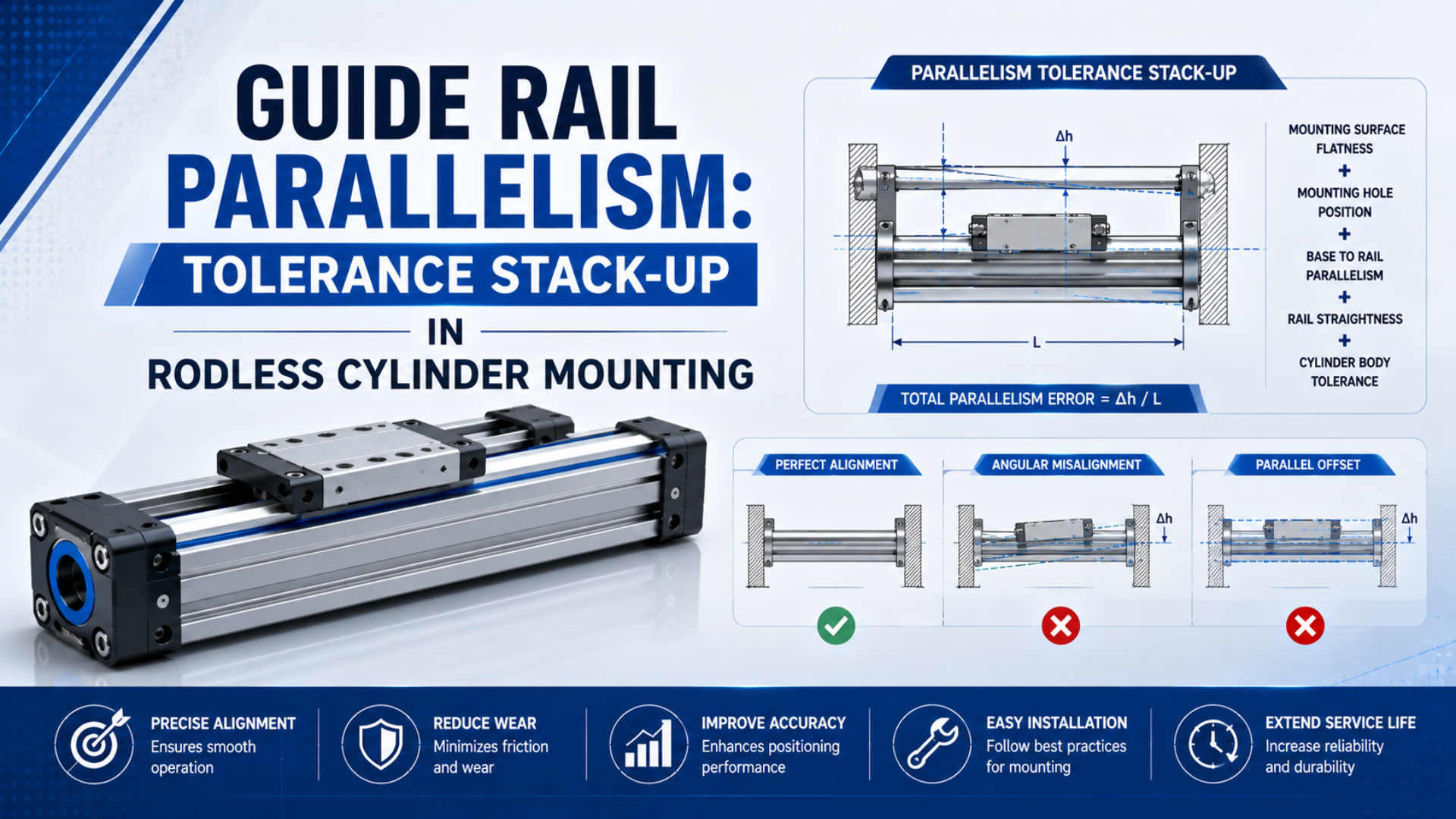
Guide rail parallelism is not one universal number. A defensible installation specification names the actuator and guide models, defines the measurement datums and direction, separates offset from angular error, and reserves enough tolerance for machining, assembly, bolt tightening, load, and temperature. The final acceptance value must come from the selected hardware and machine drawing.
HIWIN’s assembly manual illustrates the model dependency: its maximum reference-surface parallelism values, identified as , range from 2 µm to 80 µm across the tabulated guide series, sizes, and preload classes. These are maximum parallelism values, not bilateral ± limits (HIWIN Linear Guideway Assembly Manual, accessed July 26, 2026).
Guide rail parallelism is the controlled orientation of a guide reference relative to a defined datum over a stated length. Tolerance stack-up is the combined functional effect of the manufacturing and assembly variations that connect those features.
Key Takeaways
- HIWIN publishes model-dependent maximum parallelism values from 2 µm to 80 µm.
- Don’t add flatness, straightness, squareness, and offset until one datum-based functional chain connects them.
- Use worst-case for guaranteed limits; use RSS only with capable, centered, independent processes.
- Recheck alignment after final torque, payload, and thermal stabilization.
For general support spacing, body flatness, fastener torque, and commissioning precautions, use the separate rodless cylinder mounting guide. This article stays with one narrower task: building and verifying the geometric tolerance chain between a rodless cylinder, an external guide, and the moving load.
Start With a Datum Scheme, Not a Generic Parallelism Number
ISO 5459:2024 is the current third edition of the ISO standard for datums and datum systems. It makes the starting point clear: a parallelism requirement is meaningful only after the reference datum and the controlled feature have been identified (ISO 5459:2024, 2024).
Begin with the functional load path. Decide whether the guide rail or the actuator body establishes the primary motion axis. In most externally guided arrangements, the rail carries transverse forces and moments while the cylinder supplies thrust through a connection that can absorb specified misalignment. Two rigidly located axes can fight each other even when each part passed its own incoming inspection.
Put the following items on the assembly drawing or inspection plan:
- Datum A: the primary machine mounting plane.
- Datum B: the reference edge, master rail, or other feature that establishes the horizontal motion direction.
- Controlled feature: the actuator connection axis, secondary rail datum, or carriage interface being aligned.
- Measurement direction: vertical, horizontal, pitch, yaw, or roll.
- Evaluation length: the installed travel or the manufacturer-defined measurement length.
- Acceptance limit: the exact product or machine requirement, including whether the value is total variation, bilateral deviation, or an angular limit.
ISO 1101:2017 supplies the geometrical-specification language for form, orientation, location, and run-out. Straightness controls one feature’s form; parallelism controls orientation relative to a datum. They aren’t interchangeable entries in a spreadsheet (ISO 1101:2017, 2017).
The primary datum is also a constraint decision. If both the rail and cylinder are treated as masters, the tolerance stack has no planned place to release mismatch. A floating bracket is not a workaround for poor machining; it is a deliberate degree of freedom in the load path.
Which Errors Belong in the Tolerance Stack?
Only errors that affect the same functional output belong in one stack. HIWIN’s tables use different preload classes by family, including Z0/ZA/ZB and ZF/Z0/Z1, with maximum values from 2 to 80 µm. The budget must describe the configured guide, not merely a “linear rail” (HIWIN, accessed July 26, 2026).
A dimension belongs in the stack when you can answer four questions: What feature varies? Relative to which datum? In what direction? How much does one unit of that variation change the final alignment result? Without those answers, adding the catalog values creates arithmetic, not engineering.
| Contributor | Geometric meaning | How it enters the functional result | Verification |
|---|---|---|---|
| Machine mounting-plane flatness | Form error of Datum A | Can bend or tilt the installed actuator or rail | Sweep the installed mounting region |
| Master-rail straightness | Form error along travel | Changes the guide reference path | Measure the rail or carriage path over the specified length |
| Bracket squareness | Orientation of the connection interface | Produces offset or angular error through bracket height | Inspect from the drawing datums |
| Actuator-body mounting variation | Product-specific mounting interface | Can shift the cylinder axis after tightening | Use the actuator manual and installed checks |
| Fastener seating and torque | Assembly-induced distortion | Changes readings between loose and final states | Record the tightening sequence and final sweep |
| Load-plate geometry | Relationship between guide blocks and drive connection | Can over-constrain the carriage or add moment | Check unloaded and loaded |
| Thermal expansion | Temperature-dependent dimensional change | Changes offset or angle if materials and support points differ | Verify at the defined operating condition |
Don’t use catalog running parallelism as though it were installation allowance. THK defines running parallelism as the variation between the LM block and rail datum surface while the block traverses a rail secured to a reference surface. It is a product accuracy characteristic measured in a defined setup (THK accuracy guidance, accessed July 26, 2026).
The rodless cylinder definition guide can help identify whether the carriage is basic, internally guided, or magnetically coupled. That architecture determines which surfaces and connection freedoms belong in the stack.
How Do Offset and Angular Error Accumulate Over the Stroke?
Offset and angular error must be budgeted separately because one remains constant while the other grows with travel. Festo’s 2026/05 DGC catalog gives the FKC compensator ±2.5 mm for DGC-G bores 8–40 and ±4 mm for bores 50/63, in the indicated compensation direction (Festo DGC catalog, 2026).
Let be the initial transverse offset between the actuator connection axis and guide reference at the start of the evaluation length. If the axes differ by angle , the transverse error at distance is:
Here, and use the same length unit, is the evaluated travel, and is the signed angular difference. The relationship assumes rigid reference lines and a consistent measurement plane. Each input must come from an installed measurement or a validated process, not a catalog guess.
When Is Worst-Case Better Than RSS?
Worst-case is the better method when every conforming assembly must fit and the inputs are drawing limits. NIST describes RSS linear propagation using mutually independent variables and a linear or approximately linear response function (NISTIR 6524, 2000). Without those assumptions, RSS cannot guarantee compliance.
Use worst-case analysis when:
- Every conforming part must assemble without selective matching.
- Input values are drawing limits rather than measured process distributions.
- A jam, unsafe load movement, or damaged guide is the consequence of exceeding the limit.
- Suppliers or processes may shift toward the same side of their tolerances.
For a linearized stack of bounded inputs:
Here, is the maximum calculated functional contribution, is the bounded variation of input , and is its signed sensitivity coefficient before the absolute value is taken. All inputs must resolve to the same output direction and unit.
Use statistical analysis when process means, standard deviations, correlations, and inspection controls are known. For independent inputs expressed as standard deviations, the basic linear RSS relationship is:
Here, is the predicted standard deviation of the functional output and is the measured standard deviation of input . This is not the same as inserting every ± drawing tolerance into the equation. A capability study must also show that the means remain centered and that correlations, such as multiple features cut in one setup, aren’t being ignored.
What if worst-case fails but RSS passes? Treat that result as a design decision, not permission to proceed. Either introduce adjustment, add controlled compliance, tighten the dominant contributor, measure and match parts, or document the statistical acceptance strategy and its inspection plan.
A floating connector changes the functional chain instead of merely “adding tolerance.” It can reduce the sensitivity coefficient for a constrained transverse direction while still transmitting axial thrust. That makes coupling architecture part of tolerance design, not an accessory chosen after the drawing is complete.
Worked Example: Converting Mounting Errors into a Budget
Convert each geometric input into one signed functional contribution before calculating a total. Festo’s 2026/05 DGC catalog assigns the FKC compensator ±2.5 mm for DGC-G bores 8–40 and ±4 mm for bores 50/63 (Festo DGC Catalog, 2026). The following example is equally project-specific.
Assume a machine drawing sets a hypothetical maximum installed transverse deviation of 0.060 mm over its evaluated stroke. The engineer maps four bounded contributors into the same direction:
| Contributor | Bounded contribution | Sensitivity coefficient | Functional contribution |
|---|---|---|---|
| Frame datum variation | ±0.020 mm | 1.0 | 0.020 mm |
| Bracket-induced offset | ±0.010 mm | 1.0 | 0.010 mm |
| Guide-path straightness contribution | ±0.015 mm | 1.0 | 0.015 mm |
| Shift caused by final bolt torque | ±0.005 mm | 1.0 | 0.005 mm |
The worst-case result is:
That leaves 0.010 mm between the calculated bounded stack and the hypothetical 0.060 mm project limit. It does not prove the installed assembly passes. Measurement uncertainty, temperature, payload deflection, connector clearance, and any omitted contributor still require review.
For illustration only, if the four numbers were validated independent standard deviations rather than tolerance limits, the RSS result would be:
Those two answers describe different things. The first bounds a simplified stack. The second predicts standard deviation under statistical assumptions. Neither is an automatic acceptance value, and comparing 0.027 mm directly with a hard limit requires a chosen coverage factor and evidence that the process remains stable.
When the budget is tight, rank the absolute functional contributions. Tightening a feature with a small sensitivity coefficient buys little. Changing the datum or adding appropriate compliance may remove more risk than specifying expensive grinding across the whole frame.
How Should Parallelism Be Measured During Installation?
Measure the installed path in each controlled direction after final torque, then repeat under the defined load state. THK recommends securing 2 LM blocks to an inspection plate for one single-rail running-accuracy method and placing the straightedge close to the block when using a dial gauge (THK Measurement Method, accessed 2026).
Define the measurement plan before tightening the assembly:
- Identify datum A. Use the machined reference specified by the machine drawing, not an unverified frame edge.
- State the probe direction. Horizontal and vertical errors belong in separate records.
- State the evaluated length. Record the actual sweep length, not only nominal cylinder stroke.
- Record three positions. Measure near the retracted end, mid-stroke, and extended end, then retain the full sweep where possible.
- Separate loose and torqued readings. A good loose reading followed by a bad torqued reading points to mounting distortion.
- Repeat with the intended load. Payload and cable forces can move a flexible frame.
- Document instrument resolution and setup. A 0.01 mm indicator cannot substantiate a few-micrometre acceptance decision.
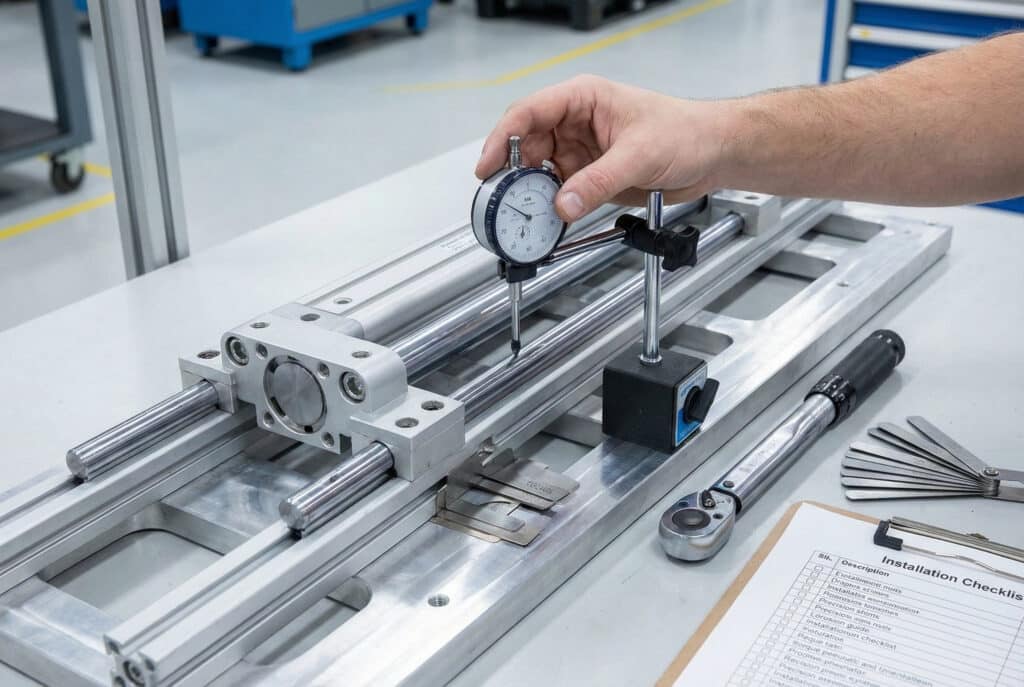
The photograph illustrates measurement tools and access. The exact indicator base, probe target, datum, sweep direction, and acceptance value must come from the machine’s inspection plan.
Don’t report only “± from nominal” if the instrument recorded maximum and minimum values. Preserve both readings, the signed change, and total indicator reading. They help distinguish a constant installation offset from angular change or a local straightness defect.
If the actuator binds after connection, disconnect it only under the approved energy-control procedure and compare the actuator and guide separately. The side-loading diagnostic guide explains how position-dependent resistance and directional wear help locate an incompatible load path.
What Sequence Prevents the Assembly from Being Pulled into Alignment?
Establish the primary guide datum first, align the actuator without forcing it, connect through the specified compliance, and remeasure after final torque. SMC’s MY1B instructions require freedom in the floating Y and Z directions for its cited external-guide arrangement (SMC MY1B Catalog, accessed 2026).
Use this installation sequence unless the selected manufacturers specify another:
- Isolate pneumatic, electrical, gravitational, and stored mechanical energy.
- Clean datum surfaces, remove burrs, and inspect threaded holes for raised material.
- Install the primary guide against its defined reference with the specified tightening sequence and torque.
- Place the rodless cylinder and supports loosely enough that bolts don’t bend the profile into position.
- Align the actuator to its own datum, then sweep the guide and actuator relationship in both transverse directions.
- Connect the payload through the specified floating bracket or moment compensator without prying either carriage.
- Tighten incrementally in the documented sequence. Repeat the indicator sweep after each critical stage.
- Check permitted manual travel, then commission at controlled speed and energy before restoring production conditions.
Never use mounting screws as a press to close an alignment gap. That stores elastic strain in the frame and makes the two bearing systems oppose one another through the stroke. Shims are acceptable only when their material, area, retention, and location are defined by the drawing or supplier instructions.
For long profiles, support spacing is a separate calculation. The mounting guide explains why maximum stroke is not maximum unsupported span. For payload force and moment limits, use the rodless-cylinder load-capacity guide rather than inferring capacity from guide size.
The most revealing record is often the change between installation stages. A stable reading before coupling but a shifted reading after the payload plate is attached identifies the interface that closed the geometric loop. One final number can’t show that cause.
Which Symptoms Point to an Alignment Problem?
Position-dependent force, torque-sensitive readings, or binding only after coupling points toward alignment. In THK’s comparison, a two-row Gothic-arch product with zero radial clearance, no seals or lubrication, and a 30 kg table measured 34 N at 0.03 mm error and 62 N at 0.04 mm (THK LM Guide, accessed 2026). Those conditions limit the result.
Look for a pattern across position, load, and assembly state:
| Observation | Plausible geometry mechanism | Next check |
|---|---|---|
| Resistance rises steadily toward one end | Angular mismatch between travel paths | Compare signed end readings and calculated |
| One short tight zone | Local rail straightness, contamination, or damaged bearing | Inspect the local surface and measure a continuous sweep |
| Smooth when uncoupled, tight when connected | Rigid connector closes an incompatible constraint loop | Verify floating degrees of freedom and connector alignment |
| Reading changes after final torque | Mounting surface or fastener sequence distorts the profile | Compare loose, staged-torque, and final-torque readings |
| Smooth unloaded, tight with payload | Frame, plate, or guide deflects under moment | Repeat measurements with production load and cable forces |
| More pressure masks the symptom | Axial thrust is overcoming transverse resistance | Stop increasing pressure and isolate the mechanical cause |
Directional wear can support the diagnosis, but it doesn’t prove it. Contamination, inadequate lubrication, damaged seals, stop impact, and overload can leave similar evidence. Use the measurement record and the exact product limits before deciding whether to realign, add compliance, change guidance, or replace damaged components.
For an established side-load problem, the side-load mitigation guide covers external guidance and connection changes. If the actuator architecture itself is unclear, begin with the rodless-cylinder type overview.
Guide Rail Parallelism FAQs
Festo’s 2026/05 DGC catalog gives the FKC compensator ±2.5 mm for bores 8–40 and ±4 mm for bores 50/63, while HIWIN’s maximum rail-parallelism values vary by series, size, and preload (Festo, 2026; HIWIN, accessed 2026). The correct FAQ answer starts with configured products.
Is ±0.05 mm the standard guide rail parallelism tolerance?
No. HIWIN’s tabulated maximum values range from 2 to 80 µm across the covered products and preload classes; they are not bilateral ± values. A rodless-cylinder assembly also includes actuator, coupling, frame, and machine requirements. Use the applicable limit with the same datum, direction, length, load state, and measurement definition.
Can I add flatness, straightness, and squareness tolerances directly?
Only after converting each feature into its contribution to one functional output. ISO 5459:2024 provides the datum-system framework, while the geometry supplies each sensitivity coefficient. Squareness may become displacement through a lever arm; flatness may create twist after torque. Adding unrelated drawing values directly is not a valid tolerance stack.
When can I use RSS instead of worst-case analysis?
Use RSS when the response is approximately linear and the input distributions, means, standard deviations, independence, and process controls are supported by data. NIST’s linear-propagation treatment assumes mutually independent inputs. If you only have drawing limits, worst-case analysis is the safer starting point for guaranteed interchangeability.
Where should the dial indicator be mounted?
The measurement setup must follow the specified datum and output. THK recommends using 2 blocks on an inspection plate for one single-rail running-accuracy method and keeping the straightedge close to the block. A convenient magnetic surface is not automatically a valid reference. Record the base, probe target, direction, and sweep length.
Can a floating bracket compensate for any alignment error?
No. A floating bracket has defined freedoms, capacity, geometry, and travel. SMC requires Y and Z freedom in its cited MY1B arrangement. Festo’s 2026/05 FKC data specify ±2.5 mm for DGC-G bores 8–40 and ±4 mm for bores 50/63. The accessory cannot correct rail straightness, weak structure, overload, or a wrong datum.
Sources and technical references
- ISO 1101:2017, geometrical tolerancing
- ISO 5459:2024, datums and datum systems
- THK, determining LM Guide accuracy
- THK, measuring accuracy after installation
- HIWIN, Linear Guideway Assembly Manual
- SMC, MY1B mechanically jointed rodless cylinder catalog
- Festo, DGC linear drives catalog
- NISTIR 6524, Information Models for Design Tolerancing