

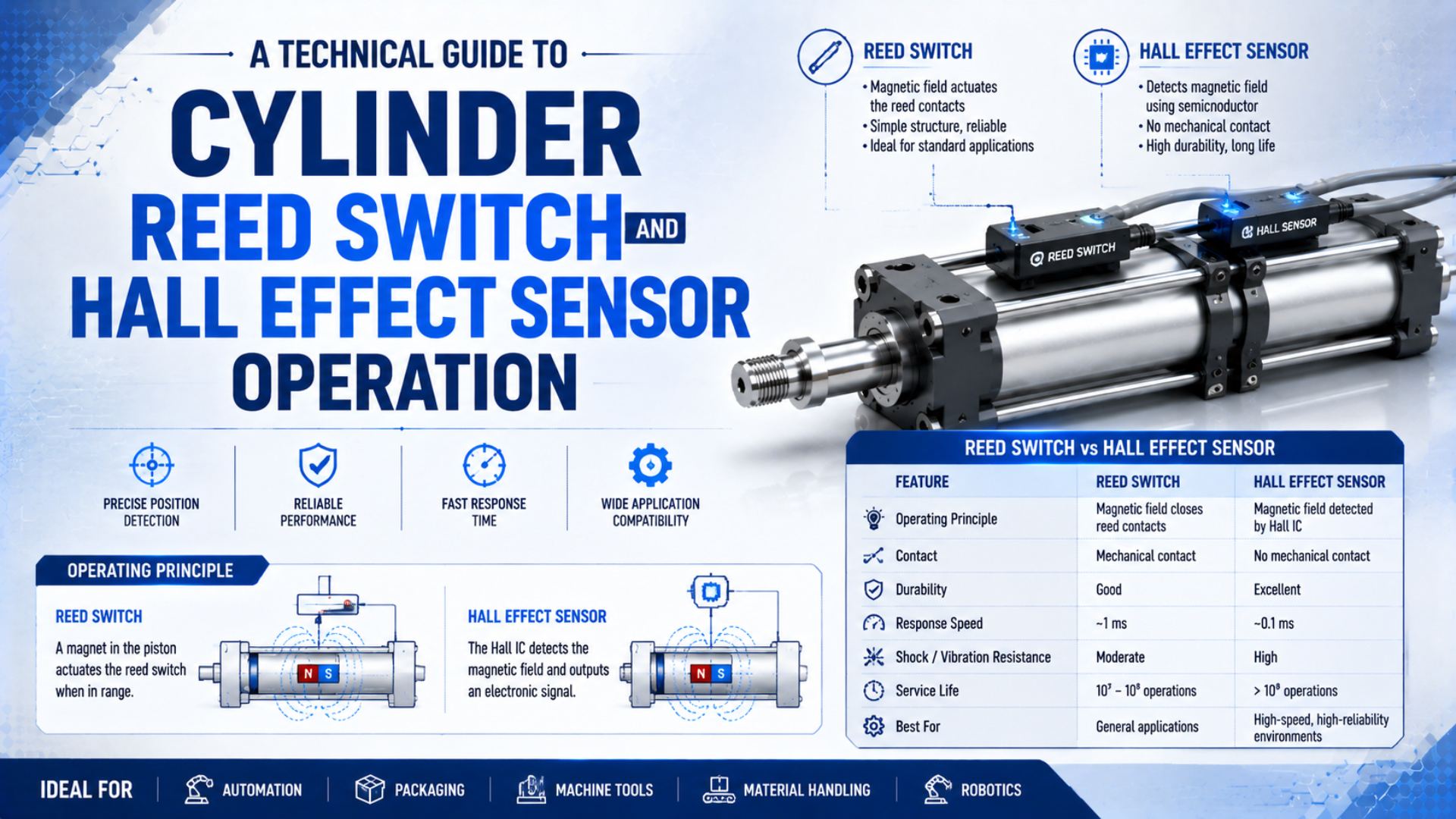
A magnetic cylinder switch changes state when the piston magnet enters its sensing window. Reed models move a sealed mechanical contact. Solid-state models use a magnetic sensing element, threshold circuit, and electronic output. That sensing element may be Hall effect, MR, AMR, or GMR, so “solid-state” and “Hall” aren’t interchangeable catalog terms.
The electrical interface matters just as much as the sensing physics. Before replacing a switch, match the approved cylinder and magnet, mounting slot, operating window, two-wire or three-wire topology, PNP or NPN output, normally open or normally closed function, voltage, current, connector pinout, and PLC input.
Key Takeaways
- One current SMC two-wire example allows up to 0.8 mA leakage and 4 V internal drop.
- A packaged Reed switch may contain an LED or protection circuit even though the Reed contact itself is passive.
- Hall, MR, PNP, NPN, two-wire, and IO-Link describe different design layers.
- Commission at the PLC under production motion and load.
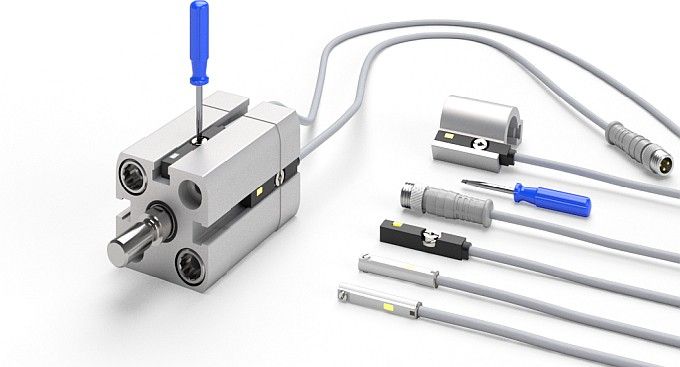
This guide stays with discrete magnetic cylinder switches and their electrical behavior. For endpoint, zone, analog, encoder, and continuous-position technologies together, use the broader pneumatic cylinder position sensing guide.
In this guide
- Reed cylinder switches close a mechanical contact
- How do Hall and MR solid-state switches work?
- Why are two-wire and three-wire outputs not interchangeable?
- Reed vs solid-state: select by datasheet, not labels
- How should you mount and commission the sensor?
- What causes false, missing, or chattering signals?
- Can a cylinder switch serve as a safety device?
- Cylinder reed and solid-state sensor FAQs
Reed Cylinder Switches Close a Mechanical Contact
SMC lists a 1.2 ms operating time, 300 m/s² impact resistance, and no leakage current for the Reed families in one Auto Switch Guide. Those figures are family-specific, but they show the defining behavior: a piston magnet physically closes ferromagnetic contacts sealed inside the Reed capsule (SMC Auto Switch Guide).
A Reed switch is a magnetically operated mechanical contact. Two flexible ferromagnetic reeds overlap inside a sealed glass envelope. When the field at the switch reaches its operate threshold, the reeds attract and complete the circuit. As the piston moves away and the field falls below the release threshold, the reeds separate.
That difference between operate and release points is hysteresis. It prevents rapid toggling near one threshold, but it also means the ON position and OFF position aren’t the same coordinate. The approach direction belongs in any switch-point test.
The Contact Is Passive, the Packaged Switch May Not Be
A bare normally open Reed contact can switch a compatible load without a separate electronics supply. A packaged cylinder switch may still include an indicator LED, surge suppressor, connector, resistor, or protective network. Those parts create polarity, voltage, current, and load restrictions.
For that reason, “Reed needs no power” is too broad. Read the complete switch circuit and data sheet. A two-wire illuminated Reed switch is installed in series with its load, so the available load voltage and current still decide whether the PLC input turns ON reliably.
Contact Load Determines Service Life
Mechanical contact life depends on the load being switched. Inrush current, capacitive inputs, relay coils, cable capacitance, and inductive voltage spikes can stress a Reed contact even when the steady current looks acceptable. Use the manufacturer’s load chart and recommended protection circuit rather than a generic wattage limit.
Contact bounce also matters. A PLC input filter may hide a short bounce event, while a high-speed counter can register it. If one piston pass produces several counts, compare the input task and filter with the switch waveform before replacing the cylinder.
The useful distinction isn’t “simple versus advanced.” It is where the switching burden sits. A Reed device places part of that burden on a mechanical contact and external load circuit. A solid-state switch moves it into the sensing, threshold, and transistor output stages.
How Do Hall and MR Solid-State Switches Work?
Texas Instruments separates Hall devices into switches, latches, and linear sensors, while SMC describes common solid-state cylinder switches that use an MR element. Those two facts prevent a common mistake: a non-contact cylinder switch isn’t necessarily Hall effect, and a Hall element doesn’t automatically provide analog, PWM, or IO-Link output (TI Hall Sensor Overview; SMC Auto Switch Guide).
A solid-state cylinder switch uses a magnetic sensing element and electronic decision circuit instead of a moving electrical contact. A digital device compares the sensed field with internal operate and release thresholds, then drives an electronic output. Hysteresis is deliberately built into that decision so noise near the threshold doesn’t cause rapid state changes.
Hall elements generate a small voltage when current and a perpendicular magnetic field interact. Signal conditioning amplifies that voltage before a comparator or converter uses it. MR-family elements change electrical resistance in response to a magnetic field. The package may look identical from outside, so the part number and data sheet decide which technology is inside.
Digital Switching Is Not Continuous Position Feedback
A digital Hall or MR switch reports whether the piston magnet crossed its threshold. It doesn’t measure the complete cylinder stroke. A linear magnetic sensor can report a position-related value, but the magnet profile, measuring range, teach procedure, linearity, repeatability, and drive compatibility remain product-specific.
SICK’s MPS-G illustrates that boundary. One current variant provides a 50 mm measuring range, two push-pull outputs, IO-Link, and programmable switching points. Those features belong to that configured four-wire product, not to every Hall or solid-state cylinder switch (SICK MPS-G datasheet).
For the relationship between the piston magnet, operating range, hysteresis, and machine position, read how internal magnet design affects sensor accuracy.
Why Are Two-Wire and Three-Wire Outputs Not Interchangeable?
SMC’s D-M9 example lists no separate supply terminal for its two-wire model, but it allows up to 0.8 mA leakage and 4 V internal drop. Its three-wire PNP/NPN versions use separate supply and output conductors, with up to 100 µA leakage and 0.8 V drop at 10 mA (SMC D-M9 Auto Switch Guide).
Two-Wire Switches Share Current with the Load
A two-wire switch sits in series with the PLC input or relay. The same conductors support the switch circuit and load current. When ON, the switch’s internal drop reduces the voltage available to the load. When OFF, leakage current can still flow through the input.
This creates two practical checks:
- ON-state check: supply voltage minus switch drop and cable loss must still exceed the PLC input’s guaranteed ON voltage.
- OFF-state check: switch leakage plus coupled noise must stay below the PLC input’s guaranteed OFF current or voltage.
If a PLC input never turns fully OFF, disconnecting the sensor and blaming the magnet is too early. Compare the switch’s maximum leakage with the input module’s OFF threshold first.
Three-Wire Outputs Separate Supply and Signal
A three-wire DC switch normally uses brown for positive supply, blue for zero volts, and black for output, but the connector pinout and colors must still be verified. The output may be PNP, NPN, push-pull, normally open, or normally closed.
| Output | What the active output does | Typical PLC pairing | Common mismatch |
|---|---|---|---|
| PNP | Sources positive voltage/current to the input | Sinking PLC input commoned to 0 V | Installed on a sourcing input system |
| NPN | Sinks the input toward 0 V | Sourcing PLC input commoned to positive supply | Installed on a sinking input system |
| Push-pull | Actively drives both logic states | Compatible digital input defined by manufacturer | Assumed to be universal without checking limits |
| Two-wire | Changes series impedance in the load circuit | Input or relay within stated voltage/current window | Leakage or internal drop crosses input thresholds |
PNP and NPN describe the output transistor behavior. They don’t identify whether the magnetic sensing element is Hall, MR, or another technology. A switch can fit the cylinder slot perfectly and still be electrically incompatible with the controller.
Treat sensor replacement as a two-key approval. The mechanical key is cylinder, magnet, slot, bracket, and operating window. The electrical key is topology, polarity, logic, voltage, current, connector, and PLC threshold. Both keys must match before the replacement is equivalent.
Reed vs Solid-State: Select by Datasheet, Not Labels
In one SMC family comparison, Reed models are listed at 1.2 ms and 300 m/s² impact resistance, while ordinary solid-state models are listed at no more than 1 ms and 1,000 m/s². The difference is meaningful for those products, but it doesn’t support a universal “200 times faster” rule (SMC Auto Switch Guide).
Use the application requirements and exact data sheets:
| Selection question | Reed switch | Solid-state switch | Approval evidence |
|---|---|---|---|
| What load is switched? | Contact rating, inrush, protection | Output voltage and current limits | Load and PLC input data |
| Is contact bounce acceptable? | Check bounce and input filtering | Usually cleaner electronic transition | Scope or PLC event test |
| Is switching frequent? | Contact life depends on electrical load | No mechanical contact wear | Rated product plus cycle test |
| Is shock or vibration high? | Verify contact and package ratings | Often higher product rating | Model-specific test values |
| Is OFF leakage critical? | Bare contact can have none; packaged circuit varies | Two-wire and three-wire leakage differ | Worst-case input threshold check |
| Is temperature unusual? | Check contact, cable, LED, and housing | Check electronics, cable, and housing | Complete switch rating |
| Is welding current nearby? | Standard model may be disturbed | Standard model may be disturbed | Approved magnetic-field-resistant model |
Solid-state removes mechanical contact wear, but it doesn’t create unlimited service life. Cable flex, connector ingress, overvoltage, output short circuit, heat, seal failure, and magnetic overexposure can still stop the signal. Reed can remain the better choice when its contact circuit, speed, environment, and expected cycles are within rating.
Don’t use purchase price alone. The cost of rewiring a PLC panel, changing input cards, replacing connectors, or diagnosing leakage-current faults can exceed the switch price. Compare the installed interface and failure consequence.
Hall Effect Is Not Automatically More Accurate
A digital Hall switch detects a magnetic threshold. Its switching repeatability isn’t the same as piston-position accuracy, and piston-position accuracy isn’t the same as tooling accuracy. Air compressibility, seal friction, load, guide clearance, bracket movement, and mechanical stops remain outside the sensor IC.
For a high-speed axis, the switching time is only one part of the timing chain. PLC input filtering, scan time, program task, valve delay, cylinder speed, and piston overtravel all contribute. The high-speed pneumatic cylinder checklist covers the mechanical and pneumatic side of that review.
How Should You Mount and Commission the Sensor?
SMC gives reference hysteresis of 2 mm or less for covered Reed switches and 1 mm or less for covered solid-state switches, while warning that environment can change those values. Commissioning therefore needs both approach directions and production conditions, not one hand-moved LED position (SMC Auto Switch Guide).
Start with the exact cylinder and switch compatibility table. Confirm bore, built-in magnet option, sensor slot, bracket, housing orientation, cable exit, and mounting screw. A switch that physically fits a slot isn’t automatically approved for the magnet system.
Use this commissioning sequence:
- Record cylinder and sensor part numbers, wiring diagram, connector pinout, and PLC input model.
- Isolate the machine safely before mounting or moving the sensor.
- Move the piston slowly from both directions and mark ON and OFF positions.
- Set the sensor inside the manufacturer’s stable operating zone, not at its first flicker point.
- Verify the sensor LED and PLC input independently.
- Run at minimum and maximum production speed with the real load and cushion settings.
- Test adjacent cylinders, solenoids, motors, welders, and normal power switching.
- Check cable strain relief, bend radius, connector sealing, and moving-part clearance.
- Test power-up, air dump, E-stop, and recovery behavior.
- Save the final sensor location and acceptance results.
The LED proves only that the local sensor circuit believes it changed state. It doesn’t prove that the PLC received the state, the program used it correctly, or the tooling reached its process datum.
Protection Ratings Are Application-Specific
IP67 is common, but it isn’t a universal minimum for every factory or proof of chemical, coolant, steam, or repeated-flex resistance. Check the full environment: temperature, washdown pressure, fluid compatibility, weld field, metallic debris, cable flex, connector orientation, and nearby steel.
SMC also notes that a two-color switch can become unstable even when fixed in its indicated proper range if installation conditions, external magnetic fields, adjacent cylinders, or temperature disturb the magnetic margin. The final machine test remains necessary.
What Causes False, Missing, or Chattering Signals?
SMC warns that solid-state two-wire leakage can reset or falsely hold a PLC input when it exceeds the input’s detection current. The same guide defines operating range as the piston travel over which the switch stays ON and notes that magnet force, sensitivity, and environment can change that range (SMC Auto Switch Guide).
Separate the checkpoints before replacing parts:
| Symptom | First electrical checks | First magnetic/mechanical checks |
|---|---|---|
| No LED and no PLC input | Supply, polarity, open cable, connector, shorted output | Wrong switch family, piston outside range, missing magnet |
| LED ON, PLC input OFF | PNP/NPN mismatch, wrong common, voltage drop, broken output wire | Usually not a magnet problem |
| LED OFF, PLC input ON | Two-wire leakage, coupled voltage, stuck input, wiring short | External magnetic field if LED behavior is abnormal |
| Signal appears only in a narrow spot | Verify supply and input thresholds | Weak margin, wrong slot, sensor misalignment, nearby steel |
| Several counts per pass | Input filter, counter task, Reed bounce, cable noise | Piston rebound or vibration through the switching zone |
| Switch point shifts after repair | Wrong replacement part or wiring | Sensor moved, magnet orientation changed, bracket loosened |
| Fault occurs near a welder | Cable routing and PLC value | External magnetic field and switch compatibility |
Use a multimeter for supply and static output checks. Use an oscilloscope or PLC trace only when the fault demands timing or noise evidence. A blanket quarterly oscilloscope test adds work without defining what constitutes failure.
Check the Load Circuit Before the Magnet
Reed contacts can fail from overcurrent, inrush, or inductive kick. Solid-state outputs can fail from reverse wiring, short circuit, or exceeding voltage/current ratings. SMC warns that some D-M9 variants do not include output short-circuit protection, so an output fault can damage the switch immediately (SMC D-M9 Instructions).
If every sensor on one PLC card behaves incorrectly, investigate the common, input thresholds, supply, and grounding before replacing every cylinder magnet. If one sensor changes when its cable is flexed, inspect the lead and connector. If the LED and PLC are stable but the workpiece is wrong, move the diagnosis to guides, stops, coupling, and pneumatic motion.
The quickest diagnostic split is local indication, controller input, piston state, and tooling state. Those four observations divide one vague “position sensor fault” into electrical, magnetic, pneumatic, or mechanical branches without guessing.
Can a Cylinder Switch Serve as a Safety Device?
OSHA documented a 2018 incident in which a worker adjusted a pneumatic position sensor without locking out the machine; unexpected motion fractured the worker’s arm. The lesson isn’t that one sensor type was wrong. It is that sensor adjustment and machine safety require controlled isolation and validated safety functions (OSHA Accident Report 108887.015).
A standard cylinder switch should be treated as process feedback unless the complete safety function has the required rating and validation. A normal PNP, NPN, or two-wire auto switch doesn’t become a guard interlock, safe position sensor, or redundant diagnostic device because the PLC program checks it twice.
Machine risk assessment may require safety-rated sensors, redundant channels, discrepancy monitoring, safe logic, controlled pneumatic energy release, mechanical blocking, or other measures. Apply the relevant machinery and functional-safety standards for the jurisdiction and machine.
Lock out electrical, pneumatic, hydraulic, mechanical, and stored energy before entering a hazard zone or adjusting a sensor where unexpected motion can injure someone. OSHA specifically states that compressed air stored in a cylinder belongs in the machine-maintenance energy-control plan (OSHA Machine Maintenance).
Hazardous Areas Need a Certified Assembly
“Hall effect” and “solid-state” are not hazardous-area approvals. Verify the exact sensor certification, entity parameters, cable, connector, barrier or isolator, installation method, temperature class, gas/dust group, and cylinder configuration. An ATEX or IECEx option code on one product doesn’t authorize a visually similar standard switch.
Cylinder Reed and Solid-State Sensor FAQs
One SMC D-M9 family lists 0.8 mA maximum leakage and 4 V maximum internal drop for its two-wire model, compared with 100 µA and lower internal drop for three-wire versions. Those values explain why replacement questions must include the PLC input and wiring topology, not only the sensing element (SMC D-M9 Auto Switch Guide).
Can I replace a Reed cylinder switch with a Hall or MR switch directly?
Only after checking cylinder and magnet compatibility, sensor slot, mounting position, wiring topology, PNP/NPN logic, voltage, load current, leakage, internal drop, connector pinout, and PLC thresholds. A solid-state model may fit the same groove but require a different input common or an additional conductor. Test the final assembly under production motion.
Is every solid-state cylinder switch a Hall effect sensor?
No. Manufacturers also use MR, AMR, GMR, and related magnetic sensing technologies. SMC describes MR-based solid-state auto switches, while Festo distinguishes magnetoresistive SMT models from magnetic Reed SME models. Use the exact data sheet. “Solid-state” tells you there is no switching contact, not which magnetic element is inside.
What is the practical difference between PNP and NPN?
A PNP output sources current to an active input; an NPN output sinks current toward zero volts. The PLC input card and its common must support the chosen behavior. PNP/NPN does not identify Reed, Hall, or MR sensing. Verify the wiring diagram and connector pins instead of relying only on wire color.
Why can a two-wire sensor keep a PLC input ON when the piston is away?
The switch may pass OFF-state leakage current through the input. If that leakage exceeds the PLC module’s guaranteed OFF threshold, the input can remain active or unstable. Check worst-case leakage, cable coupling, and input specifications. A bleeder device or different sensor may help only when the manufacturers approve the circuit.
Can a standard cylinder switch be used for personnel safety?
Not by default. Standard cylinder switches generally provide process feedback. A personnel-protection function needs a risk assessment and safety-rated architecture with the required sensor, logic, diagnostics, pneumatic energy control, installation, and validation. Always isolate stored pneumatic and electrical energy before adjusting a switch inside a machine hazard zone.
Sources and technical references
- SMC Auto Switch Guide
- SMC D-M9 Auto Switch Guide
- SMC D-M9 Installation and Maintenance Instructions
- Festo SME/SMT Proximity Sensor Data
- Texas Instruments: What Is a Hall-effect Sensor?
- Texas Instruments: Replacing Reed and MR Switches with Hall-effect Switches
- Texas Instruments Hall Switch Threshold Tutorial
- SICK MZT8 Cylinder Sensor Data
- SICK MPS-G Programmable Cylinder Sensor Data
- OSHA Machine Maintenance Energy Control