

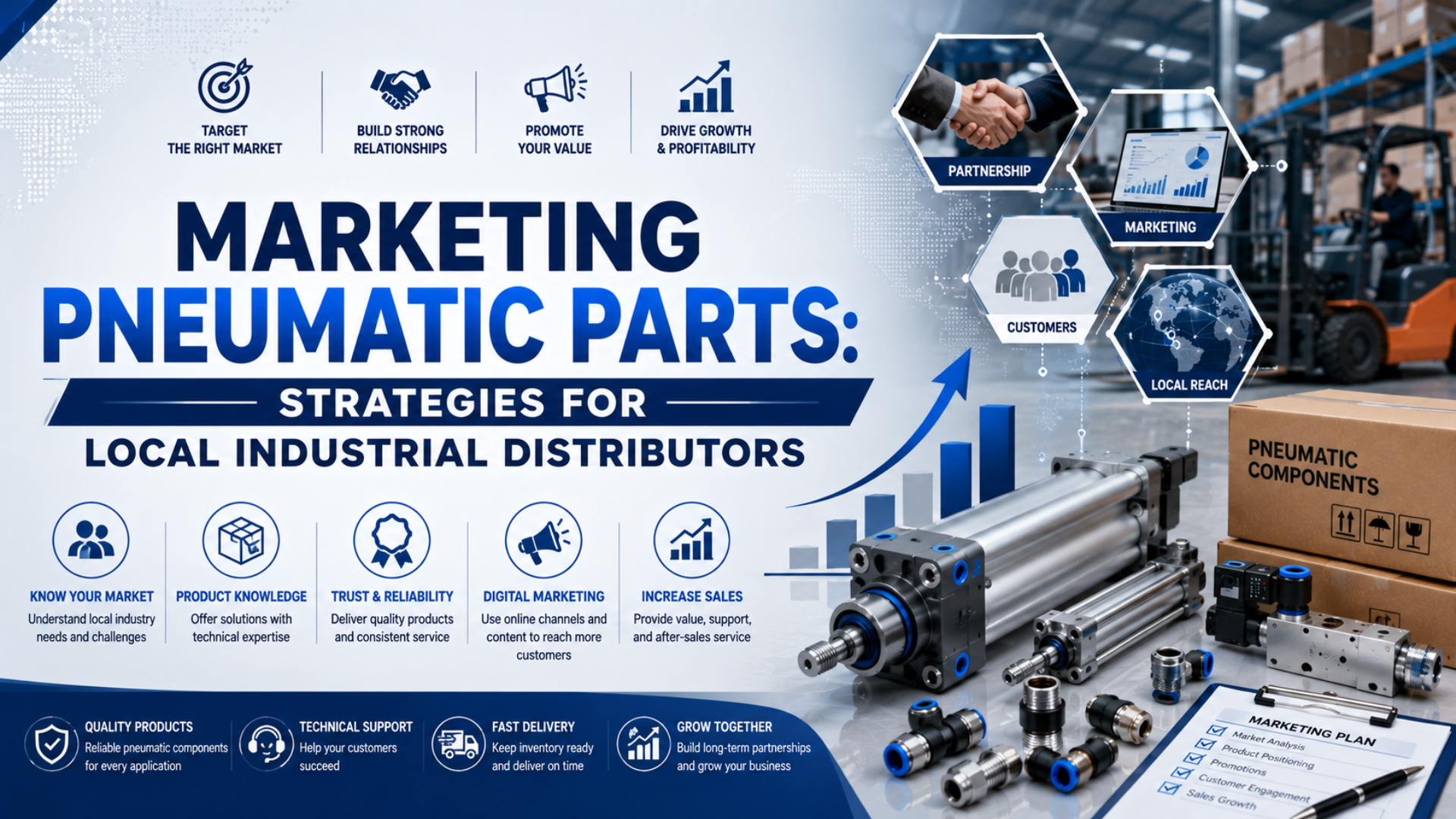
Local industrial distributors should market evidence that reduces a plant buyer’s risk: verified stock, a defined service area, application knowledge, documented response handling and traceable follow-up. Digital channels make that evidence discoverable. Field service makes it credible. A measurement chain shows which activities create qualified pneumatic-parts opportunities rather than empty traffic.
The 2025 B2B content study from Content Marketing Institute and MarketingProfs surveyed 980 marketers. Only 29% rated their content strategy very or extremely effective, while 42% of the less-effective group cited unclear goals (Content Marketing Institute, 2024). A local distributor does not need more disconnected campaigns. It needs a small number of testable promises tied to sales records.
Key Takeaways
- Publish service evidence.
- Track every channel through qualified inquiries.
- Control technical claims, reviews, permissions and email suppression as commercial records.
- Run 90-day tests, then stop any activity that cannot create attributable pneumatic opportunities within the branch’s actual service capability.
Why Should Local Pneumatic Distributors Market Service Evidence First?
Among 980 B2B respondents, 82% of the top-performing content marketers credited audience understanding and 70% credited industry expertise for their results (Content Marketing Institute, 2024). For a pneumatic distributor, that means proving which plants, applications and service problems it can support before promoting a broad catalog.
Service evidence is a buyer-verifiable statement about availability, technical scope or response handling. “Fast delivery” is a slogan. “Stock status confirmed by 3 p.m. for dispatch within the published service area” is an operating rule that sales and warehouse teams can audit.
Build the commercial message from five controlled facts:
- Coverage: served cities and plant clusters.
- Availability: a precise stock status plus the replenishment source and timestamp behind it.
- Technical scope: product families the team can competently review.
- Response process: named ownership.
- Evidence: drawings, cross-references, inspection records, service logs and training material that let a buyer verify the promise without relying on a slogan.
Local presence has value only when the buyer can predict what happens after contact. A phone number without a response rule is not an emergency program. Control defines availability. Convert proximity into a documented service product before paying to advertise it.
Proof beats proximity.
Use the private-label cylinder manufacturer qualification guide when a local cross-reference depends on an upstream manufacturing source. The distributor remains responsible for describing what has actually been checked.
Build a Local Market Map Before Buying Traffic
Google allows a service-area or hybrid business to define up to 20 service areas and advises keeping the overall area within roughly two hours of driving from its base (Google Business Profile Help, 2026). Treat that limit as profile guidance, then set the distributor’s real coverage from staffing, stock and response capability.
Map accounts by operating need rather than drawing a radius around the warehouse. A food plant with washdown exposure, an automotive fixture builder and a packaging integrator may sit ten miles apart but require different seals, documentation and follow-up.
Create one row per addressable plant or machine builder:
| Field | What to record | Why it affects marketing |
|---|---|---|
| Site and industry | Facility, segment and production process | Determines relevant applications and terminology |
| Installed base | Known cylinder, valve, FRL and fitting families | Shapes cross-reference plus stocking content |
| Service consequence | Planned demand, urgent breakdown or safety-controlled work | Sets the correct response promise |
| Buying route | Maintenance, engineering, purchasing or integrator | Determines the next useful document |
| Coverage status | Normal route, special trip, partner handoff or out of area | Prevents an unserviceable lead promise |
Ask sales and service staff to identify repeated requests from the previous quarter. The U.S. Small Business Administration separates market research questions into demand, market size, location, saturation and pricing, and recommends examining competitors by product line plus market segment (SBA, 2026). A local market map should answer those questions with plant-level evidence.
Do not publish confidential installed-base details.
Aggregate them into useful pages such as “pneumatic cylinder replacement support for packaging equipment in northern Ohio” or “washdown fitting selection for regional food plants.” The location clarifies coverage. The application demonstrates competence.
How Should a Distributor Use Google Business Profile?
Google says local results are primarily determined by three factors: relevance, distance and prominence (Google Business Profile Help, 2026). A distributor can improve the evidence Google and buyers see without buying a guaranteed local position, so complete profile data plus accurate service information should come before posting volume.
Start with business identity.
Use the exact branch name, correct address or service-area status, normal and special hours, a local phone number, the most specific valid category and a direct website URL. Do not create extra profiles for sales territories that lack eligible staffed locations.
Then align the profile with the service evidence:
- List only deliverable services.
- Add current facility, counter, warehouse and technical-team photos with accurate captions.
- Link each profile to a branch-specific page that names service coverage plus response routes rather than a generic homepage.
- Publish holiday hours before they affect urgent orders.
- Answer technical questions with application limits, required input data and a contact route; never imply that one cross-reference fits every machine.
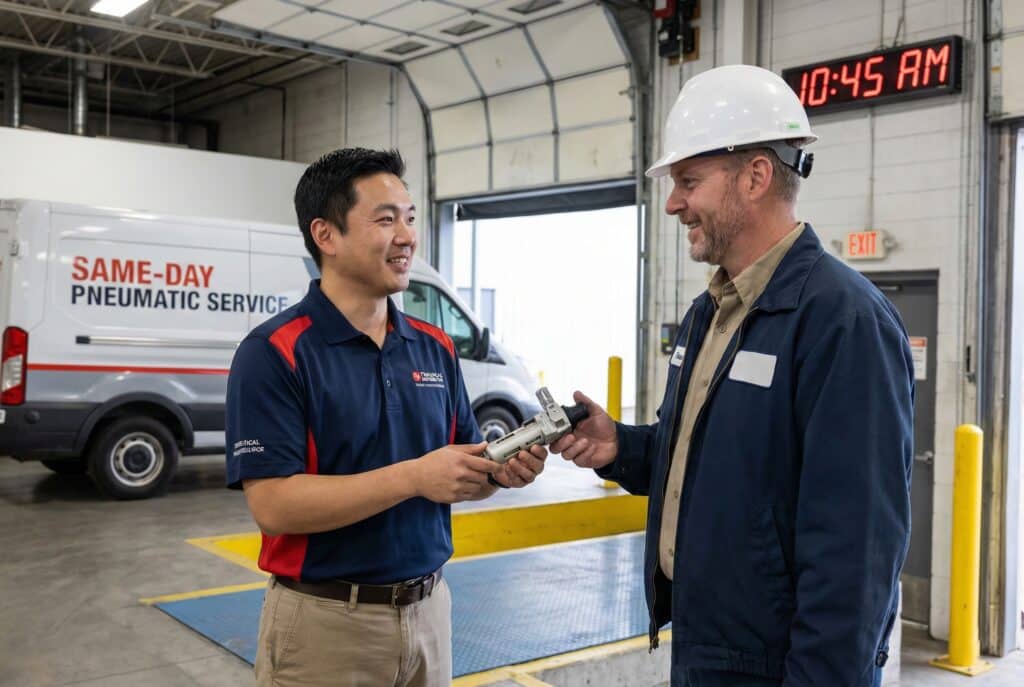
Google Business Profile performance can report profile views plus searches, direction requests, call-button clicks and website clicks; a person is counted no more than once per day for profile views (Google Business Profile Help, 2026). These are interaction signals, not closed sales. Export them monthly and compare them with call logs plus website inquiries.
Reviews need a process as well.
Ask real customers for an honest review after a completed service event. Do not write the review, require a positive sentiment or suppress unfavorable submissions. The rule appears below.
There are no shortcuts.
Which Technical Content Generates Qualified Inquiries?
In the 2025 CMI survey, 58% of B2B marketers said video produced strong results, followed by customer stories at 53% and research reports plus white papers at 45% (Content Marketing Institute, 2024). Those are broad B2B findings, so a distributor should test each format against qualified pneumatic inquiries rather than assume the percentages transfer locally.
Technical content should complete a real buying task.
Start with questions already recorded by the counter, service team and sales inbox:
- Which measurements prove that a candidate cylinder matches the installed bore, stroke, mounting, ports and sensing arrangement?
- Is restricted exhaust slowing the actuator?
- Which fitting material fits the fluid, washdown chemistry and environment?
- What belongs in an RFQ?
- When does a repair introduce more uncertainty than a controlled replacement supported by current drawings and an identified manufacturing source?
Each page should state its technical boundary. A dimensional match does not establish equal cushioning, sensing, materials or service life. A maintenance article should not instruct readers to bypass lockout or machine-specific safety procedures. The unbranded versus branded pneumatics guide provides a useful risk screen, while the repair-versus-replace guide supports a different decision.
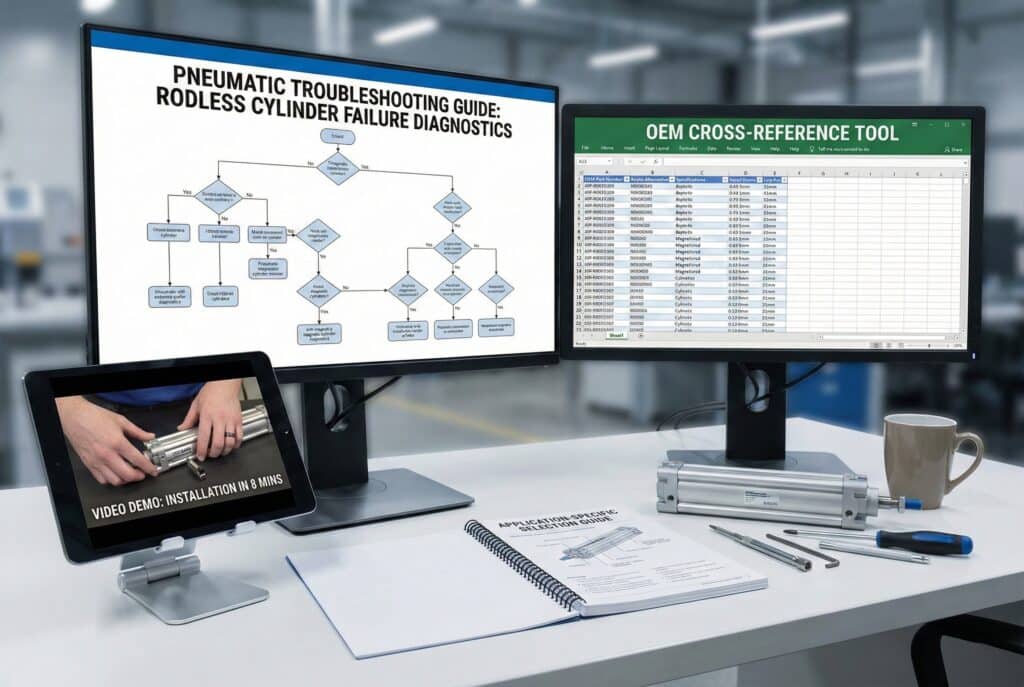
The strongest local-search page can deliver national technical value while keeping its commercial promise limited to one branch’s real service area and response capability. The engineering answer should remain useful to any reader. Location belongs in the service promise, contact route and inventory context. Stuffing city names into every technical paragraph weakens both readability and trust.
That separation matters.
Give every asset one next step. A troubleshooting guide can lead to a documented service request. A cross-reference page can request bore, stroke, mounting, port, sensing and environment. A training video can link to the written method plus product data. Avoid claiming a universal conversion rate because channel performance depends on territory plus audience plus technical intent plus how sales staff handle the response.
How Can Training and Field Service Create Demand?
NIST reports that the MEP National Network has nearly 1,400 trusted experts operating through approximately 450 service locations across the United States and Puerto Rico (NIST MEP, 2026). The network illustrates why localized manufacturing support matters: useful expertise reaches a plant through people plus regional relationships, not a product feed alone.
A distributor can apply the same principle at a smaller scale. Offer tightly scoped sessions built around a maintenance or engineering outcome:
- Cylinder replacement evidence.
- Valve plus tubing checks for a slow or unstable actuator.
- Point-of-use compressed-air preparation checks covering pressure, contamination and drainage.
- Fitting and hose identification for maintenance stores.
- RFQ data that prevents cross-reference delays by naming bore, stroke, mounting, port, sensing, environment and required delivery timing before an application engineer begins the comparison.
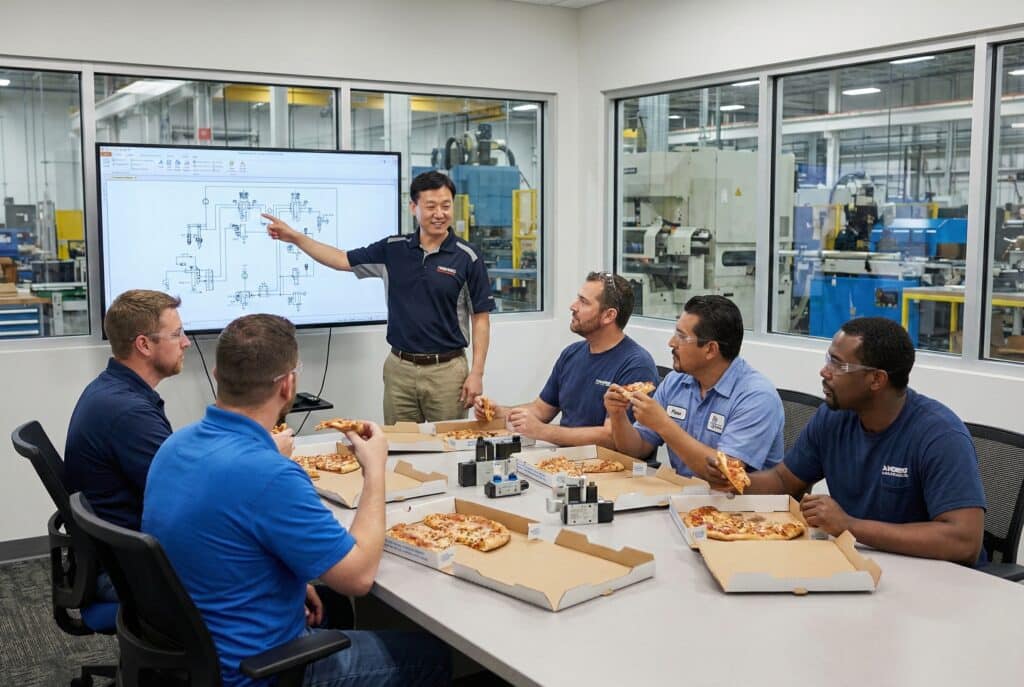
Training is not a disguised product pitch.
State the learning objective, intended audience, duration, safety boundary and documents attendees will receive. Record attendance only with an appropriate business purpose and follow the organization’s privacy practices. Field activity should generate structured observations. After an authorized plant walk, record recurring failure modes, missing identification, obsolete components and documentation gaps without copying confidential machine information into a public marketing system. Convert common, non-confidential questions into future guides. Use the pneumatic cylinder troubleshooting guide as a pre-visit reference. For fitting-intensive accounts, the bulk purchasing quality guide turns a general stock discussion into measurable inspection and traceability requirements. Repeat sessions should use the same agenda plus evidence checklist so changes in attendee questions reveal real knowledge gaps rather than differences between presenters. Document the change before the next session and assign one owner to update the training material.
Measure Every Channel from Click to Gross Profit
Google Search Console reports four primary Search metrics: clicks, impressions, average click-through rate and average position (Google Search Console Help, 2026). Google Analytics recommends consistently using three campaign parameters, utm_source, utm_medium and utm_campaign, on tagged destination URLs (Google Analytics Help, 2026).
Neither system knows whether an inquiry describes a valid pneumatic opportunity.
Connect digital activity to a controlled sales record:
Define channel return using gross profit rather than sales revenue:
Here, is gross profit from won orders assigned under a written attribution rule, is the channel’s media plus labor plus production cost, and is the resulting return ratio. Keep disputed opportunities separate instead of forcing every order into one campaign. Track qualified inquiry rate as . Define qualification before the campaign begins. A valid record may require account identity, application, required timing, location and a plausible product or service fit.
From our work with distributor inquiries, the most useful response records name the machine, requested product family, timing and unresolved technical question before a quotation is assigned. Local distributors should optimize for evidence-bearing inquiries, not lead volume. Ten requests containing photos, dimensions and machine context can deserve more engineering attention than one hundred anonymous catalog downloads. Marketing and application teams should agree on the qualification fields before comparing channels.
Which Marketing Channels Should Receive Budget First?
In the 2025 CMI study, respondents most often selected search marketing among paid channels at 61%, while 85% selected LinkedIn as the social platform providing the best value (Content Marketing Institute, 2024). These are survey perceptions across B2B organizations, not guaranteed distributor returns.
Use a channel only when its intent matches the branch’s service evidence and its outcome can be tracked:
| Channel | Best-fit job | Evidence required before launch | Continue when |
|---|---|---|---|
| Google Business Profile | Capture local service and branch-intent searches | Accurate identity, service area, hours, phone and landing page | Calls or clicks become qualified local inquiries |
| Technical search content | Answer specification, replacement and troubleshooting questions | Reviewed method plus source-backed limits plus one next step | Target queries create attributable qualified inquiries |
| Customer email | Follow up on known interests, training or service intervals | Lawful list, clear sender, useful segment and opt-out process | Replies plus opportunities justify production cost |
| Plant training | Demonstrate competence to a defined technical audience | Learning objective, host approval, presenter and follow-up record | Attendees request relevant reviews or quotations |
| LinkedIn or video | Distribute technical proof and expose staff expertise | Named audience, controlled claim and tagged destination | Engagement progresses to identifiable accounts |
Do not average performance across branches with different territories and stock profiles. Review each channel by location plus campaign plus audience. A paid campaign driving inquiries outside the service area can show strong click metrics while consuming sales time. Start with controlled evidence. This includes accurate listings plus current contact routes plus technical answers plus follow-up to known customers. Add paid media only after the landing page plus call handling plus CRM attribution work together.
Run a 90-Day Pneumatic Parts Marketing Cycle
Google Search Console shows the previous three months by default in its Performance report (Google Search Console Help, 2026). That window supports a practical 90-day operating cycle for local distributor marketing, though seasonality plus shutdown schedules plus low-volume industrial sales can require a longer comparison before a final decision.
During the baseline period, record existing inquiry sources and response quality. During the build period, correct one branch profile plus one landing page and one technical asset. The test period should keep campaign naming plus qualification rules plus response ownership stable. Do not drift. At review, classify outcomes as no response plus non-qualified response plus qualified opportunity plus won order. Continue a channel when evidence supports its cost plus opportunity quality. Change one variable when the failure cause is identifiable. Stop when the channel cannot reach the territory, cannot be attributed or consistently attracts work the branch cannot support.
How Should Reviews and Email Campaigns Stay Compliant?
The FTC’s Consumer Review Rule became fully effective on October 21, 2024 (FTC, 2025). It prohibits specified fake reviews plus sentiment-conditioned incentives plus undisclosed insider reviews plus review suppression plus fake social indicators, so local distributors should control review requests as carefully as published product claims.
Ask for an honest review after a real transaction, training session or service event. Never script the experience. Disclose material relationships where required, and do not offer a reward only for positive sentiment.
Stay neutral.
Commercial email has a separate control path.
The FTC lists eight main CAN-SPAM requirements and says opt-out requests must be honored within 10 business days; the mechanism must remain capable of processing requests for at least 30 days after sending (FTC, 2026).
Before an email campaign, verify:
- Accurate sender details.
- A subject line that matches the actual commercial message.
- Advertising identification presented in the form required for the campaign.
- A valid physical postal address.
- One clear opt-out route that remains easy to recognize and use.
- A suppression process shared with every internal sender plus outside marketing vendor so an opted-out address does not re-enter another list.
This article describes U.S. federal guidance, not a complete legal review. Privacy, consent and electronic-marketing requirements differ by jurisdiction. Route international campaigns through the distributor’s applicable legal plus privacy process. For a multi-country program, document which entity controls the list plus which law governs the recipient before the first message is released.
Final Decision Rule for Local Distributors
The SBA recommends maintaining a marketing plan at least annually and comparing marketing plus sales costs with generated revenue to evaluate return (SBA, 2025). Local pneumatic distributors need a shorter operating review inside that annual plan so weak channel evidence does not consume a full year’s budget.
Approve a channel only when four gates close:
| Gate | Release question | Stop condition |
|---|---|---|
| Service | Can the branch deliver the published promise? | Territory, stock or response route is undefined |
| Evidence | Are technical plus commercial claims retrievable? | The message relies on an unsupported number or anecdote |
| Attribution | Can responses reach a named campaign and sales record? | Traffic cannot connect to qualified opportunities |
| Compliance | Are reviews, email and customer information controlled? | Required consent, disclosure or suppression process is absent |
The goal is not to outspend a national catalog.
Make support verifiable. A branch that publishes precise coverage, useful technical answers and honest response records can build authority without inventing ROI claims. Check the public company profile plus contact route from the buyer’s perspective. The legal entity, service scope and response path should agree with the local campaign.
Verify both.
Pneumatic Parts Marketing FAQs: What Should Local Distributors Ask?
Google exposes four core Search performance metrics, permits up to 20 Business Profile service areas and recommends three required UTM campaign parameters (Google Search Console, 2026; Google Business Profile, 2026; Google Analytics, 2026). These answers turn those platform rules into distributor decisions.
How much should a local pneumatic distributor spend on marketing?
No universal percentage is defensible. Build the budget from channel cost plus staff time plus production and tracking. Release funds through controlled 90-day tests, then compare attributable gross profit plus opportunity quality with the baseline before increasing spend or reducing essential service capacity.
Which channel should a pneumatic distributor start with?
Start with the channel closest to existing buyer intent. For most branches, that means accurate Business Profile data, a working local contact route and one technical page answering a repeated request. Add email, training or paid media only after attribution plus response ownership can show what each channel produces.
Should every pneumatic product have an e-commerce price?
No. Standard stocked items may fit transactional ordering. Configured cylinders, replacement valves and application-sensitive assemblies often need drawings, operating conditions or compatibility checks before quotation. Use a structured RFQ when a published price could hide configuration risk. The buying path should match the technical uncertainty.
How should distributors measure content marketing?
Measure the full chain from Search exposure through identifiable responses, qualified opportunities, quotations, won orders and attributable gross profit. Be consistent. UTM parameters plus CRM records should preserve the campaign identity far enough downstream to show whether the content attracted a serviceable plant with a valid pneumatic application.
Can a distributor offer incentives for online reviews?
Never condition compensation on positive or negative sentiment. The FTC rule reaches other conduct too. Request honest feedback from real customers and document the review process, including material-connection disclosures plus staff instructions plus the controls applied before an outside agency can contact customers.
Sources and technical references
- Content Marketing Institute, B2B Content Marketing Benchmarks, Budgets, and Trends: Outlook for 2025, survey of 980 B2B marketers conducted with MarketingProfs; published 2024-10-09 and retrieved 2026-07-26.
- Google Business Profile Help, Tips to improve your local ranking on Google, relevance, distance and prominence guidance; retrieved 2026-07-26.
- Google Business Profile Help, Manage your service areas, service-area limits plus configuration guidance; retrieved 2026-07-26.
- Google Business Profile Help, Understand your Business Profile performance and insights, profile interaction metrics; retrieved 2026-07-26.
- Google Search Console Help, Performance report overview and basic setup, clicks, impressions, CTR plus average position; retrieved 2026-07-26.
- Google Analytics Help, Collect campaign data with custom URLs, UTM parameter guidance; retrieved 2026-07-26.
- Federal Trade Commission, Consumer Review Rule warning template, effective date plus prohibited review practices; issued 2025-12-22 and retrieved 2026-07-26.
- Federal Trade Commission, CAN-SPAM Act: A Compliance Guide for Business, commercial-email controls; retrieved 2026-07-26.
- U.S. Small Business Administration, Market research and competitive analysis, market and competitor research framework; updated 2026-03-24 and retrieved 2026-07-26.
- U.S. Small Business Administration, Marketing and sales, marketing-plan plus ROI guidance; updated 2025-05-29 and retrieved 2026-07-26.
- NIST MEP, Find an MEP Center, network size plus localized manufacturing-support locations; retrieved 2026-07-26.