

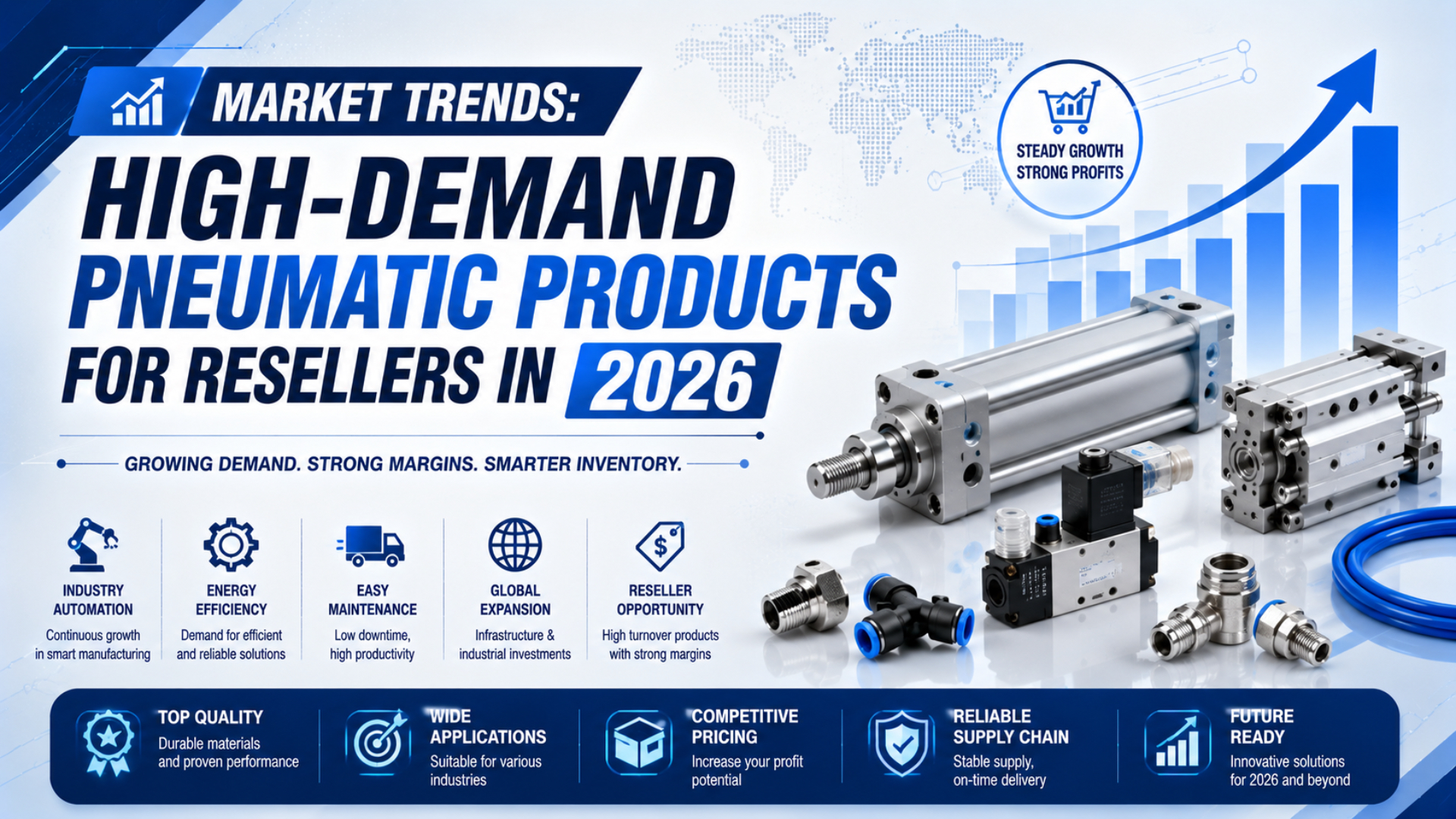
A high-demand pneumatic product is not simply a component featured in a market forecast. For a reseller, demand becomes real when repeat enquiries, quoted applications, conversion rates, replacement frequency, and service requirements point in the same direction. Global automation data can identify opportunity areas, but local customer evidence should decide what goes on the shelf.
The strongest 2026 signals favor four portfolio areas: compact linear motion, connected valve and sensor infrastructure, measurable compressed-air efficiency, and application-specific products backed by documentation. These are opportunity groups, not a universal sales ranking. Geography, installed machinery, industry mix, and the reseller’s technical capability will change the result.
Key Takeaways
- Global robot installations exceeded 500,000 units for four consecutive years.
- IO-Link reached 71 million installed nodes in 2025.
- Energy demand favors measurement and correct sizing, not “efficient” labels.
- Stock decisions should follow local enquiry and conversion evidence.
What Counts as a High-Demand Pneumatic Product in 2026?
The International Federation of Robotics recorded 542,000 industrial robot installations in 2024, with annual installations above 500,000 for a fourth consecutive year (IFR, 2025). That supports sustained automation demand, but it does not prove that one pneumatic component family leads every reseller’s market.
Use three evidence layers:
- Macro signal: robot installations, connected-device adoption, energy policy, and machinery regulation.
- Application signal: customer requests for compact motion, diagnostics, lower pressure loss, air quality, washdown, or validated replacement.
- Commercial signal: qualified enquiries, quote conversion, repeat orders, gross contribution, returns, and inventory turns.
The third layer should control inventory. A global trend can justify training, samples, supplier qualification, and campaign testing before it justifies deep stock.
Market growth and stock demand are different variables. A category can grow globally while producing poor inventory turns for a reseller whose territory lacks the matching machine builders, service skills, or installed base.
Which High-Demand Pneumatic Product Families Deserve Attention?
IO-Link reported approximately 9.7 million new devices and master ports in 2025, bringing the installed total to 71 million nodes (IO-Link Community, 2026). Combined with 542,000 recent annual robot installations, this points to demand around motion, field connectivity, diagnostics, and air management rather than a single “top-selling” component.
These four groups deserve structured testing:
| Opportunity group | Demand signal | Reseller requirement | Initial inventory posture |
|---|---|---|---|
| Compact and rodless motion | Dense automation and constrained machine layouts | Application sizing, mounting, load, and cushioning review | Stock common interfaces; configure stroke and guidance |
| Connected valves and sensors | 71 million installed IO-Link nodes | PLC, master, IODD, diagnostics, cable, and replacement knowledge | Keep demonstration units and proven interface combinations |
| Air preparation and measurement | Energy and air-quality management | Flow sizing, pressure-drop review, filtration, dew point, and drain selection | Stock service parts and common capacities |
| Application-specific hardware | Safety, hygiene, environment, and documentation requirements | Evidence review for IP rating, materials, certificates, and change control | Qualify suppliers first; stock only repeat configurations |
This list deliberately excludes compact electric actuators from the pneumatic ranking. Electric motion is an adjacent portfolio, not a pneumatic product. Resellers serving mixed-motion projects may compare both technologies, but their demand and support models should remain separate.
For a broader technology comparison, use the guide to different types of linear actuators.
Why Do Compact and Rodless Cylinders Remain Relevant?
ISO 21287 defines compact cylinders from 20 mm to 100 mm bore, while ISO 15552 covers detachable-mount cylinders from 32 mm to 320 mm; both families are rated up to 1,000 kPa or 10 bar (ISO 21287; ISO 15552). Standardized interfaces make specification support commercially useful.
Compact cylinders answer short-envelope applications. Rodless cylinders answer a different layout problem: their carriage travels along the body without an external piston rod extending beyond the stroke. Neither design is automatically better. The load, moments, guidance, speed, cushioning, contamination, installation access, and service procedure decide whether it fits.
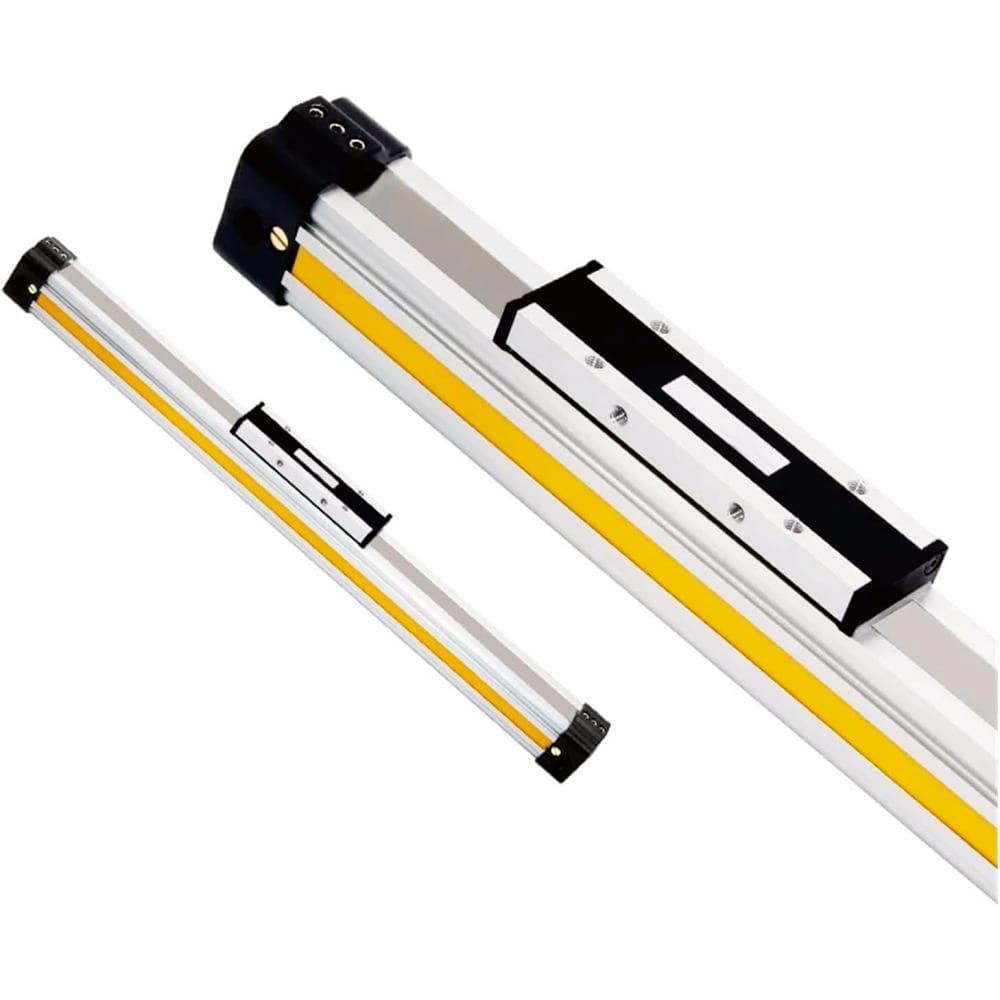
Rodless products can be attractive to resellers because the buying conversation includes more than bore and stroke:
- Guided or externally guided load handling
- Magnetic or mechanically coupled construction
- Carriage moment limits and permissible loads
- Sensor mounting and switching position
- Adjustable cushioning or external shock absorption
- Sealing-band protection and maintenance access
- Mounting feet, center supports, and application brackets
Those details create legitimate technical value. They also create risk when the reseller treats every long-stroke application as interchangeable.
In our experience, rodless-cylinder enquiries convert more cleanly when the customer provides load location, motion orientation, target time, stroke, and mounting constraints before model selection. A catalog cross-reference alone rarely captures the carriage moments and installation details that determine service life.
The rodless cylinder benefits guide explains the layout advantages, while the side-load guide covers a common selection mistake.
How Are IO-Link and Smart Valves Changing Reseller Requirements?
IO-Link added about 9.7 million nodes in 2025 and reached 71 million installed nodes worldwide (IO-Link Community, 2026). This scale is a clear connectivity signal. It does not mean every valve should be stocked with IO-Link, but resellers increasingly need to understand the full device-to-controller path.
IO-Link is a point-to-point interface for sensors and actuators. Its system description covers process data, diagnostic data, device information, parameterization, and device descriptions; valves are explicitly included as possible devices (IO-Link System Description).

A useful smart-pneumatics offer may include:
- Valve manifold and matching protocol or IO-Link interface
- IO-Link master port requirements
- IODD file and parameter documentation
- Pressure, flow, position, or condition sensors
- Compatible cables, connectors, and environmental ratings
- PLC data mapping and alarm interpretation
- Replacement and parameter-restoration procedure
The commercial unit is no longer always the valve. It may be the verified interface package: valve, electronics, IODD, cable, controller mapping, diagnostic meaning, and replacement procedure. Resellers who stock only the pneumatic hardware can still lose the application at commissioning.
That shift also changes warranty triage. A “valve fault” may originate in air quality, pressure, wiring, master configuration, parameter data, PLC logic, or the valve itself. Training and test equipment matter as much as shelf quantity.
Where Do Air Preparation and Energy Products Fit?
The U.S. Department of Energy states that more than 80% of compressor input energy is lost as heat, and recommends lowering pressure, reducing leaks, improving controls, and eliminating inappropriate air uses (DOE Better Plants). This makes measurement-led air management a durable product and service opportunity.
An “energy-efficient FRL” label is not enough. Filters, regulators, lubricators, dryers, drains, flow meters, and pressure sensors affect different parts of system performance. A component that is undersized can create pressure drop; an oversized or overly fine filter can add cost without solving the actual contamination requirement.
ISO 8573-1 classifies compressed-air purity for particles, water, and oil (ISO). It gives resellers a better starting point than asking whether the customer wants “clean air.” The application must identify the purity class and measurement location.
The most supportable opportunity areas are:
- Correctly sized FRL assemblies with documented flow curves
- Differential-pressure or service indicators for filters
- Low-loss condensate drains
- Point-of-use pressure and flow monitoring
- Dew-point measurement for moisture-sensitive applications
- Leak detection and repair accessories
- Replacement filter elements and planned service kits
From our work, air-preparation quotations improve when the reseller asks for peak flow, inlet pressure, minimum acceptable outlet pressure, required purity, ambient conditions, and drain strategy. Without those inputs, “same port size” can hide a serious flow-capacity mismatch.
For technical selection, link customers to the FRL sizing guide and the ISO compressed-air quality guide.
What Compliance-Ready Products Need More Support?
Regulation (EU) 2023/1230 on machinery applies from 20 January 2027, making 2026 a practical preparation year for machine builders and supply chains serving the EU (EUR-Lex). Component resellers should expect more questions about technical documentation, safety functions, digital elements, and traceable conformity evidence.
The regulation applies to machinery and related products, while individual pneumatic components may sit within a larger conformity assessment. A reseller should not claim that an ordinary valve or cylinder is “Machinery Regulation certified.” Instead, provide the technical evidence the machine manufacturer needs for its assessment.
Application-specific opportunities can include:
- Safety-related valves and monitored exhaust functions
- Washdown valve manifolds with verified enclosure test evidence
- Corrosion-resistant cylinders and fittings with controlled material declarations
- Clean-environment components with defined particle, lubricant, and material requirements
- Components intended for potentially explosive atmospheres with applicable documentation
- Food-contact-adjacent hardware with declared materials and cleaning limitations
These are not automatically high-margin products. They are high-support products. Stocking them without understanding the certificate scope, environmental limits, maintenance requirements, and change-notification process creates liability instead of differentiation.
From our work, the best application-specific quotation separates proven compliance, supplier declarations, test reports, and customer-specific acceptance criteria. The words “clean room,” “food grade,” “washdown,” or “explosion proof” should never stand alone.
A Stocking Matrix Beats a Trend List
IFR reported that Asia received 74% of new industrial robot deployments in 2024, compared with 16% in Europe and 9% in the Americas (IFR, 2025). That regional spread shows why a global product ranking cannot dictate one reseller’s stocking mix.
Use a three-level portfolio:
| Portfolio level | Suitable products | Decision rule |
|---|---|---|
| Stock | Common fittings, service elements, standard sensors, proven cylinder and valve interfaces | Repeat demand, stable specification, acceptable turns, manageable obsolescence |
| Configure to order | Rodless cylinders, valve manifolds, FRLs, guided actuators, sensor packages | Repeat application pattern but variable stroke, flow, protocol, or mounting |
| Engineer to order | Hazardous-area, clean-environment, special materials, unusual controls | Low frequency, high documentation burden, customer-specific qualification |
This matrix protects working capital without forcing the sales team to say no. Demonstration units, sample kits, digital configuration files, and supplier response agreements can support a category before full inventory is justified.
Do not confuse accessories with low-value stock. Mounting kits, replacement seals, cables, silencers, sensors, fittings, and filter elements often determine whether the main component can be installed and serviced. Their demand should be tied to the installed base, not treated as an unrelated catalog.
Measure Demand Before Expanding Inventory
The 542,000 industrial robots installed in 2024 are a strong automation indicator, yet they contain no information about a specific distributor’s bore sizes, valve protocols, or filter capacities (IFR, 2025). Local buying decisions need first-party commercial data collected under consistent definitions.
Track at least these metrics by product family:
- Qualified enquiries, not raw website leads
- Quotes issued with complete specifications
- Quote-to-order conversion
- Repeat-order interval
- Lost-sale reason
- Gross contribution after freight, support, and warranty
- Inventory turns and aging
- Return and nonconformity rate
- Supplier lead-time reliability
- Engineering hours per won order
Review the figures by quarter and use the same qualification rules each time. A category with many incomplete enquiries may need better content or training, not more stock. A category with low enquiry volume but high repeat demand may justify configured supply rather than shelf inventory.
The 2026 Reseller Opportunity Is Technical
Global robot installations stayed above 500,000 for four consecutive years, while IO-Link reached 71 million installed nodes in 2025 (IFR; IO-Link Community). Together, these signals favor resellers who can connect motion, controls, air management, documentation, and service rather than simply expand SKU count.
The promising product is the one the reseller can specify, demonstrate, source, commission, and support for a real customer group. Compact and rodless motion, connected valves, measurement-led air preparation, and documented application-specific components meet that test in many automation markets. Local evidence still decides the depth of commitment.
Build capability in stages: publish application guidance, train one technical owner, qualify suppliers, assemble demonstration kits, track complete enquiries, and then choose whether to stock or configure. This is slower than copying a trend table. It is also far less likely to leave expensive inventory aging on the shelf.
High-Demand Pneumatic Products for Resellers FAQs
IO-Link reached 71 million installed nodes in 2025, and DOE notes that more than 80% of compressor input energy is lost as heat (IO-Link Community; DOE Better Plants). These signals support connectivity and energy-management opportunities, but each reseller still needs local sales evidence.
Are rodless cylinders the top-selling pneumatic product in 2026?
No authoritative global dataset ranks rodless cylinders as the top-selling pneumatic product. They remain a credible opportunity where machine layouts require long travel without an extending rod. Resellers should validate demand through qualified enquiries, installed equipment, application fit, quote conversion, and repeat orders before increasing inventory.
Which smart pneumatic products should a reseller prioritize?
Start with products that solve a defined connectivity or diagnostic task: valve manifolds, pressure and flow sensors, position sensing, IO-Link interfaces, masters, cables, and documented device files. Prioritize combinations the reseller’s staff can commission and troubleshoot. Connectivity without protocol, parameter, and replacement knowledge creates support risk rather than value.
Do premium FRL units automatically reduce compressed-air energy use?
No. Energy performance depends on flow demand, pressure drop, regulator setting, filtration requirement, leaks, drains, controls, and the wider compressed-air system. Select FRLs from flow curves and required air quality. Add pressure or flow measurement when the customer needs evidence of system performance.
How should a small reseller decide what to keep in stock?
Stock products with repeat demand, stable specifications, acceptable inventory turns, and manageable obsolescence. Configure products when stroke, protocol, flow, or mounting varies. Keep engineered or compliance-heavy items as supplier-qualified, order-specific solutions. Demonstration kits and service parts can support a category without committing to deep finished-goods inventory.
Should pneumatic resellers add electric actuators to their 2026 portfolio?
Only when customer demand and technical capability justify a separate motion offer. Electric actuators are adjacent automation products, not pneumatics. Evaluate control skills, sizing support, commissioning, software, spare parts, and supplier coverage independently. Do not use electric-actuator demand as evidence that a pneumatic SKU will sell.