
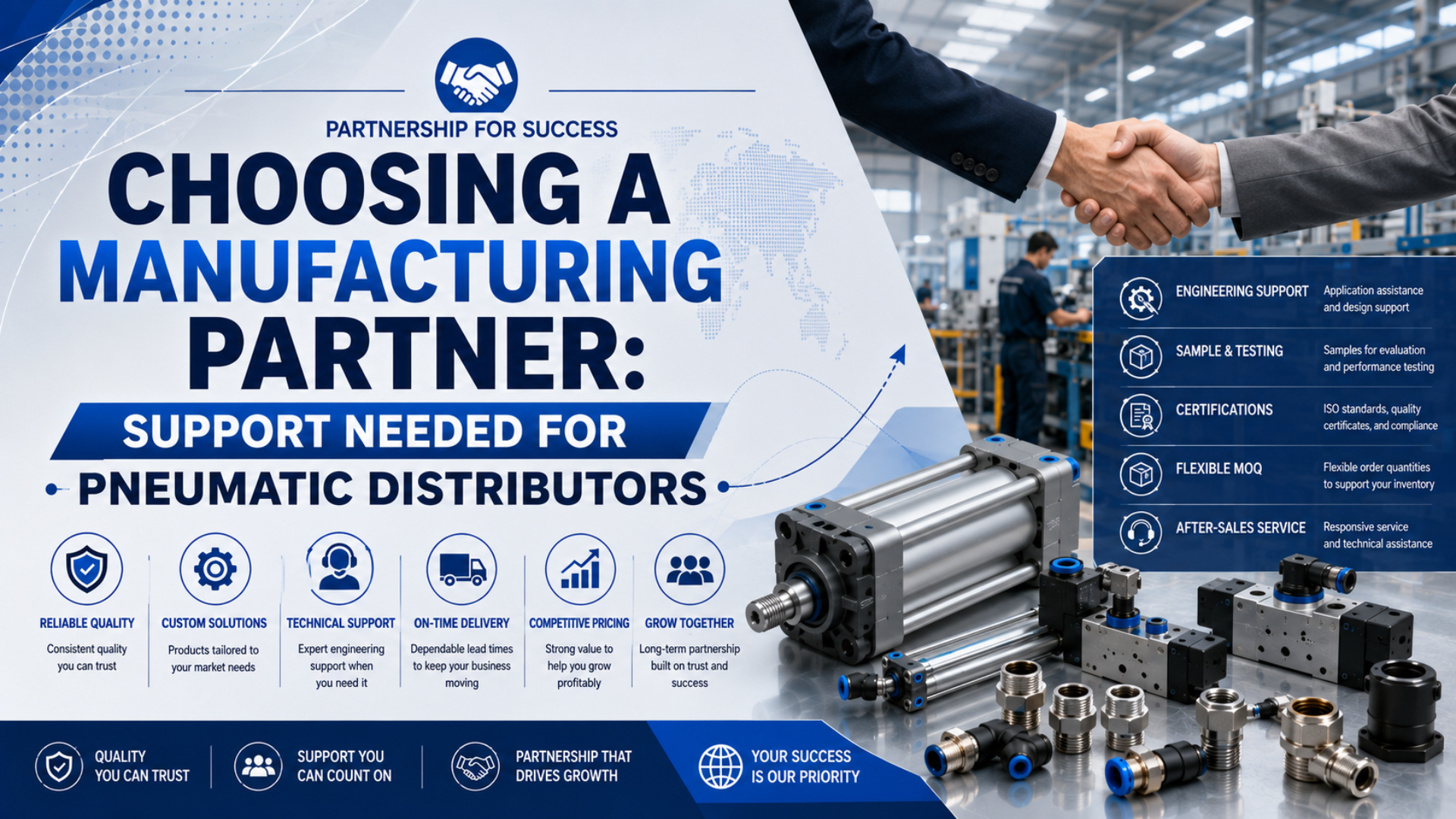
Choose a pneumatic manufacturing partner by testing four evidence chains: application engineering, commercial execution, product-quality control, and channel enablement. Product price belongs inside that review, but it cannot substitute for configured drawings, named response ownership, inspection records, change notification, or a workable claims process.
Capability lists don’t decide the partnership. The stronger factory converts its capabilities into defined deliverables your sales, engineering, purchasing, and quality teams can verify. That distinction protects the distributor when an urgent cross-reference, unusual stroke, late shipment, or field complaint reaches the customer.
Price alone can’t answer those questions.
Key Takeaways
- Define support through named owners, documents, escalation paths, and measurable closure events.
- Test execution.
- Treat ISO certification as management-system evidence, not product approval.
- Compare the full order commitment, including engineering, tooling, validation, logistics, inventory, and change exposure, then test the supplier’s problem-resolution route.
What Support Should a Pneumatic Distributor Define Before Approval?
NIST’s supplier-scouting intake separates a request into four information groups: general, technical, business, and supporting evidence (NIST MEP, 2026). A distributor can use the same separation to define the support package before comparing manufacturers, preventing a polished sales presentation from hiding missing engineering or commercial ownership.
Start with evidence.
Start with a requirement-to-support matrix. Put one expected deliverable in each row, name the event that triggers it, and identify the person responsible on both sides. “Technical support available” is not testable. “Configured drawing returned before sample approval, with deviations marked against the distributor’s requirement sheet” is.
| Support area | Evidence to request | Trigger or frequency | Distributor owner |
|---|---|---|---|
| Application review | Completed input sheet, assumptions, configuration, limits, deviations | New application or replacement request | Application engineer |
| Documentation | Current data sheet, configured drawing, CAD file, installation instructions | Before quotation or sample release | Engineering or sales |
| Quotation | Part identity, included options, quantity basis, lead-time start event, validity, freight basis | Every quotation | Sales or purchasing |
| Order execution | Acknowledgment, promised date, drawing status, delay escalation | Every order | Order coordinator |
| Quality | Certificate scope, inspection plan, functional-test evidence, traceability | Supplier approval and agreed lots | Quality |
| Change control | Written notice, affected part numbers, reason, validation plan, effective date | Before an approved change | Engineering and quality |
| Claims | Containment route, evidence request, replacement decision, corrective-action owner | Field or incoming complaint | Quality and sales |
| Channel enablement | Authorized images, current literature, training scope, brand-use rules | Onboarding and product updates | Marketing or product manager |
Support promises have value only when the distributor can route them. If every technical question enters the same generic inbox, an impressive response-time target still lacks priority, ownership, and escalation. Define at least routine, urgent, and line-down paths, then agree what information must accompany each request.
Manufacturers should state their limits too. Ask which product families receive application review, which customizations need formal engineering approval, which documents are standard, and which services require volume or territory commitments. Honest boundaries are more useful than an unlimited promise that disappears after the first purchase order.
Private-label programs need extra rows for drawing ownership, artwork approval, tooling, revision control, exclusivity, and end-of-program inventory. The private-label pneumatic cylinder manufacturer qualification guide covers those responsibilities in greater depth.
Technical Support Must Close Configuration Gaps
ISO 15552:2018 covers detachable-mount pneumatic cylinders from 32 to 320 mm bore at a maximum rated pressure of 1,000 kPa, or 10 bar, but its scope centers on basic, mounting, and accessory dimensions (ISO, 2018). A dimensional standard therefore cannot replace configuration-specific application review.
A standard defines a boundary, not the whole application.
Good technical support begins with complete inputs. For a cylinder or rodless actuator, the request may need load, orientation, stroke, target time, available pressure and flow, mounting, load-center geometry, cushioning demand, sensing, environment, and required life. A manufacturer should identify missing inputs before recommending a part number.

Useful outputs should show more than a catalog code:
- exact product family, full part code, and complete configuration
- selection assumptions
- configured dimensions, interfaces, and orientation
- accepted operating limits, including duty, environment, speed, load, and any application boundary the distributor must pass accurately to the customer
- included accessories
- every known deviation from the request
- validation still required before final application approval
- revision and date of each controlled document
For an installed replacement, require a side-by-side interface review. Bore and stroke alone do not establish equivalence. Mounting centers, overall length, rod thread, port position, sensors, cushioning, materials, seals, allowable loads, and speed limits can change the result. The ISO 15552 interchangeability workflow provides the detailed dimensional sequence. CAD files are useful only when they represent the quoted configuration. Generic STEP models can help layout work while still omitting the chosen sensor, mount, port orientation, or special rod end. Ask the supplier to link drawing and CAD revisions to the quotation and sample-approval record.
Separate application review from product substitution
Cross-references should state what was compared and what remains unverified. If a manufacturer proposes a lower-cost alternative, the distributor needs a compliance matrix, not a claim of universal compatibility. Use the unbranded versus branded pneumatics risk screen to separate low-consequence substitutions from applications that require deeper evidence.
Custom work needs a formal handoff. Record who owns the design inputs, who approves the drawing, what constitutes a change, and whether a new sample or test is required. This prevents an informal email request from becoming the only definition of a non-standard product.
Commercial Support Should Turn Promises Into Defined Events
Incoterms 2020 contains 11 trade rules, and ICC advises parties to select the correct rule for the transaction (International Chamber of Commerce, 2020). A pneumatic quotation still needs the exact named place, transport scope, exclusions, payment terms, and lead-time trigger because one trade-rule abbreviation does not complete the commercial offer.
Normalize the scope first.
Normalize every quotation before comparing price. Two suppliers can quote the same cylinder at different apparent costs because one includes mounts, sensors, documentation, export packing, or inland delivery and the other does not.
| Commercial field | What the supplier should state | Risk if omitted |
|---|---|---|
| Product identity | Full part number, revision, quantity, included accessories | Different configurations appear comparable |
| Price basis | Currency, quantity tier, validity, tooling or engineering charges | Unit price hides commitment |
| Delivery rule | Incoterms rule, named place, freight scope | Cost and risk transfer remain unclear |
| Lead time | Start event, completion event, included approvals | Buyer and supplier count different periods |
| Payment | Deposit, balance event, credit terms, bank charges | Cash requirement changes after award |
| Warranty | Covered failure, exclusions, evidence, remedy, time limit | A broad promise has no executable process |
| Returns | Authorization, condition, freight, inspection, restocking | Unsold or incorrect inventory becomes trapped |
| Change notice | Notice period, affected items, last-buy and validation route | Approved stock changes without control |
Do not label one response time “excellent” for every request. Define service classes. A routine drawing question, an urgent quotation, a stopped production line, and a field-safety concern need different inputs and escalation paths. Measure acknowledgment and technical resolution separately so a quick automated reply cannot appear to close a difficult case.
Lead-time performance needs the same discipline. Define whether “on time” means the original request date, confirmed date, latest accepted reschedule, factory departure, arrival, or receipt after inspection. Also define whether the denominator is orders, order lines, units, or shipments. A percentage without those definitions cannot support a supplier decision.
MOQ deserves a total-commitment review. Compare binding quantity with expected consumption, then add non-recurring engineering, tooling, validation, logistics, inventory, and design-change exposure. The Custom Cylinder MOQ Commitment Calculator can organize that secondary comparison without turning a quoted unit price into a false total-cost claim.
For a broader negotiation workflow covering quote normalization, Incoterms, samples, warranties, and remedies, use the pneumatic supplier negotiation guide.
Channel Enablement Should Be Controlled and Reusable
The 2025 CMI study reports results from 980 B2B marketers: 22% rated their content approach very or extremely successful, while video was the most frequently identified effective format at 58% (Content Marketing Institute, 2024). These broad findings support testing useful assets, not assigning a universal monetary value to a supplier’s library.
Useful beats abundant.
Manufacturers can shorten a distributor’s launch time by providing accurate product content that is licensed for reuse. Its package should state what can be edited, translated, co-branded, or published under the distributor’s name. Revision dates matter because an attractive brochure with obsolete dimensions or part codes creates support debt.
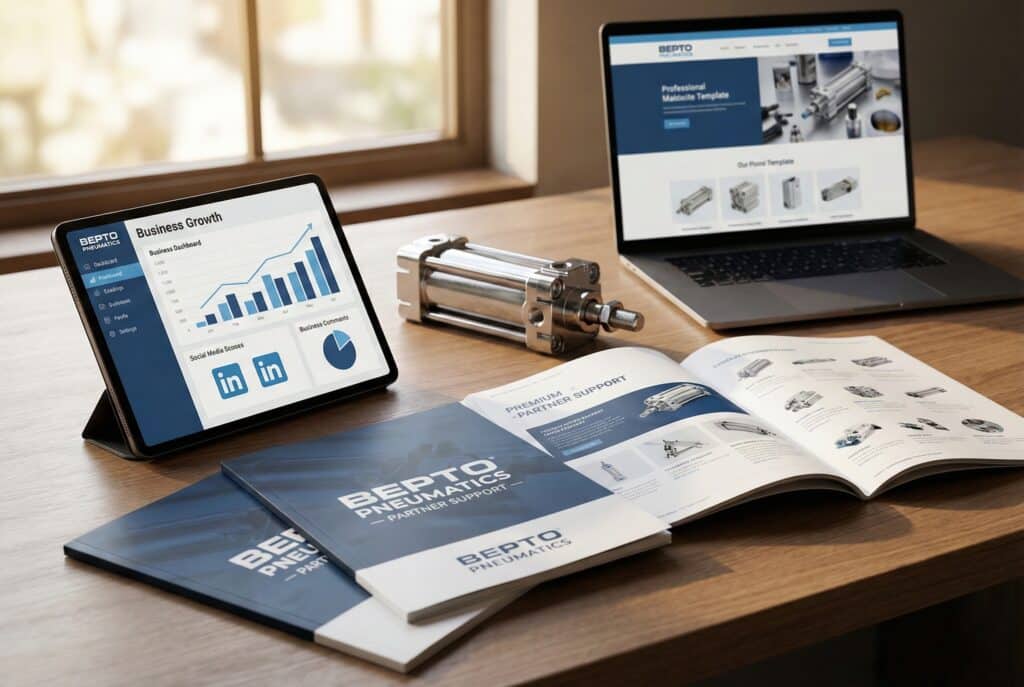
Request a controlled asset register:
- current product photographs with documented usage permission
- drawings
- editable data sheets that show revision status and the applicable product family
- approved descriptions with explicit claim boundaries
- installation, startup, and maintenance instructions
- training slides plus the intended audience, prerequisite knowledge, learning objective, reference documents, assessment method, and route for follow-up application questions
- product-change bulletins linked to affected part numbers
- contact route for technical corrections
Training should produce operational competence, not attendance alone. Define the audience, learning objective, product families, prerequisite knowledge, duration, reference documents, and follow-up assessment. For important opportunities, agree when the manufacturer’s engineer can join a customer call and who records the resulting application requirements.
Channel enablement and change control are the same system viewed from two directions. Manufacturers release product information; distributors publish and sell from it. If a drawing, seal option, or part code changes without reaching the asset library, the commercial channel continues distributing an obsolete technical promise.
Keep manufacturer support separate from the distributor’s own market plan. Local coverage, campaign measurement, customer reviews, and branch response rules remain the distributor’s responsibility. The local pneumatic-parts marketing guide covers those downstream controls.
Quality Evidence Goes Beyond an ISO 9001 Certificate
ISO now presents ISO 9001:2026 as the current quality-management standard, while its certification guidance states that ISO does not audit organizations or issue certificates (ISO, 2026; ISO Certification, 2026). Accredited QMS certification supports confidence in processes, but it does not certify every component or guarantee complete product conformity.
Follow both evidence chains.
Check the legal entity, manufacturing site, standard and edition, certificate status, scope, certification body, and accreditation chain. IAF CertSearch can show organization, site, scope, status, certification body, and accreditation-body data for accredited certificates (IAF CertSearch, 2026). Resolve missing or conflicting records with the responsible bodies.
Then follow the product evidence:
- Match the purchase requirement to the supplier’s exact configuration.
- Identify critical dimensions, materials, functions, and documents.
- Define inspection or test methods and acceptance limits.
- Connect results to the lot, serial number, date code, or other agreed traceability.
- Record nonconformity containment, disposition, cause analysis, and corrective action.
- Control changes before the next production release.
ISO 10099:2001 remains current after confirmation in 2023 and specifies final functional examination plus acceptance criteria for double-acting, single-rod pneumatic cylinders (ISO, 2023). Its narrow scope is useful: it shows why the buyer must identify the exact product type and any additional application-specific tests.
Do not confuse an AQL with the supplier’s actual defect rate. ISO 2859-1:2026 defines acceptance-sampling schemes indexed by AQL for lot-by-lot inspection, including single, double, and multiple sampling plans (ISO, 2026). Supplier PPM, incoming rejects, warranty claims, and AQL-based lot acceptance answer different questions.
The supplier certification verification guide covers certificate identity, status, accreditation, and scope in detail. Use it alongside product records rather than treating either evidence chain as complete by itself.
How Should a Distributor Run a Controlled Trial?
ISO 2859-1:2026 replaced the 1999 edition and added updated sampling guidance, but no sampling table can define the distributor’s application or commercial acceptance by itself (ISO, 2026). A controlled trial should therefore combine product checks with documentation, communication, delivery, and problem-resolution evidence.
Test the route.
Choose a trial that represents normal business. It should be large enough to exercise the required drawing, quotation, manufacturing, inspection, packing, and shipment route, but small enough to limit exposure before the supplier has earned broader approval.
Create the scorecard before issuing the order:
| Trial dimension | Record | Acceptance decision |
|---|---|---|
| Requirement capture | Missing-input questions, assumptions, deviations | Did the supplier understand the application? |
| Documentation | Quote, drawing, CAD, instructions, revisions | Were documents complete and configuration-specific? |
| Product | Agreed dimensions, materials, function, marking | Did the sample meet defined requirements? |
| Quality evidence | Inspection and test results linked to the trial | Can the supplier prove what was checked? |
| Delivery | Start event, promised event, actual event, exception handling | Was performance measured against one definition? |
| Communication | Owner, acknowledgment, technical resolution, escalation | Did the right people respond with usable answers? |
| Corrective action | Containment, cause, action, verification | Could the supplier close a real problem? |
One successful sample does not approve every product family, factory, or future revision. Define the approval scope. A distributor may approve a standard cylinder family while requiring separate qualification for rodless actuators, special seals, private-label configurations, or another production site.
Your trial should test the support system, not merely the sample. Even a perfect component delivered through an undocumented process can create repeat-order risk. A clearly contained problem may reveal more about the partner’s value than a defect-free first shipment because it exposes escalation, evidence, and corrective-action discipline.
When continuity matters, qualify an alternate source against the same controlled requirement rather than a simplified cross-reference. The dual-sourcing strategy guide explains how to maintain comparable specifications and an executable failover route.
Final Decision: Choose the Evidence Chain, Not the Sales Claim
NIST MEP says its national supplier-scouting process typically returns results in 30 to 45 days, yet the requesting organization still has to vet the identified manufacturers for fit (NIST MEP, 2026). A shortlist can accelerate discovery, but qualification remains a documented buyer decision.
Shortlists are only a starting point.
Score each candidate against the same requirement-to-support matrix. Weight the rows according to your customers and applications. A distributor serving configured OEM projects may place more weight on engineering and change control. A replacement-focused branch may emphasize identification, stock communication, and claims containment.
Use four decision gates:
- Technical fit: Can the manufacturer turn complete application inputs into a controlled, supportable configuration?
- Execution fit: Can it quote, acknowledge, build, document, ship, and escalate against defined events?
- Evidence fit: Can it connect management-system claims to product-specific inspection, testing, traceability, and change control?
- Channel fit: Can it provide current, authorized information and training without shifting responsibility for unsupported claims to the distributor?
Reject the candidate when a critical requirement has no owner or evidence, even if the total score looks acceptable. Treat commercial concessions as terms to document, not compensation for unresolved technical or quality risk.
Right manufacturing partners make the distributor’s promise more precise. They help the team answer faster because requirements, records, and escalation routes already exist. That is a stronger foundation than a low unit price supported by unverifiable quality percentages, generic testimonials, or an undefined promise of partnership.
Pneumatic Manufacturing Partner FAQs
ISO 15552 defines a 32–320 mm dimensional series, ICC maintains 11 Incoterms 2020 rules, and ISO 2859-1 was revised in 2026 (ISO, 2018; ICC, 2020; ISO, 2026). Supplier evaluation must therefore connect technical, commercial, and quality evidence.
Is the lowest unit price the best basis for choosing a manufacturing partner?
No. Normalize the complete configuration, included accessories, engineering charges, tooling, validation, logistics, inventory, warranty remedy, and change exposure first. A lower unit price may still create a higher commitment or greater application risk. Compare like-for-like scope and record unresolved deviations before awarding business.
What technical documents should a pneumatic distributor request?
Request the current product data, configured drawing, CAD file where useful, part-code definition, accepted operating limits, installation instructions, and documented deviations. For application-sensitive products, also request the selection inputs and assumptions. Link every approved document to the quoted configuration and preserve its revision for repeat orders.
Does ISO 9001 certification prove that the pneumatic product is approved?
No. ISO 9001 certification concerns the organization’s quality management system within its stated scope. It does not certify every cylinder, valve, fitting, or shipment and does not guarantee complete product conformity. Verify certificate identity and status, then review product-specific requirements, inspection, tests, traceability, and release evidence separately.
How large should the first trial order be?
There is no universal quantity. Choose enough representative configurations to exercise the normal drawing, production, inspection, packing, and delivery route while limiting exposure. Define acceptance criteria before ordering. The trial should test documentation, communication, traceability, and problem closure as well as the physical product.
Should a distributor rely on one manufacturing partner?
Concentrating volume can improve coordination, but complete dependence creates continuity risk. Decide from product criticality, qualification cost, tooling, lead time, and substitution difficulty. If an alternate source is needed, qualify it against the same controlled specification and keep its drawings, samples, contacts, and approval status current.
Sources and technical references
- Content Marketing Institute, B2B Content Marketing Benchmarks, Budgets, and Trends: Outlook for 2025, survey of 980 B2B marketers conducted with MarketingProfs; published 2024-10-09 and retrieved 2026-07-26.
- IAF CertSearch, Verify Certificates, accredited certificate identity, site, scope, status, certification-body and accreditation data; retrieved 2026-07-26.
- ICC, Incoterms 2020, 11 trade rules and selection guidance; retrieved 2026-07-26.
- ISO, Certification, roles of ISO, certification bodies and accreditation bodies; retrieved 2026-07-26.
- ISO, ISO 9001:2026, current quality-management-system edition; retrieved 2026-07-26.
- ISO, ISO 15552:2018, detachable-mount cylinder dimensional series and scope; confirmed 2025 and retrieved 2026-07-26.
- ISO, ISO 10099:2001, final examination and acceptance criteria for double-acting single-rod pneumatic cylinders; confirmed 2023 and retrieved 2026-07-26.
- ISO, ISO 2859-1:2026, AQL-indexed acceptance sampling for inspection by attributes; published 2026-01 and retrieved 2026-07-26.
- NIST MEP, Supplier Scouting, supplier discovery process and requester vetting boundary; retrieved 2026-07-26.
- NIST MEP, Supplier Scouting Opportunity Synopsis, technical, business and supporting-information intake fields; retrieved 2026-07-26.