


Вступ
Imagine your production line grinding to a halt at -40°C because a pneumatic cylinder just shattered like glass. ❄️ In extreme cold environments, standard aluminum cylinders can fail catastrophically without warning. The hidden danger? Low-temperature brittleness1 that standard testing never reveals—until it’s too late and you’re facing emergency shutdowns in subzero conditions.
Low-temperature brittleness occurs when metals lose ductility and toughness below critical temperatures, causing sudden fracture under impact loads—Charpy impact testing2 at target operating temperatures is the only reliable method to verify that polar-grade cylinders maintain sufficient energy absorption capacity (typically >15 joules at -40°C) to prevent catastrophic failures in Arctic and cold-storage applications.
Last winter, I worked with Marcus, a facilities engineer at a cold-storage warehouse in Anchorage, Alaska. His standard pneumatic cylinders were failing every few months during loading operations in -35°C conditions. The OEM supplier insisted their cylinders were “rated for cold,” but they’d never performed actual Charpy testing. We supplied him with Bepto polar-grade rodless cylinders with documented -50°C Charpy values, and he hasn’t experienced a single cold-weather failure in over 14 months. 🧊
Зміст
- What Is Low-Temperature Brittleness and Why Does It Matter for Pneumatic Cylinders?
- How Does Charpy Impact Testing Reveal Cold-Weather Performance?
- What Charpy Values Should Polar-Grade Cylinders Achieve at Extreme Temperatures?
- Which Materials and Treatments Prevent Low-Temperature Brittleness in Rodless Cylinders?
What Is Low-Temperature Brittleness and Why Does It Matter for Pneumatic Cylinders?
Understanding the physics behind cold-weather failures can save you from catastrophic equipment damage and safety incidents. 🔬
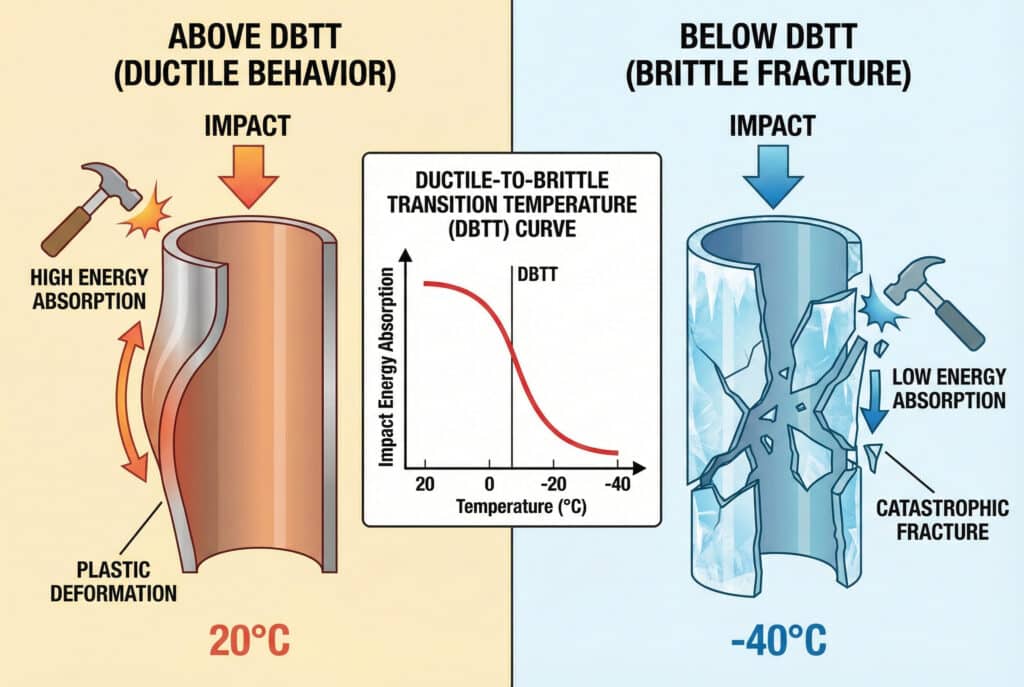
Low-temperature brittleness is a metallurgical phenomenon where materials transition from ductile to brittle behavior below their ductile-to-brittle transition temperature (DBTT)3 reducing impact energy absorption by 60-80% and causing sudden fracture without plastic deformation—critical for cylinders experiencing shock loads, vibration, or rapid pressure changes in cold environments.
The Ductile-to-Brittle Transition Temperature
Every metal has a DBTT where its fracture mechanism fundamentally changes. Above this temperature, materials deform plastically before breaking, absorbing significant energy. Below it, they fracture suddenly with minimal warning. For standard 6061-T64 aluminum, this transition begins around -50°C, but material variations and manufacturing defects can raise it to -20°C or higher.
In pneumatic applications, this matters enormously. When a cylinder extends or retracts, it experiences impact forces at the stroke ends. At room temperature, the aluminum absorbs these shocks through microscopic plastic deformation. In extreme cold, that same impact can propagate a crack through the entire barrel wall in milliseconds.
Why Standard Specifications Miss This Critical Factor
Most cylinder specifications list “operating temperature range: -20°C to +80°C” without any mechanical property data at those extremes. This is like rating a bridge for heavy trucks but only testing it with bicycles. At Bepto, we learned this lesson early when a mining customer in northern Canada experienced failures that shouldn’t have been possible according to standard specs.
Real-World Failure Modes in Cold Environments
I’ve seen three common failure patterns in cold-weather cylinder applications:
- Catastrophic barrel fracture during normal operation (most dangerous)
- Seal housing cracks allowing massive air leakage
- End cap failures where mounting threads pull out completely
Each of these stems from the same root cause: materials that lose toughness faster than expected as temperature drops, combined with impact loads that seem minor at room temperature but become critical in the cold.
How Does Charpy Impact Testing Reveal Cold-Weather Performance?
This standardized test is the gold standard for predicting how materials behave under sudden loads at various temperatures. 🎯
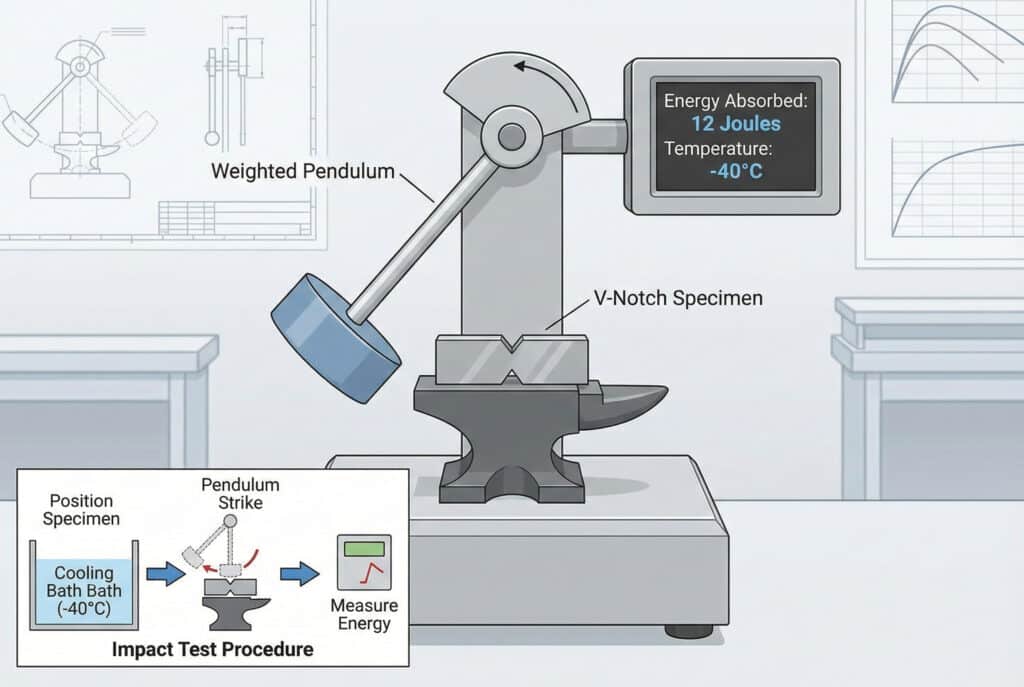
Charpy impact testing measures the energy required to fracture a notched specimen with a swinging pendulum, quantifying material toughness at specific temperatures—by testing samples pre-cooled to operational temperatures (-40°C, -50°C, etc.), engineers can predict whether components will fail catastrophically or deform safely under real-world shock loads in cold environments.
The Testing Procedure and What It Measures
The Charpy V-notch test uses a standardized specimen (10mm × 10mm × 55mm) with a precise 2mm deep V-notch. The sample is cooled to the target temperature in a bath (liquid nitrogen for extreme cold), then positioned in the test apparatus. A weighted pendulum swings down, strikes the specimen opposite the notch, and the energy absorbed during fracture is measured in joules.
What makes this test invaluable is its simplicity and repeatability. Unlike complex finite element analysis or theoretical calculations, Charpy testing gives you a direct, empirical answer: “At -40°C, this material absorbs X joules before breaking.”
Temperature Series Testing for Complete Characterization
At Bepto, we don’t just test at one temperature—we run complete series at 20°C intervals from room temperature down to -60°C. This creates a curve showing exactly how toughness degrades with temperature. The shape of this curve tells us whether a material has a sharp transition (dangerous) or gradual degradation (more predictable and safer).
| Test Temperature | Standard 6061-T6 | Bepto Polar-Grade | Minimum Required |
|---|---|---|---|
| +20°C | 28-32 J | 32-38 J | 20 J |
| 0 °C | 24-28 J | 30-36 J | 18 J |
| -20°C | 18-22 J | 26-32 J | 15 J |
| -40°C | 10-14 J | 20-26 J | 15 J |
| -60°C | 4-8 J | 14-18 J | 12 J |
Interpreting Results for Cylinder Applications
The critical question isn’t just “what’s the Charpy value?” but “is it sufficient for the application?” For pneumatic cylinders, we use this rule at Bepto: the material must absorb at least 15 joules at the lowest expected operating temperature to provide adequate safety margin against impact failures during normal operation.
Why 15 joules? Our field data from thousands of installations shows that cylinders maintaining this threshold survive typical industrial shock loads—emergency stops, load impacts, vibration—without fracture. Below 12 joules, failure rates increase exponentially.
What Charpy Values Should Polar-Grade Cylinders Achieve at Extreme Temperatures?
Knowing the target specifications helps you evaluate supplier claims and avoid inadequate components. 📊
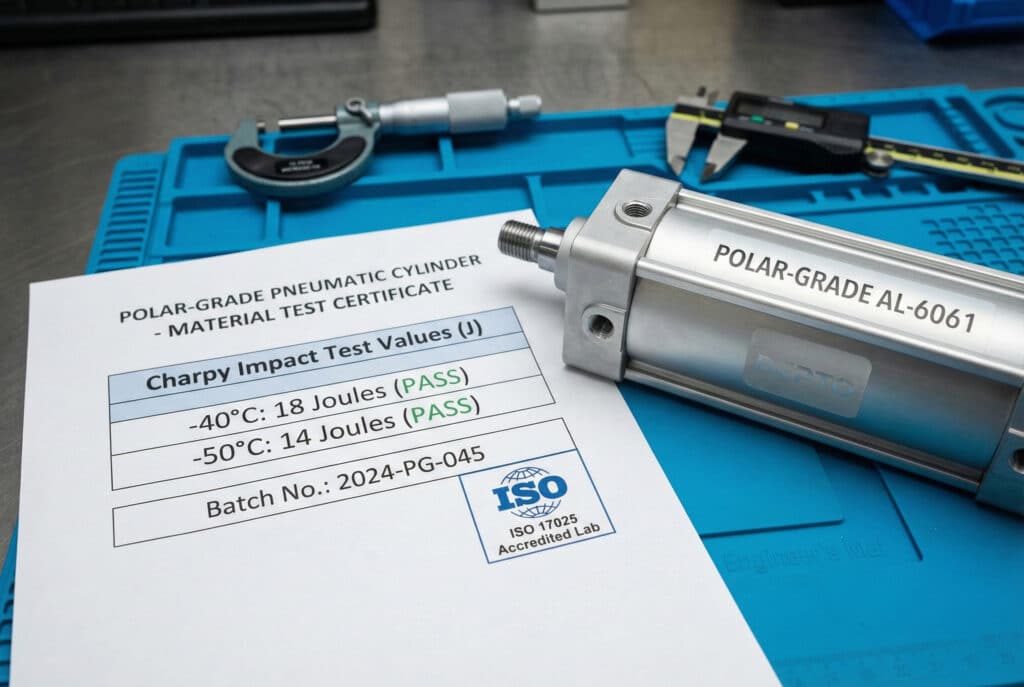
Polar-grade pneumatic cylinders should demonstrate minimum Charpy impact values of 15 joules at -40°C and 12 joules at -50°C for aluminum alloys, with documented test certificates for each production batch—these thresholds ensure adequate toughness reserves for shock loads, pressure transients, and mechanical impacts that occur during normal operation in Arctic, cold-storage, and winter outdoor applications.
Industry Standards and Regulatory Requirements
While ISO 6431 and ISO 15552 define dimensional and pressure standards for cylinders, they’re silent on low-temperature impact properties. This gap has caused problems across industries. Some sectors have developed their own requirements—offshore oil platforms in the North Sea require 18 joules at -40°C, while Antarctic research stations specify 15 joules at -60°C.
Application-Specific Threshold Determination
Not every cold application needs the same impact resistance. We help our clients at Bepto determine appropriate thresholds based on three factors:
- Lowest expected temperature (add 10°C safety margin)
- Impact severity (high for material handling, moderate for positioning)
- Consequence of failure (critical for safety systems, less critical for non-essential functions)
Verification and Documentation Requirements
Here’s where many suppliers fall short. They’ll claim “suitable for cold weather” without providing actual test data. When sourcing polar-grade cylinders, demand:
- Certified test reports from accredited labs (ISO 170255)
- Batch traceability linking test specimens to your specific cylinders
- Complete temperature series data, not just one data point
- Specimen orientation information (longitudinal vs. transverse to extrusion direction)
I remember working with Jennifer, a project engineer for a ski resort in Colorado, who was specifying cylinders for chairlift safety systems. Her initial supplier provided a single Charpy value at room temperature and claimed it was “cold-rated.” We provided complete temperature series data for our Bepto polar-grade cylinders, and she immediately saw the difference—our -40°C values were triple what the competitor could achieve. Safety systems demand that level of verification. ⛷️
Which Materials and Treatments Prevent Low-Temperature Brittleness in Rodless Cylinders?
Material selection and processing are the foundation of reliable cold-weather performance. 🔧
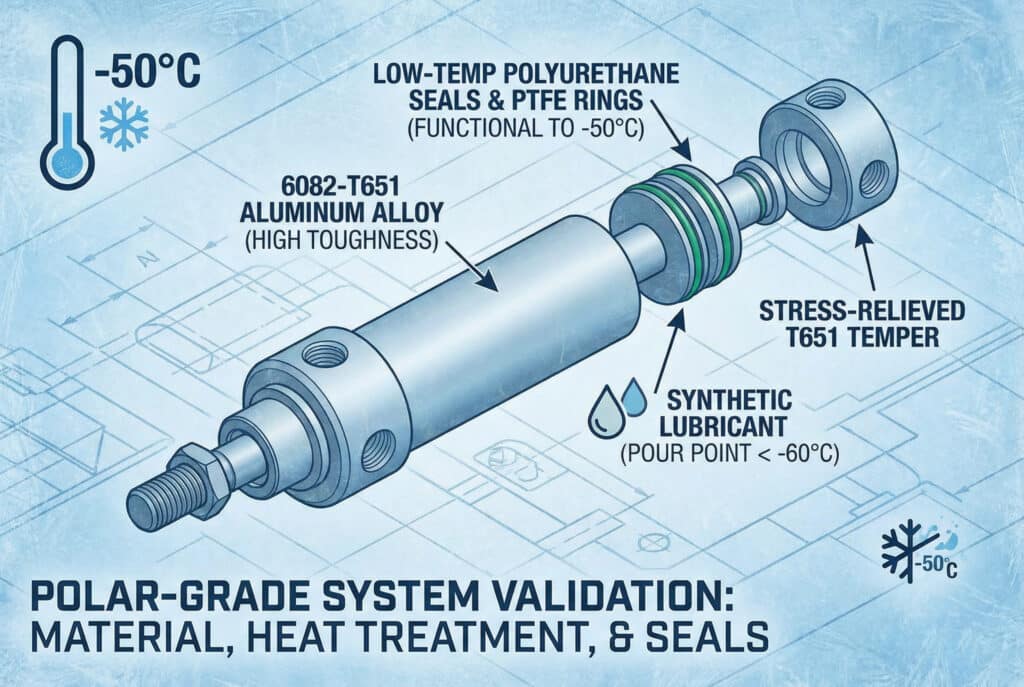
Preventing low-temperature brittleness requires aluminum alloys with high magnesium content (5000 or 6000 series), proper heat treatment (T6 or T651 temper), and stress-relief processes that minimize residual stresses—additionally, seal materials must transition to low-temperature compounds (polyurethane or PTFE instead of NBR) and lubricants must remain fluid below -40°C to prevent seal damage and friction-induced stress concentrations.
Optimal Aluminum Alloys for Cold Service
Not all aluminum is created equal for cold applications. The 6061-T6 alloy we use at Bepto for standard cylinders performs adequately to -30°C, but for true polar-grade performance, we specify 6082-T651 or 5083-H116. These alloys maintain higher toughness at extreme temperatures due to their microstructure and alloying elements.
The magnesium and silicon in 6082 create fine, evenly distributed precipitates during heat treatment. These microscopic particles strengthen the material without creating the brittle phases that cause low-temperature failures. The 5083 alloy, with 4.5% magnesium, offers even better cold performance but is harder to extrude and machine.
Heat Treatment and Stress Relief Protocols
Standard T6 heat treatment involves solution heat treatment followed by artificial aging. For polar-grade cylinders, we add an additional stress-relief step at 190°C for 4 hours. This eliminates residual stresses from extrusion and machining that can act as crack initiation sites in cold conditions.
The T651 temper designation indicates this stress-relief stretching has been performed. It’s a subtle difference in specification, but it makes the difference between 12 joules and 22 joules at -50°C in our testing.
Seal and Lubricant Compatibility
Even the toughest aluminum barrel will fail if seals become rigid and crack at low temperatures. Standard NBR (nitrile) seals lose elasticity below -20°C. For polar applications, we specify:
- Поліуретанові ущільнювачі (functional to -50°C)
- Опорні кільця з ПТФЕ (no temperature limitations)
- Синтетичні мастила (pour point below -60°C)
Complete System Validation
At Bepto, we don’t just test the barrel material—we test complete assembled cylinders in thermal chambers. We cycle them through 1,000 strokes at -40°C while monitoring for air leakage, friction increases, and any signs of material degradation. This system-level validation ensures that every component—not just the aluminum—can handle extreme cold.
Our polar-grade rodless cylinders undergo this complete validation because we understand that a cylinder is a system, not just a piece of metal. When you’re operating in Siberia, northern Canada, or Antarctica, you need that level of assurance.
Висновок
Low-temperature brittleness isn’t just a theoretical concern—it’s a real failure mode that causes costly downtime and safety hazards in cold environments. Charpy impact testing at operational temperatures is the only reliable way to verify that cylinders will perform safely when temperatures plummet. At Bepto, our polar-grade cylinders are backed by complete temperature-series Charpy data and system-level cold testing because we know your operations can’t afford cold-weather failures. Don’t trust vague “cold-rated” claims—demand the data that proves performance. 🛡️
FAQs About Low-Temperature Brittleness in Pneumatic Cylinders
Питання: При якій температурі слід почати турбуватися про крихкість стандартних алюмінієвих балонів при низьких температурах?
Стандартні алюмінієві циліндри 6061-T6 починають демонструвати знижену ударостійкість при температурі нижче -20 °C, а при температурі нижче -30 °C існує значний ризик крихкості. Якщо ваше обладнання регулярно працює при температурі нижче -15 °C або іноді досягає -25 °C, вам слід вибрати циліндри полярного класу з документально підтвердженими результатами випробувань за методом Шарпі при мінімальній робочій температурі плюс 10 °C запасу міцності.
Питання: Чи можна використовувати стандартні балони в холодних умовах, якщо експлуатувати їх обережно, уникаючи ударів?
This is risky because “gentle operation” doesn’t eliminate all impact loads—pressure transients during valve switching, vibration from nearby equipment, and thermal shock from temperature cycling all create stresses that can cause brittle fracture. Polar-grade materials provide insurance against these unavoidable real-world conditions that you can’t always control.
Питання: Як часто слід проводити випробування за методом Шарпі на виробничих партіях?
Reputable manufacturers like Bepto perform Charpy testing on each heat lot of aluminum (typically every 2-3 production batches) to verify consistent material properties. For critical applications, request test certificates with serial number traceability to your specific cylinders, ensuring the tested material matches what you’re receiving.
Q: Do stainless steel cylinders eliminate low-temperature brittleness concerns?
Austenitic stainless steels (304, 316) maintain excellent toughness to -196°C and don’t exhibit ductile-to-brittle transition, making them ideal for extreme cold. However, they’re 3-4x more expensive and heavier than aluminum. For most applications below -40°C, properly specified aluminum alloys offer the best performance-to-cost ratio while meeting safety requirements.
Q: What should I do if my current supplier can’t provide Charpy test data for cold temperatures?
Request that they perform the testing or switch to a supplier who routinely validates cold-weather performance—this isn’t optional for critical applications. At Bepto, we maintain complete temperature-series Charpy data for all our polar-grade products and can provide certified test reports with every order because we understand that your operations depend on verified performance, not assumptions.
-
Learn about the physical mechanisms that cause metals to lose toughness at extreme subzero temperatures. ↩
-
Explore the standardized methodology used to measure material toughness and energy absorption capacity. ↩
-
Understand the material properties and environmental factors that define the ductile-to-brittle transition point. ↩
-
Access the technical specifications and mechanical performance data for standard aerospace-grade aluminum. ↩
-
Discover the international standards required for testing and calibration laboratory competence and quality. ↩