

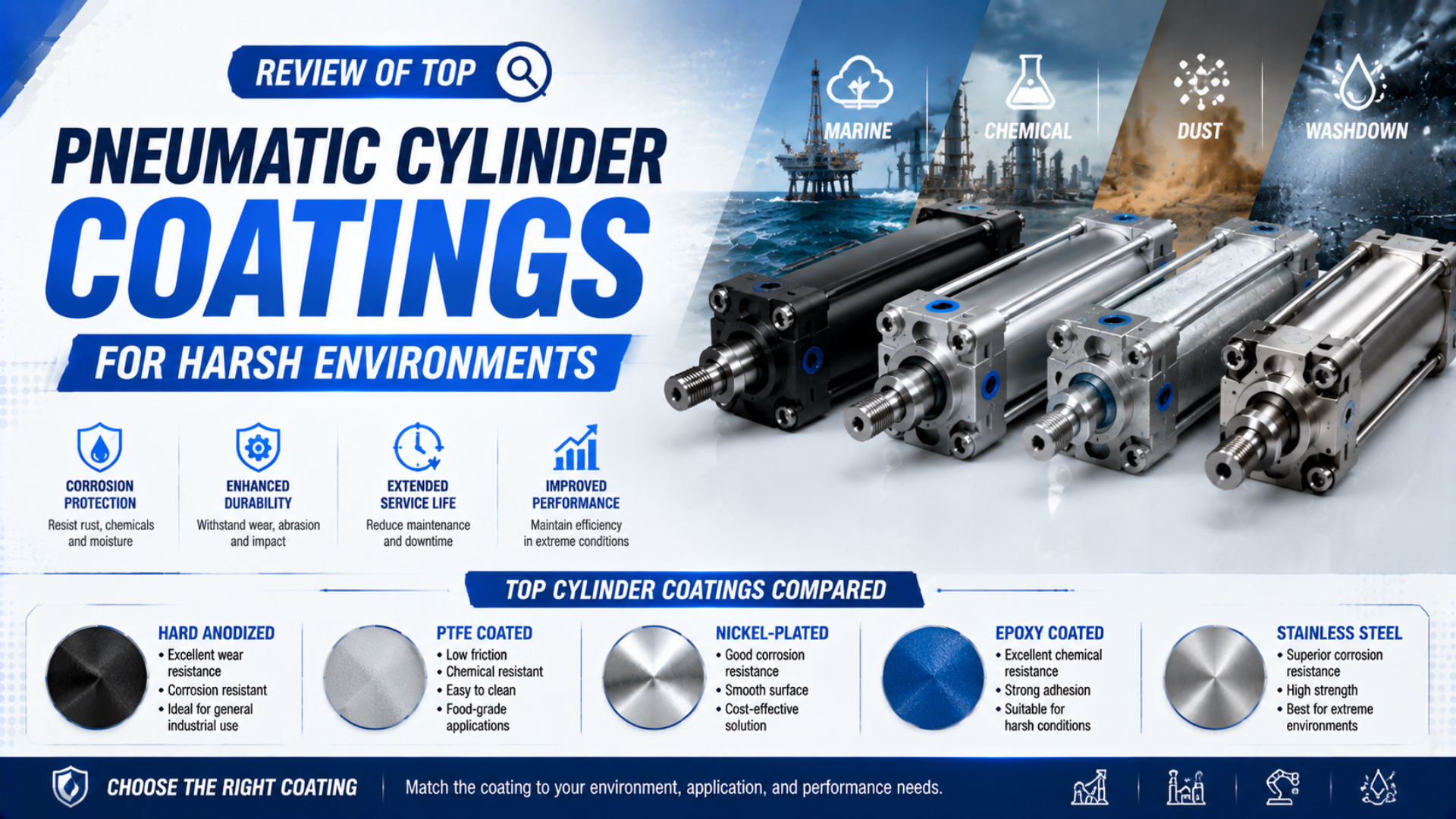
Für jede raue Umgebung gibt es nicht die eine beste Beschichtung für Pneumatikzylinder. Die richtige Spezifikation beginnt mit der tatsächlichen Belastung, ermittelt, welche Zylinderbauteile ihr ausgesetzt sind, und ordnet jedem eine kompatible Werkstoff- oder Oberflächenbehandlung zu. Ein hartes Kolbenstangenfinish, ein geschütztes Aluminium-Zylinderrohr und korrosionsbeständige Verbindungselemente lösen unterschiedliche Probleme.
Salzsprühstunden sollten nicht als allgemeine Rangliste verwendet werden. ISO 9227:2022 definiert drei Verfahren für künstliche Atmosphären, weist jedoch ausdrücklich darauf hin, dass sie nicht zur Rangfolge verschiedener Werkstoffe oder zur Vorhersage der langfristigen Korrosionsbeständigkeit dienen (ISO 9227, 2022). Behandeln Sie das Ergebnis als eine kontrollierte Qualitätsprüfung, die an eine eindeutig benannte Produktspezifikation gebunden ist.
Das Wichtigste in Kürze
- ISO 9227 definiert drei Salzsprühverfahren, rechnet Prüfungsstunden aber nicht in eine Lebensdauer im Feld um.
- Spezifizieren Sie Zylinderrohrbohrung, Außenfläche des Zylinderrohrs, Kolbenstange, Enddeckel, Verbindungselemente, Dichtungen und Zubehör getrennt.
- Eloxieren, galvanische Beschichtungen, Polymerbeschichtungen und Edelstahlausführung sind nicht austauschbar.
- Abnahmenachweise sind aussagekräftiger als die allgemeine Bezeichnung „korrosionsbeständig“.
Ein Zylinderpaket für raue Umgebungen ist die vollständige Antriebskonfiguration für eine definierte chemische, thermische und mechanische Belastung sowie Feuchteeinwirkung. Dazu gehören drucktragende Teile, bewegte Flächen, Dichtungen, Schmierstoff, Verbindungselemente, Halterungen, Sensoren, Verschraubungen, Kabel und jedes schützende Oberflächensystem.
Die Auswahlregel ist einfach: Das am wenigsten geschützte, der Umgebung ausgesetzte Bauteil bestimmt die praktische Korrosionsgrenze. Ein Edelstahl-Zylinderrohr mit galvanisch beschichtetem Gabelbolzen, ein eloxierter Körper mit ungeeignetem Kolbenstangenfinish oder eine chemikalienbeständige Beschichtung neben einer aufgequollenen Dichtung kann dennoch zu einem frühen Ausfall führen.
Warum kann eine einzige Beschichtung nicht jede Zylinderfläche schützen?
ISO 9227:2022 definiert drei Salzsprühverfahren: neutralen Salzsprühnebel, Essigsäure-Salzsprühnebel und kupferbeschleunigten Essigsäure-Salzsprühnebel. Diese Vielfalt zeigt bereits, dass „Korrosionsbeständigkeit“ keine einzelne Eigenschaft ist. Ein Zylinder benötigt für jede Oberfläche, jeden Belastungsmechanismus und jede Funktionsanforderung einen eigenen Schutz (ISO 9227, 2022).
Die Außenfläche des Zylinderrohrs ist vor allem eine Aufgabe des Barriereschutzes. Die Bohrung ist eine präzise Lauffläche für die Dichtung. Eine Kolbenstange muss korrosionsbeständig sein und zugleich Finish, Härte, Geometrie und Textur behalten, die die Kolbenstangendichtung benötigt. Enddeckel, Gewinde, Zugstangen, Halterungen, Bolzen, Schalter und Verschraubungen schaffen Spalte und Kontaktstellen zwischen unterschiedlichen Metallen.
Wenn jedes sichtbare Teil mit demselben System beschichtet wird, kann sich der Antrieb sogar verschlechtern. Ein dicker Auftrag auf einem Passdurchmesser verändert das Spiel. Eine weiche Polymerschicht auf einer abrasiv belasteten Stange kann Riefen bekommen oder sich ablösen. Eine aggressive Nachbehandlung kann Grundwerkstoff oder Endabmessungen verändern. Eine versiegelte anodische Beschichtung kann für eine Außenfläche passen, während die Bohrung nach der Behandlung eine kontrollierte Endbearbeitung benötigt.
Trennen Sie außerdem äußere und innere Korrosionspfade. Außen anhaftende Reinigungsflüssigkeit kann Fugen, Kratzer, Verbindungselemente und Sensornuten angreifen. Innere Korrosion deutet häufiger auf Feuchte in der Druckluft, Kondensation, unverträglichen Schmierstoff, Montageschäden oder einen Fehler auf der Druckseite hin. Der Leitfaden zur Korrosion bei Reinigungsprozessen erläutert diese diagnostische Trennung ausführlich.
| Zylinderbereich | Hauptaufgabe | Typische Gefahr | Spezifikationsschwerpunkt |
|---|---|---|---|
| Außenfläche des Zylinderrohrs | Strukturelle Hülle und Befestigungsschnittstelle | Feuchte, Spritzwasser, UV, Chemikalien, Kratzer | Grundlegierung, Vorbehandlung, Barrieresystem, Abdeckung von Kanten und Gewinden |
| Bohrung des Zylinderrohrs | Lauffläche der Kolbendichtung | Feuchte, Partikel, Verschleiß, Beschichtungsfehler | Enddurchmesser, Form, Textur, Beschichtungsfolge, Dichtungsverträglichkeit |
| Kolbenstange | Bewegte Dichtungslauffläche | Salz, Körnung, Stoß, chemischer Film, Abstreiferschäden | Grundwerkstoff, Finishart, Schichtdicke, Härte, Porosität, Endrauheit |
| Enddeckel und Anschlüsse | Druckabschluss und Verbindung | Spalte, beschädigte Gewinde, galvanische Elemente | Werkstoffpaarung, Beschichtungskontinuität, Stopfen, Entwässerung, Dichtflächen |
| Verbindungselemente und Halterungen | Kraftübertragung | Unterschiedliche Metalle, eingeschlossene Flüssigkeit, beschädigte Lackierung | Legierung, elektrische Trennung, Entwässerung, Zugang, Ersatzteile |
| Dichtungen und Zubehör | Verunreinigungen fernhalten und Bewegung stabil halten | Quellung, Hydrolyse, Wärme, Eindringen | Exakte Mischung, Fett, Medienverträglichkeit, Schutzart |
Beschichtung, Plattierung und Edelstahl sind unterschiedliche Spezifikationsentscheidungen
Zwei ISO-Dokumente legen unterschiedliche Grundlagen für das Eloxieren fest. ISO 7599:2018 behandelt dekorative und schützende anodische Oxidationsschichten, während ISO 10074:2021 harte anodische Oxidationsschichten für den technischen Einsatz behandelt. Eine Zeichnung sollte das anzuwendende Verfahren und die Endanforderungen benennen, statt jede dunkle Aluminiumfläche als dieselbe Beschichtung zu behandeln (ISO 7599, 2018; ISO 10074, 2021).
Verwenden Sie die Begriffe präzise:
- Eloxieren wandelt die Aluminiumoberfläche in eine Oxidschicht um. Herkömmliches Schutzeloxieren und Harteloxieren folgen unterschiedlichen Spezifikationswegen und setzen andere Leistungsschwerpunkte.
- Chemisch Nickel-Phosphor scheidet in einem autokatalytischen Verfahren eine metallische Nickel-Phosphor-Schicht ab. Phosphorgehalt, Schichtdicke, Porosität und Wärmebehandlung verändern das Ergebnis.
- Technische Verchromung scheidet metallisches Chrom gewöhnlich auf einer Stahlstange oder Verschleißfläche ab. Sie ist eine Option für die Kolbenstangenbehandlung, kein universelles Finish für den Zylinderkörper.
- PTFE-basierte Beschichtung bezeichnet eine Familie von Harzsystemen. Bindemittel, Haftgrund, Verstärkung, Aushärtungszyklus, Schichtdicke, Haftung und Endtextur müssen weiterhin festgelegt werden.
- Edelstahlausführung verändert den Grundwerkstoff selbst. Sie kann an bestimmten Flächen die Abhängigkeit von einer Barriereschicht verringern, beseitigt aber weder Loch- und Spaltkorrosion noch Fressen, Angriff zwischen unterschiedlichen Metallen oder Dichtungsunverträglichkeit.
- Organische Lack- oder Pulversysteme können äußere Stahlhalterungen und Gehäuse schützen. ISO 12944-5:2019 behandelt Schutzlacksysteme für Stahlbauten, nicht dynamische Dichtungslaufflächen oder fertig bearbeitete Pneumatikbohrungen (ISO 12944-5, 2019).
Diese Unterscheidung verhindert einen häufigen Beschaffungsfehler. „316L-Finish“, „Teflonbohrung“ und „harteloxierter Zylinder“ klingen eindeutig, definieren aber keinen vollständigen Antrieb. Fragen Sie, welches Bauteil die Behandlung erhält, welcher Grundwerkstoff vorliegt, welche Flächen abgedeckt oder anschließend bearbeitet werden und welche Abnahmeprüfungen gelten.
Wie sollte die Belastung die Beschichtungsentscheidung bestimmen?
Festo unterscheidet fünf Korrosionsbeständigkeitsklassen von CRC0 bis CRC4 und reserviert CRC4 für extreme Korrosionsbeanspruchung, etwa durch aggressive Lebensmittel- oder Chemikalienmedien und starke Außenbewitterung. Die Festo-Leitlinie fordert bei Bedarf weiterhin Prüfungen mit dem tatsächlichen Medium; das ist hilfreicher als die Auswahl aus einer allgemeinen Beschichtungsrangliste (Festo CRC, abgerufen 2026).
Erstellen Sie vor der Auswahl eines Oberflächensystems einen Belastungsdatensatz. Halten Sie mindestens Chemikalienname, Konzentration, Temperatur, Kontaktart, Einwirkdauer, Häufigkeit, Spülung, Trocknung, abrasive Verunreinigung, UV-Strahlung, mechanische Einwirkung und den erwarteten Beschichtungsschaden fest. „Außen“, „für Lebensmittel geeignet“ und „chemikalienbeständig“ sind keine Prüfbedingungen.
| Belastung | Erste Prüffrage | Sinnvolle Ausgangsrichtung | Noch benötigte Nachweise |
|---|---|---|---|
| Innenraumfeuchte und leichter Industriestaub | Erreicht Kondensat die Bohrung oder nur die Außenfläche? | Schutzeloxieren oder eine Standardkatalogausführung kann ausreichen | Luftqualität, Beschichtungsspezifikation, Grenzen von Dichtung und Schmierstoff |
| Außenbewitterung und UV | Sind Kanten, Anschlüsse, Schalter und Halterungen gleichermaßen geschützt? | Harteloxierter oder geschützter Körper mit witterungsgeeignetem Zubehör | UV, zyklische Durchfeuchtung, Beschädigung, Entwässerung, Temperaturbereich |
| Reinigung in der Lebensmittel- oder Getränkeverarbeitung | Welches Reinigungsmittel, welche Konzentration, Temperatur, Sprühart und Hygieneeinteilung gelten? | Speziell für Reinigungsprozesse ausgelegte Edelstahl- oder validierte Beschichtungskonfiguration | Reinigbarkeit, Lebensmittelkontaktstatus, Dichtungschemie, Fett, Nachweise zum Eindringschutz |
| Chemikalienspritzer oder -dämpfe | Handelt es sich um gelegentliche Spritzer, Dampf oder Eintauchen? | Werkstoff und Beschichtung anhand der exakten Mediendaten auswählen | Konzentration, Temperatur, Nasszeit, Permeation, Haftung, Reparaturplan |
| Küsten- oder Meersalz | Befindet sich der Antrieb in feuchter Luft, Salzsprühnebel, Spritzwasser oder unter Wasser? | 316L, Duplexstahl oder ein entsprechend der Zone dokumentiertes Beschichtungspaket | Spalte, Ablagerungen, galvanische Paare, Entwässerung, Kolbenstangen- und Zubehörpaket |
| Bergbau und abrasiver Staub | Erreichen Körner die Stange, den Abstreifer, die Bohrung oder das Dichtband eines kolbenstangenlosen Zylinders? | Verschleißfestes Kolbenstangenfinish, wirksamer Abstreifer, geschützte oder geführte Anordnung | Partikelgröße, Stoß, Reinigungsmethode, Endtextur der Oberfläche |
| Erhöhte Temperatur | Verändert die Wärme zuerst die Beschichtung, den Grundwerkstoff, die Dichtung oder den Schmierstoff? | Für die Temperatur ausgelegtes Werkstoffsystem | Dauer- und Spitzentemperatur, Temperaturwechsel, Kombination mit Chemikalien |
Die Lebensmittelverarbeitung zeigt, warum Werkstoffbezeichnungen allein nicht ausreichen. US-Vorschriften für die Lebensmittelherstellung verlangen, dass Anlagen ausreichend reinigbar sind und Lebensmittelkontaktflächen der vorgesehenen Umgebung, den Lebensmitteln, Reinigungsmitteln, Desinfektionsmitteln und Reinigungsverfahren standhalten (21 CFR 117.40, abgerufen 2026). Ein Beschichtungsname allein kann diese vollständige Anforderung nicht belegen.
Auch bei maritimen Anwendungen ist dieselbe Disziplin erforderlich. Eine Salzsprühkammer bildet Ablagerungen hinter einer Halterung, gelegentliches Eintauchen in Meerwasser, UV-Strahlung, das Eindringen an Kabeln oder galvanische Kontakte nicht nach. Nutzen Sie bei Chloridbelastung als primärem Lastfall den separaten Leitfaden zur Auswahl korrosionsbeständiger Zylinder für maritime Anwendungen.
Welche Oberflächenbehandlung passt zu welchem Zylinderbauteil?
ASTM B650-23 nennt sechs technische Einsatzbereiche für Chrombeschichtungen, darunter Verschleiß, Reibverschleiß, Reibung, Fressen, Korrosion und Maßwiederherstellung. Das erklärt, warum Hartverchromung mit Kolbenstangen verbunden wird, zeigt aber auch, warum „verchromt“ ohne Grundwerkstoff, Schichtdicke, Behandlungen, Finish und Abnahmenachweise unvollständig ist (ASTM B650, 2023).
Beginnen Sie beim Bauteil und wählen Sie danach die Behandlung:
Außenfläche des Aluminium-Zylinderrohrs
Schutzeloxieren kann für den normalen Industrieeinsatz geeignet sein. Harteloxieren wird interessanter, wenn Abrieb oder Beschädigung bei der Handhabung eine Rolle spielen. Dann müssen jedoch die genaue Legierung, Vorbehandlung, Schichtdicke, Versiegelung, Farbe, abgedeckten Bereiche und die Folge der Nachbearbeitung benannt werden. Der Vergleich von harteloxierten und standardmäßigen Zylinderrohren erklärt, warum die Härte allein weder Dichtungs- noch Rohrlebensdauer vorhersagt.
Aluminiumbohrung
Die Bohrung benötigt eine abschließende maßliche und tribologische Kontrolle. Legen Sie fest, ob sie eloxiert, beschichtet, ausgekleidet oder nach der Behandlung fertigbearbeitet wird. Definieren Sie anschließend Durchmesser, Rundheit, Geradheit, Textur, Sauberkeit, Beschichtungsdicke an den relevanten Stellen sowie die Verträglichkeit mit Kolbendichtung und Schmierstoff. Der Leitfaden zur Harteloxaltiefe behandelt Schichtwachstum und Maßzugabe.
Kolbenstange aus Eisenwerkstoff
Technische Verchromung ist eine etablierte Option. ISO 6158:2018 bietet eine Bezeichnungsgrundlage für die Dicke galvanisch abgeschiedener Chromschichten auf technischen Bauteilen, während ASTM B650-23 Anforderungen an Dicke, Haftung, Porosität und die Kontrolle der Wasserstoffversprödung ergänzt (ISO 6158, 2018; ASTM B650, 2023).
Nitrieren, Edelstahlstangen, Systeme auf Nickelbasis, PVD-Schichten und Keramikbeschichtungen können für andere Aufgaben passen. Jede Option verändert das Grundwerkstoff-Beschichtungssystem und das Finish, das Abstreifer und Kolbenstangendichtung sehen. Nutzen Sie den Vergleich von Hartverchromung und Nitrieren für die Verfahrensabwägung und den Leitfaden zu Keramikbeschichtungen für Kolbenstangen bei abrasiver Bergbaubelastung.
Enddeckel, Verbindungselemente, Halterungen und Zubehör
Diese Teile entscheiden häufig über die Leistung im Feld. Stimmen Sie Legierungen nach Möglichkeit ab, trennen Sie unterschiedliche Metalle, wenn die Konstruktion dies erlaubt, leiten Sie Flüssigkeit ab, statt sie einzuschließen, und halten Sie beschichtete Kanten prüfbar. Ein 316L-Körper mit empfindlichen Bolzen, Scheiben, Schalterteilen oder Verschraubungen ist kein vollständiges 316L-Umgebungspaket. Prüfen Sie bei gemeinsam benetzten unterschiedlichen Metallen die galvanische Korrosion zwischen Zylinderbauteilen.
Der nützlichste Vergleich lautet nicht: „Welche Beschichtung steht an erster Stelle?“ Sondern: „Welcher Ausfallpfad bleibt bestehen, nachdem dieses Bauteil diese Behandlung erhalten hat?“ Diese Frage legt Lücken an Kolbenstangendichtungen, Kanten, Gewinden, Montagevertiefungen, Sensoren und Ersatzteilen offen, bevor die Maschine in Betrieb geht.
Was leisten die wichtigsten Beschichtungsfamilien tatsächlich?
ASTM B733 ordnet chemisch abgeschiedene Nickel-Phosphor-Beschichtungen nach drei Spezifikationsachsen: Phosphortyp, einsatzbezogene Beanspruchung und Klasse der Wärmebehandlung nach der Beschichtung. Derselbe Beschichtungsname kann daher unterschiedliches Korrosions-, Verschleiß-, Härte- und Maßverhalten bedeuten. Die Beschaffung benötigt die vollständige Bezeichnung und den Abnahmeplan, nicht nur die Angabe ENP (ASTM B733, 2022).
| Oberflächensystem | Mögliche Leistung | Typischer Einsatz | Wichtige Spezifikationsfallen |
|---|---|---|---|
| Schutzeloxieren | Korrosionsbarriere und härtere Aluminiumoberfläche als die blanke Legierung | Aluminium-Außenfläche im kontrollierten Industrieeinsatz | Nicht benannte Legierung, fehlende Angaben zu Dicke oder Versiegelung, beschädigte Kanten, angenommene Bohrungsbehandlung |
| Harteloxieren | Größere Abriebreserve und dickere technische Oxidschicht | Aluminiumbohrungen oder Außenflächen mit relevanter Verschleißbeanspruchung | Maßzuwachs, Rauheit, Rissbildung, Nachbearbeitung, Dichtungsverträglichkeit |
| Chemisch Nickel-Phosphor | Metallische Barriere mit relativ gleichmäßiger Abscheidung auf frei benetzter Geometrie | Komplexe Aluminium- oder Stahlteile, ausgewählte Bohrungen und Gehäuse | Phosphorgehalt, Porosität, Vorbehandlung, Wärmebehandlung, Toleranzaufbau |
| Technische Verchromung | Harte, verschleißbeständige technische Schicht | Kolbenstangen aus Eisenwerkstoff und ausgewählte Verschleißflächen | Mikrorisse oder Porosität, Zustand des Grundwerkstoffs, Dicke, Schleifen, Wasserstoffkontrolle |
| PTFE-basiertes System | Niedrige Oberflächenenergie und Chemikalienbeständigkeit eines definierten Harzsystems | Ausgewählte nichthaftende oder chemisch belastete Flächen | Allgemeine Bezeichnung „Teflon“, weiche Schicht, Abrieb, Haftung, Aushärtung, Endtextur |
| Organischer Lack oder Pulverlack | Äußere Barriere und Farbsystem | Stahlhalterungen, Schutzvorrichtungen, Gehäuse, nicht gleitende Außenflächen | Oberflächenvorbereitung, Kantenabdeckung, Kratzer, Reparatur, ungeeignete dynamische Schnittstellen |
| Edelstahlausführung | Korrosionsbeständiger Grundwerkstoff, ohne an jeder Fläche auf eine äußere Barriere angewiesen zu sein | Ausführungen für Reinigung, maritime, hygienische oder chemische Anwendungen | Güte, Finish, Spalte, Fressen, unterschiedliche Metalle, Unterschiede bei Stange und Zubehör |
Chemisch Nickel zeigt, warum die Chemie entscheidend ist. ASTM B733 besagt, dass phosphorarme Schichten eine hohe Härte im abgeschiedenen Zustand begünstigen, mittlere Phosphorgehalte allgemeinen Verschleiß- und Korrosionsanforderungen dienen und phosphorreiche Schichten einen stärkeren Salzsprüh- und Säurewiderstand bieten. Das ist eine Auswahlgrenze, kein universelles Versprechen für jeden beschichteten Zylinder.
Auch bei PTFE ist Sorgfalt erforderlich. Eine PTFE-Harzdispersion kann gespritzt, gewalzt oder im Vorhangverfahren aufgetragen werden; das fertige Beschichtungssystem hängt jedoch von Formulierung und Verarbeitung ab (Chemours Teflon PTFE DISP 40, abgerufen 2026). Für eine gleitende Pneumatikfläche spezifizieren Sie das vollständige System und prüfen Haftung, Textur, Verschleiß, Dichtungsverhalten und Chemikalieneinwirkung gemeinsam.
Edelstahl gehört in dieselbe Entscheidungstabelle, weil er einen beschichteten Grundwerkstoff ersetzen kann, sollte aber nicht als Beschichtung vermarktet werden. Die Produktdetails bestimmen weiterhin die Eignung. Der CG5-S-Katalog von SMC nennt beispielsweise äußere Teile aus Edelstahl 304, wählbare NBR- oder FKM-Dichtungen, einen wasserbeständigen Abstreifer und für das angegebene Produkt eine Einschränkung für den Lebensmittelbereich (SMC CG5-S, abgerufen 2026).
Qualifikationsnachweise sind wichtiger als eine Salzsprüh-Rangliste
ASTM B117-26 überlässt der jeweils geltenden Produktspezifikation drei Entscheidungen: den Prüfkörper, die Einwirkdauer und die Interpretation der Ergebnisse. Die Norm warnt außerdem, dass die Leistung in natürlicher Umgebung nur selten mit isolierten Salzsprühdaten korreliert. Fordern Sie ein benanntes Verfahren, eine Prüfkörperkonfiguration, ein Abnahmekriterium und ergänzende Produktnachweise (ASTM B117, 2026).
Ein belastbares Nachweispaket umfasst mehrere Ebenen:
- Zeichnung und Prozessdefinition: Legierung und Zustand des Grundwerkstoffs, behandelte Flächen, Abdeckungen, Vorbehandlung, Beschichtungsbezeichnung, Dicke, Versiegelung oder Wärmebehandlung, Nachbearbeitung und Reparaturregeln.
- Prozessüberwachung: Rückverfolgbarkeit der Zertifikate, Aussehen, Dickenkarte, Haftungs- oder Porositätsprüfungen, Härteverfahren und Prüflast bei Bedarf sowie Aufzeichnungen für jedes Los.
- Prüfung der Funktionsflächen: Enddurchmesser, Rundheit, Geradheit, Textur, Fehler, Sauberkeit und Passung an Dichtungen, Lagern, Gewinden und Anschlüssen.
- Werkstoffverträglichkeit: exakter Reiniger, Prozesschemikalie, Schmierstoff, Dichtungsmischung, Temperatur, Konzentration und Einwirkdauer.
- Validierung auf Zylinderebene: Leckage, Losbrechverhalten, Laufreibung, Bewegung, Korrosionsschaden und Dichtungszustand vor, während und nach der festgelegten Belastung.
- Prüfung der montierten Einheit: Halterungen, Bolzen, Verbindungselemente, Schalter, Kabel, Verschraubungen, Entwässerung, Schutzvorrichtungen und Wartungszugang.
Verwenden Sie für das jeweilige Paar aus Beschichtung und Grundwerkstoff das passende Dickenmessverfahren. ISO 2360:2017 behandelt die amplitudensensitive Wirbelstrommessung für nichtleitende Beschichtungen auf nichtmagnetischen, leitfähigen Grundwerkstoffen und ist besonders auf viele anodische Oxide anwendbar. ISO 21968:2019 behandelt die phasensensitive Wirbelstrommessung für nichtmagnetische metallische Beschichtungen auf geeigneten Grundwerkstoffen (ISO 2360, 2017; ISO 21968, 2019).
Salzsprühprüfungen sind am nützlichsten, um Prozessunterbrechungen zu finden und zu prüfen, ob ein definiertes Schutzsystem beherrscht bleibt. Sie können weder Dichtungslebensdauer, Abrieblebensdauer, Chemikalienverträglichkeit noch Betriebsjahre im eingebauten Zustand belegen. Ist die Lebensdauer eine Beschaffungsanforderung, verwenden Sie ein Programm auf Zylinderebene mit benannter Belastung und Ausfallgrenzen. ISO 19973-3:2015 beschreibt Verfahren zur Bewertung der Zuverlässigkeit von Zylindern mit Kolbenstange und gibt die Lebensdauer in Zyklen oder Kilometern an (ISO 19973-3, 2015).
Lassen Sie einen bestandenen Prüfcoupon nicht eine fehlerhafte Baugruppe überstimmen. Der Beschichtungsanbieter kann eine flache Prüfplatte beherrschen, während der Zylinderhersteller Kanten, Bohrungen, Gewinde, Schleifen, Dichtungen, Reinigung und Montageschäden kontrolliert. Beide Datensätze sind wichtig, aber der eingebaute Antrieb ist der abschließende Prüfgegenstand.
Wie sollte die Beschaffung die RFQ und den Abnahmeplan formulieren?
ASTM B650-23 fordert für technische Verchromung Nachweise in mindestens fünf technischen Bereichen: Vor- und Nachbehandlungen, Dicke, Haftung, Porosität und Aussehen. Eine gute Zylinder-RFQ wendet dieselbe Disziplin auf jedes spezifizierte Oberflächensystem an und ergänzt Endabmessungen, Dichtungsverträglichkeit, Baugruppenprüfung und Dokumentationsanforderungen (ASTM B650, 2023).
Senden Sie dem Lieferanten eine Belastungstabelle statt der Formulierung „raue Umgebung“. Fügen Sie ein:
| RFQ-Feld | Angabe | Warum sie wichtig ist |
|---|---|---|
| Umgebung | Innenraum, Außenbereich, Reinigung, maritime Anwendung, Bergbau, Chemikalien, hohe Temperatur | Legt die dominierenden Schadenspfade fest |
| Medium | Produktname, Chemie, Konzentration, Verunreinigungen | Grenzt Metalle, Beschichtungen, Dichtungen, Fett, Kennzeichnungen und Kunststoffe ein |
| Kontakt | Dampf, Spritzer, direkter Strahl, Nass-/Trockenzyklen, Eintauchen | Verändert das Risiko von Spaltkorrosion, Permeation und Eindringen |
| Temperatur | Dauer-, Spitzen-, Fluid-, Oberflächen- und Umgebungstemperatur | Verändert Korrosion, Aushärtegrenzen, Dichtungen und Schmierung |
| Mechanische Belastung | Bohrung, Hub, Geschwindigkeit, Zykluszahl, Seitenlast, Stoß, Partikel | Verknüpft das Oberflächensystem mit dem tatsächlichen Verschleiß |
| Bauteilumfang | Bohrung, Außenfläche, Stange, Enddeckel, Verbindungselemente, Halterungen, Zubehör | Verhindert ein unvollständiges „Edelstahl-“ oder „Beschichtungspaket“ |
| Oberflächenspezifikation | Norm, Bezeichnung, Dicke, Finish, Nachbehandlung | Macht den gelieferten Prozess prüfbar |
| Abnahme | Stichprobe, Stellen, Verfahren, Grenzwerte, Berichtsformat | Definiert vor dem Versand, was als bestanden gilt |
| Funktionsprüfung | Leckage, Reibung, Bewegung, Belastung, Lebensdauer, Ausfallgrenze | Verknüpft Coupon-Nachweise mit der Zylinderleistung |
| Wartung | Reinigung, Spülung, Prüfung, Ausbesserung, Ersatzdichtungen und Hardware | Erhält den ausgewählten Schutz im Betrieb |
Fordern Sie hinter jeder Katalogaussage die exakte Teilenummer und Konfiguration an. Fragen Sie, ob das angegebene Korrosionsergebnis für einen flachen Prüfcoupon, ein Bauteil oder den montierten Zylinder gilt. Benennen Sie Messstellen, Probenzahl, Abnahmekriterium und das Vorgehen, wenn eine Beschichtungsreparatur ein kritisches Maß verändert.
Fordern Sie für Lebensmittelanwendungen Erklärungen an, die an die tatsächliche Hygienezone und Bauteilkonfiguration gebunden sind. Für maritime Anwendungen fügen Sie Belastungszone und Montagezeichnung für unterschiedliche Metalle bei. Für den Bergbau gehören Partikelgröße, Stoß, Abstreiferanordnung und Kolbenstangenschutz in die RFQ. Eine gute RFQ gibt dem Lieferanten genug Informationen, um eine ungeeignete Katalogoption abzulehnen, bevor daraus ein Feldausfall wird.
FAQ zu Beschichtungen für Pneumatikzylinder
ISO 19973-3:2015 gibt die Lebensdauer von Pneumatikzylindern in zwei praktischen Einheiten an: Zyklen oder Kilometern. Diese fünf Antworten binden Beschichtungsaussagen an definierte Bauteile, Prüfungen und Betriebsgrenzen, damit ein Lieferantenzertifikat den Einsatzfall stützt und nicht als universelle Feldlebensdauer missverstanden wird (ISO 19973-3, 2015).
Welche Beschichtung ist die beste für einen Pneumatikzylinder in rauer Umgebung?
Es gibt keinen universellen Gewinner. ISO 9227:2022 enthält drei unterschiedliche Salzsprühverfahren und warnt davor, Werkstoffe anhand dieser Ergebnisse zu rangieren. Definieren Sie zuerst Medium, Temperatur, Kontakt, Abrieb und Bauteil. Wählen Sie anschließend getrennte Systeme für Außenfläche des Zylinderrohrs, Bohrung, Kolbenstange, Abschlüsse, Hardware, Dichtungen und Zubehör.
Ist 316L-Edelstahl eine Beschichtung für Pneumatikzylinder?
Nein. 316L ist eine Edelstahlsorte und damit ein Grund- oder Konstruktionswerkstoff, keine Beschichtung. Er kann die Abhängigkeit von Barriereschichten verringern, benötigt aber weiterhin einen geeigneten Oberflächenzustand, passende Dichtungen und Verbindungselemente, Entwässerung und Zubehör. Auch der wasserbeständige CG5-S von SMC verwendet in der angegebenen Konfiguration äußere Teile aus 304.
Können Salzsprühstunden vorhersagen, wie viele Jahre ein Zylinder hält?
Nein. ASTM B117-26 erklärt, dass isolierte Salzsprühergebnisse selten mit der Leistung in natürlicher Umgebung korrelieren. Auch ISO 9227:2022 lehnt eine Langzeitvorhersage ab. Prüfungsstunden sind nur zusammen mit benanntem Verfahren, Prüfkörper, Vorbereitung, Belastung, Abnahmekriterium und Produktspezifikation aussagekräftig, ergänzt durch relevante Baugruppen- oder Felddaten.
Sollten Kolbenstange und Zylinderkörper dieselbe Beschichtung erhalten?
In der Regel nicht. ISO 6158:2018 behandelt technische Chrombeschichtungen, die häufig für Verschleißflächen wie Kolbenstangen passen, während ISO 7599 und ISO 10074 unterschiedliche anodische Systeme für Aluminium behandeln. Kolbenstange, Bohrung, Außenfläche und Hardware stellen unterschiedliche Anforderungen an Bewegung, Korrosion, Maße und Dichtungsschnittstellen.
Welche Beschichtungsnachweise sollte ein Pneumatikzylinder-Lieferant vorlegen?
Fordern Sie mindestens fünf Nachweisgruppen: Rückverfolgbarkeit von Grundwerkstoff und Prozess, Schichtdicke und Zustand der Beschichtung, Endgeometrie und Textur, Dichtungs- und Medienverträglichkeit sowie Funktionsergebnisse auf Zylinderebene. Ergänzen Sie Messstellen, Verfahren, Abnahmegrenzen, Belastungsbedingungen, Reparaturen und alle Einzelergebnisse. Ein allgemeines Salzsprühzertifikat reicht nicht aus.
Quellen und technische Hinweise
- ISO 9227:2022, Korrosionsprüfungen in künstlichen Atmosphären – Salzsprühprüfungen, abgerufen am 27.07.2026.
- ASTM B117-26, Standardverfahren für den Betrieb von Salzsprühnebelgeräten, abgerufen am 27.07.2026.
- ISO 7599:2018, Dekorative und schützende anodische Oxidationsschichten auf Aluminium, abgerufen am 27.07.2026.
- ISO 10074:2021, Harte anodische Oxidationsschichten auf Aluminium und seinen Legierungen, abgerufen am 27.07.2026.
- ASTM B733-22, Autokatalytische Nickel-Phosphor-Beschichtungen auf Metall, abgerufen am 27.07.2026.
- ISO 6158:2018, Galvanisch abgeschiedene Chromschichten für technische Zwecke, abgerufen am 27.07.2026.
- ASTM B650-23, Galvanisch abgeschiedene technische Chromschichten auf Eisenwerkstoffen, abgerufen am 27.07.2026.
- ISO 2360:2017, Amplitudensensitive Wirbelstrommessung der Beschichtungsdicke, abgerufen am 27.07.2026.
- ISO 21968:2019, Phasensensitive Wirbelstrommessung der Beschichtungsdicke, abgerufen am 27.07.2026.
- ISO 19973-3:2015, Zuverlässigkeitsprüfung von Pneumatikzylindern mit Kolbenstangen, abgerufen am 27.07.2026.
- ISO 12944-5:2019, Schutzlacksysteme für Stahlbauten, abgerufen am 27.07.2026.
- Festo-Korrosionsbeständigkeitsklassen CRC0 bis CRC4, abgerufen am 27.07.2026.
- SMC-Katalog für Edelstahlzylinder CG5-S, abgerufen am 27.07.2026.
- 21 CFR 117.40, Geräte und Utensilien, abgerufen am 27.07.2026.
- Chemours Teflon PTFE DISP 40, Produktinformationen, abgerufen am 27.07.2026.