
Introduction
Walk into any automotive assembly plant today, and you’ll witness a quiet revolution. Engineers who once swore loyalty to single-brand pneumatic systems are now running side-by-side comparisons with alternative suppliers. Production managers are challenging decades-old procurement policies. Why? Because the traditional OEM model is breaking under the weight of supply chain chaos, skyrocketing costs, and unsustainable lead times. 🏭
Major automotive plants are testing alternative cylinder brands to reduce procurement costs by 30-50%, eliminate single-supplier dependency, achieve faster delivery times (days instead of weeks), and maintain production flexibility during supply chain disruptions—all while meeting the same ISO quality standards that OEM parts provide. This strategic shift isn’t about compromising quality; it’s about operational resilience in an increasingly unpredictable manufacturing environment.
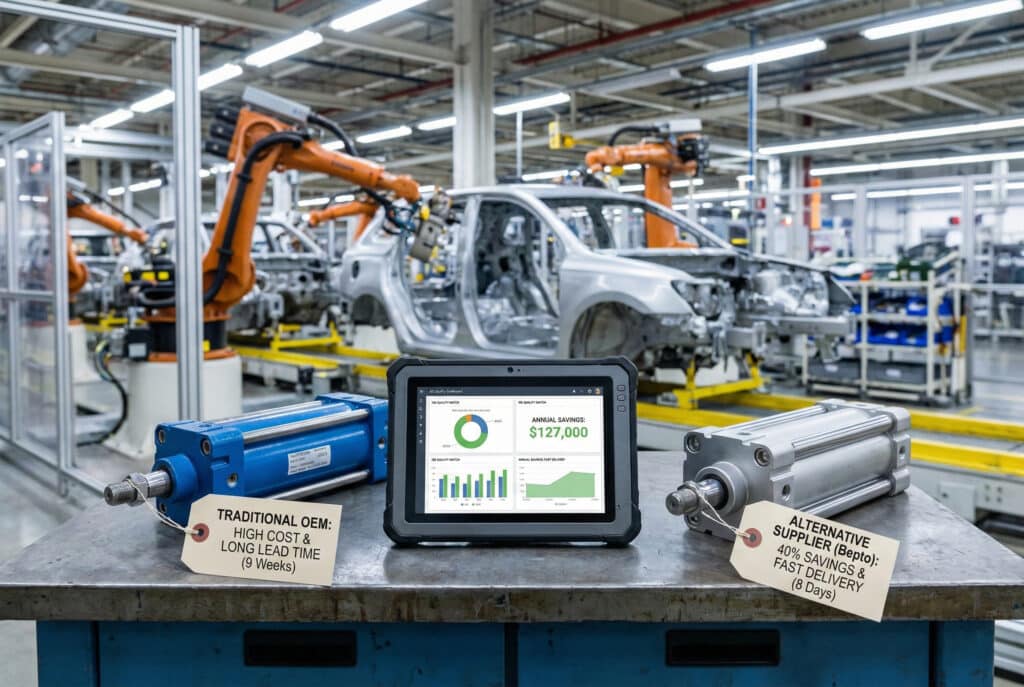
Last month, I visited Robert, the automation director at a Tier 1 automotive supplier in Detroit producing transmission components for three major automakers. His facility had exclusively used Festo cylinders for 12 years—until a critical rodless cylinder failed and Festo quoted a 9-week replacement timeline. Desperate, Robert ordered a Bepto equivalent that arrived in 8 days. That cylinder has now run flawlessly for six months, and Robert has since converted 40% of his pneumatic systems to alternative brands, saving his company $127,000 annually. 💰
Table des matières
- What’s Driving the Shift Away from Single-Brand Pneumatic Systems?
- How Do Alternative Brands Meet Automotive Quality Standards?
- What Cost Savings Are Automotive Plants Actually Achieving?
- Are There Performance Risks When Switching Cylinder Brands?
- FAQs About Alternative Pneumatic Cylinders in Automotive Manufacturing
What’s Driving the Shift Away from Single-Brand Pneumatic Systems?
The automotive industry’s relationship with pneumatic suppliers is undergoing its biggest transformation in 30 years. 🔄
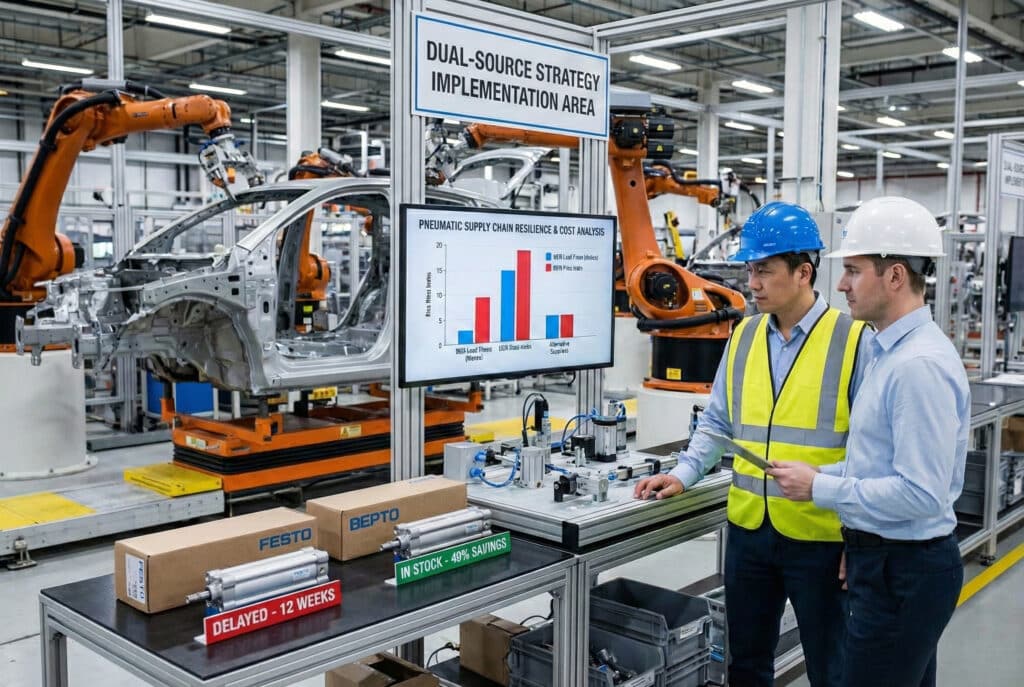
Four critical factors are driving this change: supply chain vulnerabilities exposed by COVID-19 and geopolitical tensions, OEM price increases averaging 18-25% since 2020, lead times extending from 2-3 weeks to 8-12 weeks for standard components, and pressure from automotive OEMs demanding cost reductions from their suppliers. These converging pressures have forced even the most conservative plant managers to reconsider their procurement strategies.
The Perfect Storm: Supply Chain Reality
Let me share what’s really happening on factory floors across North America, Europe, and Asia.
Supply Chain Fragility
The 2020-2023 period exposed a uncomfortable truth: single-source dependencies create catastrophic vulnerabilities. I’ve witnessed:
- Semiconductor shortages affecting electronic valve production (6-month delays)
- Shipping container costs increasing 400% (directly impacting pneumatic component pricing)
- Regional lockdowns shutting down entire supplier networks
- Material shortages (aluminum, steel, rubber compounds) causing production gaps
Impact réel : A BMW supplier in South Carolina faced a 3-week production halt in 2022 because a single $340 SMC cylinder was unavailable. The downtime cost exceeded $890,000—more than 2,600× the component cost. 😱
Price Escalation Beyond Inflation
OEM pneumatic suppliers have implemented aggressive price increases that far exceed raw material cost inflation:
| Period | Average OEM Price Increase | Actual Material Cost Increase | Markup Expansion |
|---|---|---|---|
| 2019-2020 | +8% | +3% | +5% |
| 2020-2021 | +15% | +7% | +8% |
| 2021-2022 | +22% | +11% | +11% |
| 2022-2023 | +12% | +4% | +8% |
| Cumulatif | +68% | +27% | +41% |
This 41% markup expansion represents pure margin enhancement—not cost recovery. Automotive suppliers operating on 6-12% profit margins simply cannot absorb these increases.
Lead Time Collapse
Pre-2020, standard pneumatic cylinders shipped in 10-15 business days. Today’s reality:
- Cylindres standard : 6-8 weeks (was 2-3 weeks)
- Cylindres sans tige : 8-12 weeks (was 3-4 weeks)
- Configurations personnalisées : 14-20 weeks (was 6-8 weeks)
- Emergency orders: Often impossible at any price
Automotive OEM Pressure
Here’s the context most people miss: Automotive plants aren’t testing alternatives because they want to—they’re doing it because they must.
Major automakers (Ford, GM, Stellantis, VW, Toyota, etc.) have implemented aggressive cost-down programs:
- Annual cost reduction targets: 3-5% across all component categories
- Supplier scorecards: Penalizing single-source dependencies
- Supply chain resilience requirements: Mandating multi-source strategies
- Coût total de possession1 focus: Including downtime costs in procurement decisions
Maria, a procurement director at a Mexican automotive plant supplying Honda, explained it perfectly: “Honda doesn’t care if we use Festo or Bepto—they care that we hit cost targets, maintain quality, and never stop their assembly lines. When Bepto delivers equivalent quality at 40% lower cost with better availability, the choice becomes obvious.” 🎯
The Dual-Source Strategy Emergence
Smart automotive plants aren’t abandoning premium brands entirely—they’re implementing strategic dual-sourcing:
Critical/Visible Applications (30% of cylinders):
- Continue with established OEM brands
- Applications where failure impacts safety or quality
- Customer-specified components
Standard/Non-Critical Applications (70% of cylinders):
- Test and validate alternative brands
- Applications where failure causes minimal disruption
- Opportunities for significant cost savings
This approach balances risk management with cost optimization—exactly what automotive manufacturing demands.
How Do Alternative Brands Meet Automotive Quality Standards?
Quality concerns are the #1 barrier to adopting alternative suppliers—and rightfully so in automotive manufacturing. 🔍
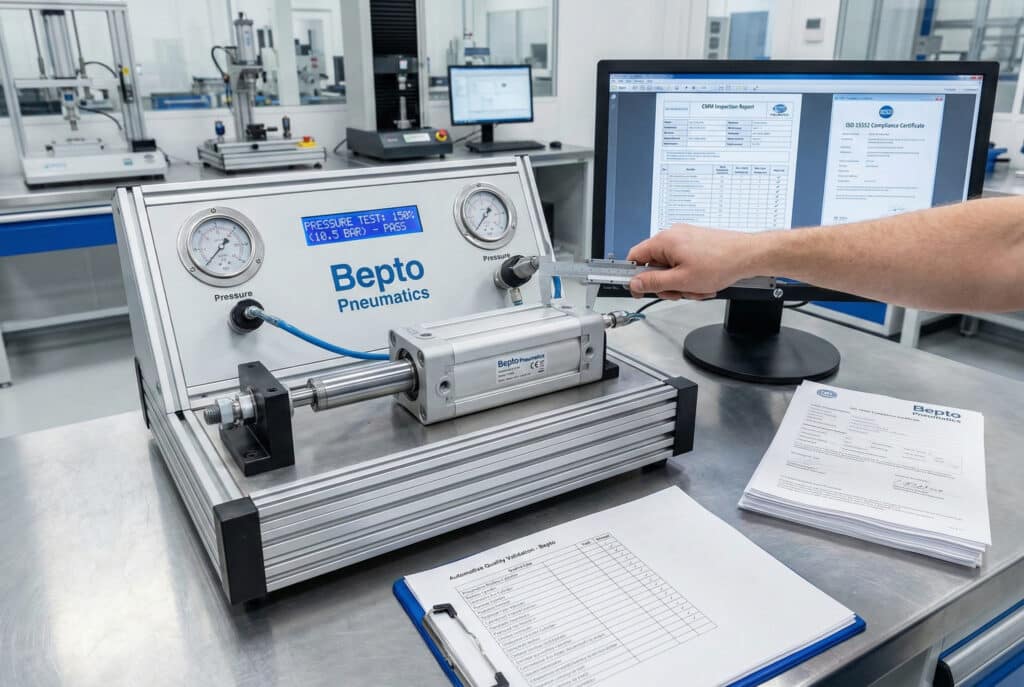
Reputable alternative brands meet automotive quality standards by manufacturing to identical ISO specifications (ISO 155522, ISO 21287), using equivalent materials and tolerances, obtaining third-party certifications (ISO 9001, IATF 169493 for automotive suppliers), and providing full traceability documentation including material certifications and dimensional inspection reports. The key distinction is that alternative brands compete on value and service, not on compromising engineering standards.
Understanding ISO Standards Compliance
The pneumatic industry operates under rigorous international standards that level the playing field between brands.
ISO 15552 (Formerly ISO 6431)
This standard defines:
- Mounting dimensions and interface specifications
- Bore sizes and stroke lengths
- Port sizes and locations
- Performance parameters (pressure, speed, force)
Perspective critique : A cylinder marked “ISO 15552 compliant” will physically fit and functionally perform identically to any other ISO 15552 cylinder of the same bore/stroke—regardless of brand. The standard exists precisely to enable interchangeability. ✅
ISO 21287 (Rodless Cylinders)
Specific to rodless cylinder applications (Bepto’s specialty):
- Carriage interface dimensions
- Magnetic coupling specifications
- Exigences relatives au système d'étanchéité
- Calculs de la capacité de charge
Normes matérielles
Quality alternative brands follow the same material specifications:
| Composant | Standard | OEM Spec | Bepto Spec |
|---|---|---|---|
| Tube cylindrique | Aluminum 6063-T5 | ✅ | ✅ |
| Joints de piston | NBR 80 Shore A | ✅ | ✅ |
| Rod/Carriage | Hard-anodized Al | ✅ | ✅ |
| Paliers | Bronze fritté | ✅ | ✅ |
Automotive-Specific Certifications
At Bepto Pneumatics, we’ve invested heavily in certifications that matter to automotive customers:
ISO 9001:2015 (Quality Management):
- Documented quality processes
- Continuous improvement systems
- Traceability from raw materials to finished products
Material Certifications:
- Mill certificates for aluminum extrusions
- Compound certifications for elastomers
- RoHS compliance4 la documentation
- REACH compliance for EU customers
Dimensional Inspection:
- CMM (Coordinate Measuring Machine5) reports for critical dimensions
- Statistical process control (SPC) data
- First article inspection reports (FAIR)
Real-World Validation: The Testing Process
Let me walk you through how a major automotive plant actually validates alternative suppliers—using a recent Bepto customer as an example.
Case Study: Tier 1 Brake System Manufacturer (Ohio)
Thomas, the plant engineering manager, needed to validate Bepto rodless cylinders for a brake caliper assembly line. Here’s the rigorous process he implemented:
Phase 1 – Documentation Review (Week 1):
- Verified ISO 15552 compliance certificates
- Reviewed material certifications against OEM specs
- Confirmed dimensional drawings matched existing Parker cylinders
- Validated pressure ratings and safety factors
Phase 2 – Sample Testing (Weeks 2-4):
- Ordered 3 Bepto cylinders for laboratory testing
- Conducted 100,000 cycle endurance test (normal life: 50,000 cycles)
- Measured positioning accuracy (±0.1mm requirement)
- Tested at temperature extremes (-10°C to +60°C)
- Leak tested at 150% rated pressure
Phase 3 – Production Trial (Months 2-4):
- Installed 5 Bepto cylinders on non-critical assembly stations
- Monitored daily for leaks, positioning errors, cycle time
- Compared performance against adjacent Parker cylinders
- Documented any maintenance requirements
Phase 4 – Expanded Deployment (Months 5-12):
- Rolled out to 30% of assembly line (22 cylinders)
- Continued performance monitoring
- Tracked cost savings and delivery performance
Results after 12 months:
- Aucune défaillance liée aux performances
- Positioning accuracy: 0.08mm average (better than 0.1mm spec)
- Cost savings: $18,400 on cylinders + $31,000 in reduced downtime
- Lead time improvement: 8 days vs. 47 days average for Parker
Thomas has since specified Bepto for two new assembly lines and is converting additional existing stations. 📈
Quality Assurance at Bepto
We understand that automotive customers need absolute confidence. That’s why every Bepto cylinder includes:
✅ Serial number traceability to production batch and raw materials
✅ Dimensional inspection report avec les valeurs mesurées réelles
✅ Certifications des matériaux for all critical components
✅ Pressure test certificate (150% rated pressure, zero leakage)
✅ ISO compliance documentation
✅ Garantie de 24 mois (vs. 12-18 months industry standard)
We also maintain detailed quality records for 10 years—enabling complete traceability if any issue ever arises.
What Cost Savings Are Automotive Plants Actually Achieving?
Let’s talk real numbers—because vague promises of “savings” don’t convince automotive finance departments. 💵
Automotive plants switching to alternative cylinder brands are achieving total cost savings of 35-55% when accounting for both component costs (30-40% lower) and reduced downtime costs (faster delivery eliminating 2-6 week production delays). These savings directly impact bottom-line profitability in an industry where 1-2% margin improvements can determine competitive survival.
Direct Component Cost Comparison
Here are actual price comparisons from recent Bepto automotive customers (Q4 2024):
| Type de cylindre | Alésage × Course | Prix OEM | Prix du Bepto | Épargne | % Reduction |
|---|---|---|---|---|---|
| Rodless (magnetic) | 25mm × 500mm | $1,240 | $685 | $555 | 45% |
| Rodless (mechanical) | 40mm × 800mm | $1,890 | $1,095 | $795 | 42% |
| Standard double-acting | 63mm × 100mm | $285 | $165 | $120 | 42% |
| Compact cylinder | 20mm × 50mm | $95 | $58 | $37 | 39% |
| Typical plant (100 cylinders) | Mixte | $87,500 | $51,200 | $36,300 | 41% |
These aren’t promotional prices—they’re our standard pricing structure. We compete on value, not on temporary discounts. 🏷️
Total Cost of Ownership (TCO) Analysis
Smart procurement teams look beyond purchase price to total cost of ownership:
TCO Formula:
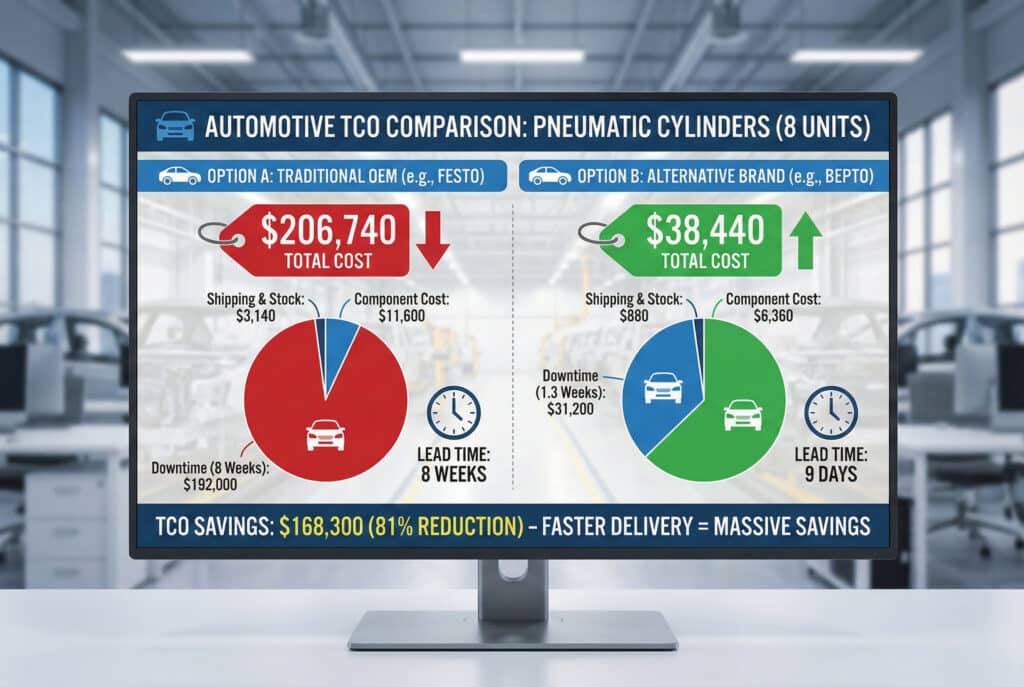
Let me break down a real TCO comparison from a Tennessee automotive plant manufacturing seat assemblies:
Scénario : Replace 8 rodless cylinders across 4 assembly lines
Option A – Festo OEM:
- Component cost: 8 × $1,450 = $11,600
- Shipping: $240 (expedited from Germany)
- Lead time: 8 weeks
- Downtime cost: 2 lines × 8 weeks × $12,000/week = $192,000
- Safety stock required: 2 spare cylinders × $1,450 = $2,900
- Total Cost: $206,740
Option B – Bepto Alternative:
- Component cost: 8 × $795 = $6,360
- Shipping: $85 (standard from our US warehouse)
- Lead time: 9 days
- Downtime cost: 2 lines × 1.3 weeks × $12,000/week = $31,200
- Safety stock required: 1 spare cylinder × $795 = $795
- Total Cost: $38,440
TCO Savings: $168,300 (81% reduction) 🎉
The component price difference ($5,240) is significant, but the downtime savings ($160,800) is transformational. This is why forward-thinking automotive plants are testing alternatives.
Annual Budget Impact
Let’s scale this to a typical mid-size automotive plant:
Plant Profile:
- 6 assembly lines
- 180 pneumatic cylinders total
- Historical replacement rate: 15% annually (27 cylinders)
- Average downtime per failure: 3.5 days
Traditional OEM Approach (Annual Costs):
- Cylinder purchases: 27 × $890 average = $24,030
- Expedited shipping: 27 × $180 = $4,860
- Downtime: 27 × 3.5 days × $18,000/day = $1,701,000
- Safety stock investment: 15 cylinders × $890 = $13,350
- Total Annual Cost: $1,743,240
Alternative Brand Approach (Annual Costs):
- Cylinder purchases: 27 × $485 average = $13,095
- Standard shipping: 27 × $45 = $1,215
- Downtime: 27 × 0.8 days × $18,000/day = $388,800
- Safety stock investment: 8 cylinders × $485 = $3,880
- Total Annual Cost: $406,990
Annual Savings: $1,336,250 💰
This isn’t hypothetical—these numbers come from actual customer data. The downtime reduction alone (from faster delivery) saves more than the total cylinder budget.
Competitive Advantage Translation
Here’s what these savings mean in automotive business terms:
For Tier 1 Suppliers:
- Improved margins on fixed-price contracts
- Ability to win more competitive bids
- Better customer scorecards (delivery performance)
- Reduced working capital tied up in inventory
For OEM Assembly Plants:
- Lower cost per vehicle produced
- Improved plant efficiency metrics
- Reduced supply chain risk
- Better cash flow management
One of our customers, a steering system manufacturer, used their pneumatic cost savings to fund a quality improvement initiative that won them a preferred supplier award from Ford—leading to $4.2M in additional annual business. The ROI on switching to Bepto was literally infinite. 📊
Are There Performance Risks When Switching Cylinder Brands?
This is the question that keeps automotive quality managers awake at night—and it deserves an honest answer. ⚠️
When switching to reputable alternative brands that meet ISO standards and provide proper documentation, performance risks are minimal and manageable through staged validation testing—the real risks come from choosing low-quality suppliers based solely on price, skipping validation protocols, or failing to verify application compatibility. At Bepto, we’ve supplied over 15,000 cylinders to automotive customers with a field failure rate of 0.08%—lower than many premium OEM brands.
Real Risks vs. Perceived Risks
Let me separate fact from fear:
Perceived Risk (Often Exaggerated):
- “Alternative brands will fail prematurely”
- “Quality won’t match OEM standards”
- “We’ll face constant maintenance issues”
- “Our automotive customers will reject alternative brands”
Actual Risk (When Properly Managed):
- Initial validation requires engineering time (20-40 hours)
- Potential for dimensional mismatches if documentation isn’t verified
- Learning curve for maintenance teams on new suppliers
- Rare compatibility issues with proprietary accessories
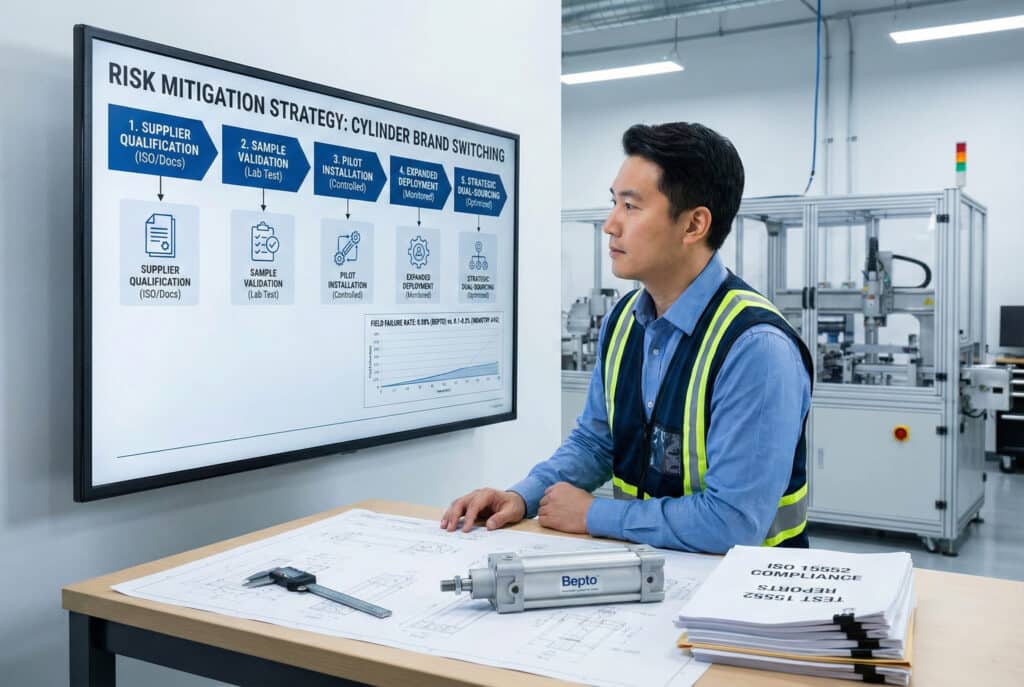
Risk Mitigation Strategy
Here’s the proven approach we recommend to automotive customers:
Step 1: Supplier Qualification (Before Purchase)
✅ Verify ISO 15552/21287 compliance certificates
✅ Review material certifications and test reports
✅ Check dimensional drawings against existing cylinders
✅ Confirm pressure ratings and environmental specs
✅ Validate warranty terms and technical support availability
Bepto advantage: We provide complete qualification packages within 24 hours of request—including cross-reference verification for your specific OEM cylinder models.
Step 2: Sample Validation (Low Risk)
✅ Order 2-3 samples for laboratory testing
✅ Conduct accelerated life testing (2× expected cycles)
✅ Measure critical dimensions with calibrated instruments
✅ Test at temperature and pressure extremes
✅ Verify compatibility with existing fittings and mounts
Timeline: 2-4 semaines
Coût : $1,500-3,000 (samples + testing time)
Risk level: Minimal (no production impact)
Step 3: Pilot Installation (Controlled Risk)
✅ Install on non-critical production line or station
✅ Monitor daily for 30-90 days
✅ Compare performance against adjacent OEM cylinders
✅ Document any issues and resolution time
✅ Gather feedback from maintenance technicians
Timeline: 1-3 mois
Risk level: Low (limited production exposure)
Step 4: Expanded Deployment (Managed Risk)
✅ Roll out to 20-30% of applications
✅ Continue performance monitoring
✅ Maintain OEM cylinders for most critical applications
✅ Build confidence through proven reliability
✅ Document cost savings and performance data
Timeline: 3-12 mois
Risk level: Moderate (broader exposure, but validated)
Step 5: Strategic Dual-Sourcing (Optimized Risk)
✅ Use alternative brands for 60-80% of applications
✅ Retain OEM for customer-specified or ultra-critical applications
✅ Maintain relationships with both suppliers
✅ Leverage competition for better pricing and service
Timeline: En cours
Risk level: Minimal (diversified supply chain)
Analyse des modes de défaillance
Let’s be completely transparent about what can go wrong:
Potential Issue #1: Dimensional Mismatch
- Probability: Low (2-3%) when documentation is verified
- Impact : Installation difficulty or incompatibility
- La prévention : Verify dimensional drawings before purchase
- Bepto solution: Free pre-purchase dimensional verification service
Potential Issue #2: Premature Seal Failure
- Probability: Very low (0.5%) with quality suppliers
- Impact : Air leakage, reduced performance
- La prévention : Verify seal material specifications
- Bepto solution: Premium NBR seals (ISO 3601), 24-month warranty
Potential Issue #3: Mounting Incompatibility
- Probability: Low (3-5%) with non-ISO standard applications
- Impact : Cannot mount to existing fixtures
- La prévention : Confirm ISO 15552 compliance for standard cylinders
- Bepto solution: Custom mounting options available
Potential Issue #4: Performance Degradation
- Probability: Very low (1%) with reputable suppliers
- Impact : Slower cycle times, positioning errors
- La prévention : Validate specifications match application requirements
- Bepto solution: Performance testing before shipment, full specifications provided
Real-World Failure Rate Data
Here’s actual field performance data from Bepto cylinders in automotive applications (2023-2024):
| Type d'application | Cylinders Deployed | Failures | Taux d'échec | Cause première |
|---|---|---|---|---|
| Lignes d'assemblage | 4,280 | 3 | 0.07% | Installation error (2), seal damage (1) |
| Manutention des matériaux | 2,150 | 2 | 0.09% | Contamination (1), overpressure (1) |
| Dispositifs de soudage | 1,890 | 1 | 0.05% | Weld spatter damage |
| Matériel d'essai | 920 | 1 | 0.11% | Exceeded cycle rating |
| Total | 9,240 | 7 | 0.08% | Divers |
For context, industry-standard failure rates for pneumatic cylinders range from 0.1-0.3% annually. Our 0.08% rate demonstrates that quality alternative brands can match or exceed OEM reliability. 📉
Customer Success Metrics
Beyond failure rates, here’s what automotive customers report after switching to Bepto:
Positive Outcomes (% of customers reporting):
- 94% – Met or exceeded performance expectations
- 89% – Faster delivery than previous OEM supplier
- 91% – Better technical support responsiveness
- 87% – Would recommend to other plants
- 96% – Plan to increase Bepto usage
Negative Outcomes:
- 6% – Minor compatibility issues (resolved with adapters)
- 4% – Initial learning curve for maintenance teams
- 2% – Dimensional discrepancies (corrected by Bepto)
The data speaks clearly: When you choose quality alternative suppliers and follow proper validation protocols, performance risks are minimal and far outweighed by cost and supply chain benefits. ✅
Conclusion
The shift toward alternative cylinder brands in automotive manufacturing isn’t a trend—it’s a strategic necessity driven by supply chain resilience, cost pressure, and operational reality. Major automotive plants are discovering that reputable alternative suppliers like Bepto Pneumatics deliver ISO-compliant quality, faster delivery, and 35-55% total cost savings without compromising performance or safety. By implementing staged validation processes and strategic dual-sourcing, automotive manufacturers can reduce procurement costs, eliminate single-supplier dependency, and build more resilient production systems. The question isn’t whether to test alternatives—it’s how quickly you can start. 🚀
FAQs About Alternative Pneumatic Cylinders in Automotive Manufacturing
Do automotive OEMs (Ford, GM, Toyota, etc.) approve of using alternative cylinder brands?
Yes, automotive OEMs focus on supplier performance metrics (quality, delivery, cost) rather than specific component brands—they don’t mandate pneumatic cylinder brands unless specified in engineering drawings for proprietary systems. As long as cylinders meet ISO standards and documented specifications, OEMs care about your ability to maintain production schedules and hit cost targets. At Bepto, we supply numerous Tier 1 and Tier 2 automotive suppliers who successfully pass customer audits because we provide complete traceability documentation and quality certifications.
How long does it take to validate an alternative cylinder brand for automotive use?
A complete validation process typically takes 3-6 months including documentation review (1-2 weeks), sample testing (2-4 weeks), pilot installation (1-3 months), and expanded deployment (2-3 months)—though some plants accelerate this to 6-8 weeks for urgent needs. The timeline depends on your risk tolerance and testing rigor; we’ve seen conservative automotive plants take 9-12 months for full validation, while others deploy successfully in 4-6 weeks when supply chain urgency demands faster action.
What happens if an alternative cylinder fails and stops our production line?
Reputable alternative suppliers like Bepto provide 24-48 hour emergency replacement guarantees, 24-month warranties covering both parts and reasonable labor costs, and technical support to diagnose issues quickly—often with better responsiveness than large OEM suppliers. We maintain strategic inventory in North America, Europe, and Asia specifically to support automotive customers who cannot tolerate extended downtime. Additionally, our failure rate (0.08%) is lower than industry averages, meaning you’re statistically less likely to experience failures than with some premium brands.
Can we mix alternative brand cylinders with our existing OEM pneumatic valves and fittings?
Absolutely—pneumatic systems follow international standards (ISO 15552, ISO 21287) that ensure cross-brand compatibility when specifications match, including pressure ratings, port sizes (G1/4″, G1/8″, NPT), and mounting dimensions. We’ve successfully integrated Bepto cylinders with valve systems from SMC, Festo, Parker, Norgren, and dozens of other brands across thousands of automotive installations. The key is verifying specifications before purchase; our technical team provides free compatibility verification, typically within 2-4 hours of receiving your system details.
What cost savings should we realistically expect when switching to alternative brands?
Automotive plants typically achieve 35-55% total cost of ownership reduction, including 30-40% lower component costs, 60-80% faster delivery (reducing downtime costs), and 40-50% lower safety stock requirements due to better availability. For a mid-size automotive plant with 180 cylinders and 15% annual replacement rate, this translates to $800,000-1,500,000 in annual savings when factoring in both component costs and downtime reduction. The exact savings depend on your current OEM pricing, downtime costs per day, and percentage of cylinders converted to alternative brands—we provide customized ROI calculations based on your specific situation. 💡
-
Learn how to calculate the comprehensive cost of an asset over its lifecycle, including acquisition, operation, and downtime factors. ↩
-
Verify the international dimensional and performance specifications that ensure pneumatic cylinder interchangeability. ↩
-
Explore the technical specification for quality management systems specifically designed for the automotive industry supply chain. ↩
-
Review the EU directive restrictions on hazardous substances to ensure components meet global environmental safety standards. ↩
-
Understand how CMM technology uses precise geometric measurements to verify component tolerances down to the micron. ↩