


Inleiding
Have you ever ordered a pneumatic cylinder based on pressure specifications, only to discover it won’t operate correctly because you confused psia with psig? 😰 This simple misunderstanding has caused equipment failures, safety hazards, and thousands of dollars in losses for manufacturing facilities worldwide. The confusion between these two pressure measurements is one of the most common—and most costly—mistakes in compressed air systems.
PSIA (pounds per square inch absolute) measures total pressure including atmosferische druk1, starting from absolute zero2 in a perfect vacuum, while PSIG (pounds per square inch gauge) measures pressure relative to atmospheric pressure, showing only the pressure above or below the surrounding air. The difference between them is always 14.7 psi at sea level—the weight of Earth’s atmosphere.
I’m Chuck, Sales Director at Bepto Pneumatics, and I’ve helped hundreds of clients avoid this critical error when specifying rodless cylinders and pneumatic systems. Just last week, a maintenance engineer named Robert from a food processing plant in Wisconsin called us frustrated—his newly installed rodless cylinder system wasn’t generating enough force because he’d spec’d it using psia when the compressor gauge showed psig. Let me clear up this confusion once and for all.
Inhoudsopgave
- What Is PSIG and When Should You Use It?
- What Is PSIA and Why Does It Matter for Compressed Air?
- How Do You Convert Between PSIA and PSIG?
- Which Pressure Measurement Should You Use for Rodless Cylinders?
What Is PSIG and When Should You Use It?
When you walk up to your air compressor and check the gauge, you’re reading psig—the most common pressure measurement in industrial pneumatic systems. 📊
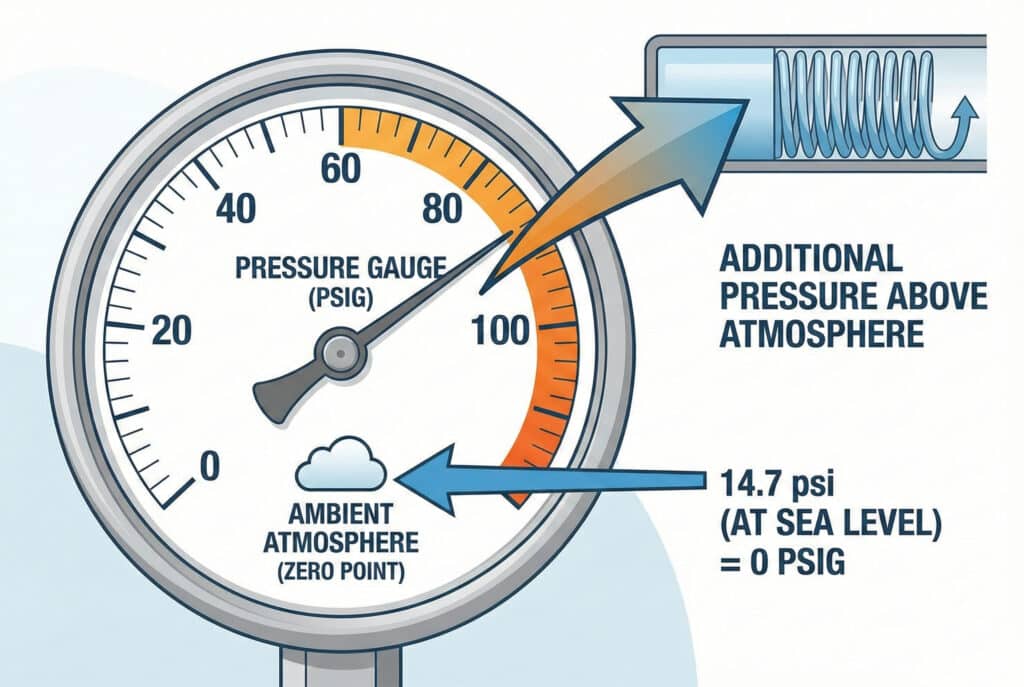
PSIG (pounds per square inch gauge) measures pressure relative to the surrounding atmospheric pressure, with zero psig representing normal atmospheric conditions. This gauge pressure reading shows only the additional pressure your compressor or system generates above the ambient air pressure, which is why most pressure gauges in factories display psig.
Understanding Gauge Pressure
The “G” in PSIG stands for “gauge,” which means the measurement starts at atmospheric pressure as its zero point. Here’s what that means practically:
- 0 PSIG = Normal atmospheric pressure (you’re not adding any pressure)
- 100 PSIG = 100 psi above atmospheric pressure
- -5 PSIG = 5 psi below atmospheric pressure (partial vacuum)
Why Industrial Systems Use PSIG
At Bepto Pneumatics, we specify our rodless cylinders in psig because that’s what you see on your equipment every day. When we say a cylinder operates at “80-100 psig,” you can immediately verify that against your compressor gauge without any conversion.
Practical Applications for PSIG:
| Toepassing | Typical PSIG Range | Why PSIG Is Used |
|---|---|---|
| Pneumatische cilinders | 60-125 psig | Matches shop floor gauges |
| Air Compressors | 100-175 psig | Industry standard measurement |
| Drukregelaars | 0-150 psig | Adjusts relative to atmosphere |
| System Specifications | Varieert | Easy for operators to understand |
The Limitation of PSIG
Here’s what catches people off guard: psig changes with altitude and weather. At sea level, atmospheric pressure is about 14.7 psi, but at 5,000 feet elevation it drops to roughly 12.2 psi. Your gauge still reads the same psig, but the absolute pressure (psia) is different. For most pneumatic applications, this difference is negligible, but for precise calculations—especially when converting to SCFM or ACFM—you need to account for it.
What Is PSIA and Why Does It Matter for Compressed Air?
PSIA represents the complete picture of pressure—the total force acting on a surface, including the invisible weight of the atmosphere above us. 🌍
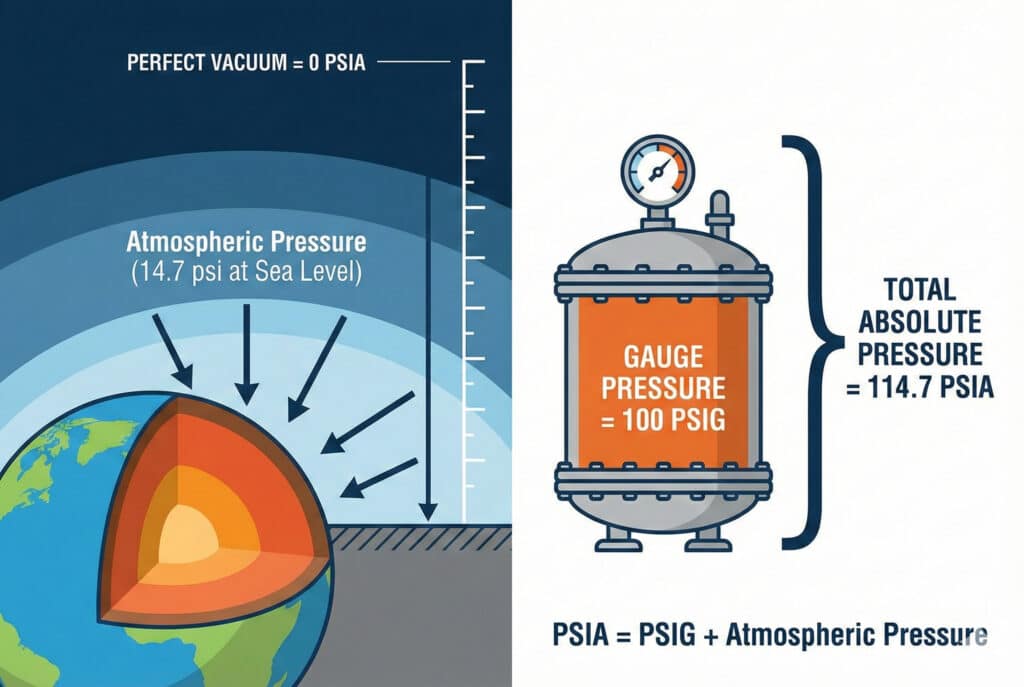
PSIA (pounds per square inch absolute) measures total pressure starting from absolute zero (a perfect vacuum with no air molecules), including both the applied pressure and atmospheric pressure. At sea level, atmospheric pressure equals 14.7 psia, so a system operating at 100 psig is actually at 114.7 psia total pressure.
The Science Behind Absolute Pressure
Absolute pressure is essential for thermodynamic calculations3 and gas law equations. When engineers calculate air flow rates, temperature effects, or compressor performance, they must use psia because gas behavior depends on total molecular pressure, not just the pressure above atmosphere.
When PSIA Becomes Critical
Let me share a story that illustrates why this matters. Jennifer, a process engineer at a pharmaceutical manufacturing facility in New Jersey, was designing a new automated packaging line with multiple rodless cylinders. Her calculations for air consumption kept coming out wrong, causing her to undersize the compressor system. 😓
When she contacted our technical team at Bepto, we quickly identified the problem: she was using psig values in formulas that required psia. Her system operated at 90 psig, which is actually 104.7 psia at sea level. Once we corrected her calculations using absolute pressure, everything fell into place. We supplied her with precision Bepto rodless cylinders and helped her properly size the air system. The installation went smoothly, and she saved over $12,000 compared to OEM parts while getting faster delivery—our standard 4-day turnaround versus 6-week OEM lead times.
Applications Requiring PSIA
When You Must Use PSIA:
- Gas law calculations (Boyle’s Law, Charles’s Law, Ideale gaswet4)
- SCFM to ACFM conversions for accurate flow measurements
- Compressor efficiency calculations and energy audits
- High-altitude installations where atmospheric pressure varies significantly
- Vacuum systems where pressure drops below atmospheric
PSIA at Different Altitudes
| Location/Altitude | Atmosferische druk (PSIA) | 100 PSIG Equals |
|---|---|---|
| Zeespiegel | 14,7 psia | 114.7 psia |
| Denver (5.280 voet) | 12,2 psia | 112.2 psia |
| Mexico City (7,382 ft) | 11,3 psia | 111.3 psia |
| High Mountains (10,000 ft) | 10,1 psia | 110.1 psia |
This table shows why absolute pressure matters for precise engineering work—the same gauge reading represents different total pressures at different elevations.
How Do You Convert Between PSIA and PSIG?
The conversion between psia and psig is refreshingly simple compared to other pneumatic calculations—it’s just addition or subtraction! 🔧
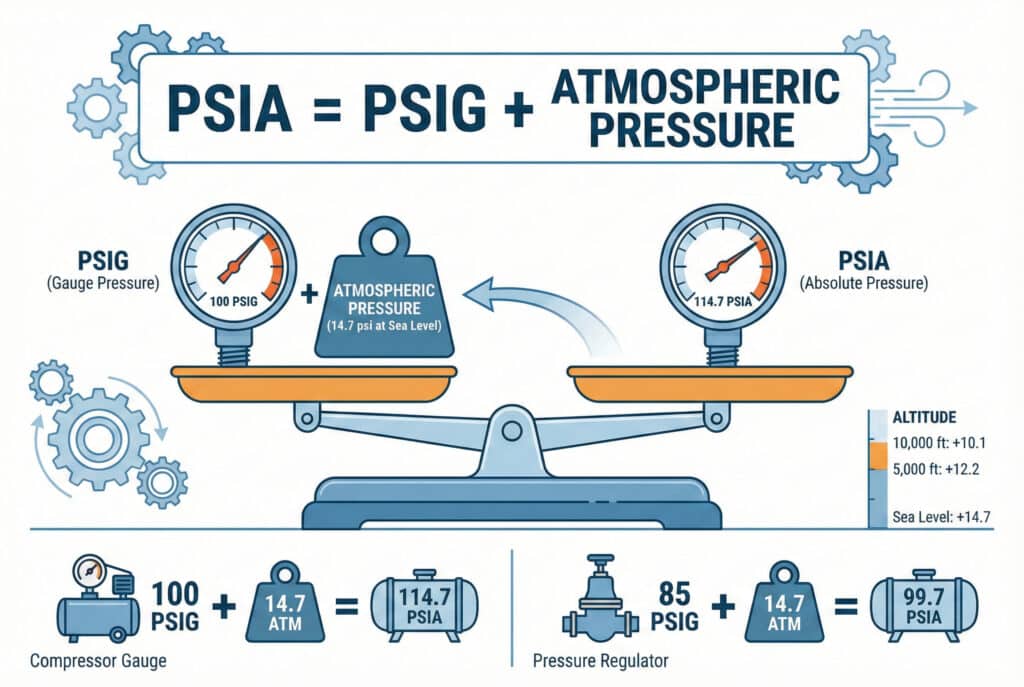
The conversion formula is: PSIA = PSIG + atmospheric pressure. At sea level, atmospheric pressure is 14.7 psi, so PSIA = PSIG + 14.7. Conversely, PSIG = PSIA – 14.7. However, atmospheric pressure varies with altitude and weather, so for precision work at high elevations or in vacuum applications, you must use the actual local atmospheric pressure.
Simple Conversion Examples
Converting PSIG to PSIA (Sea Level)
Example 1: Your compressor gauge reads 100 psig
- PSIA = 100 + 14.7 = 114.7 psia
Example 2: Your pressure regulator is set to 85 psig
- PSIA = 85 + 14.7 = 99.7 psia
Example 3: You have a slight vacuum of -5 psig
- PSIA = -5 + 14.7 = 9.7 psia
Converting PSIA to PSIG (Sea Level)
Example 1: A specification calls for 120 psia
- PSIG = 120 – 14.7 = 105.3 psig
Example 2: Your calculation yields 75 psia required
- PSIG = 75 – 14.7 = 60.3 psig
Altitude Adjustments
At elevations other than sea level, you need to adjust for local atmospheric pressure:
Denver, Colorado (5,280 feet elevation):
- Atmospheric pressure ≈ 12.2 psi
- 100 psig = 100 + 12.2 = 112.2 psia
Phoenix, Arizona (1,100 feet elevation):
- Atmospheric pressure ≈ 14.2 psi
- 100 psig = 100 + 14.2 = 114.2 psia
Quick Reference Conversion Table
| PSIG | PSIA (Sea Level) | PSIA (5,000 ft) | PSIA (10,000 ft) |
|---|---|---|---|
| 0 | 14.7 | 12.2 | 10.1 |
| 50 | 64.7 | 62.2 | 60.1 |
| 80 | 94.7 | 92.2 | 90.1 |
| 100 | 114.7 | 112.2 | 110.1 |
| 125 | 139.7 | 137.2 | 135.1 |
Veelvoorkomende conversiefouten
❌ Forgetting to add atmospheric pressure when converting psig to psia
❌ Using 14.7 at high altitude instead of actual atmospheric pressure
❌ Mixing units in calculations (using psig in formulas requiring psia)
❌ Ignoring weather variations in precision applications (barometric pressure can vary ±1 psi)
At Bepto Pneumatics, we help clients avoid these errors by providing clear specifications in both psig and psia for our rodless cylinders, along with performance curves that account for your specific operating conditions.
Which Pressure Measurement Should You Use for Rodless Cylinders?
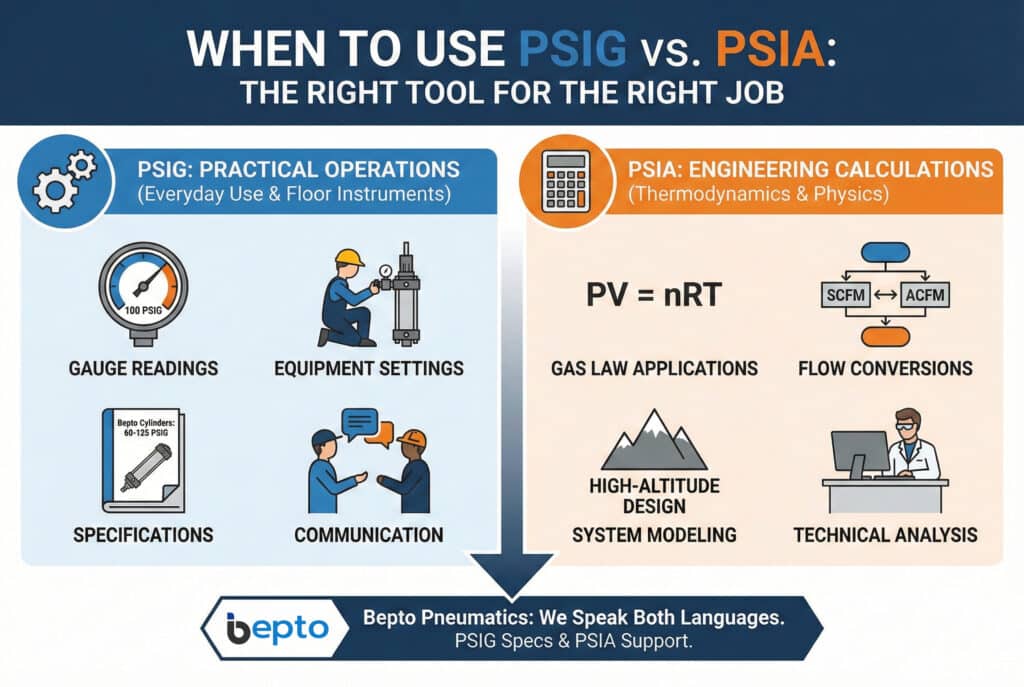
Choosing between psia and psig isn’t about which is “better”—it’s about using the right tool for the right job. Let me break down exactly when to use each. 💡
Use PSIG for everyday operations, equipment specifications, pressure gauge readings, and communicating with operators, because it matches what you see on shop floor instruments. Use PSIA for engineering calculations, thermodynamic formulas, gas law applications, SCFM/ACFM conversions, and any situation where absolute pressure affects the physics of your system.
Practical Decision Matrix
Use PSIG When:
Dagelijkse activiteiten
- Setting pressure regulators for your rodless cylinders
- Reading compressor output gauges
- Adjusting system pressure for different applications
- Training operators on equipment settings
Equipment Specifications
- Ordering pneumatic cylinders (we list Bepto cylinders in psig)
- Comparing pressure ratings between manufacturers
- Checking valve and fitting pressure limits
- Documenting standard operating procedures
Communication
- Discussing requirements with suppliers like us at Bepto
- Writing maintenance procedures
- Troubleshooting with your team
Use PSIA When:
Technische berekeningen
- Converting between SCFM and ACFM for air consumption
- Calculating cylinder force output precisely
- Designing systems for high-altitude locations
- Performing energy efficiency audits
Technische analyse
- Applying the ideal gas law: PV = nRT
- Calculating air density changes with pressure
- Determining compressor work and efficiency
- Modeling system performance across temperature ranges
The Bepto Advantage: We Speak Both Languages
At Bepto Pneumatics, we understand that confusion between psia and psig costs our clients time and money. That’s why we provide:
| What We Offer | PSIG Specs | PSIA Support |
|---|---|---|
| Productcatalogi | ✅ Primary specification | ✅ Conversion charts included |
| Technical Datasheets | ✅ Operating ranges | ✅ Absolute pressure calculations |
| Online gereedschap | ✅ Pressure selectors | ✅ SCFM/ACFM calculators |
| Customer Support | ✅ Quick answers | ✅ Engineering consultation |
Our rodless cylinders are designed to deliver consistent performance across the typical industrial range of 60-125 psig (74.7-139.7 psia at sea level). We provide replacement parts that match or exceed OEM specifications while offering:
- 25-35% cost savings compared to original equipment
- 3-5 day delivery versus 4-6 week OEM lead times
- Free technical support to ensure proper specification
- Compatibility guarantees with major brands
Whether you’re replacing a failed cylinder on an urgent basis or designing a new system from scratch, our team helps you navigate the psia vs psig question to ensure optimal performance.
Conclusie
Understanding the difference between psia and psig is fundamental to properly specifying, operating, and troubleshooting compressed air systems—use psig for daily operations and equipment specs, but always convert to psia for engineering calculations and thermodynamic formulas. 🎯
FAQs About PSIA vs PSIG in Compressed Air Systems
Is psia always higher than psig?
Yes, psia is always higher than psig by the amount of atmospheric pressure (approximately 14.7 psi at sea level). Since absolute pressure includes atmospheric pressure while gauge pressure measures only above atmosphere, psia values are always greater. For example, 100 psig equals 114.7 psia at sea level. The only exception is when discussing perfect vacuum (0 psia = -14.7 psig).
Can I use psig and psia interchangeably for pneumatic cylinders?
No, never use them interchangeably in calculations, though for basic operation you’ll primarily use psig. When operating rodless cylinders, you’ll set regulators and read gauges in psig. However, if you’re calculating air consumption (SCFM), cylinder force at altitude, or system efficiency, you must convert to psia first. Mixing them up in formulas will give you incorrect results that can lead to undersized equipment.
Why do pressure gauges show psig instead of psia?
Pressure gauges display psig because it shows the useful pressure available for work, eliminating the constant atmospheric pressure that’s always present. Since atmospheric pressure surrounds us constantly, operators need to know only the additional pressure being generated. A gauge reading 0 psig means no compressed air is present—just normal atmosphere. This makes psig more intuitive for daily operations than psia would be.
How does altitude affect the difference between psia and psig?
Altitude changes atmospheric pressure, which affects the conversion between psia and psig but doesn’t change gauge readings. At sea level, add 14.7 to convert psig to psia. At 5,000 feet elevation, add only 12.2 because atmospheric pressure is lower. Your gauge still reads the same psig, but the absolute pressure (psia) is lower. This matters for performance calculations, especially when sizing compressors or calculating air flow for rodless cylinders at high-altitude facilities.
Do I need to specify psia or psig when ordering rodless cylinders from Bepto?
Always specify psig when ordering from us—it’s the industry standard and matches your facility’s pressure gauges. At Bepto Pneumatics, all our rodless cylinder specifications use psig for operating pressure ranges (typically 60-125 psig). Our technical team will handle any psia conversions needed for performance calculations or special applications. If you’re unsure about your requirements, contact us for a free consultation—we’ll help you specify the right cylinder for your exact operating conditions and ensure compatibility with your existing system.
-
Understand the force exerted by the weight of the air above measurement points and how it establishes the baseline for gauge pressure. ↩
-
Learn about the theoretical state of zero thermal energy and molecular motion that serves as the baseline for absolute pressure measurements. ↩
-
Explore the branch of physics dealing with heat, work, and temperature, where absolute pressure values are mathematically required. ↩
-
Review the fundamental equation (PV=nRT) describing the relationship between pressure, volume, temperature, and amount of gas. ↩