

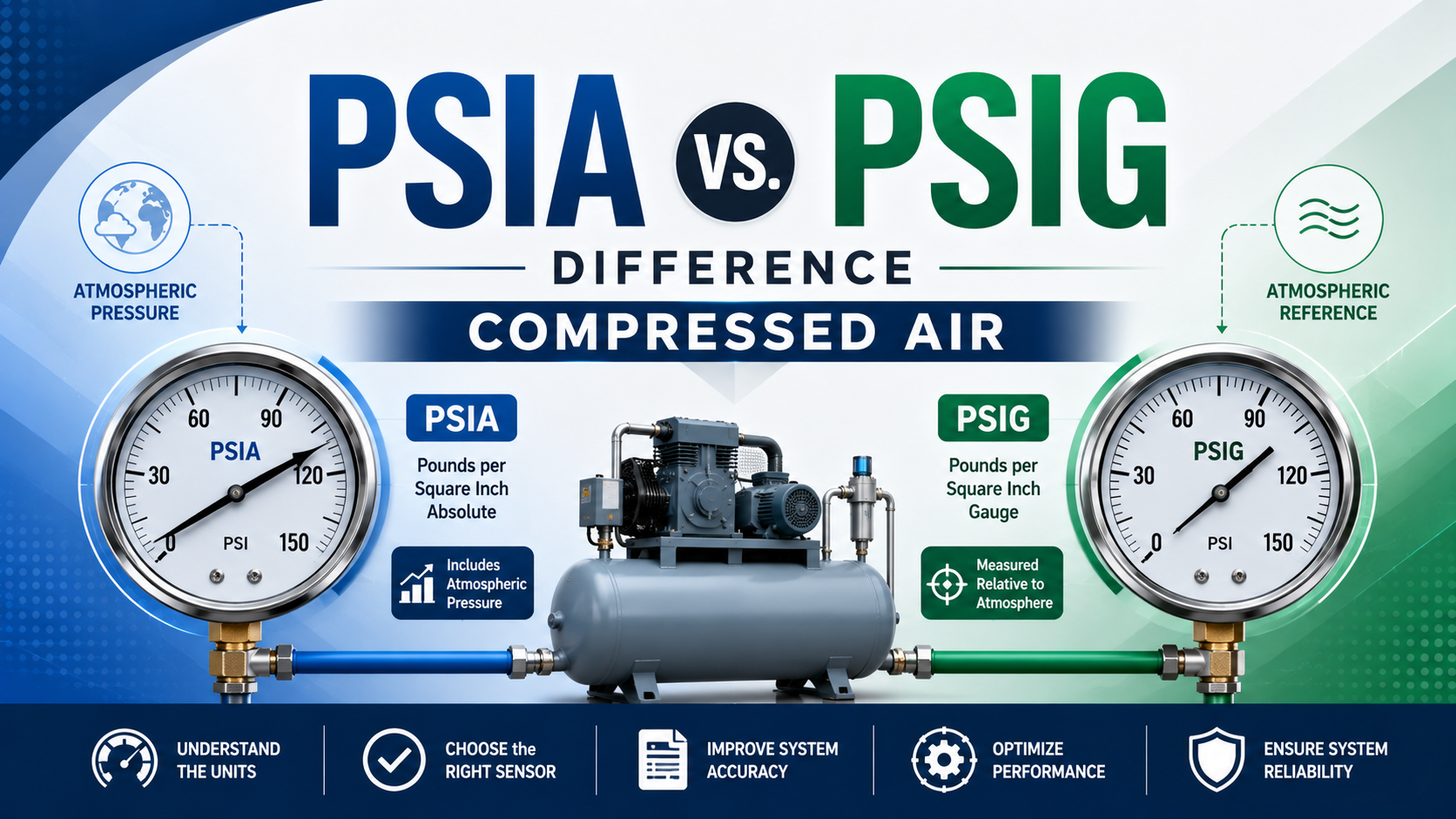
PSIA measures pressure from absolute vacuum, while PSIG measures pressure relative to local atmospheric pressure. Convert between them by adding or subtracting the atmospheric pressure at the measurement location and time. The familiar 14.7 psi offset is a standard sea-level approximation, not a universal constant for every factory.
The practical choice depends on the calculation. Shop gauges, regulators, and basic cylinder-force checks commonly use gauge pressure. Gas laws, compressor ratios, air-mass calculations, vacuum work, and compressible-flow ratios require absolute pressure. An unlabeled “100 psi” is incomplete engineering information.
Key Takeaways
- Standard atmosphere is 14.6959 psi, but actual local atmosphere varies.
- Use PSIG for pressure difference against the same local atmosphere.
- Use PSIA whenever the gas state or an absolute pressure ratio matters.
- Convert the pressure reference before converting psi to bar or kPa.
What Is the PSIA vs PSIG Difference in Compressed Air?
NIST defines one standard atmosphere as exactly 101,325 Pa, equivalent to approximately 14.6959 psi. Under that standard sea-level assumption, 100 PSIG converts to about 114.696 PSIA. At another atmospheric pressure, the offset changes with the local reference (NIST, Pressure and Gas Flow Unit Conversions, updated 2025).
PSIA is pounds per square inch absolute. Its zero point is an ideal absolute vacuum, not the thermodynamic temperature called absolute zero. An absolute transducer therefore reports the total pressure of the gas above the vacuum reference.
PSIG is pounds per square inch gauge. Its zero point is local atmospheric pressure. A vented gauge exposed to the same room as the machine normally reads 0 PSIG when its pressure port is also open to that room.
The relationship is simple, but every term must use the same pressure unit:
is absolute pressure, is gauge pressure, and is atmospheric absolute pressure at the location and time of interest. Rearranging gives:
These equations define the pressure reference. They do not convert psi to bar, temperature, or flow reference conditions. Complete the reference conversion first, then convert units.
The longer absolute-pressure guide covers gas-state theory in more depth. This article stays focused on reading specifications, choosing the correct reference, and performing defensible conversions.
Pressure Labels Reveal the Instrument Reference
NIST operates piston gauges in two distinct modes: gauge mode leaves the piston and weight stack at atmospheric pressure, while absolute mode evacuates that reference. The sensing reference, not the dial shape, determines what the instrument reports (NIST, Piston Gauges and Pressure Transducers, accessed July 23, 2026).
Do not assume every device with a pressure display is a vented gauge. Read the datasheet and wiring configuration:
| Pressure type | Reference | Common label | Typical use |
|---|---|---|---|
| Absolute | Sealed vacuum reference | PSIA, bara, kPa absolute | Gas laws, vacuum, air density, compressor calculations |
| Vented gauge | Local atmosphere through a vent | PSIG, barg, kPa gauge | Regulators, plant-air gauges, actuator settings |
| Sealed gauge | Fixed reference sealed during manufacture | Manufacturer-specific | Outdoor or washdown transmitters where an open vent is undesirable |
| Differential | A second process port | PSID, bar differential, kPa differential | Filter drop, valve drop, flow elements |
| Compound gauge | Local atmosphere with positive and negative range | PSIG and vacuum scale | Suction, evacuation, leak checks |
A sealed-gauge transducer can drift relative to current atmosphere because its reference is fixed. A vented-gauge transducer tracks local atmosphere through its vent, provided that vent is clean and open. Calling both devices “a pressure sensor” hides the difference that matters.
The suffix is part of the value. Write 100 PSIG, 114.7 PSIA, 6 barg, or 7.013 bara. If a drawing says only 100 psi, ask for the reference before selecting a transducer, checking a formula, or accepting an RFQ.
How Do You Convert PSIG to PSIA Correctly?
NIST lists 1 psi as 6,894.757 Pa and one standard atmosphere as 14.6959 psi. Use those factors only after identifying the reference. A mathematically correct psi-to-kPa conversion still produces the wrong engineering state when a PSIG input is mislabeled as PSIA (NIST, Pressure Conversion Table, updated 2025).
Use this sequence:
- Identify whether the source value is gauge, absolute, differential, sealed gauge, or vacuum.
- Obtain local atmospheric absolute pressure or state that a standard-atmosphere model is being used.
- Convert the reference using the PSIA/PSIG equations.
- Convert the resulting unit to bar, kPa, MPa, or another required unit.
- Round only after the final step and record the assumption.
Standard-atmosphere example
A regulator reads 100 PSIG and the calculation intentionally assumes standard atmosphere:
For a normal specification, report 114.7 PSIA. Do not imply that the last decimal is a measured site value.
High-altitude example
A plant near 5,000 ft uses 12.2 PSIA as a rounded standard-atmosphere estimate:
The gauge pressure remains 100 PSIG. The absolute pressure is lower because the local atmospheric offset is lower.
Compound-gauge vacuum example
A compound gauge reads -5 PSIG while local atmospheric pressure is 14.4 PSIA:
Confirm that the negative value is genuinely gauge-referenced. Vacuum instruments also use inHg, Torr, millibar absolute, percentage vacuum, and other conventions that cannot be converted safely from the number alone.
Which Compressed-Air Calculations Normally Use PSIG?
Parker publishes pneumatic-cylinder force tables at applied pressures such as 80 and 100 psi, matching the operating pressure maintained across the piston area. For a cylinder exhausting to the same local atmosphere, gauge pressure represents that working pressure difference (Parker, Atlas Series A Heavy-Duty Air Cylinders, accessed July 23, 2026).
Use gauge pressure, differential pressure, or measured port-to-port pressure when the engineering question concerns a force or loss relative to another local point:
- regulator set pressure;
- plant-header or branch pressure;
- basic cylinder thrust against a vented opposite chamber;
- pressure drop across filters, dryers, valves, tubing, and silencers;
- proof-test or working-pressure limits stated in gauge units;
- operator settings and maintenance trend sheets.
The words “basic cylinder thrust” matter. A double-acting actuator can have nonzero back pressure on the exhaust side, especially with a restricted flow controller, undersized silencer, shared exhaust, or fast motion. The net force then depends on pressure at both cylinder ports, piston areas, friction, and external load. One regulator gauge does not describe that condition.
For the complete force method, use the pneumatic cylinder theoretical-force guide. At high altitude, a correctly regulated 80 PSIG still represents an 80 psi differential above local atmosphere, but compressor intake, vacuum force, and stored air mass do not remain unchanged.
The fastest review question is: “What is on the other side of the force balance?” If the answer is the same local atmosphere, gauge pressure is usually the useful starting point. If the answer is another sealed gas state, an inlet, or an evacuated volume, absolute or differential pressure is likely required.
Which Calculations Require PSIA Instead?
CAGI defines SCFM using a stated reference of 14.5 PSIA, 68°F, and 0% relative humidity, while other standards use different reference conditions. That difference shows why standard flow is not only a unit label: pressure, temperature, and moisture basis must travel with the value (CAGI, Resource Library, accessed July 23, 2026).
Use absolute pressure whenever the equation describes gas state, density, mass, or an absolute pressure ratio:
- ideal-gas and combined-gas-law calculations;
- compressor suction-to-discharge ratio;
- receiver air mass and free-air storage;
- SCFM, ACFM, FAD, NL/min, and other referenced-flow conversions;
- compressible flow, sonic conductance, and critical pressure ratio;
- vacuum level and vacuum-cup holding force;
- leak-rate calculations affected by barometric pressure;
- air-density and altitude corrections.
A compressor inlet gauge may read 0 PSIG even though the inlet gas is near 14.7 PSIA at standard sea-level conditions. Dividing a discharge pressure by that 0 PSIG reading is meaningless. Convert both suction and discharge to absolute pressure before forming the ratio. The compressor compression-ratio guide gives the full method.
Valve and orifice calculations also require care. A pressure ratio such as downstream pressure divided by upstream pressure must use absolute values. The sonic-conductance guide explains why a gauge-pressure ratio can predict the wrong flow regime.
Standard flow needs one more warning. NIST notes that sccm can use different standard temperatures depending on the source. Before converting SCFM to ACFM, record the named standard, actual line temperature, actual absolute pressure, and humidity treatment. A bare “500 SCFM” may not be comparable across two datasheets.
Altitude and Weather Change the Offset, Not the Meaning
NASA’s standard-atmosphere model places atmospheric pressure near 14.7 PSIA at sea level, 12.2 PSIA around 5,000 ft, and 10.1 PSIA around 10,000 ft. These are model values; actual weather and site elevation change the measured atmosphere (NASA Glenn, Standard Atmosphere Model, accessed July 23, 2026).
A vented gauge set to 100 PSIG still indicates 100 psi above the atmosphere surrounding its vent. What changes with altitude is the absolute pressure:
| Standard-atmosphere example | Local atmosphere | 100 PSIG expressed as absolute |
|---|---|---|
| Sea level | 14.7 PSIA | 114.7 PSIA |
| About 5,000 ft | 12.2 PSIA | 112.2 PSIA |
| About 10,000 ft | 10.1 PSIA | 110.1 PSIA |
Do not assign a fixed pressure to a city name. The atmospheric value should come from a calibrated local barometer, a verified weather or facility instrument, or a clearly identified standard-atmosphere model. Record whether the reported pressure is station pressure or a weather service’s sea-level-corrected pressure.
Altitude affects different pneumatic tasks in different ways:
- Cylinder force: A vented actuator at the same measured PSIG can retain approximately the same basic pressure differential, subject to port pressure and back pressure.
- Compressor intake: Lower suction absolute pressure and density change capacity, ratio, and temperature.
- Receiver storage: The same volume and PSIG contain less air mass when absolute pressure is lower.
- Vacuum handling: Lower atmosphere reduces the maximum available pressure differential across a suction cup.
- Flow calculations: Absolute upstream and downstream pressures change critical ratios and corrected flow.
The high-altitude pneumatic-cylinder guide separates these effects instead of applying a single percentage derating rule to the whole machine.
What Should a Pressure Specification or RFQ Include?
NIST warns that standard gas-flow units can assume different temperatures, while CAGI’s SCFM definition names 14.5 PSIA, 68°F, and 0% relative humidity. A complete RFQ therefore needs at least pressure reference, measurement location, operating condition, and flow reference state (NIST, 2025; CAGI, accessed 2026).
Record these fields before comparing components or simulation results:
- Pressure value and suffix: Write PSIG, PSIA, barg, bara, kPa gauge, or kPa absolute.
- Instrument type: Vented gauge, absolute, sealed gauge, differential, or compound vacuum gauge.
- Measurement location: Compressor discharge, dryer outlet, header, regulator outlet, valve inlet, or cylinder port.
- Operating state: Static, flowing, actuator accelerating, end-of-stroke, compressor loaded, or compressor unloaded.
- Local atmosphere: Measured barometric pressure, site elevation model, and date when precision matters.
- Flow reference: SCFM, ACFM, FAD, ANR, or NL/min with pressure, temperature, and humidity basis.
- Temperature: Actual line temperature and any standard temperature used for normalization.
- Allowable range: Normal, minimum dynamic, maximum, proof, and surge pressure as separate fields.
In our experience, the fastest way to catch a pressure-reference mistake is to reject every unlabeled psi or bar value during design review. Add the suffix before discussing the arithmetic. This also exposes cases where a compressor gauge, simulation input, and actuator-port measurement came from three different locations.
For flow-dependent systems, pair the reference check with the pneumatic flow-rate guide. The pressure number at rest may be correct while the actuator still loses force because the valve, tube, or exhaust path cannot maintain it during motion.
PSIA vs PSIG FAQs for Compressed Air
NIST lists standard atmosphere as 14.6959 psi, while CAGI uses 14.5 PSIA in its SCFM reference definition. That 0.1959 psi difference is enough to show why “standard” must be named rather than assumed when specifications, flow conversions, or acceptance limits are compared (NIST, 2025; CAGI, accessed 2026).
Is PSIA always 14.7 psi higher than PSIG?
No. PSIA exceeds PSIG by the local atmospheric absolute pressure at the location and time of measurement. The offset is approximately 14.6959 psi only under the standard-atmosphere assumption. At altitude or during changing weather, use measured local atmosphere or clearly state the standard-atmosphere model used for the conversion.
Can PSIG be negative?
Yes. A compound gauge can report pressure below local atmosphere as negative PSIG. Perfect vacuum would be negative local atmospheric pressure on that scale, not a universal -14.7 PSIG. Convert a negative gauge reading by adding the local atmospheric absolute pressure and confirm the instrument’s reference and vacuum-unit convention.
Should cylinder-force calculations use PSIG or PSIA?
Use the pressure difference across the piston. When the opposite chamber exhausts freely to the same local atmosphere, gauge pressure is normally the practical input. If exhaust back pressure is significant, measure both cylinder ports and calculate their opposing forces. PSIA is not automatically more accurate for a simple vented-cylinder force check.
Why must compressor ratios use PSIA?
Compression ratio compares discharge absolute pressure with suction absolute pressure. Atmospheric suction can read 0 PSIG while still containing gas near local atmospheric absolute pressure. Dividing by gauge zero is undefined. Convert both states to PSIA or bara, then divide values expressed in the same absolute-pressure unit.
Does the same SCFM value always represent the same airflow?
Not unless both sources use the same standard pressure, temperature, and humidity convention. CAGI uses 14.5 PSIA, 68°F, and 0% relative humidity in its SCFM definition, while other standards may differ. Record the named reference conditions before converting standard flow to actual flow or comparing catalogues.
Sources and technical references
- CAGI, Resource Library and Compressed-Air Terminology, retrieved July 23, 2026.
- NASA Glenn, Air Properties Definitions, retrieved July 23, 2026.
- NASA Glenn, Standard Atmosphere Model, retrieved July 23, 2026.
- NIST, Piston Gauges and Pressure Transducers, retrieved July 23, 2026.
- NIST, Pressure and Gas Flow Unit Conversions, updated July 28, 2025; retrieved July 23, 2026.
- Parker, Atlas Series A Heavy-Duty Air Cylinders, retrieved July 23, 2026.
- U.S. Department of Energy, Improving Compressed Air System Performance: A Sourcebook for Industry, retrieved July 23, 2026.