

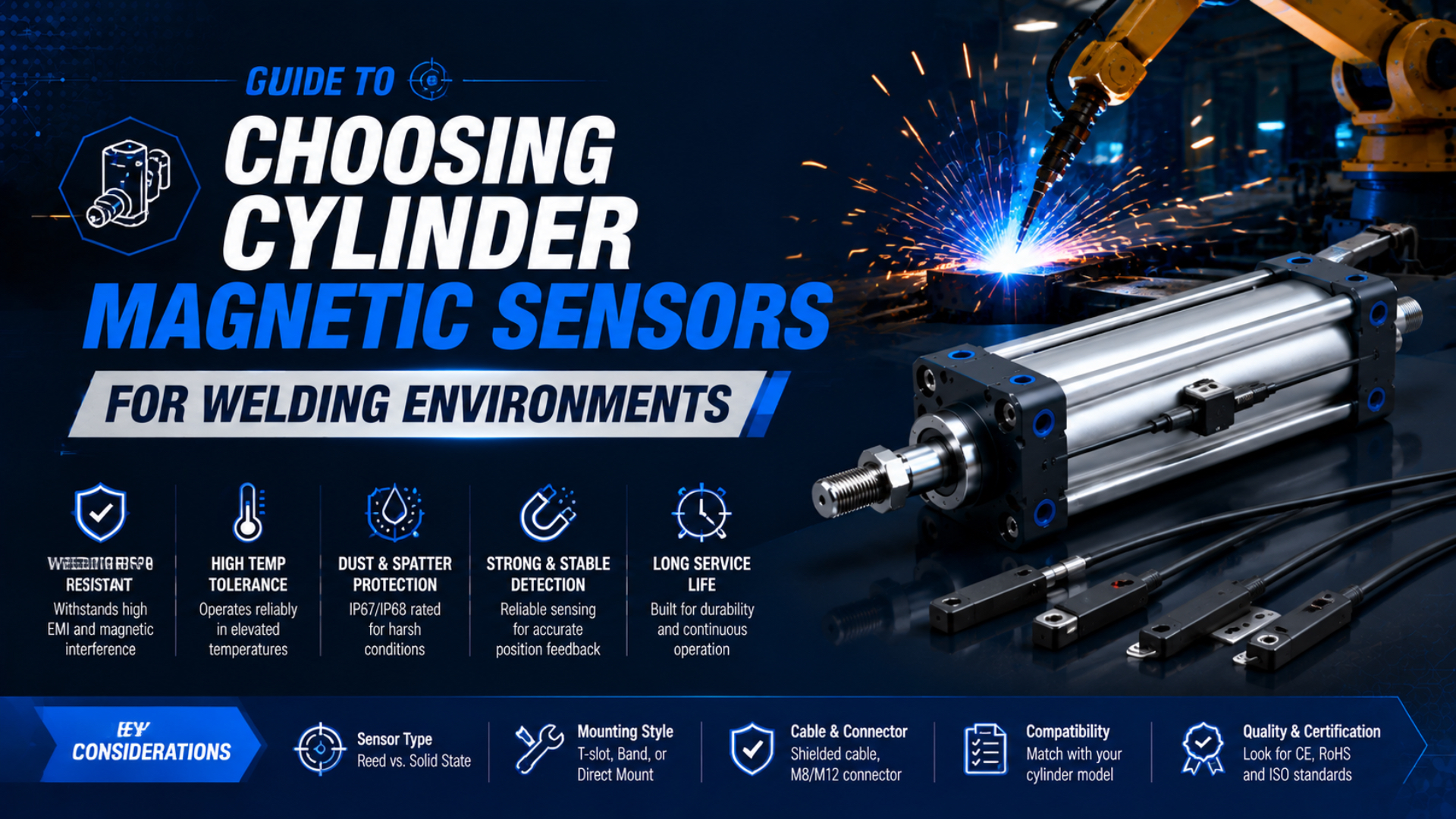
The right cylinder sensor for a welding cell is a cylinder-compatible magnetic switch whose datasheet, cable system, mounting arrangement, and completed installation have been qualified under the cell’s worst credible welding cycle. A generic “weld-field immune” label isn’t enough. It may describe an inductive proximity sensor that detects an external metal target rather than the magnet inside a pneumatic cylinder.
Start by identifying what must be detected. If the existing sensor reads a piston magnet through the cylinder wall, the replacement must be approved for that cylinder, magnet, groove, and mounting hardware. If the machine can instead present a metal flag or bracket, a weld-field-immune inductive sensor may be an option. Those are two different sensing architectures.
Key Takeaways
- Match a magnetic cylinder switch to the exact cylinder and piston magnet.
- Don’t substitute a metal-target inductive sensor without redesigning the target.
- Treat spatter, external magnetic fields, electrical interference, and cable damage separately.
- Follow manufacturer wiring and protective-bonding instructions rather than a universal shield rule.
- Approve the sensor only after a worst-case production test at the PLC input.
Why Do Cylinder Sensors Misbehave Near Welding?
One SMC welding-cylinder catalog tells users to consult the manufacturer when welding current exceeds 16,000 A and warns that nearby welding cables or gun electrodes can affect the cylinder magnets. That model-specific warning is more useful than a universal separation distance because current, conductor geometry, return-path layout, orientation, and cylinder construction all change the exposure (SMC MK2T catalog).
In our experience, a sensor that fails only during welding hasn’t necessarily suffered permanent electronic damage. The same PLC symptom can come from a temporary magnetic offset, a conducted disturbance, a damaged cable, a moved switch, a connector fault, or a piston that never reached the expected position. Separate these paths before specifying a replacement.
| Exposure path | Typical symptom | Evidence to collect | First check |
|---|---|---|---|
| External magnetic field | False or missed switch during welding | Current path, sensor position and orientation | Compare weld-off and weld-on cycles |
| Electrical disturbance | PLC flicker, extra transitions, or signal loss | Event log, supply, cable route and connector | Compare sensor LED with PLC input |
| Spatter and heat | Pitted jacket, damaged connector or stuck hardware | Temperature limits and spatter path | Inspect the full cable assembly |
| Mechanical movement | Detection point shifts after service or impact | Switch position, torque and piston arrival | Mark and verify the installed position |
| Unintended current path | Heating, arcing or repeated electrical damage | Welding return and bonding review | Use qualified electrical inspection |
The last category deserves caution. A sensor cable shield, signal common, machine protective-bonding conductor, and welding work-return lead don’t perform the same job. Never disconnect protective bonding or remove live connections to “find” a current path. Electrical investigation belongs under the site’s safe-work procedure and the machine and welding-equipment documentation.
If the fault continues with welding disabled, use the broader pneumatic cylinder sensor failure diagnostic sequence before blaming the welding process.
Which Detection Method Does the Machine Actually Need?
Two official product families show why the sensing method must come first: SMC sells a magnetic-field-resistant solid-state auto switch for air cylinders, while ifm describes its Kplus welding sensor as an inductive device that detects metal objects. Both address welding environments, but they don’t detect the same target (SMC D-P3DWA, ifm Kplus).
Magnetic cylinder switch
A magnetic cylinder switch is a device that senses the field from a magnet built into the piston. The complete sensing chain includes the magnet, cylinder wall, sensor element, switching thresholds, mounting groove, bracket, and electrical output. A switch that physically fits a T-slot or C-slot isn’t automatically compatible with the piston magnet or the required switching window.
“Solid-state” also doesn’t identify one sensing principle. A packaged switch may use Hall, magnetoresistive, or another magnetic sensing element. For a practical comparison of Reed, Hall, MR, two-wire, PNP, and NPN terminology, see the cylinder switch operation guide.
Choose this architecture when the PLC needs confirmation that the piston has entered a defined end-of-stroke or intermediate detection zone and the cylinder manufacturer approves the switch combination.
Weld-field-immune inductive proximity sensor
A weld-field-immune inductive proximity sensor is a device that generates its own electromagnetic sensing field and responds to a nearby metal target. Welding-oriented models may use non-stick coatings and circuitry or coil designs intended to resist strong magnetic fields. Balluff and ifm both describe weld-field-immune inductive families as metal-detection devices, not through-wall piston-magnet switches (Balluff Factor 1 weld-field sensors, ifm welding inductive sensors).
This architecture can be appropriate if the machine has a repeatable external metal flag, stop, jaw, slide, or bracket to detect. Converting from a cylinder switch normally requires mechanical target design, sensing-distance tolerance analysis, cable protection, and a new failure review. It isn’t a drop-in sensor substitution.
Remote or mechanically isolated detection
When neither sensor type can be protected at the required location, move the detection task. A protected inductive target, mechanical limit arrangement, remote linear transducer, or other application-specific device may provide better access and service life. The choice depends on required resolution, cycle rate, available space, contamination, and whether the signal is merely operational or part of a safety function.
If the control system needs more than an endpoint bit, the feedback-sensor integration guide explains why discrete confirmation, analog position feedback, and closed-loop control shouldn’t be treated as equivalent.
What Evidence Should the Sensor Datasheet Provide?
At least six evidence groups are needed for a defensible selection: cylinder compatibility, magnetic-field behavior, EMC declarations, electrical interface, environmental limits, and installation restrictions. These groups come from the different phenomena separated by the IEC 61000 immunity methods and from the model-specific restrictions shown in pneumatic manufacturers’ catalogs (IEC 61000-4-3, IEC 61000-4-6).
Exact cylinder and magnet compatibility
Record the cylinder manufacturer, series, bore, groove or rail, magnet option, sensor bracket, detection position, and required cable exit. Ask the supplier for the approved sensor list or a written compatibility statement for that exact configuration. ISO dimensional conformity of the cylinder doesn’t standardize every magnet field or sensor groove.
For the magnetic side of the problem, distinguish operating range, hysteresis, repeatability, and mounting tolerance. The internal piston magnet guide explains why a stronger magnet alone doesn’t guarantee a more stable switching point.
Named EMC tests and performance criteria
Don’t accept “EMI protected” without the underlying declaration. Ask which product or generic EMC standard applies, which ports were tested, which IEC 61000-4-x methods were used, the test levels, cable configuration, and performance criteria.
These methods address different disturbances:
- IEC 61000-4-3 covers radiated radio-frequency electromagnetic-field immunity.
- IEC 61000-4-4 covers repetitive electrical fast transients on supply, signal, control, and earth ports.
- IEC 61000-4-5 covers unidirectional surges associated with switching and lightning transients.
- IEC 61000-4-6 covers conducted disturbances induced by radio-frequency fields.
- IEC 61000-4-8 covers 50 Hz and 60 Hz power-frequency magnetic fields.
Passing one test doesn’t prove immunity to every phenomenon in a resistance-welding, arc-welding, or high-frequency-start environment. It also doesn’t replace a completed-cell validation.
Electrical interface
Specify supply range, two-wire or three-wire topology, PNP or NPN output, normally open or normally closed function, load-current range, internal voltage drop, off-state leakage, response time, connector pinout, short-circuit protection, and cable length.
Check the PLC input rather than stopping at the sensor LED. A two-wire switch can illuminate while its leakage current, internal voltage drop, input threshold, or wiring still prevents a reliable logic state. Record the actual input module and channel type in the RFQ.
Environmental construction
Temperature rating belongs to the complete assembly. A stainless housing doesn’t give the electronics, potting compound, connector, or cable an 800 °C operating rating. Likewise, a fluoropolymer or silicone jacket description doesn’t prove survival from a particular spatter droplet without a defined product test.
SMC’s arc-welding version of the D-P3DWA uses special fluorine compounds in the lead-wire construction and offers a metal spatter cover. That is useful product evidence, but it still applies to named variants and installation conditions rather than every stainless or fluoropolymer-covered sensor (SMC product information).
How Should You Evaluate the Welding Exposure?
Four IEC immunity methods are often relevant to the electrical discussion, yet none can convert a weld current into one universal safe sensor distance. IEC 61000-4-3, -4-4, -4-5, and -4-6 define reproducible test phenomena; the actual installation still depends on the welding process, conductor layout, ports, cable routing, and equipment instructions.
Build an exposure map around the real cycle:
- Identify resistance spot, MIG/MAG, TIG, stud, laser, or combined processes.
- Record the welding power source and controller model.
- Document the peak current or programmed process schedule from the equipment data.
- Trace the welding positive and work-return conductors.
- Photograph their distance and orientation relative to the cylinder, sensor, connector, and signal cable.
- Mark direct spatter paths and hot surfaces.
- Record simultaneous weld operations and movable cable positions.
- Identify the exact cycle in which the input becomes unstable.
Why does orientation matter? The magnetic field at a sensor depends on the geometry of the complete current loop, not only on the current printed on the welder. A short, closely coupled outgoing and return path behaves differently from a wide loop around a fixture. Steel structures and moving cables can alter the local field further.
Use distance as a recorded test variable, not a universal guarantee. For example, Fronius recommends at least 30 cm where possible between a voltage-sensor cable and welding return cable or hosepack in its own cable-management context. That is valuable installation guidance for the covered system, not proof that every cylinder switch is safe at 300 mm (Fronius Cable Management Guide).
How Do You Protect the Sensor From Spatter and Mechanical Damage?
IEC 60529 classifies enclosure protection against access, foreign objects, dust, and water for covered electrical equipment; it doesn’t certify resistance to weld spatter, cable flexing, connector impact, or external magnetic fields (IEC 60529). Treat the IP code as one requirement, not a welding-survival ranking.
Apply physical protection in this order:
- Move out of the direct trajectory. Place the sensor and cable exit behind an existing guard or on the cylinder side facing away from the weld when the cylinder manufacturer’s mounting rules permit it.
- Use the specified cover. Prefer a manufacturer-approved spatter cover or bracket over an improvised steel enclosure that could affect the magnetic path or prevent adjustment.
- Protect the cable entry. The first bend, molded entry, connector, and exposed drag section often need more attention than the switch body.
- Control cable motion. Maintain the stated bend radius, provide strain relief, and prevent rubbing against sharp fixture edges.
- Preserve service access. A cover that traps debris or makes the switch impossible to adjust can create another failure mode.
Don’t rank housing materials by melting point alone. The switch’s operating-temperature range, cable construction, cover option, spatter test, chemical exposure, and installation geometry are more relevant. Ask whether the anti-spatter coating or cover is replaceable and which cleaning products the manufacturer permits.
For repeated faults, photograph the failed part before cleaning. We’ve found that a pitted cable, heat-shrunken jacket, loose bracket, contaminated connector, and electrically intact but mispositioned switch lead to very different corrective actions.
How Should Wiring, Shielding, and Bonding Be Handled?
IEC 60204-1 includes revised protective-bonding and EMC requirements for machine electrical equipment, while Fronius separately instructs users to shorten welding return paths, ensure good contacts, keep outgoing and return conductors together where possible, and avoid coils and crossed paths. These are distinct layers of the installation and shouldn’t be collapsed into one “ground” rule (IEC 60204-1, Fronius guide).
| Layer | Primary purpose | Selection rule |
|---|---|---|
| Protective bonding and PE | Electrical safety and equipotential bonding | Follow machine, component, and applicable electrical-safety requirements |
| Welding work-return circuit | Carry intended welding current back to its power source | Follow the welding-equipment manufacturer’s route, connection, and cable-sizing instructions |
| Sensor supply and signal common | Complete the low-voltage sensor circuit | Follow the sensor and PLC wiring diagrams |
| Cable shield, when specified | Control defined electromagnetic coupling | Terminate exactly as required by the device and system EMC design |
There is no safe universal answer to “ground the shield at one end or both?” Low-frequency potential differences, high-frequency impedance, connector construction, cabinet bonding, cable type, and the manufacturer’s tested arrangement all matter. In our application reviews, the useful question is whether the installed termination matches the documented, tested arrangement at both ends.
Keep the sensor conductors together as designed, minimize unnecessary loop area, and avoid long parallel runs beside welding conductors. Where separation can’t be maintained, involve the welding-equipment and controls suppliers rather than selecting a distance from an unsourced table.
Ferrites are also application-specific. Their material, impedance-versus-frequency curve, placement, conductor arrangement, and saturation behavior determine whether they help. Install them only when the equipment manufacturer recommends them or an EMC investigation identifies an appropriate common-mode or differential-mode treatment.
Most importantly, don’t isolate protective earth, remove bonding connections, or use a signal shield as a welding return-path cure. Correct the intended welding circuit and protective-bonding system under qualified electrical review.
How Do You Qualify a Sensor Before Production Release?
One SMC welding-cylinder catalog explicitly says to adjust the auto switch after confirming operation in the actual setting. Turn that instruction into a documented acceptance test rather than approving the sensor from a bench check alone (SMC spatter-resistant cylinder catalog).
Use this sequence:
-
Verify identity. Record the cylinder, sensor, bracket, cable, connector, PLC input, firmware or input-filter setting, and weld schedule.
-
Inspect the installation. Confirm mounting torque, cable bend radius, strain relief, cover, connector seating, and separation from moving or hot parts.
-
Establish a weld-off baseline. Cycle the cylinder at production pressure, load, and speed with welding disabled. Record sensor LED and PLC input behavior.
-
Test the worst weld state. Run the highest approved current schedule, closest movable cable position, simultaneous weld combination, and maximum expected cycle rate.
-
Observe both ends. Compare the local switch indication with the raw PLC input and event log. This distinguishes sensing changes from wiring or input-circuit effects.
-
Challenge the switching margin. Move the sensor within the manufacturer’s allowed adjustment range, then confirm reliable ON and OFF transitions at both temperature and mechanical extremes.
-
Repeat after heat soak. A cold test may miss cable, connector, magnet, or electronic behavior that changes after sustained production.
-
Record pass criteria. Define permitted transitions, response window, repeat count, inspection interval, and what constitutes a failed test.
If the position input is used in a safety-related control function, a standard automation sensor isn’t automatically a safety device. The safety architecture, diagnostic coverage, fault response, and component suitability need a separate machinery-safety assessment.
How Can You Diagnose Failures Without Guessing?
Three observations usually narrow the search quickly: whether the fault exists with welding off, whether the sensor LED and PLC input disagree, and whether the fault follows the sensor when a known-compatible unit is exchanged. The staged checks in the cylinder sensor failure guide use the same principle: isolate the signal chain before blaming the piston magnet.
| Observation | More likely paths | Next evidence |
|---|---|---|
| Sensor LED changes, PLC input does not | Connector, cable, input threshold, common or module | Test the input under an approved procedure |
| LED and PLC fail only during welding | Magnetic influence, supply disturbance or susceptibility | Change one controlled variable |
| Fault remains with welding disabled | Mounting, piston arrival, switch, cable, magnet or PLC | Follow the standard diagnostic sequence |
| Fault follows a known-compatible sensor | Sensor or attached lead/connector | Inspect failure mode and compare part/lot history |
| Fault stays at the location after sensor exchange | Cylinder, bracket, wiring, input, local field, or process geometry | Compare against an identical healthy station |
| Physical damage appears first at the cable entry | Spatter trajectory, bend radius, unsupported cable, or cover design | Correct the installation before upgrading electronics |
Avoid diagnosing “magnet decay” from one handheld field reading. Probe orientation, distance, cylinder wall, piston position, temperature, and nearby steel change the measurement. Compare with an identical healthy axis using a repeatable fixture and the same operating state.
Also avoid destructive troubleshooting in the welding return or protective-bonding network. If abnormal current is suspected, qualified personnel should use suitable instruments and an approved procedure without defeating protective measures.
What Should an RFQ and Acceptance Record Contain?
A 12-field RFQ closes most of the evidence gaps exposed by the SMC cylinder-specific instructions, IEC immunity methods, and welding-equipment cable guidance. It also makes supplier answers comparable instead of relying on “weld-proof” marketing language.
Include:
- Cylinder manufacturer, series, bore, stroke, and magnet option
- Groove, rail, bracket, and required cable-exit direction
- Detection task: piston zone, endpoint, external metal target, or measured position
- Welding process, power-source model, and approved schedules
- Maximum documented weld current and simultaneous operations
- Sensor distance and orientation relative to gun, electrode, outgoing lead, and work-return lead
- Direct spatter and hot-surface exposure
- Ambient and measured local temperature range
- Supply voltage, PNP/NPN or two-wire interface, PLC input model, load, and connector
- Required IP code plus separate spatter, chemical, and cable-flex requirements
- Applicable EMC declaration, test methods, levels, ports, cable configuration, and performance criteria
- Required qualification cycle, pass criteria, traceability, and replacement availability
Ask the supplier to identify every assumption and limitation. If compatibility depends on a specific cylinder magnet, cover, cable length, or minimum mounting distance, put that condition on the drawing, bill of materials, or approved-parts record. For an application-specific review, send the same evidence package through the technical contact form.
Cylinder Magnetic Sensor FAQs: What Should Buyers Ask?
Five buyer questions separate the sensor’s detection principle, environmental construction, EMC evidence, installation rules, and completed-cell performance. Those distinctions follow the separate product categories shown by SMC and ifm and the separate immunity phenomena defined by the IEC 61000 series.
What is the best cylinder sensor for a welding environment?
There isn’t one universal best sensor. Start with a manufacturer-approved magnetic switch for the exact cylinder and piston magnet, then verify its welding-field, spatter, cable, electrical, and EMC documentation. If the machine can present an external metal target, a weld-field-immune inductive sensor may be evaluated as a different architecture.
Can a Reed switch be used near welding equipment?
Don’t reject or approve every Reed switch by technology name alone. Use the cylinder and switch manufacturer’s application limits, output protection, load rating, external-field restrictions, and actual installation test. Where a qualified magnetic-field-resistant solid-state switch is available, it may offer clearer application evidence for the welding cell.
Can a weld-field-immune inductive sensor detect a cylinder piston magnet?
Normally, no. Standard weld-field-immune inductive proximity sensors detect metal targets entering their sensing field. They don’t replace a magnetic cylinder switch that reads a piston magnet through the cylinder wall. Using one requires an accessible external metal flag or other target plus mechanical and electrical redesign.
Does an IP69 or IP69K rating prove that a sensor is weld-spatter resistant?
No. An IP code addresses enclosure protection against access, foreign objects, dust, and water under its governing standard. It doesn’t establish resistance to molten spatter, cable flexing, magnetic fields, or conducted interference. Ask for separate evidence covering the housing, cable, connector, coating, and intended welding application.
Should a sensor cable shield be grounded at one end or both ends?
Follow the sensor, PLC, connector, and machine EMC documentation. One-end and both-end terminations solve different coupling problems and depend on frequency, bonding impedance, cable construction, and the tested installation. Never disconnect protective earth or use the shield as a substitute for correcting the welding work-return path.