

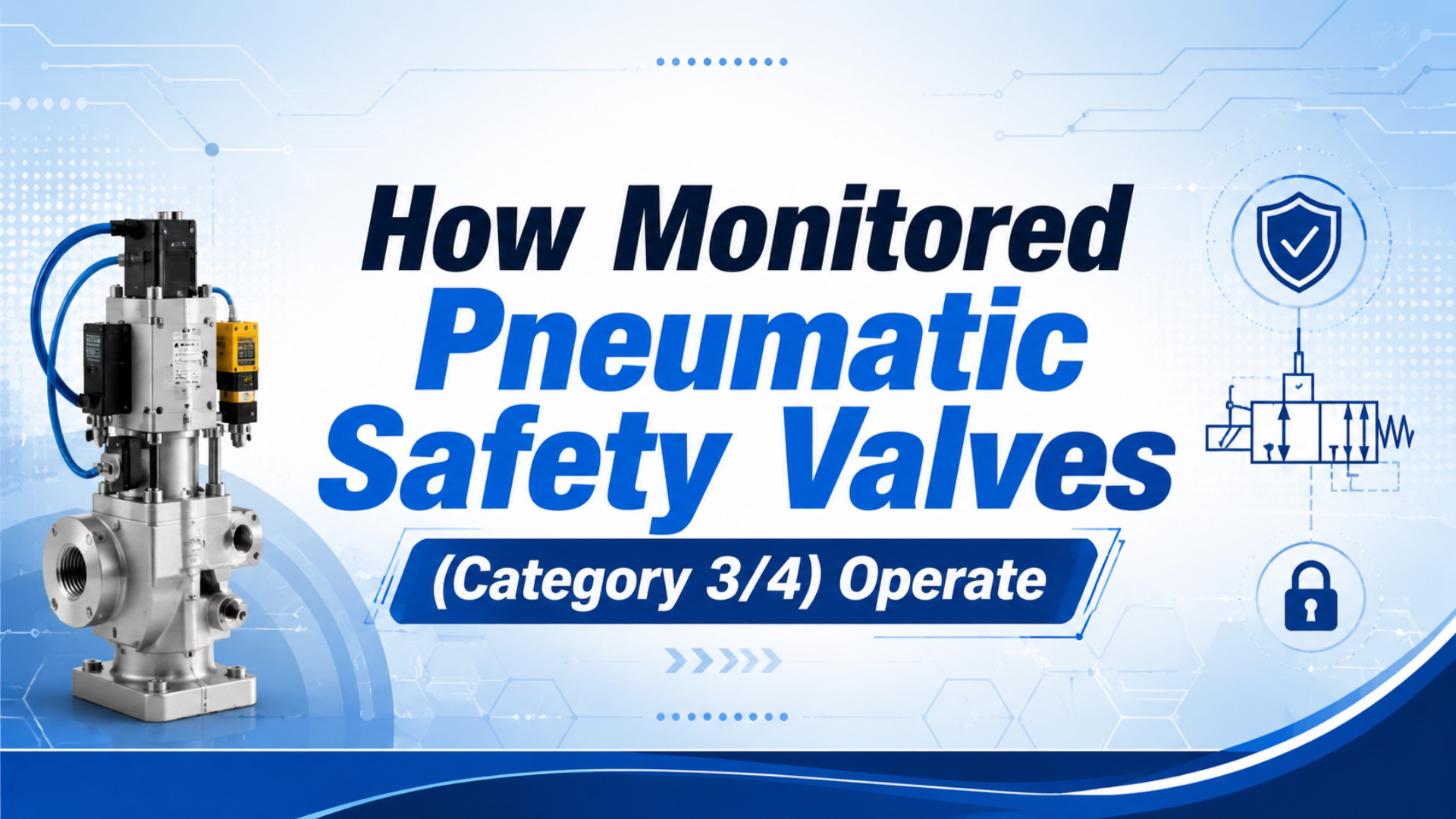
A monitored pneumatic safety valve is a redundant power-control subsystem that supplies air only when both channels operate correctly, then blocks supply and exhausts downstream pressure when the safety function is demanded. Feedback tells a safety controller whether the elements reached the expected state. Any discrepancy removes the command and can inhibit restart until the fault is cleared.
Category 3 or Category 4 does not belong to the valve label alone. Instead, Category describes the architecture and fault behavior of the complete safety-related control system. Together, the valve, sensors, safety logic, wiring, pneumatic circuit, diagnostics, reset behavior, and physical machine response must achieve the required Performance Level.
Key Takeaways
- ISO 13849-1:2023 applies to electrical, hydraulic, pneumatic, mechanical, and software safety-related control systems.
- Two redundant valve elements can preserve safe exhaust after one element fails.
- Feedback must agree with the command within the product’s documented timing window.
- A monitored valve does not prove that the machine reached a safe state.
What Does Category 3/4 Mean for a Pneumatic Safety Valve?
ISO 13849-1:2023 is a 152-page methodology for safety-related control systems, not a product-selection table that assigns one PLr to every valve application. It applies across pneumatic and other technologies, but explicitly does not specify the safety function or required Performance Level for a particular machine (ISO, 2023).
Manufacturers may state that a product is suitable for use up to Category 4, PL e under defined conditions. Such a statement supplies component or subsystem evidence; it does not certify the completed machine. Integrators still have to define the safety function, determine PLr, model the real architecture, follow the safety manual, and validate the installed response. Category describes structural and fault-behavior requirements. Performance Level (PL) describes the ability of the safety-related control system to perform its safety function under foreseeable conditions. Category contributes to PL, but component reliability, diagnostic coverage, common-cause failure measures, systematic measures, software, and subsystem interfaces also affect the result.
This distinction prevents a common specification error: asking for a “Category 4 valve” without defining what must become safe. Depending on the hazard, a machine may need safe exhaust, prevention of unexpected pressurization, controlled return, safe load holding, or a combination. Exhausting air can create a new hazard if a vertical load drops or a clamp releases.
For the system-level design process, use the guides to ISO 13849 pneumatic safety circuits and integrating safety exhaust valves into machine guarding. This article stays at the valve-operation and monitoring boundary.
The Two Operating States of a Monitored Safety Exhaust Valve
Parker’s externally monitored P33 uses two operating solenoids that must actuate together, with a documented 150 ms synchronicity limit for that product. Its 3/2 function connects supply port 1 to outlet port 2 when actuated, then blocks port 1 and connects outlet port 2 to exhaust port 3 when de-actuated (Parker, accessed 2026).
That sequence illustrates the usual operating logic of a redundant safety exhaust valve:
| Valve state | Electrical command | Supply path | Exhaust path | Expected feedback |
|---|---|---|---|---|
| Safe, de-energized | Both safety outputs off | Supply blocked | Downstream connected to exhaust | Both elements report the safe state |
| Transition to supply | Both outputs turn on | Opens only after both elements shift | Closes as the elements shift | Both signals change within the permitted window |
| Normal supply | Both outputs on | Supply connected downstream | Exhaust closed | Both elements report the supply state |
| Safety demand | Both outputs turn off | Supply closes | Downstream opens to exhaust | Both signals return to the safe state |
| Discrepancy | Commands and feedback disagree | Product-dependent safe reaction | Product-dependent exhaust reaction | Fault declared and restart inhibited as specified |
“Normally closed” refers to the supply path. With electrical power removed, springs drive the valve elements toward the state that blocks inlet air and opens the downstream circuit to exhaust. Some products add soft-start behavior during repressurization, but that feature must be used exactly as described in the product safety documentation.
De-energizing the valve does not automatically place the machine in its safe state. Check valves, closed-center directional valves, accumulators, cylinder chambers, boosters, and long manifolds can retain pressure beyond the exhaust valve. Gravity, springs, inertia, or vacuum can still move the mechanism after downstream pressure falls. Where pressure loss can release a vertical load, evaluate rod-lock behavior and its application limits.
How Does External Monitoring Detect a Valve Fault?
The ROSS RSe uses two PNP proximity sensors and states 99% diagnostic coverage when both sensors are monitored on every actuation and de-actuation in the documented external-control architecture. Each sensor observes one valve element, while the external safety controller compares both feedback states with the commanded state (ROSS Controls, accessed 2026).
External monitoring separates the pneumatic power elements from the diagnostic logic. Separate feedback signals describe the two valve elements. An external safety relay or safety PLC supplies both commands, checks feedback transitions, applies the allowed discrepancy time, detects shorts or cross-circuits where required, and determines whether restart is permitted.
Feedback technology varies by product. ROSS senses spool position in the cited example, while Parker’s P33 external-monitoring guide describes solid-state pressure sensors associated with its redundant elements. Neither method is universal, and a controller program written for one signal truth table cannot be transferred to another valve without reviewing the new safety manual. Internally monitored valves perform some or all comparison and fault-lockout logic inside the assembly. Some provide a combined status output and require a dedicated reset input. Internal monitoring reduces user-programmed comparison logic, but the machine controller still has to evaluate status, prevent unexpected restart, and validate the physical safe state.
Compare the two arrangements this way:
| Monitoring arrangement | Valve provides | External safety system must provide |
|---|---|---|
| Externally monitored | Separate element feedback and product timing rules | Safe outputs, channel comparison, discrepancy timing, fault latch, reset logic |
| Internally monitored | Internal comparison, fault reaction, and defined status signals | Correct command interface, status evaluation, reset control, machine-level validation |
Strong diagnostics observe the claimed dangerous failure. Pressure sensing may confirm an internal pressure state without proving full valve-element travel. Position sensing may confirm spool travel without proving that downstream pressure passed a closed-center valve. Diagnostic credit must match the failure mode it can actually detect.
What Changes Between Category 3 and Category 4?
IFA’s Category comparison gives both Category 3 and Category 4 single-fault tolerance, while Category 4 additionally requires high average diagnostic coverage and consideration of fault accumulation. Category 3 permits low-to-medium diagnostic coverage, so some faults can remain undetected and accumulated faults may defeat the safety function (IFA, 2017).
Architecture, not the number printed on a valve body, determines behavior under faults:
| Requirement | Category 3 | Category 4 |
|---|---|---|
| Redundant architecture | Required | Required |
| One fault causes immediate loss of the safety function | No | No |
| Fault detection | Where reasonably practicable | At or before the next demand where reasonably practicable |
| Diagnostic coverage | Low to medium | High |
| Accumulated undetected faults | Can lead to loss of the safety function | Must not lead to loss of the safety function |
| Achieved PL | Depends on the full evaluation | Depends on the full evaluation |
Two coils do not prove two independent channels. Trace shared pilot air, common exhaust passages, common connectors, software outputs, power supplies, mounting, contamination exposure, and maintenance errors. Redundancy can be defeated when both elements share a cause that the design has not controlled. Category alone also does not establish PL d or PL e. Use the declared reliability data and restrictions for the exact valve, sensor, controller, and interfaces. Then document diagnostic coverage, common-cause measures, systematic controls, mission time, switching rate, and the mean frequency of dangerous failure for the complete safety function.
Frequent signal checks do not make a Category 4 claim stronger by themselves. Diagnostics must detect relevant dangerous faults soon enough, and accumulated undetected faults must not defeat safe exhaust or prevention of unexpected pressurization.
What Can Valve Feedback Prove, and What Can It Miss?
ROSS states that its RSe valve cannot exhaust pneumatic energy trapped downstream of obstructions such as check valves and closed-center valves. That product limitation illustrates why valve-element feedback cannot prove the pressure, motion, or load state throughout a machine (ROSS Controls, accessed 2026).
Feedback can support specific claims:
- One or both valve elements reached the specific position observed by the installed sensor, within the documented transition window, and the controller received that signal without an input fault.
- Internal pressure at a defined sensing point crossed the product threshold.
- The two channels changed state within the allowed timing window.
- Feedback is stuck, absent, contradictory, or inconsistent with the command.
- The valve has entered a product-defined fault or lockout state.
Feedback cannot automatically prove:
- Every downstream branch has depressurized, including isolated cavities beyond check valves, closed-center valves, and regulators, at the pressure threshold and time defined by the machine safety requirement.
- A silencer or exhaust tube passes the required flow.
- Cylinder stopping distance meets the machine-level acceptance limit.
- A vertical load remains supported after air is removed.
- A check valve, regulator, booster, or manifold cavity released trapped pressure.
- Closing a guard and restoring air cannot restart hazardous motion.
Add pressure sensing at the volume relevant to the hazard when pressure decay is part of the acceptance criterion. Add motion or position sensing at the hazardous mechanism when the machine must stop or remain within a defined position. Valve status is one input to that validation, not a substitute for it. Rotary systems have the same boundary, as explained in the guide to integrating rotary actuators into ISO 13849 safety circuits. Safe exhaust is also different from a standard quick-exhaust function. Standard quick-exhaust valves shorten an actuator’s exhaust path but normally provide no redundant architecture, safety data, diagnostic feedback, or controlled fault response. See the quick-exhaust valve guide for that flow function without treating it as a safety component.
Fault Response and Reset Logic
Parker requires the two P33 sensor outputs to change within 150 ms of each other in its external-monitoring example and recommends against automatic reset. When the signals disagree beyond the permitted time, the monitoring logic must remove power from the solenoids and prevent another actuation attempt until a safety-system reset occurs (Parker, accessed 2026).
Use the exact timing values and truth table from the selected product. Product-specific timing matters: Parker’s 150 ms figure is not a universal Category 3 or Category 4 limit. Other valves can use different sensors, switching sequences, pulse-test restrictions, reset arrangements, and fault-recovery conditions.
Controller logic usually follows these decisions:
- Remove both valve commands when the safety function is demanded.
- Confirm both feedback channels reach their documented safe states in time.
- Declare a fault if either signal is missing, late, contradictory, or stuck.
- Keep the valve commands off after a detected discrepancy.
- Require the specified fault clearance and deliberate reset conditions.
- Verify that reset does not start hazardous motion or automatically repressurize an unsafe zone.
| Fault example | What monitoring sees | Required engineering response |
|---|---|---|
| One coil loses power | One channel fails to transition | Remove both commands and inhibit restart |
| One element shifts slowly | Feedback discrepancy exceeds the product limit | Enter the documented fault state and investigate contamination, pressure, or hardware |
| One feedback signal is stuck | Signal conflicts with command during one transition | Treat the channel as failed and prevent the next hazardous cycle |
| Exhaust path is restricted | Valve feedback can appear normal while pressure falls too slowly | Detect through machine pressure or motion validation, not valve feedback alone |
| Air returns after an outage | Feedback can return to its start condition | Prevent automatic hazardous motion through reset and start logic |
Reset is permission to resume evaluation, not proof that the fault disappeared. The program should verify safe inputs, valid feedback, permitted pressure state, and any required manual action before enabling the next cycle. A reset button must not double as the machine start command when that creates hazardous motion.
How Should the Installed Safety Function Be Validated?
ISO 13849-2:2012 is the current 79-page published validation standard as of July 2026, although ISO lists a replacement draft under development. It requires validation by analysis and testing of the specified safety functions, achieved Category, and achieved Performance Level, so a valve datasheet alone cannot complete validation (ISO, accessed 2026).
Write measurable acceptance criteria before commissioning. Record the safety demand, controller outputs, both valve feedback channels, downstream pressure, and hazardous motion on the same time base. Test the worst credible supply pressure, downstream volume, temperature, permitted exhaust accessories, machine load, and operating mode.
Validation should cover at least:
- Normal energization, safe exhaust, deliberate reset, and confirmation that reset alone does not initiate hazardous motion in every operating mode where a person may approach the hazard.
- One valve output channel prevented from changing state.
- Each feedback channel stuck on, stuck off, open, shorted, or cross-connected as applicable to the product interface.
- Feedback transitions outside the permitted discrepancy window.
- Loss and restoration of electrical and pneumatic power.
- Restricted exhaust where foreseeable and safe to test.
- Pressure trapped beyond check valves or closed-center control valves.
- Worst-case cylinder or mechanism position and load.
- Prevention of unexpected restart after demand, fault, and power restoration.
Do not invent one universal inspection or proof-test interval. Festo, for example, specifies a minimum monthly forced switching procedure for particular MS6-SV variants when the process does not already switch them that often (Festo, 2023). That requirement belongs to those listed variants, not to every monitored valve. Keep the valve model and revision, safety manual, declared safety data, safety-controller program checksum, pneumatic schematic, wiring drawing, parameter values, sensor thresholds, silencers, test equipment, raw traces, and approval record under configuration control. Substituting the valve or changing the exhaust path can require a new calculation and revalidation.
ISO 4414:2010 remains the current general pneumatic-system safety standard after its 2021 confirmation and covers design, construction, modification, installation, operation, and maintenance (ISO, accessed 2026). This scope reinforces the system boundary: a safe valve installation has to address hazards throughout the pneumatic circuit.
Monitored Pneumatic Safety Valve FAQs
Parker documents both internally and externally monitored versions of one P33 valve family, showing why “monitored valve” does not identify one universal circuit. These answers define the component boundary, Category claim, feedback role, fault behavior, and servicing limits that buyers should clarify before selecting or retrofitting a valve (Parker, 2024).
Is Category 3 or Category 4 a valve rating?
Not by itself. A manufacturer can declare that a valve or subsystem is suitable for a Category 3 or Category 4 architecture under specified conditions. The achieved Category and PL belong to the complete safety function after the valve, diagnostics, controller, interfaces, fault assumptions, and machine response are evaluated and validated.
What happens if one valve element fails to shift?
A suitable redundant design is intended to preserve the safety function after one fault. Feedback should expose the disagreement, the monitoring system should remove both commands, and restart should be inhibited according to the safety manual. The exact pneumatic reaction, timing window, signal states, and reset sequence remain product-specific.
Does valve feedback prove that downstream pressure is safe?
No. It proves only the state measured by that feedback method at its sensing point. Pressure can remain trapped beyond a check valve, closed-center valve, regulator, or isolated cavity. Validate pressure at the relevant downstream volume and measure hazardous motion when the safety requirement includes stopping or load holding.
Does a monitored safety exhaust valve replace lockout/tagout?
No. OSHA 1910.147 covers servicing where unexpected energization, startup, or stored-energy release can cause injury. It requires hazardous-energy control procedures and energy-isolating devices; push buttons and control-circuit devices are not energy-isolating devices (OSHA, accessed 2026).
What Should Engineers Remember?
ISO 13849-1:2023 covers five technology domains named in its scope: electrical, hydraulic, pneumatic, mechanical, and software-based safety-related control systems. That breadth is the final clue that Category 3/4 performance cannot be reduced to one monitored pneumatic valve or one feedback contact (ISO, 2023).
Treat the valve as a defined subsystem. Confirm its two operating states, safety function, monitoring method, timing limits, fault reaction, reset requirements, reliability data, permitted accessories, and diagnostic assumptions. Then verify that the complete machine reaches its specified pressure and motion state under normal demands and credible faults. The safest purchasing question is not “Does this valve have Category 4?” Ask instead: “Which safety function and failure modes does this exact valve support, under which integration conditions, and what evidence must we validate on the installed machine?”