

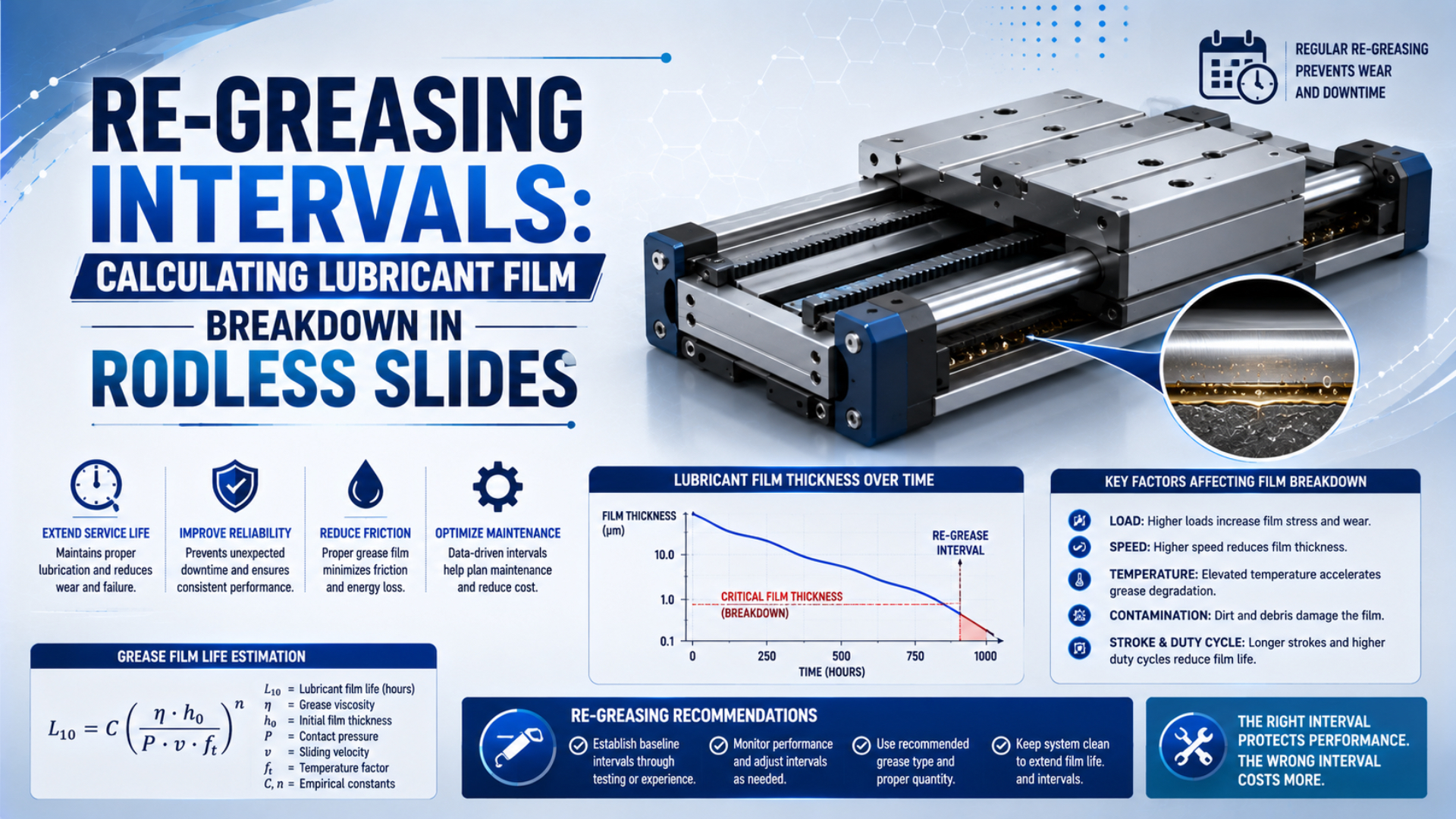
You cannot calculate the exact moment a lubricant film will fail in every rodless slide from stroke, load, speed, temperature, and a few generic multipliers. What you can calculate is the slide’s exposure in cycles, travel distance, and operating time. Use that exposure against the exact manufacturer’s lubrication rule, then adjust the interval from documented inspections.
This distinction matters because “rodless slide” covers different mechanisms. The pneumatic cylinder, sealing-band system, plain guide, cam-follower guide, and recirculating-ball guide may have separate lubrication instructions. Some are permanently greased. Others use a distance-based interval or a model-specific load chart.
Key Takeaways
- Festo specifies 3,000 km or 3 years for one DGC-8 guide, while other DGC variants are maintenance-free or load-dependent.
- Calculate actual cycles and travel, not an invented grease-life percentage.
- Keep the lubricant, quantity, lubrication points, inspection evidence, and adjustment rule tied to the complete model.
Can Lubricant Film Breakdown Be Calculated Directly?
Schaeffler states that precise grease operating life can only be determined under operating conditions because every influence cannot be calculated (Schaeffler). Its approximation uses product-specific basic intervals and correction factors. That does not validate a universal rodless-cylinder equation assembled from arbitrary load, stroke, cycle, environment, and temperature exponents.
Lubricant film breakdown is the loss of sufficient separation and protection at a contact. It can result from grease depletion, mechanical working, contamination, oxidation, lubricant incompatibility, temperature, or an unsuitable viscosity. Yet none of those mechanisms has one fixed field threshold that applies to every guide and seal design.
Why not calculate film thickness directly? A defensible elastohydrodynamic or mixed-lubrication model would need contact geometry, surface roughness, load distribution, entrainment speed, lubricant rheology at the actual temperature, pressure-viscosity behavior, and starvation state. A rodless-slide maintenance team usually doesn’t have that dataset. Even if it did, an internal seal band and an external recirculating guide would require different models.
Use three evidence levels instead:
- Manufacturer instruction: the specified grease, quantity, points, interval, and permitted maintenance method for the exact ordering code.
- Calculated exposure: actual cycles, accumulated travel, running hours, and calendar age.
- Observed condition: motion, pressure, noise, temperature, visible grease, contamination, leakage, and guide condition measured with a repeatable procedure.
The calculation should predict when to inspect or service, not claim to predict the instant a microscopic film disappears. That narrower claim is still useful. It is also auditable: another technician can reconstruct the cycle count, distance, OEM limit, inspection result, and reason for changing the interval.
The grease-aging mechanisms guide covers oxidation, oil separation, mechanical working, and contamination in more detail. This article stays focused on turning a manufacturer rule into a maintenance schedule.
Two Lubrication Zones, Two Maintenance Rules
Parker describes the OSP-P basic cylinder as permanently grease lubricated and recommends special slow-speed grease below 0.2 m/s (Parker). Festo, by contrast, gives different guide-rail rules across DGC variants (Festo). The internal cylinder and external guide therefore need separate maintenance decisions.
Start by identifying which contact the maintenance instruction addresses:
| Lubrication zone | Typical components | Question to resolve |
|---|---|---|
| Pneumatic drive | Piston seals, bearing strips, internal barrel surface | Is it permanently greased, non-lube, or intended for continuous airline lubrication? |
| Band system | Inner sealing band, outer cover band, wipers | Is surface grease required, and which cleaning agents are prohibited? |
| External guide | Plain bearing, cam follower, recirculating-ball carriage | Is it maintenance-free, distance-based, time-based, or load-chart based? |
| Added module | Brake, secondary carriage, shock absorber, central lubrication adapter | Does it have a separate grease, point, quantity, or interval? |
Don’t transfer an external-guide interval to the pneumatic piston. Parker warns that if oil-mist lubrication is introduced to the OSP-P, the oil supply must then remain continuous. Additional oil mist is not the same as replenishing grease in a guide carriage.
Festo’s DGC instructions also distinguish the band system from the guide. The manufacturer says grease-dissolving cleaners can damage the PU cover strip’s grease coating; if the coating is absent, the strip is lightly greased with the specified product. That is not permission to pump an arbitrary quantity into the cylinder.
The construction matters just as much as the brand. A mechanically jointed rodless cylinder with a directly supported carriage may place guide loads differently from a basic cylinder paired with a separate linear rail. The guide to rodless-cylinder load-carrying mechanisms explains why moments and external guidance change contact loading.
How Do You Convert Cycles Into Sliding Distance?
Festo specifies a 3,000 km or 3-year limit for the DGC-8-G/-GF guide under its stated conditions (Festo). To turn that distance into a date, calculate the actual travel accumulated by the slide. This is an exposure conversion, not a grease-chemistry model.
For one full extension and return at stroke (s), the travel per cycle is:
After (N) complete cycles, total sliding distance is:
Here, (d_{\mathrm{cycle}}) and (D) use the same length unit as stroke (s), and (N) is the number of complete out-and-back cycles. Convert the result to kilometres before comparing it with a kilometre-based manufacturer limit.
If only scheduled frequency and operating hours are available, estimate theoretical cycle count as:
where (f) is cycles per minute and (H) is scheduled operating hours. The corresponding theoretical travel is:
The estimate assumes full-stroke, uninterrupted cycling at constant frequency. It will overstate exposure during changeovers and downtime, but it can understate exposure if the PLC counter resets, the motion includes extra positioning strokes, or several carriages share maintenance records.
Worked exposure example
Consider a 750 mm stroke operating at 20 cycles per minute for 16 scheduled hours per day:
The theoretical travel is 28.8 km per scheduled day. A 3,000 km distance threshold would be reached after about 104 fully productive days, but the OEM’s calendar limit could still arrive first. This calculation does not authorize using the Festo DGC-8 limit on another model.
Whenever possible, use a non-resettable PLC cycle counter or accumulated-distance register. Partial strokes should contribute their actual distance, not the nominal stroke. Record maintenance-counter resets with the work order so the next service calculation starts from traceable data.
The 24/7 rodless-cylinder durability guide explains how duty profile and shutdown patterns affect a broader reliability review.
OEM Intervals Depend on Exact Guide Design
Festo’s 2024 DGC instructions give at least three maintenance treatments within one product family. DGC-8-G/-GF uses 3,000 km or 3 years, DGC-12 through -63-G/-GF is described as maintenance-free with relubrication permitted, and DGC-KF uses a load-dependent interval diagram (Festo). The suffix matters.
That variation is the strongest reason to reject a generic “base life” such as 3,500 hours. Before calculating anything, record the full model and configuration:
| Manufacturer example | Published lubrication treatment | What the example proves |
|---|---|---|
| Festo DGC-8-G/-GF | Grease when coating is absent; at least every 3,000 km or 3 years | A distance and calendar limit can coexist |
| Festo DGC-12…63-G/-GF | Described as maintenance-free; relubrication permitted | Larger sizes cannot inherit the DGC-8 rule |
| Festo DGC-KF | Interval (S_{\mathrm{int}}) selected from a load-comparison factor and diagram; calendar maximum also applies | Load correction belongs to the exact guide model |
| Festo DGC-HD | Relubricate after 3 years or corresponding load-dependent distance | Heavy-duty guide has its own instructions |
| Parker OSP-P basic cylinder | Permanent grease lubrication; special slow-speed grease below 0.2 m/s | Internal cylinder lubrication may not use a recurring distance interval |
“Maintenance-free” also needs careful reading. It describes the manufacturer’s intended maintenance treatment under documented conditions. It doesn’t mean immune to contamination, misalignment, side load, seal damage, or an incorrect cleaner.
In our experience reviewing replacement specifications, a shortened product name is a common source of lubrication errors. “DGC” or “OSP-P” isn’t enough. The guide suffix, size, options, installed carriage, band system, and manual revision determine which instruction applies. Put the document revision next to the maintenance counter.
For a complete preventive-maintenance context, link the lubrication task to the rodless-cylinder maintenance checklist. Lubrication cannot compensate for loose mounting, poor alignment, excess moment load, damaged bands, or a restricted air circuit.
Which Conditions Justify a Shorter Interval?
Festo tells users to reduce DGC guide intervals for strokes below 50 mm, speeds above 2 m/s, temperatures above 40°C, and dirty environments. Some variants also flag strokes above 2,000 mm (Festo). These are model-specific warnings, not universal percentage multipliers.
Use the OEM’s stated correction method when it exists. If the manual says “halve the interval,” apply that rule only to the listed configuration and condition. If it provides a load-comparison formula and chart, retain the chart revision and calculated input. Don’t invent an exponent to fill a missing instruction.
The following conditions should trigger an engineering review:
- Short reciprocating strokes: the rolling elements or wipers may work only a narrow section, limiting redistribution.
- High speed or frequent acceleration: contact conditions, heat, and grease movement can change.
- High or low temperature: viscosity, bleeding, ageing, and starting resistance may leave the grease outside its intended operating window.
- Dust, washdown, or process fluid: contamination and cleaner compatibility can dominate the interval.
- High combined load or moment: carriage loading may exceed the reference condition behind the OEM interval chart.
- Long idle periods: calendar ageing, condensation, corrosion, or grease migration may matter before the distance counter reaches its limit.
- Misalignment or side load: extra friction is a mechanical fault, not evidence that more grease is the correct repair.
NLGI advises against mixing different greases and recommends ASTM D6185 compatibility testing when mixing cannot be avoided (NLGI). A thickener chart alone is only a rough guide because base oil and additives also influence compatibility.
Schaeffler gives an even tighter screening rule for its precision rail guides: same base-oil type, compatible thickener, base-oil viscosities within one ISO VG grade, and the same NLGI consistency class, or compatibility must be checked (Schaeffler). Those criteria explain the risk; the rodless-slide manufacturer’s approved grease remains controlling.
Do you see higher drive pressure or stick-slip after servicing? Check lubricant identity, quantity, guide loading, alignment, speed controls, and contamination before shortening the interval again. The stick-slip troubleshooting guide separates lubrication symptoms from flow-control and seal-friction causes.
How Should the First Interval Be Validated?
Festo’s DGC-HD instructions say its roller carriages should be relubricated after 3 years or a load-dependent distance, and that listed severe conditions halve the interval (Festo). The same document requires movement during lubrication and identifies two holes because the carriages do not share lubricant. Procedure details therefore matter as much as timing.
Start with the exact OEM limit, then schedule an inspection before that limit on a new or poorly documented application. The inspection point is not automatically the new relubrication point. Its purpose is to establish whether the initial assumption is conservative enough.
Record a healthy baseline after commissioning:
- supply and port pressure during representative motion;
- full-stroke or segment travel time;
- breakaway behavior after the normal idle period;
- repeatable noise or vibration reading at a named location;
- guide or carriage temperature using the same instrument and emissivity method;
- visible grease condition where inspection is permitted;
- band, wiper, rail, carriage, and fitting condition;
- actual load, moment, speed, stroke pattern, cycle count, and accumulated distance.
At the planned inspection, compare like with like. A higher surface temperature on a hotter day is not automatically grease failure. A longer stroke time after a regulator change isn’t comparable with the original baseline. Note the operating condition next to every measurement.
Use two clocks: exposure and calendar age. The next action occurs at the earlier documented limit. A low-duty slide may reach the three-year requirement before its distance limit, while a high-cycle slide can consume the distance allowance in months. This simple “earliest limit wins” rule is more defensible than a single hours-only schedule.
Do not extend an OEM interval merely because the outside of the guide looks clean. Any extension needs supplier approval or a documented reliability process with repeatable measurements, inspection access, risk review, and failure consequences. Safety-related axes, overhead loads, brakes, and inaccessible slides deserve tighter controls.
If pressure, alignment, or guide load is drifting, correct the mechanical cause first. The side-loading guide explains why lubrication alone cannot remove unintended bearing and seal loads.
A Defensible Re-greasing Worksheet
Schaeffler notes that relubrication quantity for its precision rail guides is approximately 50% of the initial quantity and prefers several partial applications over one full application (Schaeffler). This is useful evidence for those guides, but it is not a universal gram value for rodless slides.
Build the work order from model-specific fields:
| Field | Required entry | Check |
|---|---|---|
| Asset | Maker, model, serial, guide and options | Matches the machine |
| Instruction | Manual, revision, page and method | Correct configuration |
| Interval | Distance, cycles, hours, calendar or condition | Limit and units stated |
| Exposure | Counter, stroke, distance and hours | Resets are traceable |
| Lubricant | Exact approved product | Existing fill is compatible |
| Quantity | OEM amount and every point | No guessed gram range |
| Procedure | Isolation, cleaning, position, motion and restart | OEM and safety compliant |
| Inspection | Pressure, motion, noise, temperature and condition | Same baseline method |
| Decision | Keep, shorten, investigate or escalate | Evidence recorded |
Before release, confirm that the maintenance method itself is allowed. A protected guide may not accept relubrication. A central-lubrication option may require both adapters to be connected. A permanent-grease cylinder may prohibit the recurring operation assumed by a generic worksheet.
No first-party calculator card is inserted here because the current Bepto tool library does not calculate model-specific lubrication intervals. A spreadsheet or PLC counter can perform the distance conversion, but it must not imply that distance alone predicts grease failure.
Rodless Slide Re-greasing FAQs: What Should Maintenance Teams Ask?
Festo’s DGC documentation spans a 3,000 km or 3-year rule, maintenance-free variants, and load-dependent guide intervals within one series (Festo). These answers focus on identifying the governing rule, calculating exposure, and validating it without presenting an estimate as a universal grease-life prediction.
Can one formula calculate the re-greasing interval for every rodless slide?
No. Schaeffler states that precise grease life can only be established under operating conditions, while Festo uses different rules for different DGC guides. Calculate cycles, distance, hours, and calendar age, then apply the exact model’s documented interval. Use inspections to review the schedule without inventing universal load or temperature multipliers.
How do I convert a 3,000 km interval into calendar time?
For full out-and-back cycles, multiply stroke by two and by the actual cycle count. A 750 mm slide accumulates 1.5 m per complete cycle. Divide 3,000 km by the measured daily distance, then compare the result with the manufacturer’s calendar limit. Use PLC counts when available instead of assuming uninterrupted scheduled production.
Should I add grease until old grease is expelled?
Only when the exact manufacturer procedure provides an outlet or purge method and states the required quantity. Festo’s DGC-HD requires both lubrication holes because its two carriages don’t share lubricant, while other DGC variants are maintenance-free. Blind purging can overfill a mechanism, contaminate bands, or damage seals and wipers.
Can different NLGI Grade 2 greases be mixed?
Not automatically. NLGI says compatibility charts are rough guides and recommends ASTM D6185 testing when mixing cannot be avoided. Two NLGI Grade 2 products can use different base oils, thickeners, and additive systems. Keep the approved product identity in the maintenance record and obtain written guidance before changing it.
What condition signals should be trended between services?
Track cycle count, accumulated distance, motion time, drive pressure, repeatable noise or vibration, carriage temperature, visible grease, contamination, and guide condition. Festo flags conditions such as strokes below 50 mm, speeds above 2 m/s, and temperatures above 40°C for shorter intervals on specified DGC guides. Always retain the operating context.
Sources and technical references
- Festo: DGC-G/GF/KF Operating Instructions, 2024
- Festo: DGC-HD Maintenance and Lubrication Instructions
- Festo: DGC Linear Drives and Central Lubrication Options
- Parker: OSP-P Maintenance Instructions
- Parker: OSP-P Rodless Cylinders and Linear Guides
- Schaeffler: Precision Rail Guides
- Schaeffler: Grease Operating Life and Correction Factors
- NLGI: Lubricating Grease Technical FAQs