Introduction
The Problem: Your company needs cost-effective pneumatic cylinders, and Chinese suppliers offer prices 40-60% lower than domestic alternatives—but how do you separate reliable manufacturers from risky vendors? 🏭 The Agitation: One wrong supplier choice means defective products, production delays, quality inconsistencies, and potential safety hazards that cost 10-50x more than the initial savings, destroying your reputation and customer relationships. The Solution: A systematic supplier evaluation framework transforms the overwhelming Chinese pneumatic market into a manageable selection process, identifying partners who deliver consistent quality, reliable delivery, and genuine technical support.
Here’s the direct answer: Evaluating Chinese pneumatic cylinder suppliers requires assessing five critical factors: manufacturing capabilities (ISO 9001 certification, production capacity, quality control systems), technical competence (engineering support, customization ability, testing facilities), supply chain reliability (lead times, inventory management, logistics experience), compliance and certifications (CE, RoHS, industry-specific standards), and commercial stability (financial health, export experience, communication quality). Suppliers meeting all five criteria deliver 95%+ on-time delivery with <2% defect rates, while those failing even one factor show 20-40% failure rates within the first year.
Last year, I worked with Thomas, a procurement manager at an automation equipment manufacturer in Ontario, Canada. His company had sourced pneumatic cylinders from three different Chinese suppliers over 18 months—one delivered perfect quality consistently, one had 15% defect rates requiring expensive rework, and one disappeared entirely after taking a deposit. Thomas was frustrated: “They all looked legitimate online, had similar prices, and claimed ISO certification. How was I supposed to know which one was real?” This is the challenge every buyer faces when sourcing from China—and why a structured evaluation process is essential. 🔍
Table of Contents
- What Manufacturing Capabilities Should You Verify in Chinese Cylinder Suppliers?
- How Do You Assess Technical Competence and Engineering Support?
- What Supply Chain and Logistics Factors Indicate Supplier Reliability?
- Which Certifications and Compliance Standards Matter Most?
What Manufacturing Capabilities Should You Verify in Chinese Cylinder Suppliers?
Understanding a supplier’s actual production capabilities prevents costly surprises after you’ve committed to orders. ⚙️
Verifying manufacturing capabilities requires examining three core elements: production scale (minimum 5,000+ cylinders monthly capacity for stable supply), quality control systems (incoming inspection, in-process monitoring, final testing with documented procedures), and equipment sophistication (CNC machining centers, automated assembly lines, coordinate measuring machines1 for precision verification). Suppliers with ISO 9001:20152 certification, dedicated quality departments, and traceability systems deliver 95-98% conformance rates, while those lacking formal systems show 10-25% defect rates. Request factory audits, production videos, and customer references to verify claims—legitimate manufacturers welcome scrutiny, while problematic suppliers make excuses.
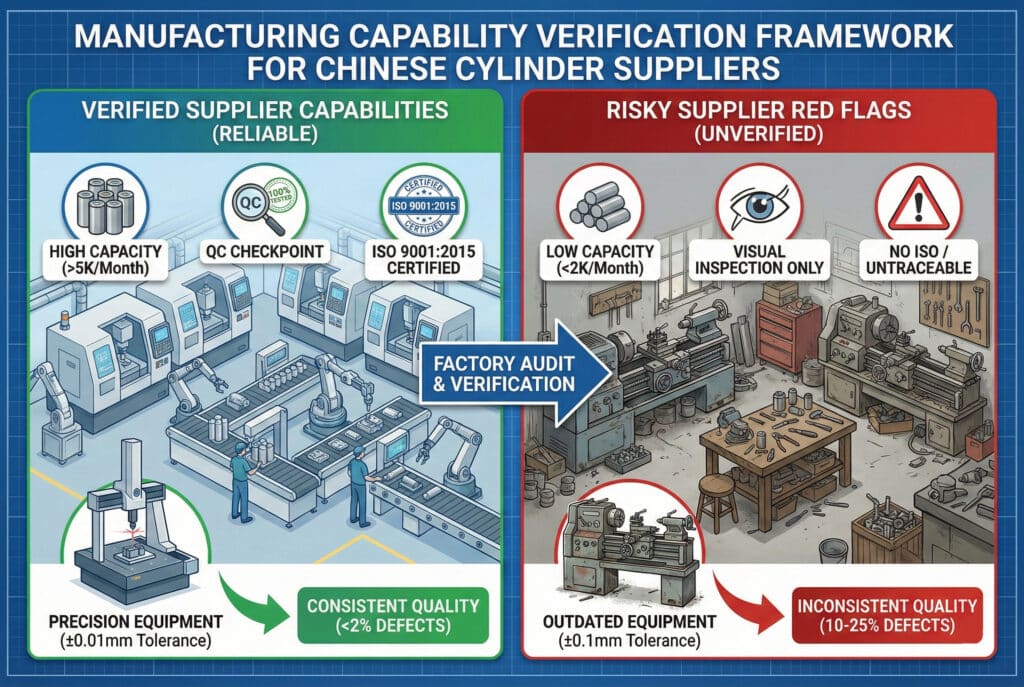
Production Capacity Assessment
Minimum Viable Scale:
- Small suppliers (<2,000 units/month): High risk of capacity constraints, inconsistent quality
- Medium suppliers (2,000-10,000 units/month): Suitable for most buyers, balanced capability
- Large suppliers (>10,000 units/month): Stable supply, but may deprioritize smaller customers
Red Flags:
- Supplier claims huge capacity but factory photos show small workshops
- Unable to provide production schedule or capacity utilization data
- Reluctance to discuss current customer base or order volumes
Quality Control Systems
Essential QC Elements:
| QC Stage | What to Verify | Quality Indicator |
|---|---|---|
| Incoming Inspection | Material certifications, dimensional checks | <1% material rejection rate |
| In-Process Control | Statistical process control, operator training | Cpk3 ≥ 1.33 for critical dimensions |
| Final Testing | Pressure testing, stroke verification, leak testing | 100% testing with documented results |
| Traceability | Batch coding, test record retention | Minimum 3-year record retention |
At Bepto Pneumatics, we maintain:
- ISO 9001:2015 certified quality management system
- 100% pressure testing at 1.5x rated pressure
- Coordinate measuring machine verification for critical dimensions
- Full traceability from raw material to finished product
- <1.5% defect rate across all product lines
Equipment and Technology Level
Critical Manufacturing Equipment:
- CNC machining centers: For precision cylinder bodies and end caps (±0.02mm tolerance)
- Automated honing machines: For cylinder bore finishing (Ra 0.4-0.8 µm)
- Rod grinding and polishing: For chrome-plated rod surface quality (Ra 0.2-0.4 µm)
- Automated assembly lines: For consistent assembly quality and efficiency
- Testing equipment: Pressure test stands, CMM, surface roughness testers
Thomas’s Ontario Experience:
His failed supplier claimed “advanced manufacturing” but factory audit revealed:
- Manual machining with worn equipment (±0.1mm tolerances—inadequate)
- No automated testing—visual inspection only
- No CMM or precision measurement capability
- Result: 15% of cylinders had binding issues from poor bore quality ❌
His successful supplier (similar to Bepto) showed:
- CNC machining centers with ±0.01mm capability
- Automated honing for consistent bore finish
- 100% automated pressure and stroke testing
- CMM verification of critical dimensions
- Result: <1% defect rate over 18 months ✅
How Do You Assess Technical Competence and Engineering Support?
Manufacturing capability means nothing without the technical expertise to apply it correctly. 🛠️
Technical competence evaluation focuses on four areas: engineering staff qualifications (minimum 3-5 engineers with pneumatics expertise), customization capability (ability to modify standard designs or create custom solutions), testing and validation facilities (pressure testing, endurance testing, environmental testing), and responsive technical support (English-speaking engineers, CAD drawing capability, application troubleshooting). Suppliers with dedicated engineering teams respond to technical inquiries within 24 hours and provide detailed specifications, while weak suppliers offer vague answers or disappear when technical questions arise. Request sample technical drawings, test reports, and direct engineer contact to verify capabilities.

Engineering Team Assessment
Minimum Requirements:
- At least 3-5 full-time engineers with pneumatics background
- English-speaking technical staff for international communication
- CAD capability (SolidWorks, AutoCAD, or equivalent)
- Experience with international standards (ISO, VDMA, JIS)
Evaluation Questions:
- “Can you modify the mounting style on your standard 50mm bore cylinder?”
- “What’s the maximum operating pressure for your rodless cylinders at 80°C ambient?”
- “Can you provide a force calculation for a 300mm stroke cylinder with 20kg side load?”
Strong Supplier Response:
- Detailed technical answer within 24 hours
- CAD drawings showing proposed modifications
- Force calculations with safety factor analysis
- Alternative solutions if requested spec isn’t optimal
Weak Supplier Response:
- “Yes, we can do it” with no technical details
- Delayed responses (3-5 days) or no response
- Inability to provide calculations or drawings
- Pushback on any customization requests
Customization and Application Support
Bepto Pneumatics Engineering Capabilities:
- 8 full-time engineers with 5-15 years pneumatics experience
- Custom bore sizes, stroke lengths, and mounting configurations
- Application-specific modifications (food-grade, high-temp, corrosion-resistant)
- Free engineering consultation for orders >$5,000
- 24-hour response time for technical inquiries
Real Example:
A German packaging machinery manufacturer needed rodless cylinders with:
- Non-standard 68mm bore (standard is 63mm or 80mm)
- Food-grade stainless steel construction
- Integrated position sensors with IO-Link output
- 45-day delivery requirement
Our Response:
- Engineering review completed in 2 days
- Custom design drawings provided for approval
- Prototype delivered in 3 weeks for testing
- Production order delivered in 42 days
- Result: Customer now orders 200+ units annually 🎯
Testing and Validation Facilities
Essential Testing Capabilities:
| Test Type | Purpose | Equipment Required |
|---|---|---|
| Pressure Testing | Verify seal integrity, burst strength | Automated pressure test stands |
| Endurance Testing | Validate cycle life (typically 1-2 million cycles) | Automated cycling test rigs |
| Temperature Testing | Verify performance at temperature extremes | Environmental chambers (-20°C to +80°C) |
| Contamination Testing | Assess performance with dust/particles | Dust injection test systems |
Red Flag: Supplier claims “we test everything” but cannot provide test reports or show testing equipment during factory visit.
What Supply Chain and Logistics Factors Indicate Supplier Reliability?
Even perfect products are worthless if they don’t arrive on time and intact. 📦
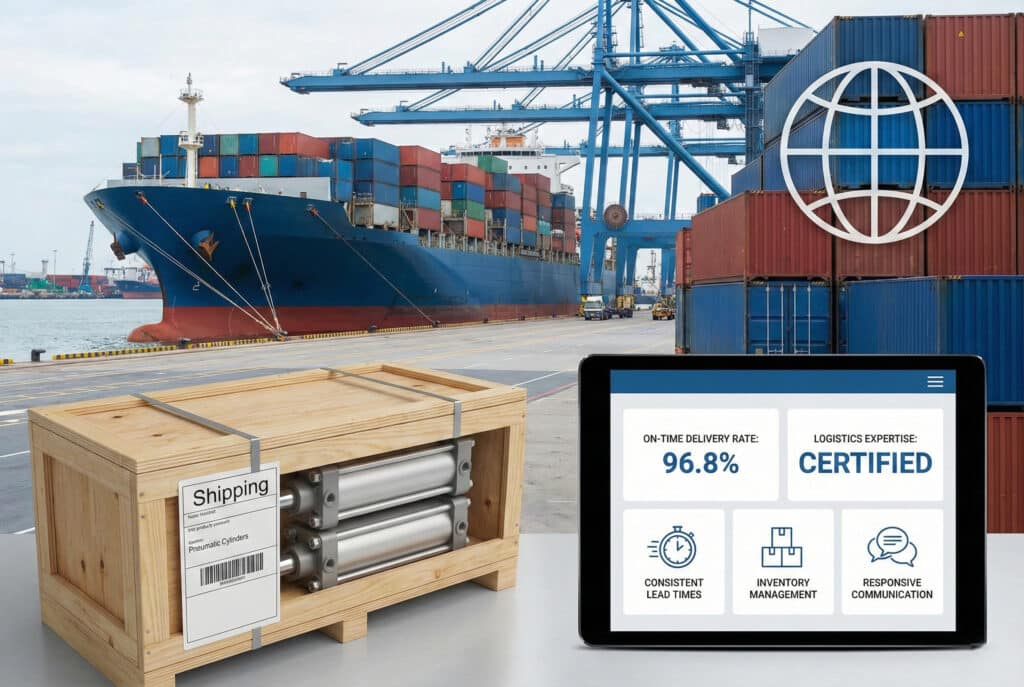
Supply chain reliability assessment examines five factors: lead time consistency (±3 days variance for standard products), inventory management (stock of common components for fast delivery), logistics expertise (experience with international shipping, proper packaging for pneumatic components), communication responsiveness (daily updates during production, proactive problem notification), and order flexibility (ability to handle rush orders, partial shipments, or specification changes). Reliable suppliers maintain 95%+ on-time delivery rates with <1% shipping damage, while unreliable suppliers show 20-40% late deliveries and frequent communication gaps. Verify with reference customers and request delivery performance data for the past 12 months.
Lead Time and Delivery Performance
Standard Lead Time Benchmarks:
| Product Type | Reasonable Lead Time | Red Flag Lead Time |
|---|---|---|
| Standard Cylinders (Stock) | 3-7 days | >14 days |
| Standard Cylinders (Made-to-Order) | 15-25 days | >35 days |
| Custom Cylinders | 25-35 days | >45 days |
| Rodless Cylinders | 20-30 days | >40 days |
Bepto Pneumatics Delivery Performance:
- Standard products: 7-10 days average (stock items ship within 48 hours)
- Custom products: 25-30 days average
- On-time delivery rate: 96.8% (measured as ±3 days from committed date)
- Rush order capability: 50% lead time reduction for +15% premium
Inventory and Component Management
Strong Supplier Indicators:
- Maintains stock of common bore sizes and stroke lengths
- Has relationships with multiple component suppliers (seals, rods, sensors)
- Can provide component lead times and availability status
- Offers partial shipments if some items ready early
Weak Supplier Indicators:
- “Everything is made-to-order” (no stock, long lead times)
- Single-source dependencies creating supply chain risk
- Cannot provide component availability information
- All-or-nothing delivery (no partial shipment flexibility)
International Logistics Expertise
Critical Logistics Capabilities:
- Experience with FOB, CIF, DDP incoterms4
- Proper packaging for pneumatic cylinders (protective caps, anti-corrosion treatment)
- Freight forwarder relationships for competitive shipping rates
- Documentation expertise (commercial invoice, packing list, certificates of origin)
- Customs compliance knowledge for target markets
Thomas’s Ontario Lesson:
His disappeared supplier had:
- No export license (operating illegally)
- No freight forwarder relationships (couldn’t arrange shipping)
- Poor packaging (30% of first shipment arrived damaged)
- Incomplete documentation (customs delays added 2 weeks)
His successful supplier (like Bepto) provided:
- Full export licensing and compliance
- Multiple freight forwarder options with competitive quotes
- Professional packaging with protective caps and desiccant
- Complete documentation package ready before shipment
- Proactive tracking updates throughout transit 🚢
Which Certifications and Compliance Standards Matter Most?
Certifications separate legitimate manufacturers from document forgers and ensure your products meet market requirements. 📋
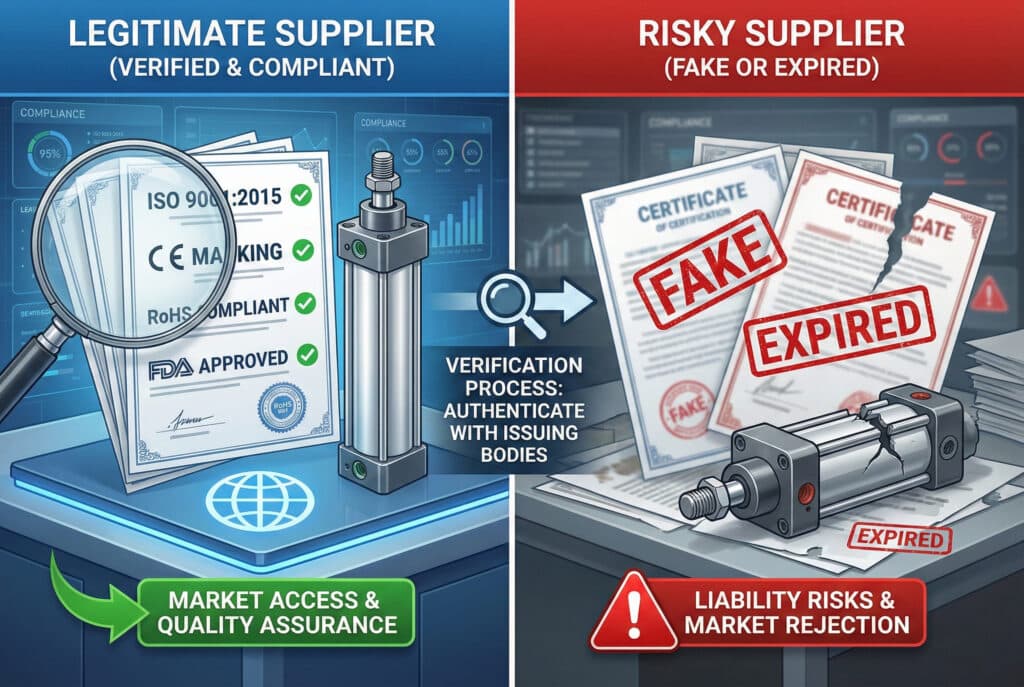
Critical certifications for pneumatic cylinder suppliers include: ISO 9001:2015 quality management (verify certificate authenticity through issuing body), CE marking for European markets (requires technical file and declaration of conformity), RoHS compliance for electronics integration (material testing reports required), and industry-specific certifications like ATEX for explosive atmospheres or FDA compliance for food applications. Always verify certificates directly with issuing authorities—30-40% of claimed certifications in China are fake or expired. Request certificate numbers, issuing body contact information, and scope of certification to confirm legitimacy. Certified suppliers demonstrate commitment to quality and market access, while uncertified suppliers create liability risks.
Essential Certifications Checklist
ISO 9001:2015 Quality Management:
- ✅ Certificate from accredited body (TÜV, SGS, BSI, etc.)
- ✅ Scope covers pneumatic cylinder manufacturing
- ✅ Valid dates (certificates expire every 3 years)
- ✅ Verifiable through issuing body website or contact
CE Marking (for European Markets):
- ✅ Declaration of Conformity document
- ✅ Technical file demonstrating compliance with Machinery Directive 2006/42/EC5
- ✅ Risk assessment documentation
- ✅ Test reports from accredited laboratories
RoHS Compliance:
- ✅ Material testing reports for restricted substances
- ✅ Supplier declarations for all components
- ✅ Updated for RoHS 2 (2011/65/EU) and RoHS 3 (2015/863/EU)
Industry-Specific Certifications:
- Food-grade applications: FDA 21 CFR 177.2600 compliance, 3-A Sanitary Standards
- Explosive atmospheres: ATEX certification (Europe) or IECEx (international)
- Marine applications: DNV, ABS, or Lloyd’s Register approval
- Cleanroom applications: ISO 14644 compliance documentation
Verification Process
How to Verify Certificates:
- Request certificate copies with clear certificate numbers
- Contact issuing body directly using contact info from their official website (not from supplier)
- Verify scope matches supplier’s actual products
- Check validity dates and renewal status
- Request audit reports if available (some bodies provide summary reports)
Red Flags:
- Supplier refuses to provide certificate numbers
- Certificate from unknown or unaccredited body
- Scope doesn’t match products being purchased
- Expired certificates with no renewal evidence
- Generic certificates not specific to the factory location
Bepto Pneumatics Certifications
Our Verified Certifications:
- ISO 9001:2015 (Certificate No. [verifiable], issued by TÜV Rheinland)
- CE marking with full technical files for EU market
- RoHS compliance with material test reports
- Export licenses and customs compliance documentation
- Third-party factory audit reports available upon request
We Provide:
- Certificate copies with all orders
- Direct contact information for verification
- Technical files and declarations of conformity
- Material certifications and test reports
- Transparent compliance documentation 📄
Commercial Stability Assessment
Financial Health Indicators:
- Years in business (minimum 5 years preferred)
- Export volume and percentage of revenue
- Major customer references (verifiable)
- Payment terms flexibility (indicates financial strength)
- Factory ownership vs. leasing (ownership indicates stability)
Communication Quality:
- English proficiency of sales and technical staff
- Response time to inquiries (<24 hours for initial contact)
- Proactive communication during order process
- Willingness to use video calls for factory tours
- Professional documentation and quotations
Conclusion
Sourcing pneumatic cylinders from China isn’t about finding the lowest price—it’s about systematically evaluating manufacturing capabilities, technical competence, supply chain reliability, certifications, and commercial stability to identify partners who deliver consistent quality, on-time delivery, and genuine support that transforms cost savings into competitive advantage. 🎯
FAQs About Evaluating Chinese Pneumatic Cylinder Suppliers
How can I verify a Chinese supplier’s factory without visiting in person?
Request live video factory tours via video call, ask for recent production videos with date stamps, and hire third-party inspection services like SGS or Bureau Veritas to conduct on-site audits and provide detailed reports with photos. Virtual verification has become highly effective—request to see specific equipment (CNC machines, testing stands), observe production in progress, and speak directly with quality managers. At Bepto Pneumatics, we offer live factory tours via video call and welcome third-party audits, providing full transparency to build trust with international customers.
What payment terms should I expect from reliable Chinese suppliers?
Established suppliers typically offer 30% deposit with 70% balance before shipment for new customers, transitioning to 30-60 day payment terms after 3-6 months of successful transactions—be wary of suppliers demanding 100% advance payment or offering unrealistic credit terms immediately. Payment terms reflect both supplier confidence and financial stability. Suppliers demanding full payment upfront may be undercapitalized or unreliable, while those offering generous terms too quickly may be desperate for orders. We at Bepto start with standard 30/70 terms and offer extended terms to customers with proven payment history.
How many samples should I order before committing to production quantities?
Order 3-5 samples minimum to test in your actual application over 2-4 weeks, including one sample for destructive testing to verify internal quality—samples that perform well in short-term testing may still fail in production use. Sample testing should include pressure testing, cycle testing under load, temperature exposure, and dimensional verification. Don’t skip destructive testing—cutting open one cylinder reveals internal quality, weld integrity, and component specifications that external inspection cannot verify.
What’s a reasonable price difference between Chinese and domestic suppliers?
Chinese pneumatic cylinders typically cost 40-60% less than European/North American equivalents for comparable quality—prices more than 70% below domestic indicate potential quality compromises, while prices within 20-30% suggest the supplier may be a trading company adding unnecessary markup. At Bepto Pneumatics, our rodless cylinders are priced 45-55% below major European brands while maintaining equivalent specifications and quality. Extremely low prices often mean inferior materials (aluminum instead of stainless steel, low-grade seals, thin-wall construction) that create long-term costs exceeding initial savings.
Should I work with a trading company or direct manufacturer?
Work directly with manufacturers when possible—they offer 15-25% better pricing, faster communication, greater customization flexibility, and direct accountability, while trading companies add markup and communication delays without adding significant value for standard pneumatic products. Trading companies can be valuable for complex multi-product sourcing or when you need local language support, but for pneumatic cylinders, direct manufacturer relationships provide better technical support and pricing. At Bepto Pneumatics, we’re a direct manufacturer with English-speaking sales and engineering teams, eliminating the need for intermediaries while providing full technical support. 🚀
-
Learn how Coordinate Measuring Machines (CMM) ensure dimensional accuracy in precision manufacturing. ↩
-
Understand the specific requirements of the ISO 9001:2015 standard for quality management systems. ↩
-
Explore the Process Capability Index (Cpk) to understand how manufacturers measure process stability and defect rates. ↩
-
Review the official Incoterms rules to determine responsibilities and risks in international shipping. ↩
-
Read the official European Union Machinery Directive to understand safety requirements for industrial equipment. ↩