


Einführung
Your pneumatic cylinders are either leaking air or wearing out seals every few months—but never both at the same time. 💨 You’re caught in a frustrating trade-off: increase sealing force to stop leaks, and friction skyrockets causing premature wear. Reduce friction, and pressure loss becomes unacceptable. This isn’t a component quality issue—it’s a fundamental lip profile design problem that costs manufacturers millions in energy waste and maintenance.
Die Optimierung des Lippenprofils ist der technische Prozess der Konstruktion der Dichtungslippengeometrie – einschließlich Kontaktwinkel (typischerweise 8–25°), Kontaktbreite (0,3–1,5 mm) und Lippendicke – um ein optimales Gleichgewicht zwischen Dichtkraft (Verhinderung von Leckagen) und Reibungskraft (Minimierung von Verschleiß und Energieverlust) zu erreichen. Durch entsprechend optimierte Profile wird eine Reibungsreduzierung von 40–60% erzielt, während die Leckageraten bei Nenn-Druck in Pneumatikzylinderanwendungen unter 0,1 Litern/Minute bleiben.
Just last quarter, I worked with Brian, a maintenance manager at an automotive parts plant in Tennessee, whose production line was consuming 35% more compressed air than design specifications. His OEM cylinders used aggressive seal profiles that created excessive friction, causing heat buildup and rapid seal degradation. After switching to our Bepto rodless cylinders with optimized lip profiles, his air consumption dropped by 28%, seal life tripled, and his annual maintenance costs decreased by $43,000. 📉
Inhaltsübersicht
- What Is Lip Profile Optimization and Why Does It Matter for Cylinder Performance?
- How Do Contact Angle and Lip Geometry Affect Sealing Force vs. Friction Trade-offs?
- What Are the Key Design Parameters for Optimized Seal Lip Profiles?
- Which Lip Profile Designs Deliver the Best Performance for Rodless Cylinders?
What Is Lip Profile Optimization and Why Does It Matter for Cylinder Performance?
Understanding the engineering fundamentals behind seal lip design helps you select cylinders that deliver both reliability and efficiency. 🔧
Lip profile optimization involves precisely engineering the seal’s contact geometry to generate sufficient contact pressure for sealing (typically 0.8-2.5 MPa) while minimizing friction force—the lip profile determines contact area, pressure distribution, and deformation behavior under load, directly affecting air consumption (friction accounts for 60-80% of cylinder energy loss), seal wear rates (proper profiles extend life 3-5x), and system efficiency in pneumatic applications.
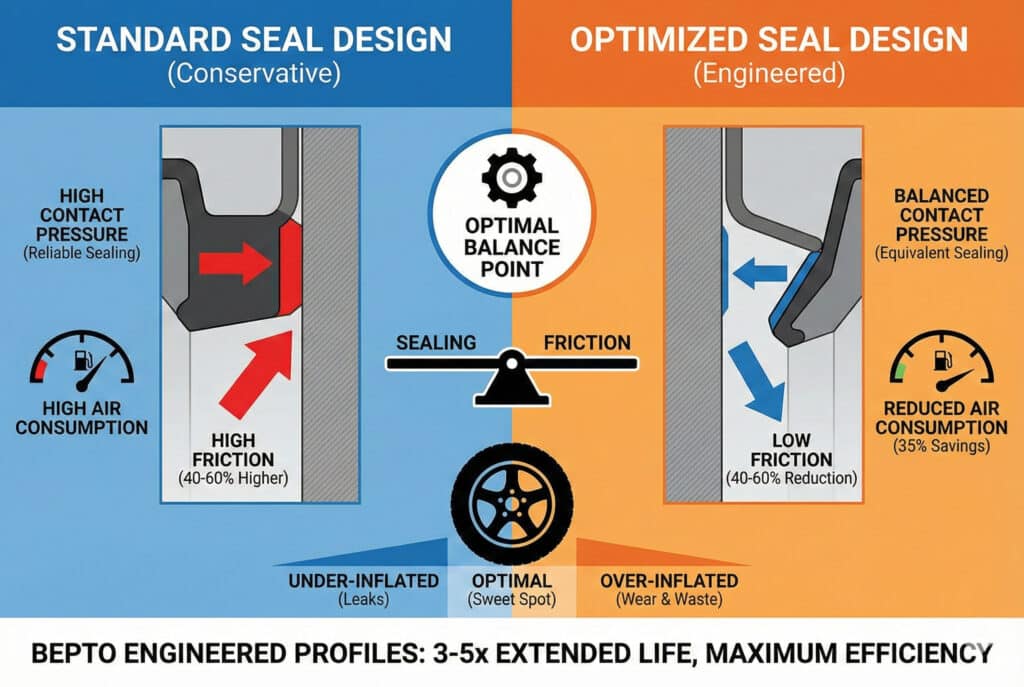
The Fundamental Sealing vs. Friction Conflict
Every seal lip must press against the cylinder barrel with enough force to prevent compressed air from escaping. This contact pressure creates friction—it’s unavoidable physics. The challenge is finding the “sweet spot” where contact pressure is just sufficient for sealing but not excessive.
Think of it like a car tire: too little pressure and it leaks air, too much and it wears out quickly while wasting fuel. Seal lips work the same way, but the optimization is far more complex because the contact area is measured in square millimeters rather than square inches.
Traditional seal design (conservative approach):
- High contact angles (20-25°)
- Wide contact bands (1.0-1.5mm)
- Excessive safety margins
- Result: Reliable sealing but 40-60% higher friction than necessary
Optimized seal design (engineered approach):
- Moderate contact angles (10-15°)
- Narrow contact bands (0.4-0.7mm)
- Calculated safety factors
- Result: Equivalent sealing with 40-60% friction reduction
At Bepto, we’ve invested heavily in finite element analysis and empirical testing to develop lip profiles that sit precisely at this optimal balance point—maximum efficiency without compromising reliability.
Why Standard Cylinders Over-Design Seal Profiles
Most cylinder manufacturers use conservative seal designs because they’re designing for worst-case scenarios: contaminated environments, poor maintenance, extreme pressures. This “one-size-fits-all” approach creates unnecessarily high friction for the majority of applications operating in normal industrial conditions.
The cost of this over-design is substantial:
- Energieverschwendung: Excess friction increases air consumption by 20-40%
- Wärmeerzeugung: Higher friction creates temperatures that accelerate seal degradation
- Reduzierte Geschwindigkeit: Excessive breakaway forces limit cylinder velocity
- Positionierungsfehler: High friction creates stick-slip and Hysterese1
Quantifying the Performance Impact
In our testing laboratory at Bepto, we’ve measured the real-world impact of lip profile optimization across hundreds of cylinder configurations:
Air consumption comparison (50mm bore, 8 bar, 500mm stroke, 60 cycles/minute):
- Standard profile: 145 liters/hour
- Optimized profile: 95 liters/hour
- Ersparnisse: 50 liters/hour = 35% reduction
For a facility with 100 such cylinders running 16 hours/day, 250 days/year:
- Annual air savings: 20 million liters
- Energy cost savings: $3,600-$7,200 (at $0.018-$0.036/m³)
- Compressor capacity freed: Equivalent to 15-20 kW compressor
These aren’t theoretical calculations—they’re measured results from customer installations that demonstrate the tangible value of proper lip profile engineering.
How Do Contact Angle and Lip Geometry Affect Sealing Force vs. Friction Trade-offs?
The geometric parameters of the seal lip directly determine the force balance that governs performance. 📐
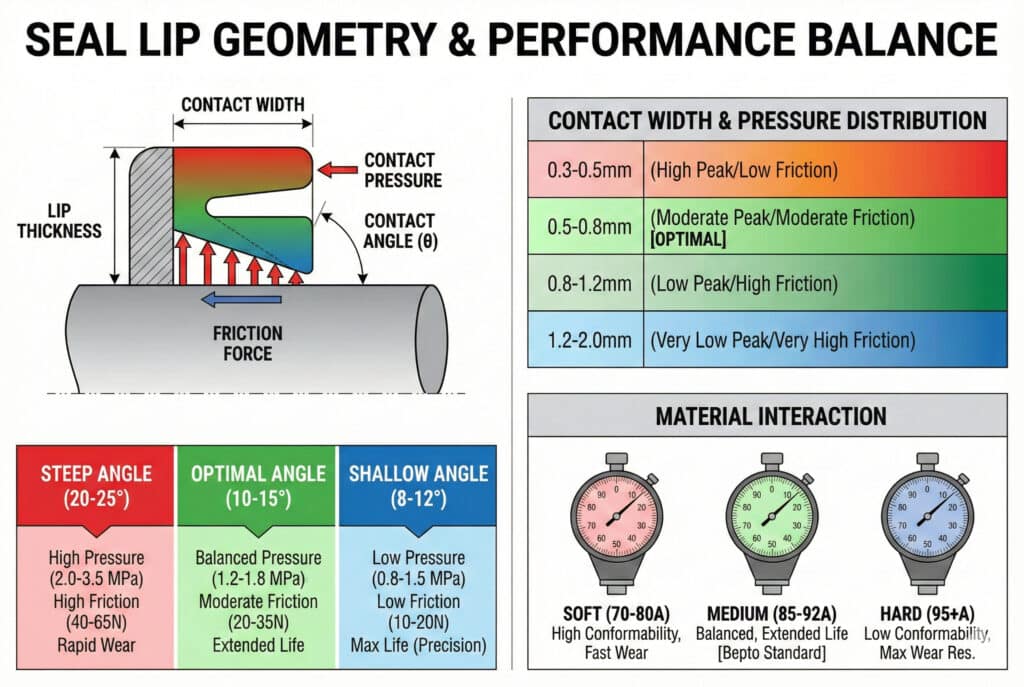
Contact angle (the angle between the seal lip and sealing surface) is the primary determinant of contact pressure: steeper angles (20-25°) create 2-3x higher contact pressure than shallow angles (8-12°), while contact width and lip thickness modulate pressure distribution—optimal profiles use 10-15° angles with 0.4-0.7mm contact width to achieve 1.2-1.8 MPa contact pressure, sufficient for sealing up to 12-16 bar pneumatic pressure while minimizing friction coefficient and wear rate.
Contact Angle: The Primary Design Variable
The seal lip contact angle has the most dramatic effect on performance. This angle determines how the seal’s interference (the amount it’s compressed in the groove) translates into contact pressure against the barrel.
Steep angle (20-25°) mechanics:
- High mechanical advantage (force multiplication)
- Contact pressure: 2.0-3.5 MPa
- Excellent sealing reliability
- High friction force (40-65N for 50mm bore)
- Rapid wear due to high contact stress
Moderate angle (12-18°) mechanics:
- Balanced mechanical advantage
- Contact pressure: 1.2-2.0 MPa
- Good sealing reliability
- Moderate friction (20-35N for 50mm bore)
- Verlängerte Lebensdauer der Dichtung
Shallow angle (8-12°) mechanics:
- Low mechanical advantage
- Contact pressure: 0.8-1.5 MPa
- Adequate sealing with proper surface finish
- Low friction (10-20N for 50mm bore)
- Maximum seal life (requires precision manufacturing)
At Bepto, we use 12-15° angles for our standard rodless cylinders and 10-12° for our low-friction precision series. These angles require tighter manufacturing tolerances but deliver measurably superior performance.
Contact Width and Pressure Distribution
The width of the contact band affects how pressure is distributed across the sealing interface. Wider contact creates lower peak pressure but higher total friction force.
| Contact Width | Peak Pressure | Total Friction | Sealing Capability | Abnutzungsrate | Beste Anwendung |
|---|---|---|---|---|---|
| 0.3-0.5mm | Sehr hoch | Niedrig | Mäßig | High (stress concentration) | Low-friction, moderate pressure |
| 0.5-0.8mm | Mäßig | Mäßig | Gut | Niedrig | Optimal balance (Bepto standard) |
| 0.8-1.2mm | Niedrig | Hoch | Ausgezeichnet | Mäßig | High-pressure, contaminated environments |
| 1.2-2.0mm | Sehr niedrig | Sehr hoch | Ausgezeichnet | High (excessive friction heat) | Avoid (over-designed) |
The optimal contact width for most pneumatic applications is 0.5-0.8mm—narrow enough to minimize friction but wide enough to distribute stress and prevent premature wear.
Lip Thickness and Flexibility
The seal lip thickness determines its flexibility and ability to conform to barrel surface irregularities. This creates another design trade-off:
Thin lips (1.0-1.5mm):
- High flexibility
- Excellent conformability to surface variations
- Lower contact force for given interference
- Risk of extrusion at high pressure
- Better for precision-machined surfaces
Thick lips (2.0-3.0mm):
- Lower flexibility
- Requires tighter surface tolerances
- Higher contact force for given interference
- Excellent extrusion resistance
- Better for high-pressure applications
We engineer our Bepto seal profiles with 1.5-2.0mm lip thickness—a compromise that provides good flexibility while maintaining structural integrity for pressures up to 16 bar.
Material Hardness Interaction
Lip profile optimization must consider seal material hardness (Shore A durometer), as this affects how the geometry translates into contact pressure:
Soft materials (70-80 Shore A):
- Require steeper angles or wider contact to generate sufficient pressure
- Better conformability
- Höher Reibungskoeffizient2
- Faster wear
Medium materials (85-92 Shore A):
- Optimal for balanced profiles (12-15° angles)
- Good conformability with adequate structural integrity
- Mäßige Reibung
- Extended wear life (our Bepto standard)
Harte Materialien (95+ Shore A):
- Can use shallower angles while maintaining sealing
- Reduced conformability (requires excellent surface finish)
- Lower friction coefficient
- Maximum wear resistance
This interaction explains why you can’t simply copy a seal profile from one material to another—the entire system must be optimized together.
What Are the Key Design Parameters for Optimized Seal Lip Profiles?
Successful lip profile optimization requires controlling multiple interdependent geometric and material parameters. 🎯
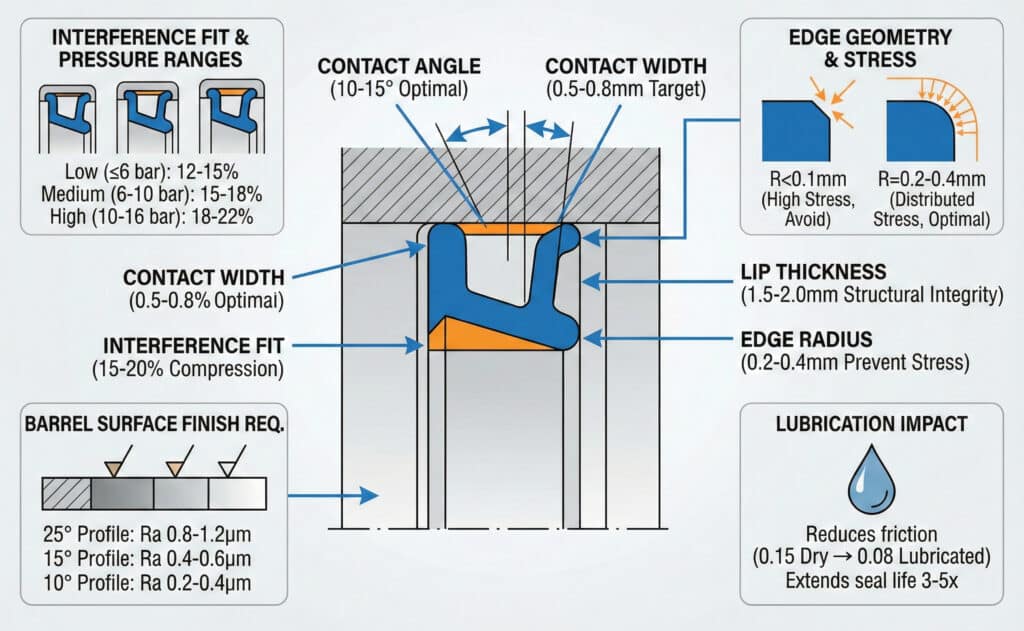
Key optimization parameters include contact angle (10-15° optimal for most applications), interference fit3 (15-20% compression of seal cross-section), contact width (0.5-0.8mm target), lip thickness (1.5-2.0mm for structural integrity), edge radius (0.2-0.4mm to prevent stress concentration), and surface finish requirements (Ra 0.3-0.6μm barrel finish for shallow-angle profiles)—these parameters must be optimized as a system, not independently, with finite element analysis and empirical testing validating performance before production.
Interference Fit: The Foundation of Contact Pressure
Interference is the difference between the seal’s free diameter and the groove/barrel diameter—it determines how much the seal is compressed during installation. This compression generates the contact pressure that creates sealing.
Interference calculation:
Für eine U-cup seal4 in a 50mm bore cylinder:
- Seal lip free diameter: 51.5mm
- Barrel diameter: 50.0mm
- Interference: 1.5mm (3% of diameter)
- Resulting compression: ~18% of lip cross-section
Optimal interference ranges:
- Low pressure (≤6 bar): 12-15% compression
- Medium pressure (6-10 bar): 15-18% compression
- High pressure (10-16 bar): 18-22% compression
Too little interference causes leakage, too much creates excessive friction and heat. At Bepto, we precisely control seal groove dimensions to ±0.03mm to ensure consistent interference across all cylinders.
Edge Geometry and Stress Concentration
The seal lip edge—where it contacts the barrel—requires careful radiusing to prevent stress concentration that causes premature failure:
Sharp edge (R<0.1mm):
- High stress concentration
- Rapid wear initiation
- Risk of edge tearing
- Avoid in all applications
Moderate radius (R=0.2-0.4mm):
- Distributed stress
- Extended wear life
- Optimal für die meisten Anwendungen
- Bepto standard specification
Large radius (R>0.5mm):
- Very low stress concentration
- Reduced sealing effectiveness (rounded contact)
- May require higher interference
- Special applications only
This seemingly minor detail makes a major difference—proper edge radiusing can double seal life in high-cycle applications.
Barrel Surface Finish Requirements
Lip profile optimization is meaningless without appropriate barrel surface finish. Shallow-angle, low-friction profiles require better surface finish than aggressive high-friction designs:
Profile-specific finish requirements:
- 25° aggressive profile: Ra 0.8-1.2μm acceptable (standard honing)
- 15° balanced profile: Ra 0.4-0.6μm required (precision honing)
- 10° low-friction profile: Ra 0.2-0.4μm required (super-finishing)
At Bepto, we use precision honing processes to achieve Ra 0.3-0.5μm on our rodless cylinder barrels—the surface quality that allows our optimized lip profiles to deliver their full performance potential.
I worked with Jennifer, a quality engineer at a medical device manufacturer in Massachusetts, who was experiencing inconsistent seal performance despite using “identical” cylinders from her previous supplier. When we measured the barrel finish, we found variations from Ra 0.6μm to Ra 1.4μm—completely inconsistent. Our Bepto cylinders with controlled Ra 0.35±0.05μm finish delivered the consistency she needed for her FDA-regulated processes. 🏥
Lubrication and Surface Chemistry
Even perfectly optimized lip profiles require appropriate lubrication to achieve their design performance:
Lubrication functions:
- Reduces boundary friction coefficient (0.15 dry → 0.08 lubricated)
- Prevents adhesive wear
- Dissipates friction heat
- Extends seal life 3-5x
Lubricant selection criteria:
- Viscosity: ISO VG 32-68 for pneumatic applications
- Compatibility: Must not swell or degrade seal material
- Temperature stability: Maintain properties across operating range
- Application method: Factory pre-lubrication plus periodic re-application
We pre-lubricate all Bepto cylinders with synthetic lubricants specifically formulated for our seal materials, ensuring optimal performance from the first stroke.
Which Lip Profile Designs Deliver the Best Performance for Rodless Cylinders?
Rodless cylinders present unique sealing challenges that require specialized lip profile optimization approaches. 🚀
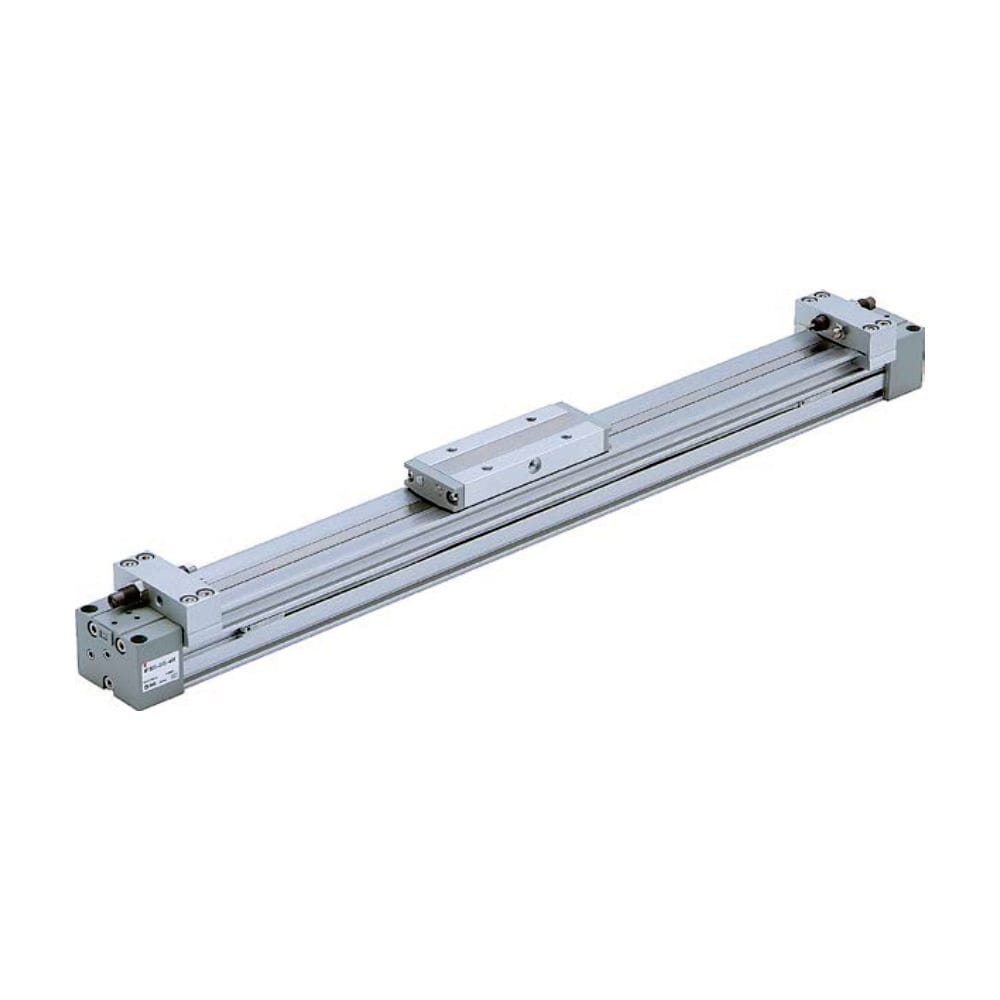
Optimal rodless cylinder lip profiles use asymmetric dual-lip designs with 12-15° primary sealing lip (pressure side) and 8-10° secondary wiper lip (atmospheric side), combined with 0.5-0.7mm contact width and pressure-balanced geometry to minimize net friction force—this configuration achieves bidirectional sealing while maintaining friction forces 30-40% lower than single-lip designs, critical for rodless cylinders where carriage seals must slide across the entire stroke length while maintaining consistent performance.
Dual-Lip Asymmetric Profiles
Rodless cylinders require sealing on both sides of the carriage—pressure side and atmospheric side. Using identical lip profiles on both sides creates unnecessary friction. Optimized designs use asymmetric profiles:
Primary seal (pressure side):
- Contact angle: 12-15°
- Contact width: 0.6-0.8mm
- Function: Pressure containment (primary sealing)
- Material: 90-92 Shore A polyurethane
Secondary seal (atmospheric side):
- Contact angle: 8-10°
- Contact width: 0.4-0.6mm
- Function: Wiper and backup seal
- Material: 88-90 Shore A polyurethane (softer for lower friction)
This asymmetric approach reduces total friction by 25-35% compared to symmetric dual-lip designs while maintaining excellent sealing reliability.
Pressure-Balanced Geometry
In rodless cylinders, pressure acts on both sides of the carriage seals. Clever geometry can use this pressure to reduce net friction force:
Conventional design:
- Pressure pushes seals outward
- Increases contact pressure and friction
- Friction increases linearly with pressure
Pressure-balanced design:
- Opposing seal lips with controlled pressure exposure
- Pressure forces partially cancel
- Friction increases only 30-50% as much with pressure
At Bepto, our rodless cylinders use proprietary pressure-balanced seal configurations that maintain nearly constant friction across the 6-16 bar operating range—a significant advantage for applications requiring consistent speed and positioning accuracy.
Material Pairing and Compatibility
Optimized lip profiles work best when paired with appropriate materials for both seal and barrel:
Seal material selection:
- Standardanwendungen: 90 Shore A cast polyurethane
- Low-friction applications: 92 Shore A polyurethane with internal lubricant
- Hochtemperatur: 88 Shore A HNBR (hydrogenated nitrile)
- Ultra-niedrige Reibung: Filled PTFE with elastomer energizer
Barrel material and treatment:
- Standard: Hard-anodized aluminum (Ra 0.4-0.6μm)
- Prämie: Hard-anodized with PTFE impregnation (Ra 0.3-0.4μm)
- Ultimativ: Ceramic coating (Ra 0.2-0.3μm, maximum wear resistance)
The material pairing must be optimized together with lip geometry—a profile optimized for polyurethane on anodized aluminum won’t perform the same with PTFE on ceramic coating.
Leistungsvalidierung und -prüfung
At Bepto, we don’t just design lip profiles theoretically—we validate performance through rigorous testing:
Friction force testing:
- Measure breakaway and dynamic friction across pressure range
- Target: <15N dynamic friction for 50mm bore at 10 bar
- Verify consistency over 1 million cycle life test
Leakage testing:
- Measure air loss at rated pressure
- Target: <0.05 liters/minute at 10 bar
- Test at temperature extremes (0°C and 60°C)
Wear life testing:
- Accelerated life testing at 120% rated pressure
- Target: >2 million cycles with <20% friction increase
- Inspect seal condition at intervals
Only profiles that pass all validation criteria make it into our production cylinders—ensuring that our customers receive documented, verified performance.
I recently helped Robert, a machine builder in Oregon, solve a persistent problem with his 3-meter stroke rodless cylinder application. His previous supplier’s cylinders showed 40% friction increase after 500,000 cycles, causing speed variations and positioning errors. Our Bepto rodless cylinders with validated lip profiles maintained friction within ±8% over 2 million cycles, giving him the consistency his precision application demanded. ⚙️
Application-Specific Optimization
Different applications benefit from different optimization priorities:
Hochgeschwindigkeitsanwendungen (>500mm/s):
- Priority: Minimize friction and heat generation
- Profile: 10-12° angles, 0.4-0.6mm contact width
- Material: Low-friction polyurethane or filled PTFE
Hochdruckanwendungen (12-16 bar):
- Priority: Sealing reliability and extrusion resistance
- Profile: 14-16° angles, 0.7-0.9mm contact width
- Material: 92-95 Shore A polyurethane with backup rings
Präzise Positionierung (<±0.2mm repeatability):
- Priority: Consistent, low friction (minimal hysteresis)
- Profile: 11-13° angles, 0.5-0.7mm contact width
- Material: Filled PTFE or premium polyurethane
Long-life applications (>5 million cycles):
- Priority: Wear resistance and friction stability
- Profile: 13-15° angles, 0.6-0.8mm contact width
- Material: HNBR or wear-resistant polyurethane
At Bepto, we help customers select the optimal lip profile configuration for their specific requirements—balancing performance, cost, and application demands to deliver the best total value.
Schlussfolgerung
Lip profile optimization is the key to breaking the traditional trade-off between sealing reliability and friction performance in pneumatic cylinders. Through precise engineering of contact angles, contact width, interference, and material selection, properly optimized profiles deliver 40-60% friction reduction while maintaining excellent sealing—translating to lower energy costs, extended seal life, and improved system performance. At Bepto, our rodless cylinders incorporate advanced lip profile optimization developed through extensive testing and field validation, delivering the efficiency and reliability that modern industrial automation demands. 🌟
FAQs About Seal Lip Profile Optimization
F: Kann ich meine vorhandenen Zylinder mit optimierten Dichtungsprofilen nachrüsten, um die Reibung zu verringern?
Eine Nachrüstung ist möglich, jedoch durch die vorhandene Oberflächenbeschaffenheit des Zylinders und die Geometrie der Nuten begrenzt – optimierte reibungsarme Profile erfordern eine Oberflächenbeschaffenheit von Ra 0,3–0,5 μm und präzise Nutabmessungen, die Standardzylinder möglicherweise nicht bieten. In den meisten Fällen bietet der Austausch durch speziell entwickelte Zylinder wie unsere optimierten kolbenstangenlosen Bepto-Zylinder eine bessere Leistung und Wirtschaftlichkeit als eine Nachrüstung mit ungewissem Ergebnis.
F: Wie viel Reibungsreduzierung kann ich realistischerweise von optimierten Lippenprofilen erwarten?
Richtig optimierte Profile reduzieren die Reibung in der Regel um 40-60% im Vergleich zu konservativen Standardkonstruktionen, während die Dichtungsleistung gleich bleibt. Bei einem Zylinder mit 50 mm Bohrung und 10 bar bedeutet dies eine Reduzierung der Reibung von 45-50 N (Standard) auf 18-25 N (optimiert). Die genaue Reduzierung hängt von den Betriebsbedingungen ab, aber unsere Bepto-Kunden verzeichnen in der Regel eine Reduzierung des gemessenen Luftverbrauchs um 30-45% nach dem Wechsel von Standardzylindern.
F: Beeinträchtigen optimierte reibungsarme Profile die Dichtungszuverlässigkeit oder die Druckfestigkeit?
No—when properly engineered, optimized profiles maintain full sealing reliability and pressure rating while reducing friction. The key is systematic optimization using FEA analysis and empirical testing rather than simply reducing contact pressure arbitrarily. Our Bepto optimized cylinders are rated to 16 bar with documented leak rates below 0.05 liters/minute, proving that optimization doesn’t require compromising reliability.
F: Wie wirkt sich die Optimierung des Lippenprofils auf die Lebensdauer und die Austauschhäufigkeit der Dichtung aus?
Optimierte Profile verlängern die Lebensdauer der Dichtung in der Regel um das 2- bis 4-fache im Vergleich zu aggressiven Designs mit hoher Reibung, da eine geringere Reibung weniger Wärme und Verschleiß erzeugt. Unseren Felddaten zufolge halten die von Bepto optimierten Dichtungen durchschnittlich 1,5 bis 3 Millionen Zyklen, bevor sie ausgetauscht werden müssen, gegenüber 500.000 bis 1 Million Zyklen bei Standardprofilen mit hoher Reibung. Die geringere Reibung verringert auch den Verschleiß des Zylinders und verlängert so die Gesamtlebensdauer des Zylinders.
F: Welche Informationen muss ich angeben, wenn ich optimierte Lippenprofile für kundenspezifische Anwendungen festlege?
Specify your critical requirements: operating pressure range, required seal life (cycles), speed range, positioning accuracy requirements (if applicable), operating temperature range, and environmental conditions (contamination, chemicals, etc.). At Bepto, our application engineers use this information to recommend the optimal lip profile configuration—whether standard, low-friction, or high-pressure variants—ensuring you receive cylinders engineered specifically for your performance requirements and operating conditions.
-
Understand the causes of mechanical hysteresis and its impact on positioning accuracy in pneumatic systems. ↩
-
Access a technical overview of friction coefficients for common industrial seal materials. ↩
-
Review engineering standards and mathematical calculations used to define proper interference fits. ↩
-
Explore the design characteristics and standard applications for U-cup seals in fluid power systems. ↩