Introduction
The Problem: Your production line is running perfectly—until a critical pneumatic cylinder fails and you discover your supplier has a 12-week backorder with no expedite options available. 🚨 The Agitation: Supply chain disruptions have transformed from rare inconveniences into constant threats, with lead times doubling or tripling overnight, prices fluctuating wildly, and previously reliable suppliers unable to deliver even standard components, forcing production shutdowns that cost thousands per hour. The Solution: A strategic pneumatic components inventory management system combining dual sourcing, critical spare identification, buffer stock optimization, and supplier diversification transforms supply chain vulnerability into competitive resilience.
Here’s the direct answer: Securing pneumatic components stock requires a four-pillar strategy: maintain 3-6 months buffer stock of critical cylinders and valves (those causing >$10K/day downtime), establish relationships with minimum two qualified suppliers per critical component (primary and backup), implement predictive maintenance to forecast replacement needs 60-90 days ahead, and source compatible alternatives from reliable manufacturers like Bepto Pneumatics who stock common sizes and deliver within 7-10 days. Companies implementing this strategy reduce supply-related downtime by 70-85% and avoid 90%+ of emergency expedite costs.
Two months ago, I spoke with Jennifer, operations director at a automotive parts manufacturer in Michigan. A single pneumatic rodless cylinder failure on her assembly line caused a 4-day shutdown because her OEM supplier had 16-week lead times and no stock. The downtime cost her company $180,000, plus $8,500 in expedited air freight for a replacement. When we analyzed her situation, she had zero backup suppliers, no spare stock policy, and complete dependence on a single source. “I never thought a $2,000 cylinder could cost us nearly $200,000,” she told me. This wake-up call led her to completely restructure her pneumatics sourcing strategy. 💡
Table of Contents
- What Are the Critical Pneumatic Components You Must Stock?
- How Do You Calculate Optimal Buffer Stock Levels?
- Why Is Dual Sourcing Essential for Supply Chain Resilience?
- How Can Alternative Suppliers Reduce Your Supply Chain Risk?
What Are the Critical Pneumatic Components You Must Stock?
Not all pneumatic components deserve equal inventory investment—identifying critical items prevents both overstocking and catastrophic shortages. 🎯
Critical pneumatic components requiring buffer stock are those meeting two criteria: high failure impact (production downtime cost >$5,000/day) and supply risk (lead time >4 weeks or single-source dependency). This typically includes production-critical cylinders (standard bore cylinders, rodless cylinders, specialized actuators), control valves (directional control valves, proportional valves, safety valves), and wear components (seal kits, rod assemblies, sensor brackets). Use ABC analysis1 to classify inventory: A-items (top 20% causing 80% of downtime risk) require 6-month stock, B-items (middle 30%) need 3-month stock, and C-items (remaining 50%) can be ordered as needed. This targeted approach optimizes capital investment while maximizing supply security.
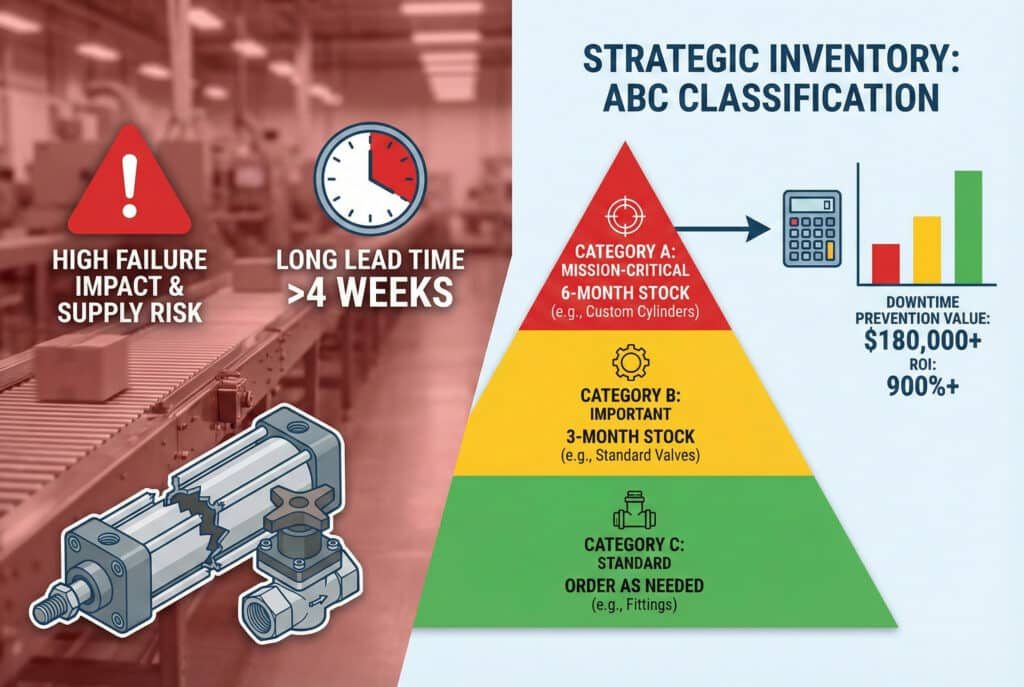
ABC Classification Framework
Category A: Mission-Critical (Stock 6 Months)
These components cause immediate production stoppage with high financial impact:
| Component Type | Criticality Indicators | Typical Examples | Stock Recommendation |
|---|---|---|---|
| Production Line Cylinders | Unique specifications, long lead time, high downtime cost | Custom rodless cylinders, large bore actuators | 2-3 complete units + seal kits |
| Control Valves | Specialized function, limited suppliers | Proportional valves, servo valves, safety valves | 1-2 complete units |
| Specialty Actuators | Application-specific design | Gripper cylinders, rotary actuators, multi-position | 1-2 complete units |
Category B: Important (Stock 3 Months)
Components causing significant disruption but with some workaround options:
| Component Type | Criticality Indicators | Typical Examples | Stock Recommendation |
|---|---|---|---|
| Standard Cylinders | Common sizes, multiple suppliers available | 32mm, 40mm, 50mm bore cylinders | 1 unit + seal kits |
| Common Valves | Standard 5/2, 5/3 directional valves | Solenoid valves, manual valves | Seal kits only |
| Sensors & Switches | Magnetic sensors, pressure switches | Reed switches, pressure transducers | 2-3 units |
Category C: Standard (Order As Needed)
Low-risk components with fast availability:
- Fittings and connectors (readily available, low cost)
- Tubing and hoses (commodity items, multiple sources)
- Mounting accessories (standard hardware)
- Basic manual valves (common, fast delivery)
Criticality Assessment Method
Step-by-Step Process:
- Identify all pneumatic components in your facility
- Calculate downtime cost for each component failure
- Assess supply risk (lead time × supplier reliability)
- Plot on criticality matrix:
High Impact + High Risk = Category A (Must Stock)
High Impact + Low Risk = Category B (Moderate Stock)
Low Impact + High Risk = Category B (Moderate Stock)
Low Impact + Low Risk = Category C (Order As Needed)
Jennifer’s Michigan Automotive Plant Analysis
When we conducted her criticality assessment:
Category A Components (6-Month Stock):
- 4× custom rodless cylinders (80mm bore, 2000mm stroke) – $2,200 each
- 2× servo proportional valves – $1,800 each
- 6× specialty gripper cylinders – $650 each
- Total A-Category Investment: $15,700
- Downtime Prevention Value: $180,000+ per incident
Category B Components (3-Month Stock):
- 8× standard 50mm bore cylinders – $280 each
- 12× 5/2 solenoid valve assemblies – $120 each
- 20× magnetic sensor sets – $45 each
- Total B-Category Investment: $4,580
Result: $20,280 inventory investment preventing $180K+ downtime incidents—900%+ ROI on first prevented failure alone. 📊
Bepto Pneumatics Stock Support
At Bepto Pneumatics, we help customers identify and stock critical components:
Our Stock Program:
- Free criticality assessment for customers with >$10K annual spend
- Consignment inventory2 options (we stock, you pay when used)
- Rapid replacement guarantee: 7-10 days for standard rodless cylinders
- Emergency stock: 48-hour expedite available for critical situations
- Compatible replacements for major brands (Festo, SMC, Parker, Norgren)
How Do You Calculate Optimal Buffer Stock Levels?
Scientific buffer stock calculation balances inventory costs against downtime risk, optimizing capital efficiency. 📐
Optimal buffer stock calculation uses the formula: Buffer Stock = (Average Lead Time + Safety Margin) × Usage Rate × Risk Factor. Average lead time is your supplier’s typical delivery time in days, safety margin adds 50-100% for disruption protection (use 100% for single-source items), usage rate is annual consumption divided by 365 days, and risk factor multiplies by 1.5-2.0 for high-criticality items. For example, a cylinder with 60-day lead time, 12 units annual usage, and high criticality requires: (60 + 60) × (12/365) × 2.0 = 7.9 units, rounded to 8 units buffer stock. This provides 240+ days coverage accounting for supply disruptions while avoiding excessive capital tie-up.
![A professional office desk with a hand holding a calculator. In the background, a whiteboard displays the buffer stock formula: "Buffer Stock = [(Lead Time + Safety Margin) x Usage Rate] x Risk Factor". A tablet shows an "INVENTORY COST VS. DOWNTIME RISK" graph, and boxes labeled "BUFFER STOCK" sit next to a pneumatic cylinder and technical drawings.](https://rodlesspneumatic.com/wp-content/uploads/2026/01/Calculating-Optimal-Buffer-Stock-Levels-Formula-Analysis-1024x687.jpg)
Buffer Stock Calculation Formula
Complete Formula:
Buffer Stock = [(Lead Time + Safety Margin) × Usage Rate] × Risk Factor
Where:
Lead Time = Supplier’s typical delivery time (days)
Safety Margin = Additional time buffer (50-100% of lead time)
Usage Rate = Annual consumption ÷ 365 days
Risk Factor = 1.0 (low risk) to 2.0 (high risk)
Worked Examples
Example 1: High-Criticality Custom Rodless Cylinder
- Lead Time: 45 days (custom manufacturing)
- Safety Margin: 45 days (100% buffer for single source)
- Annual Usage: 6 units
- Risk Factor: 2.0 (production-critical, no alternative)
Calculation:
Buffer Stock = [(45 + 45) × (6/365)] × 2.0
Buffer Stock = [90 × 0.0164] × 2.0
Buffer Stock = 1.48 × 2.0 = 2.96 ≈ 3 units
Coverage: 3 units ÷ 0.0164 usage/day = 183 days coverage
Example 2: Medium-Criticality Standard Cylinder
- Lead Time: 30 days (standard product)
- Safety Margin: 15 days (50% buffer, multiple sources available)
- Annual Usage: 24 units
- Risk Factor: 1.5 (important but alternatives exist)
Calculation:
Buffer Stock = [(30 + 15) × (24/365)] × 1.5
Buffer Stock = [45 × 0.0658] × 1.5
Buffer Stock = 2.96 × 1.5 = 4.44 ≈ 4-5 units
Coverage: 4.5 units ÷ 0.0658 usage/day = 68 days coverage
Example 3: Low-Criticality Common Component
- Lead Time: 10 days (stock item from multiple suppliers)
- Safety Margin: 5 days (50% buffer)
- Annual Usage: 48 units
- Risk Factor: 1.0 (readily available, low impact)
Calculation:
Buffer Stock = [(10 + 5) × (48/365)] × 1.0
Buffer Stock = [15 × 0.1315] × 1.0
Buffer Stock = 1.97 ≈ 2 units
Coverage: 2 units ÷ 0.1315 usage/day = 15 days coverage
Adjusting for Supply Chain Conditions
Increase Buffer Stock When:
- ✅ Supplier lead times increasing (add 25-50% to safety margin)
- ✅ Single-source dependency (use 100% safety margin3)
- ✅ Geopolitical risks (China sourcing during trade tensions)
- ✅ Seasonal demand spikes (increase usage rate by peak factor)
- ✅ New product launches (multiply risk factor by 1.5x)
Decrease Buffer Stock When:
- ✅ Multiple qualified suppliers available (reduce safety margin to 50%)
- ✅ Supplier offers consignment inventory (reduce to 1-2 weeks coverage)
- ✅ Component being phased out (reduce to consumption through phase-out)
Inventory Cost vs. Downtime Cost Analysis
Total Cost Calculation:
| Stock Level | Inventory Carrying Cost | Expected Downtime Cost | Total Cost | Optimal? |
|---|---|---|---|---|
| 0 units (No Stock) | $0 | $45,000/year (frequent shortages) | $45,000 | ❌ |
| 2 units (1 month) | $880/year | $18,000/year (occasional shortages) | $18,880 | ❌ |
| 4 units (3 months) | $1,760/year | $3,600/year (rare shortages) | $5,360 | ✅ Optimal |
| 8 units (6 months) | $3,520/year | $600/year (almost never short) | $4,120 | ✅ Good |
| 12 units (9 months) | $5,280/year | $100/year (never short) | $5,380 | ❌ Over-stock |
Assumptions: $2,200 cylinder cost, 20% carrying cost, $15,000 downtime cost per incident
Optimal Range: 4-8 units providing 3-6 months coverage minimizes total cost. 💰
Why Is Dual Sourcing Essential for Supply Chain Resilience?
Single-source dependency creates catastrophic vulnerability—dual sourcing provides insurance against supplier failures. 🛡️
Dual sourcing4 means qualifying minimum two suppliers for every critical pneumatic component, with 70-80% volume to primary supplier and 20-30% to secondary supplier maintaining active relationship and capability. This strategy provides four critical benefits: supply continuity when primary supplier faces disruptions (COVID shutdowns, factory fires, material shortages), competitive pricing leverage (5-15% cost reduction from supplier competition), quality improvement through comparative benchmarking, and negotiating power for better terms and priority treatment. Implementation costs 5-10% more than single sourcing but reduces supply disruption risk by 80-90%, with payback typically achieved after first prevented shortage incident.
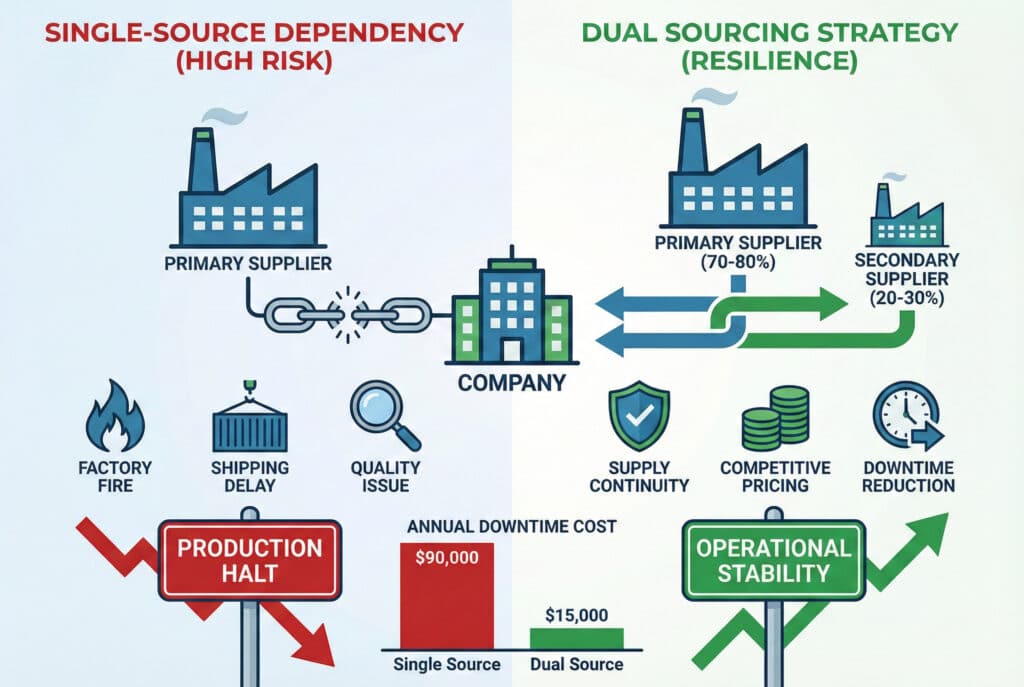
The Single-Source Risk
What Can Go Wrong:
- Supplier factory fire or natural disaster (weeks to months disruption)
- Financial problems or bankruptcy (permanent loss)
- Quality issues requiring production halt (weeks to resolve)
- Capacity constraints prioritizing larger customers (indefinite delays)
- Geopolitical issues (tariffs, trade restrictions, shipping disruptions)
- Labor strikes or workforce shortages (unpredictable duration)
Jennifer’s Michigan Experience:
Her single OEM supplier faced all of these within 18 months:
- COVID-19 factory shutdown: 8-week delay
- Shipping container shortage: 6-week delay
- Quality issue batch recall: 4-week delay
- Capacity allocation to larger customer: Ongoing 16-week lead times
Total Impact: 3 production shutdowns, $340,000 downtime costs, lost customer contracts
Dual Sourcing Implementation Strategy
Step 1: Identify Dual Source Candidates
Prioritize components with:
- High criticality (Category A and B items)
- Single current supplier
- Lead times >4 weeks
- Annual spend >$5,000 per component
Step 2: Qualify Secondary Supplier
Requirements for qualification:
- ✅ Technical capability to meet specifications
- ✅ Quality system (ISO 9001 minimum)
- ✅ Capacity to handle 20-30% of volume
- ✅ Competitive pricing (within 10% of primary)
- ✅ Acceptable lead times (within 50% of primary)
Step 3: Establish Volume Split
Recommended Split:
- Primary Supplier: 70-80% of volume (maintains relationship and economies of scale)
- Secondary Supplier: 20-30% of volume (keeps them engaged and capable)
Example Annual Volume: 24 Cylinders
- Primary: 18 units (75%)
- Secondary: 6 units (25%)
Step 4: Maintain Active Relationships
- Place orders with secondary supplier quarterly minimum
- Share specifications and quality requirements equally
- Conduct periodic performance reviews with both
- Test samples from both suppliers regularly
- Maintain updated tooling and documentation with both
Dual Sourcing Cost-Benefit Analysis
| Factor | Single Source | Dual Source | Advantage |
|---|---|---|---|
| Unit Price | $2,000 | $2,100 (5% premium) | Single source |
| Annual Volume | 24 units | 24 units | Neutral |
| Total Purchase Cost | $48,000 | $50,400 | Single source +$2,400 |
| Downtime Incidents | 2-3/year | 0-1/year | Dual source |
| Downtime Cost | $90,000/year | $15,000/year | Dual source -$75,000 |
| Net Annual Benefit | Baseline | -$72,600 savings | Dual source wins |
ROI: 3,025% return on dual sourcing investment 📈
Bepto Pneumatics as Your Secondary Source
Why We’re an Ideal Backup Supplier:
Technical Compatibility:
- Compatible replacements for Festo, SMC, Parker, Norgren rodless cylinders
- Equivalent specifications and mounting dimensions
- Interchangeable seal kits and spare parts
- Technical drawings and specifications provided
Supply Chain Advantages:
- 7-10 day delivery for standard configurations
- Stock of common bore sizes (32mm, 40mm, 50mm, 63mm, 80mm)
- Flexible minimum order quantities (no MOQ for stocked items)
- Emergency expedite available (48-72 hours for critical needs)
Commercial Benefits:
- 30-40% lower cost than European OEM brands
- Flexible payment terms (30/70 for new customers, net 30-60 for established)
- No exclusivity requirements
- Transparent pricing and lead times
Customer Success Story:
A packaging machinery manufacturer in Texas now sources:
- 70% from their traditional European supplier (custom designs, long relationship)
- 30% from Bepto Pneumatics (standard sizes, faster delivery)
Results:
- Zero supply disruptions in 24 months (vs. 4 in previous 24 months)
- 18% overall cost reduction from competitive pressure
- Average lead time reduced from 12 weeks to 8 weeks
- $250,000+ downtime cost avoidance
How Can Alternative Suppliers Reduce Your Supply Chain Risk?
Alternative suppliers offering compatible replacements provide immediate risk mitigation without complete re-engineering. 🔄
Alternative suppliers like Bepto Pneumatics reduce supply chain risk by providing drop-in compatible replacements for major OEM brands, eliminating re-engineering costs and approval cycles while offering 30-50% cost savings and 40-60% faster delivery. Key evaluation criteria include dimensional compatibility (mounting holes, port locations, stroke length), performance equivalence (force output, speed, cycle life), seal and spare parts interchangeability, and technical support quality. Successful alternative sourcing requires initial validation testing (sample evaluation, side-by-side comparison, production trial) but delivers permanent supply chain diversification with minimal engineering investment, typically achieving payback within 3-6 months through combined cost savings and risk reduction.
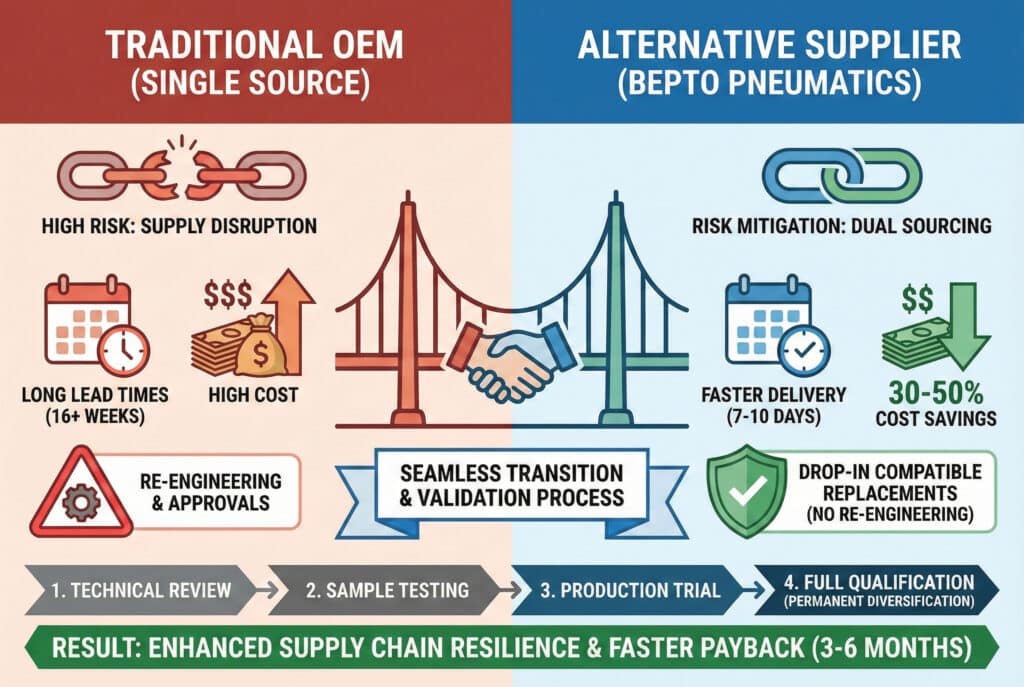
What Makes a Good Alternative Supplier?
Essential Capabilities:
Dimensional Compatibility
– Exact mounting hole patterns and spacing
– Identical port thread sizes and locations
– Same stroke lengths and extended dimensions
– Interchangeable mounting accessoriesPerformance Equivalence
– Equal or better force output at same pressure
– Comparable cycle life (minimum 2 million cycles)
– Similar speed capabilities
– Equivalent seal life and reliabilityDocumentation Quality
– Detailed technical drawings with dimensions
– Performance specifications and test data
– Material certifications and compliance documents
– Installation and maintenance manualsTechnical Support
– Engineering assistance for compatibility verification
– Sample provision for testing
– Responsive communication (24-hour response time)
– Problem-solving capability
Bepto Pneumatics Compatibility Program
Major Brand Compatibility:
| OEM Brand | Compatible Bepto Series | Interchangeability | Cost Savings |
|---|---|---|---|
| Festo DGC/DGCI | Bepto RLC Series | 95%+ dimensional match | 35-40% |
| SMC MY1/MY2 | Bepto RLC Series | 90%+ dimensional match | 30-35% |
| Parker OSP-P | Bepto RLC-HD Series | 95%+ dimensional match | 40-45% |
| Norgren RM/RMT | Bepto RLC Series | 90%+ dimensional match | 35-40% |
What We Provide:
- Detailed compatibility cross-reference charts
- Side-by-side dimensional comparison drawings
- Free samples for validation testing (for orders >$5,000)
- Technical support throughout evaluation process
- Performance guarantee matching OEM specifications
Alternative Supplier Validation Process
Step 1: Technical Review (1-2 Days)
- Submit OEM part number and specifications
- Receive Bepto equivalent recommendation
- Review dimensional drawings for compatibility
- Confirm performance specifications
Step 2: Sample Testing (2-4 Weeks)
- Order 1-2 sample units
- Install in actual application
- Test under real operating conditions
- Compare performance to OEM unit
- Measure cycle life, speed, force output
Step 3: Production Trial (1-3 Months)
- Order small production quantity (5-10 units)
- Install across multiple machines
- Monitor performance and reliability
- Collect feedback from maintenance team
- Document any issues or differences
Step 4: Full Qualification (Ongoing)
- Approve for regular use
- Add to approved vendor list
- Establish ordering procedures
- Maintain performance monitoring
- Conduct periodic re-evaluation
Real-World Success: Jennifer’s Transformation
Jennifer’s Michigan plant implemented complete supply chain restructuring:
Before (Single Source, OEM Only):
- 1 supplier (European OEM)
- 16-week lead times
- $2,200 per rodless cylinder
- 3 disruption incidents in 18 months
- $340,000 downtime costs
After (Dual Source with Alternative):
Primary Supplier (60%): European OEM
- Custom configurations
- Long-term relationship maintained
- 12-week lead times (improved through competition)
Secondary Supplier (40%): Bepto Pneumatics
- Standard configurations
- 7-10 day delivery
- $1,400 per equivalent cylinder (36% savings)
- Emergency backup capability
Results After 12 Months:
- ✅ Zero supply disruptions
- ✅ $19,200 annual cost savings (40% × 24 units × $800 savings)
- ✅ Average lead time: 9 weeks (vs. 16 weeks original)
- ✅ Buffer stock reduced from 8 units to 4 units (faster replenishment)
- ✅ $60,000+ downtime cost avoidance
- ✅ Total annual benefit: $79,200+
Jennifer told me: “I was skeptical about using an alternative supplier—I thought OEM was the only safe choice. But Bepto’s cylinders perform identically to our original equipment at 36% lower cost with much faster delivery. The dual sourcing strategy has completely eliminated our supply chain anxiety.” ✅
Getting Started with Alternative Sourcing
Action Steps:
- Identify candidates: List all pneumatic cylinders with OEM dependency
- Contact Bepto: Send OEM part numbers for compatibility review
- Request samples: Test in your application (free for qualified projects)
- Start small: Begin with 20-30% volume split
- Expand gradually: Increase as confidence builds
We Make It Easy:
- No minimum order quantities for samples
- Free technical consultation and compatibility verification
- 30-day satisfaction guarantee
- Full technical support throughout transition
Conclusion
Supply chain resilience isn’t about predicting disruptions—it’s about building systematic defenses through critical component identification, scientific buffer stock calculation, dual sourcing strategies, and qualified alternative suppliers that transform supply chain vulnerability into competitive advantage, ensuring production continuity regardless of external disruptions. 🎯
FAQs About Pneumatic Components Supply Chain Security
How much inventory investment is reasonable for supply chain security?
Invest 2-4% of annual production revenue in critical pneumatic components buffer stock—this typically provides 3-6 months coverage for Category A items and prevents downtime costs 10-50x larger than the inventory investment. Calculate by identifying components where failure causes >$5,000/day downtime, then stock enough to cover average lead time plus 50-100% safety margin. For a facility with $10M annual revenue, $200-400K in strategic pneumatic inventory is reasonable insurance against supply disruptions.
Can I negotiate consignment inventory with suppliers to reduce capital requirements?
Yes, many suppliers including Bepto Pneumatics offer consignment programs where we stock critical components at our facility or yours, and you pay only when components are consumed—this provides supply security without capital tie-up for customers with >$50K annual spend. Consignment works best for high-value, slow-moving critical items. We maintain ownership and inventory risk while you get guaranteed availability. Typical terms include minimum annual volume commitments and 30-60 day payment after consumption.
How do I handle obsolescence risk when stocking pneumatic components?
Minimize obsolescence by focusing buffer stock on mature, stable designs rather than new products, negotiating return/exchange agreements with suppliers for unused stock, and implementing first-in-first-out rotation to use oldest inventory first. At Bepto Pneumatics, we offer 80% credit for unused stock returned within 24 months for customers transitioning equipment designs. Also consider modular designs where components like seal kits can be stocked separately from complete cylinders, reducing obsolescence risk.
What’s the fastest way to establish a secondary supplier relationship?
Start with a small trial order (3-5 units) of your most critical component, conduct side-by-side testing against your primary supplier’s product, and expand gradually based on performance—full qualification typically takes 3-6 months but provides immediate risk reduction. Don’t wait for a supply crisis to start qualifying alternatives. At Bepto Pneumatics, we expedite the qualification process by providing free samples, detailed compatibility documentation, and technical support throughout testing, often achieving qualification in 60-90 days.
Should I stock complete cylinders or just seal kits and wear parts?
Stock complete cylinders for Category A critical items (custom designs, long lead times, high downtime cost) and seal kits only for Category B standard items (readily available, multiple suppliers, moderate impact)—this optimizes capital efficiency while ensuring availability. Complete cylinders provide immediate replacement capability for production-critical applications, while seal kits offer cost-effective solutions for standard components where the cylinder body rarely fails. At Bepto Pneumatics, we offer both complete assemblies and comprehensive seal kit programs, helping you optimize your spare parts strategy based on actual failure modes and supply risk. Also, implement predictive maintenance5 to anticipate failures. 📞
-
Understand the ABC analysis method for classifying inventory items based on their value and importance. ↩
-
Discover best practices for setting up consignment inventory agreements to improve cash flow and availability. ↩
-
Learn the mathematical formula for calculating safety stock to buffer against supply chain variability. ↩
-
Read about the strategic advantages of dual sourcing for improving supply chain resilience and reducing risk. ↩
-
Explore the differences between predictive and preventive maintenance strategies to optimize equipment uptime. ↩