

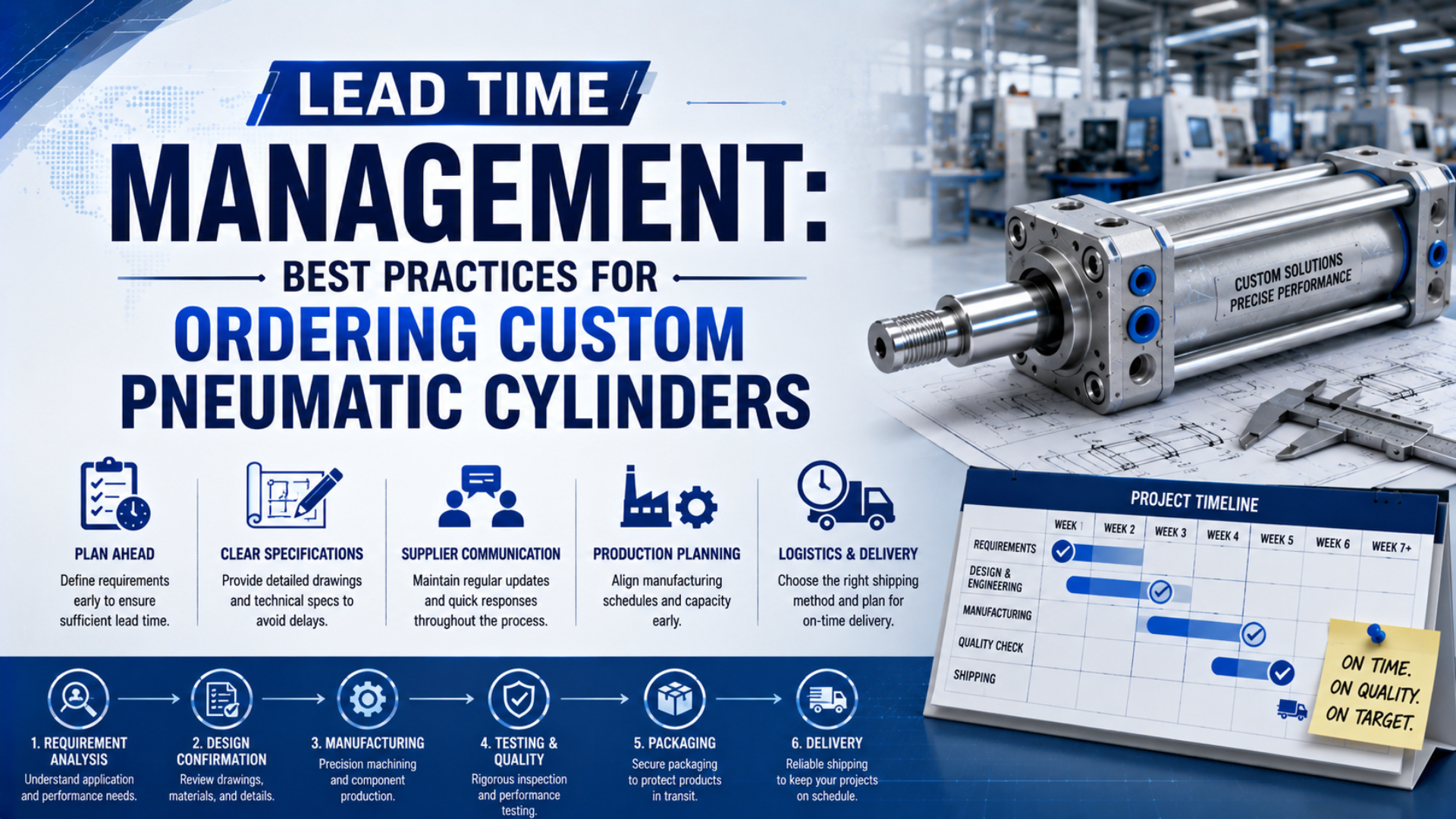
Custom pneumatic cylinder lead time cannot be managed with one generic promise such as “four to eight weeks.” A reliable schedule needs a defined starting gate, an approved configuration, dated dependencies, acceptance requirements, a named delivery point, and a change-control process. Without those controls, buyer and supplier may be measuring different clocks.
The best practice is to manage the order as a small engineering project. Freeze the inputs that release work, separate forecast dates from committed dates, track the critical path, and make each delay visible before it consumes the delivery buffer. This approach works for a one-off actuator, a modified catalog cylinder, or a recurring custom part.
Key Takeaways
- ISO 15552 standardizes selected cylinder interfaces from 32 to 320 mm bore, but it does not set delivery time.
- Start the schedule from an agreed release gate, not the first email.
- Keep requested, forecast, committed, shipped, and delivered dates separate.
- Set spare stock from consequence and variability, not a universal quantity.
Custom pneumatic cylinder lead time is the elapsed time between two contractually defined events for a configured actuator. The start might be receipt of a complete RFQ, drawing approval, purchase-order acceptance, or material release. The finish might be factory acceptance, handover to a carrier, arrival at a named destination, or receipt at the machine site.
What Does Lead Time Mean in a Custom Cylinder Order?
Define the clock before comparing suppliers. Incoterms 2020 contains 4 “C” rules and 3 “D” rules, and ICC explains that delivery under a C rule occurs at origin while delivery under a D rule occurs at the named destination (ICC Academy, retrieved 2026-07-26).
That distinction is not only for the logistics team. A supplier can meet an agreed carrier-handover date while the cylinder reaches the plant later than the buyer expected. Conversely, a quotation marked “delivery in six weeks” is ambiguous if it doesn’t identify the start gate, delivery point, transport mode, customs responsibility, and acceptance hold points.
Use separate fields for these events:
| Date field | Meaning | Typical evidence |
|---|---|---|
| Need date | When the machine or project requires the cylinder | Project schedule or maintenance plan |
| RFQ complete date | When the supplier has enough controlled data to quote | RFQ revision and attachment register |
| Order acceptance date | When commercial and technical scope is acknowledged | Supplier order acknowledgment |
| Design-freeze date | When one drawing revision is released | Approved drawing and deviation list |
| Forecast completion date | Current best estimate, allowed to move with evidence | Updated milestone schedule |
| Committed completion date | Supplier-controlled promise against defined assumptions | Written commitment and baseline |
| Ship or handover date | When the goods are passed to the carrier | Packing list and transport record |
| Delivery date | When delivery occurs under the named contractual rule | Receipt or contractual delivery evidence |
| Site-acceptance date | When the installed cylinder passes agreed checks | Commissioning or acceptance record |
One date should not overwrite another. If the need date changes, the manufacturing commitment does not automatically change. If the forecast slips, the original committed date should remain visible so the variance can be managed.
From our analysis of custom-order handoffs, a useful quotation has two clocks: the technical-release clock and the logistics clock. The first ends when the configured cylinder is accepted and ready to ship. The second ends at the named delivery point. Keeping them separate exposes whether a delay came from specifications, approval, production, acceptance, export, transport, customs, or site readiness.
Seven Controlled Gates for Custom-Cylinder Delivery
Treat the order as 7 controlled gates rather than a single queue. ISO 21502:2020 applies project-management guidance to any project regardless of delivery approach, complexity, size, cost, or duration; ISO also identifies planning, control, risks, issues, and change control as relevant practices (ISO 21502, 2020).
Each gate needs an entry condition, an owner, an output, and a dated status. The gates may overlap when the risk is understood, but no team should assume that unapproved work has been released.
The first three gates are where buyers often have the most schedule influence. A missing mounting datum, undecided sensor, unknown port orientation, or unapproved material can hold the design while the calendar keeps moving. The custom pneumatic cylinder lifecycle covers the manufacturing and acceptance work inside gates 4 through 6.
Track progress by completed evidence. “Engineering mostly complete” is difficult to verify. “Outline drawing revision B issued; sensor interface unresolved; approval due Friday” tells both parties what remains and who owns it.
Freeze the Configuration Before Scheduling Production
Freeze one identifiable product baseline before treating the completion date as firm. ISO 10007:2017 is a 10-page configuration-management guideline that applies from product concept to disposal; ISO reports that the third edition was reviewed and confirmed in 2023 (ISO 10007, retrieved 2026-07-26).
The baseline does not need every production detail, but it must control everything that changes fit, function, compliance, test scope, material release, or delivery. A custom cylinder quotation based only on bore and stroke leaves too many schedule variables open.
Freeze these fields before production commitment:
| Control group | Minimum schedule-relevant inputs |
|---|---|
| Motion and load | Stroke, moving mass, force cases, speed, duty, orientation, side load, stopping method |
| Pneumatic | Pressure available during motion, port thread and position, cushioning, air quality, lubrication policy |
| Mechanical interfaces | Mounting datums, hole and pin pattern, rod end, retracted length, envelope, guide arrangement |
| Electrical | Sensor type, quantity, switching positions, connector, cable exit, controller interface |
| Environment | Temperature, particles, moisture, washdown, chemicals, corrosion, hygiene or cleanroom requirements |
| Materials and finish | Tube, rod, seals, wipers, coating, surface requirements, restricted substances |
| Acceptance | Recorded dimensions, functional test, leakage limit, documents, witness points, release authority |
| Commercial | Quantity, prototype or production status, delivery rule, destination, packaging, target date |
For a reusable RFQ format, see the ISO 15552 cylinder procurement checklist. Even when the design is not ISO 15552, its method of controlling part identity, interfaces, quotation evidence, and order acknowledgment remains useful.
In our experience, schedule discussions go wrong when an unresolved engineering assumption is hidden inside a commercial date. A supplier may reserve machining capacity while the buyer still expects to change the mount. Both actions can be reasonable, but the order needs to state which work is authorized at risk and who pays if the configuration changes.
How Should Changes and Delays Be Controlled?
Use one written change process from drawing freeze through shipment. ISO 10007:2017 identifies configuration management across the full product lifecycle, so a changed seal, sensor, coating, port, tolerance, test, or quantity should update the controlled baseline and schedule impact rather than survive as an email-side agreement (ISO 10007, retrieved 2026-07-26).
Every change request should record:
- requested change and reason;
- affected drawing, specification, bill of material, test, packaging, and documents;
- parts or material already committed;
- technical review and new risks;
- cost and schedule effect;
- disposition of work in progress;
- revised baseline and approvals;
- effect on spares and future repeat orders.
How should a delay be reported? State the missed milestone, cause, affected dependency, recovery action, action owner, decision needed, and updated forecast. Do not erase the previous baseline or substitute a new committed date without approval.
Use four status labels consistently:
- On plan: gate evidence is complete or forecast within the approved baseline.
- At risk: a dependency can still meet the baseline but has lost planned margin.
- Late: a milestone has missed its baseline date.
- Blocked: progress cannot continue until a named input, decision, material, or resource is available.
In our experience, the most useful escalation threshold is not “days late.” It is “buffer consumed on the critical path.” A noncritical activity may slip without moving delivery, while a one-day delay in a zero-float approval can move the entire schedule. Track dependency and float, not only elapsed days.
How Do You Set a Realistic Commit Date?
Build the committed date from dependency paths, then add an explicit risk buffer. ISO 21502:2020 applies across predictive, incremental, iterative, adaptive, and hybrid delivery approaches, which supports choosing a schedule method that fits the order instead of forcing every custom cylinder into one fixed duration (ISO 21502, 2020).
A compact critical-path representation is:
Here, is the planned duration from the agreed release gate to the contractual finish. Each is the duration of one complete dependency path, such as drawing approval through machining or material purchase through coating. is the approved protection for identified variability. All durations must use the same unit.
This formulation avoids double-counting parallel work. Material procurement and drawing detailing may overlap, for example, while a special coating cannot start until machining finishes. The longest dependent route controls the finish date.
Build the schedule from supplier evidence:
- engineering review and drawing issue;
- customer review time and resubmission allowance;
- long-lead material and bought-out component availability;
- tooling, programming, and first-piece work;
- machining, surface treatment, cleaning, and assembly;
- in-process inspection and nonconformance resolution;
- final examination, FAT, documents, packing, and release;
- carrier booking, export formalities, transport, import, and final delivery.
Don’t convert uncertainty into false precision. Record a forecast range when an external coating slot or customs event is not yet confirmed. Convert it into a committed milestone only when the dependency and assumptions are controlled.
The buyer also needs decision deadlines. If a drawing must be approved by a certain date to preserve the material slot, write that relationship into the schedule. Otherwise, a late approval can appear to be a supplier delay even though the dependency was never visible.
Should You Hold a Critical Spare?
Hold a spare when the consequence, replenishment uncertainty, repair route, and obsolescence risk justify it. ASCM’s 2025 safety-stock guidance cites typical service-level goals of 90% to 98% and explains that lead-time variability needs its own calculation; it does not prescribe one or two units for every part (ASCM, 2025).
For repeat demand with a suitable statistical model, ASCM presents the lead-time-variability relationship in the form:
Here, is safety stock for lead-time variation, is the service-level factor, is average demand per time unit, and is the standard deviation of lead time in the same time unit. The assumptions matter. Intermittent demand for a serialized custom cylinder may not fit a normal-distribution model or have enough observations for a stable estimate.
For one-off or highly intermittent parts, use a scenario decision instead:
- What happens to safety, quality, throughput, and customer delivery if the cylinder is unavailable?
- Can the machine use a standard or verified alternate cylinder?
- Is a seal kit, rod assembly, sensor, or wear-part package enough?
- Can the cylinder be rebuilt on site, locally, or only by the manufacturer?
- Is the design stable, or could a spare become obsolete after a machine revision?
- How variable are material, production, acceptance, and transport times?
- Where will the spare be stored, preserved, inspected, and identified?
The article on custom-cylinder MOQ commitments explains the commercial exposure created by batch quantity, tooling, material, and design change. For recurring demand, vendor-managed inventory may reduce site stock, but the agreement still needs ownership, release, inspection, availability, and end-of-program terms.
RFQ and Order-Acknowledgment Controls
Control the order with linked technical and commercial documents. ISO 15552:2018 covers detachable-mounting cylinders from 32 to 320 mm bore at up to 1,000 kPa, but its 18 pages define selected interchangeability dimensions rather than supplier lead time, configured options, or logistics (ISO 15552, confirmed 2025).
The RFQ should state:
- application function and target need date;
- required quote date and decision schedule;
- cylinder type, quantity, prototype or production status;
- complete technical specification and reference drawings;
- requested supplier drawing and deviation response;
- acceptance tests, records, witness points, and approval owners;
- required material, compliance, traceability, labeling, and packaging documents;
- delivery rule, named place, destination, transport assumptions, and split-delivery options;
- spare parts, repair documents, repeat-order support, and change-notification expectations.
The supplier quotation should return:
- exact scope and product identity;
- assumptions, exclusions, and open technical questions;
- proposed gate dates and the event that starts the clock;
- long-lead material, outside processing, tooling, and customer dependencies;
- forecast and committed dates identified separately;
- quotation validity, capacity reservation, expedite conditions, and cancellation exposure;
- ship date and delivery date with the applicable named rule;
- inspection, FAT, documentation, and packing duration included in the schedule.
After the purchase order, compare the order acknowledgment line by line with the approved scope. Acknowledgment is where a changed drawing suffix, omitted sensor, revised quantity, later delivery basis, or different Incoterm should be caught.
ISO 10099:2001 is a four-page standard for final examination and acceptance criteria for double-acting, single-rod pneumatic cylinders, and it was confirmed in 2023 (ISO 10099). Its narrow scope is a useful warning: the acceptance gate for a rodless, guided, locking, tandem, stainless, or otherwise custom actuator must be defined for that product, not assumed from a generic cylinder test.
If an alternate uses a standardized mounting family, verify dimensions, ports, accessories, sensors, ratings, and deviations through the ISO 15552 interchangeability process. Standardization can reduce unique engineering content, but it does not guarantee equivalent performance or a particular delivery date.
Lead Time Management FAQs: What Should Buyers Ask?
ISO 10099 contains only 4 pages and applies to final examination of double-acting, single-rod pneumatic cylinders, while ISO 15552 addresses selected dimensions across 32 to 320 mm bores (ISO 10099; ISO 15552, retrieved 2026-07-26). These narrow scopes show why schedule, configuration, acceptance, and delivery terms must be written for the exact custom cylinder being purchased.
When should custom cylinder lead time start?
Start it from the event named in the quotation and order acknowledgment. Good options include receipt of a complete RFQ, commercial order acceptance, approved drawing, or release of long-lead material. Record the date and required evidence. The first email is not a reliable starting point when technical inputs remain unresolved.
Can a supplier guarantee a delivery date before drawing approval?
The supplier can provide a forecast based on stated assumptions, but a firm production commitment may depend on drawing approval, materials, capacity, outside processing, and acceptance scope. If work begins before approval, identify what is authorized at risk, who owns possible rework, and which date will be rebaselined after configuration freeze.
What information is needed for a reliable schedule?
Provide the application, load and motion cases, pressure, interfaces, environment, materials, sensors, acceptance evidence, quantity, target date, delivery rule, destination, and decision owners. Ask the supplier to return assumptions, open items, dependencies, milestone dates, and the clock-start event. Bore and stroke alone do not define a custom-cylinder schedule.
How should a design change be handled after approval?
Submit a written change request tied to the approved drawing revision. The supplier should report affected material, work in progress, tooling, tests, documents, cost, and schedule before implementation. Keep the original baseline and record the approved revision. A verbal instruction should not silently replace the controlled product or committed date.
Should every critical custom cylinder have a stocked spare?
No. Base the decision on safety and production consequence, demand pattern, lead-time variability, repairability, alternate fit, design stability, storage, and obsolescence. A site spare may be justified, but other controls can be better: standardizing the interface, holding a repair kit, using shared stock, qualifying a second source, or redesigning the machine.
Sources and technical references
- ISO 10007:2017, Quality management, Guidelines for configuration management, retrieved 2026-07-26. Used for configuration baseline, lifecycle control, change handling, and status-accounting principles.
- ISO 21502:2020, Guidance on project management, retrieved 2026-07-26. Used for the project-planning, control, risk, issue, and delivery-approach framework.
- ISO 15552:2018, Pneumatic cylinders with detachable mountings, confirmed 2025. Used to distinguish dimensional interchangeability from configured performance and delivery commitments.
- ISO 10099:2001, Pneumatic cylinders, Final examination and acceptance criteria, confirmed 2023. Used to define the limited scope of a cited final-acceptance standard.
- ASCM, Calculate Inventory with Precision Even Amid Variability, 2025. Used for safety-stock purpose, service-level context, and lead-time-variability treatment.
- ICC Academy, Incoterms 2020 C and D Rules, retrieved 2026-07-26. Used to distinguish carrier handover, contractual delivery, destination, cost, and risk transfer.