
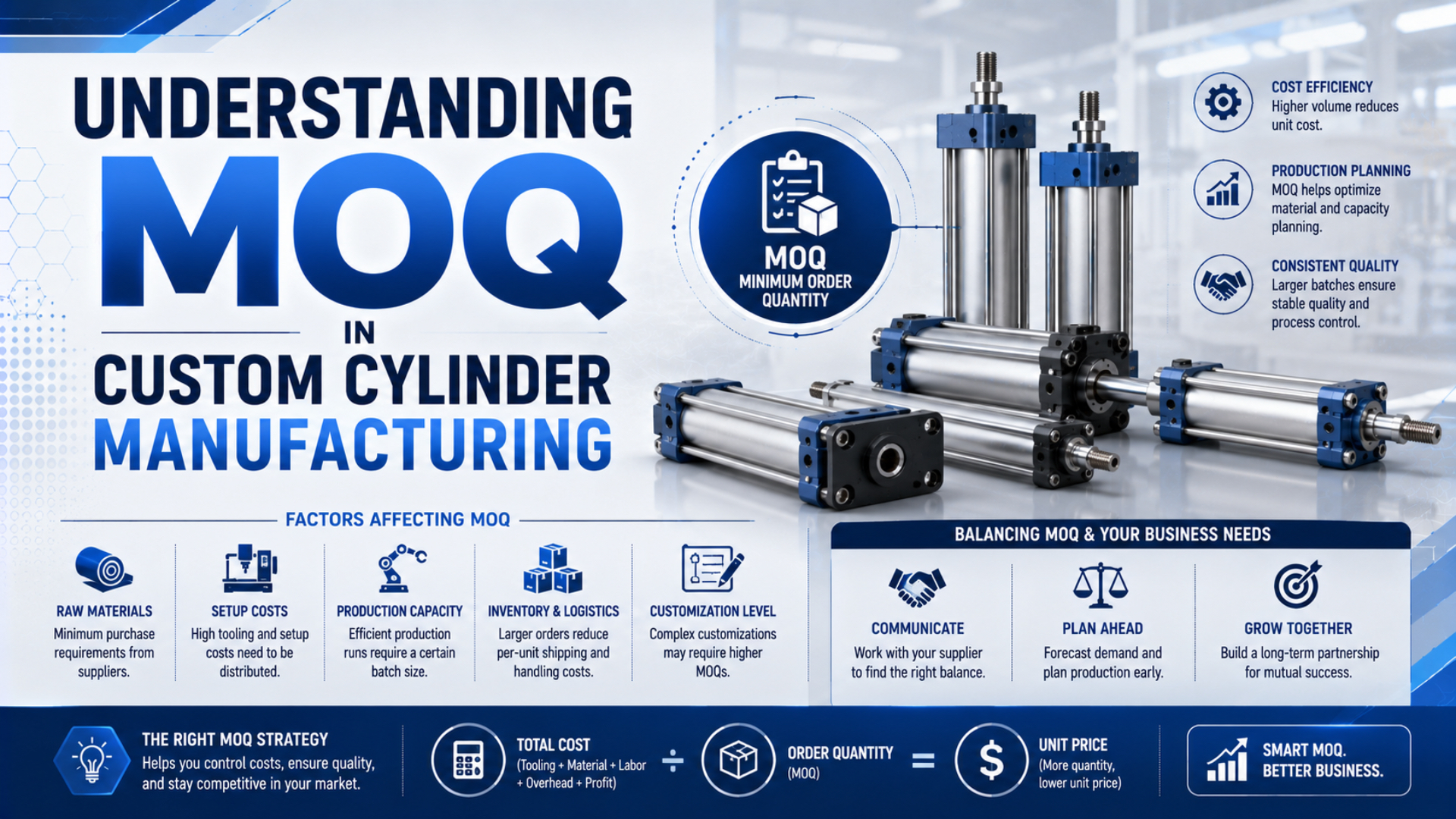
MOQ is a commercial boundary, not a universal engineering constant. For a custom pneumatic cylinder, it may reflect a production batch, an upstream material purchase, a validation lot, or a supplier’s preferred way to recover project-specific work. A useful quotation separates those causes instead of presenting one unexplained quantity.
This matters because the lowest quoted unit price can create the highest commitment. Extra cylinders consume cash and storage, while a design revision can strand stock that still meets its original drawing. The buying decision therefore needs to compare the complete commitment, the quantity likely to be used, and the contractual path from prototype to repeat production.
Key Takeaways
- Separate prototype quantity, production MOQ, price-break quantity, release quantity, and annual forecast.
- Ask suppliers to quote recurring unit cost separately from NRE, tooling, validation, and logistics.
- Reduce project-specific content before negotiating quantity: standards-based dimensions, stocked materials, common seals, and familiar test methods usually create more options.
- Approve a higher commitment only when demand, drawing maturity, acceptance criteria, storage, and change control are understood.
What Does MOQ Mean in a Custom-Cylinder Quote?
MOQ should identify the smallest quantity a supplier will accept under a stated configuration, price, and delivery condition. It is not automatically the prototype quantity, the number delivered at one time, or the quantity forecast for a year. Put all five quantities on the request for quotation so each supplier prices the same commercial scenario.
Use these terms deliberately:
| Quantity term | What it should mean in the RFQ | Question it answers |
|---|---|---|
| Prototype or sample quantity | Units made to confirm fit, function, interfaces, and preliminary performance | Can the concept be evaluated before production commitment? |
| Pilot lot | A controlled batch used to confirm the drawing, process, inspection plan, and machine integration | Is the design and production route ready to release? |
| Production MOQ | Smallest production order accepted at the quoted terms | What must the buyer commit to purchase? |
| Price-break quantity | Quantity at which a different unit price applies | How does price change with batch size? |
| Release quantity | Units shipped from a larger blanket order on each schedule date | What arrives, is invoiced, and is stored at each release? |
| Annual forecast | A non-order demand estimate unless the contract says otherwise | What future demand may support capacity and material planning? |
A blanket order may satisfy a production MOQ while using several releases, but that does not necessarily reduce the buyer’s legal or financial commitment. The contract must state when title transfers, when payment is due, who stores finished units, and what happens to work in progress or reserved material after cancellation.
Release quantity is the portion scheduled for one shipment under a larger order. It controls physical flow, but the contract determines whether it also controls invoicing, title, cancellation rights, or total purchase liability.
ISO 15552 defines a metric dimensional-interchangeability series for detachable-mount cylinders from 32 mm through 320 mm bore at a maximum rated pressure of 1,000 kPa. It does not prescribe MOQ, unit price, or delivery terms (ISO 15552, 2018). A supplier calling a cylinder “ISO 15552” is therefore making a dimensional-platform statement, not proving that every interface, accessory, performance value, or commercial condition is interchangeable. The ISO 15552 interchangeability guide explains the dimensional checks that still belong in the comparison.
The first MOQ question is not “Can you lower the number?” It is “Which obligation does this number represent?” A material purchase, one machining campaign, one acceptance batch, and one annual blanket order can all produce the same displayed MOQ while allocating inventory and revision risk very differently.
Why Does Custom Manufacturing Create a Minimum Batch?
A custom-cylinder MOQ usually emerges when project-specific work or purchasing cannot be recovered economically from the requested quantity. The relevant drivers are recurring conversion work, non-recurring engineering, dedicated tooling, upstream material packs, setup and inspection effort, and the risk that unused custom content cannot be applied to another order. Their values are quotation-specific.
Do not assume every supplier uses the same cost structure. One may machine a non-standard port into a stocked end cap; another may need a new casting or extrusion. One may own a suitable test fixture; another may quote a dedicated fixture. A supplier with compatible material on hand may accept a smaller batch without having a generally “lower MOQ policy.”
For a clean comparison, divide quoted content into five groups:
- Recurring unit content: material, machining, assembly, seals, sensors, inspection, packaging, and ordinary production scrap attributable to each unit.
- Non-recurring engineering (NRE): drawing creation, design review, programming, process planning, special documentation, and other one-time work.
- Dedicated tooling and test equipment: fixtures, gauges, dies, molds, adapters, or test hardware made for the project.
- Qualification and validation: prototype tests, first-article work, capability studies, special reports, or witnessed acceptance beyond routine production inspection.
- Supply and commitment effects: minimum raw-material buys, freight, storage, phased-release handling, obsolescence exposure, and cancellation liability.
U.S. Federal Acquisition Regulation 17.106-1 lists special tooling, special test equipment, preproduction engineering, initial rework, pilot runs, and labor-learning effects as examples of nonrecurring costs. That list is useful vocabulary for separating a quotation, but it is federal acquisition guidance—not a rule that governs every commercial cylinder order (FAR 17.106-1).
Non-recurring engineering (NRE) is project-specific engineering work charged outside ordinary unit conversion cost. The exact boundary depends on the quote; drawing creation, programming, process planning, and special documentation should therefore be itemized rather than assumed.
IFRS IAS 2 similarly distinguishes purchase, conversion, and other costs incurred to bring inventory to its location and condition. It is an accounting standard, not an MOQ formula, but it reinforces why purchase price alone is an incomplete view of inventory commitment (IAS 2 Inventories).
Which Cylinder Specifications Change Production Economics?
The most practical way to change MOQ is usually to reduce project-specific content before asking for a price concession. A non-standard stroke cut from a familiar platform is commercially different from a new barrel profile, seal geometry, or pressure-boundary architecture. Classify every requirement as standard, modified-standard, or genuinely unique before the drawing is frozen.
Review these specification groups:
| Specification area | Lower-disruption route | Higher-disruption route | Evidence to request |
|---|---|---|---|
| Bore and envelope | Established platform and mounting dimensions | New pressure-boundary geometry or extrusion | Platform drawing, rated pressure, material and test basis |
| Stroke | Cut-to-length within an existing design limit | Stroke requiring a new guide, tube, band, or support solution | Stroke tolerance, support method, cushioning limits |
| Mounting interface | Catalog mounting or external adapter plate | Newly machined end cap, carriage, trunnion, or bracket | Interface drawing and load/moment limits |
| Ports and threads | Existing port face and standard thread | New port angle, manifold face, or restricted internal passage | Port drawing, thread specification, flow path |
| Seals and materials | Qualified stocked compound and standard profile | Unique compound, profile, coating, or traceability lot | Material designation, compatibility basis, storage limits |
| Sensors and connectors | Existing groove and stocked sensor | New sensing architecture, cable, connector, or certification | Electrical drawing, switching limits, approvals |
| Documentation | Standard drawing and inspection record | Customer format, special traceability, witnessed testing, FAI package | Deliverable list, revision, language, acceptance authority |
ISO 6432 covers mounting dimensions for a commonly used single-rod cylinder series from 8 mm through 25 mm bore, while ISO 15552 covers another series from 32 mm through 320 mm. These standards can reduce interface novelty when the application fits their scope; neither standard turns a special material, sensor, port, or documentation package into a catalog item (ISO 6432, 2015; ISO 15552, 2018).
An adapter plate can sometimes preserve a catalog cylinder and move the unique geometry into a simpler purchased part. That can improve replacement options, but only if the adapter and fasteners are checked for load, moment, alignment, stiffness, access, and environment. It is an engineering change, not a universal MOQ trick.
Before changing the actuator architecture, compare the adjacent design trade-offs. The custom-cylinder lifecycle guide covers specification freeze, drawing approval, manufacture, acceptance, and commissioning. If the motion can remain standards-based, compare that path with the cylinder-versus-electric-actuator cost guide rather than assuming a different technology automatically removes project cost.
How Should Buyers Request Comparable MOQ Quotes?
A comparable RFQ gives each supplier the same drawing revision, duty, environment, acceptance criteria, quantity matrix, and delivery assumptions. It also asks suppliers to identify exclusions and separate recurring price from one-time charges. Without that structure, two apparently similar unit prices may cover different validation, ownership, storage, and change obligations.
Send one controlled RFQ package containing:
- Application and machine function
- Approved drawing or a clearly marked inquiry drawing with revision
- Bore, stroke, interfaces, ports, mounting, sensors, materials, seals, and finish
- Working pressure, proof or acceptance requirement, speed, load, moment, duty, temperature, air quality, chemicals, washdown, and other environmental conditions
- Required inspection records, certificates, serialization, traceability, packaging, and language
- Sample quantity, pilot quantity, at least two production quantities, and the proposed release schedule
- Required dates for samples, pilot approval, and production releases
- Expected design life of the machine and service-spares approach
Then ask every bidder to complete the same commercial matrix:
| Quote line | Supplier response required |
|---|---|
| Prototype | Quantity, unit price, lead time, test coverage, and whether the design is production-representative |
| Pilot lot | Quantity, price, inspection plan, approval hold point, and disposition after rejection |
| Production | MOQ and unit price at each requested quantity |
| NRE | Itemized deliverables, payment milestone, and whether it repeats after revision |
| Tooling | Description, ownership, location, maintenance, replacement, access, and end-of-program disposition |
| Material commitment | Purchased pack size, quantity consumed, balance ownership, storage life, and cancellation exposure |
| Releases | Minimum release, notice period, storage charge, title transfer, invoice timing, and final-release deadline |
| Quote control | Drawing revision, assumptions, exclusions, currency, taxes, freight term, and validity period |
SAE AS9102C establishes a process for performing and documenting first-article inspection in aerospace. It also states that its requirements complement customer and regulatory requirements rather than replacing them. Specify AS9102 only when the program needs it; do not use “FAI” as an undefined label for every industrial cylinder order (SAE AS9102C, 2023).
In our experience reviewing custom-cylinder inquiries, the fastest way to expose a quotation gap is to ask whether the sample is made with production material, tooling, inspection, and assembly methods. A hand-finished prototype may prove fit and motion while leaving production capability and repeatability unverified.
How Do You Compare the Total Committed Cost?
Compare quotations over one declared demand horizon and one currency. Include the ordered quantity, unit price, one-time engineering, tooling, validation, logistics, inventory effects, and expected design-change exposure. Then divide by the quantity expected to be consumed—not merely purchased—when excess stock or phased releases differ between offers. Document every estimate.
One practical comparison model is:
Here, is total committed cost over the chosen horizon, is the binding purchase quantity, and is unit price. The remaining terms represent non-recurring engineering, dedicated tooling, validation, logistics, inventory-related cost, and expected design-change or obsolescence exposure. Use one currency and avoid counting a charge twice when it is already included in .
This is not a universal accounting formula. It is a comparison frame that forces assumptions into view. For example:
- If a supplier includes NRE in the unit price, set the separate NRE term to zero and record that treatment.
- If the buyer owns and can transfer tooling, its value and transfer cost differ from supplier-owned tooling that cannot be removed.
- If releases defer delivery but the blanket order is non-cancellable, cash timing may improve without reducing quantity commitment.
- If the design is not frozen, estimate change exposure by scenario rather than inserting an unsupported industry percentage.
- If unused units can serve installed spares, they are not necessarily waste; connect them to the service plan and shelf-life limits.
NIST advises manufacturers to assess total cost of ownership beyond purchase price, including freight, tariffs, longer lead times, inventory, supplier-management overhead, and risks such as lost sales. NIST also notes that supply-chain spending accounts for more than half of manufacturer spending on average, which is why small quotation differences deserve disciplined comparison (NIST Supply Chain Management).
IAS 2 requires inventory to be measured at the lower of cost and net realizable value under IFRS. That accounting test is not a procurement forecast, but it highlights a real commercial boundary: inventory can remain technically usable while its recoverable economic value falls after a revision or demand change (IAS 2 Inventories).
The OEM-versus-aftermarket rodless-cylinder TCO guide addresses replacement-channel costs after equipment is installed. Keep that lifecycle analysis separate from the initial MOQ comparison, then connect them through the approved drawing, spare strategy, and supplier qualification.
A higher unit price for a controlled pilot can be cheaper than production pricing applied to an immature drawing. The decisive variable is not the premium per sample; it is whether the sample purchases evidence that prevents a larger irreversible commitment.
When Is a Higher MOQ Justified—and When Is It the Wrong Choice?
A higher MOQ can be reasonable when demand is approved, the drawing is mature, validation is complete, the consumption horizon fits storage limits, and the price benefit survives a total-cost comparison. It is the wrong choice when it mainly masks unresolved design, demand, shelf-life, supplier, or contract risk. No universal percentage decides this.
Use the following gate:
A larger commitment is easier to justify when:
- Production demand is backed by an approved machine build, service requirement, or credible schedule.
- Prototype and pilot results close the technical unknowns.
- The exact drawing revision, deviations, and acceptance records are agreed.
- The expected usage schedule is shorter than relevant storage or material-life constraints.
- Remaining units have a defined service-spares or future-production role.
- The supplier’s capacity, continuity, and quality controls have been evaluated.
- The total committed cost is better under documented demand and risk scenarios.
Reduce quantity or seek another design/supply route when:
- Demand depends on an unapproved pilot or speculative forecast.
- Interfaces, seals, sensor logic, load, speed, environment, or acceptance criteria are still changing.
- The supplier cannot explain what creates the MOQ.
- Custom material or tooling ownership is unclear.
- A blanket order is non-cancellable but release timing, storage, and final disposition are undefined.
- A standards-based cylinder plus a verified adapter can meet the requirement with less unique content.
- Excess inventory would be revision-sensitive and has no service use.
Phased delivery manages physical flow; it does not automatically transfer demand risk. If the supplier purchases all material and completes the batch, the buyer may still owe the entire amount even when only a portion has shipped. Conversely, a supplier-funded stock agreement may reduce buyer commitment but change price, availability guarantees, or cancellation terms. Write the allocation explicitly.
Which Terms Belong in the Purchase Order or Supply Agreement?
The final order should convert quotation assumptions into controlled obligations. At minimum, bind the drawing revision, acceptance method, approved deviations, price and quantity matrix, one-time charges, tooling rights, release schedule, cancellation treatment, and disposition of unused material. Technical approval alone does not settle commercial ownership or revision liability.
Include these points where applicable:
- Product identity: part number, drawing revision, bill of materials or specification, approved deviations, and precedence when documents conflict.
- Acceptance: inspection and test method, sample plan, records, pass/fail limits, approval authority, and response to nonconforming units.
- Change control: written approval before material, process, sub-tier supplier, drawing, firmware, sensor, or inspection changes that affect the agreed product.
- NRE: deliverables, milestones, reuse rights, and the event that triggers a new charge.
- Tooling: owner, custodian, location, marking, maintenance, access, transfer, replacement, insurance, and end-of-program disposition.
- Material: supplier pack commitment, leftover ownership, shelf life, storage conditions, traceability, and use on later revisions.
- Forecast and order status: which numbers are forecasts, which are cancellable orders, and which are non-cancellable commitments.
- Releases and storage: minimum release, notice period, title transfer, invoicing, storage fee, environmental controls, inspection before shipment, and final-release date.
- Cancellation and revision: liability for finished units, work in progress, committed sub-tier material, tooling, and obsolete stock.
- Continuity: last-time-buy notice, drawing and record retention, service-spares availability, and approved alternate sources or materials.
ISO 10099 defines functional final examination and acceptance criteria for double-acting, single-rod pneumatic cylinders. Its scope does not cover every rodless, guided, rotary, or special actuator, but it is a useful example of why the exact product class and acceptance method must be named rather than implied (ISO 10099, 2001).
A production purchase order should reference the approved evidence, not merely the prototype part number. If the sample used hand rework, substitute material, temporary tooling, or reduced documentation, list those deviations and require their closure before production release.
FAQ
Is there a standard MOQ for custom pneumatic cylinders?
No. ISO cylinder standards define selected dimensions, mounting interfaces, or test scopes; they do not set commercial order quantities. MOQ depends on the supplier’s production route, project-specific engineering, tooling, material commitments, validation, and contract terms. Ask for those drivers and compare the same sample, pilot, production, and release quantities across suppliers.
Can I order one prototype before committing to production?
Sometimes, if the supplier can price the prototype’s engineering, setup, material, and inspection separately. Confirm whether it uses production material, tooling, processes, and acceptance methods. A one-off sample may demonstrate fit and function without proving production capability, so define the evidence required before authorizing the pilot or production batch.
Should tooling and NRE be included in the unit price?
Either structure can work, but the quotation must make it visible. Separating NRE and tooling usually makes quantity comparisons, ownership, repeat charges, and revision exposure easier to audit. If they are included in unit price, request the assumptions and confirm whether the price changes after those one-time costs have been recovered.
Does phased delivery reduce MOQ risk?
It can reduce the buyer’s on-site inventory and smooth delivery, but it may not reduce purchase commitment. Check when title transfers, when payment is due, who owns stored stock and material, whether the order is cancellable, which storage conditions apply, and what happens if demand or the drawing changes before final release.
What information helps a supplier quote a lower-risk MOQ?
Provide a controlled drawing, duty and environment, acceptance requirements, sample and pilot needs, production quantity scenarios, release schedule, forecast status, and design-change outlook. Also identify where standard interfaces, stocked materials, familiar seals, or external adapter parts are acceptable. Fewer unresolved assumptions let the supplier price actual work instead of uncertainty.
Sources and Technical References
- ISO 15552:2018, Pneumatic fluid power—Cylinders with detachable mountings, 1,000 kPa series — dimensional-interchangeability scope for 32 mm through 320 mm bore; confirmed current in 2025.
- ISO 6432:2015, Pneumatic fluid power—Single rod cylinders, 1,000 kPa series — mounting-dimension scope for 8 mm through 25 mm bore.
- ISO 10099:2001, Pneumatic fluid power—Cylinders—Final examination and acceptance criteria — scoped to double-acting, single-rod cylinders; confirmed current in 2023.
- NIST Manufacturing Extension Partnership, Supply Chain Management — total-cost-of-ownership factors and manufacturer supply-chain context.
- IFRS Foundation, IAS 2 Inventories — cost composition and lower-of-cost-and-net-realizable-value accounting treatment.
- SAE AS9102C, Aerospace Series—First Article Inspection Requirements — aerospace FAI process and documentation scope; revised in 2023.
- Federal Acquisition Regulation 17.106-1, General — examples of nonrecurring costs in U.S. federal multiyear acquisition; used here only as bounded cost vocabulary.