

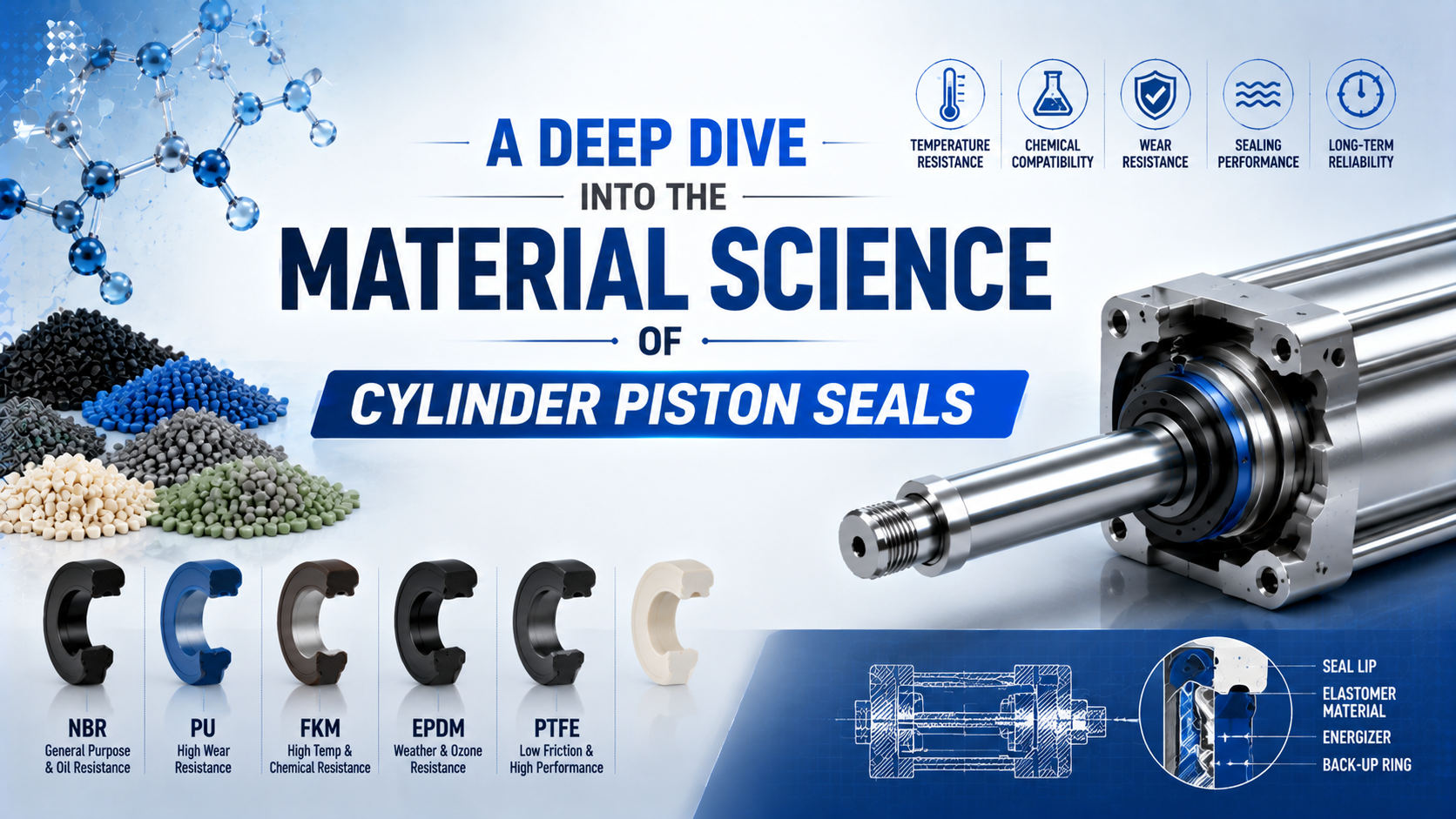
A cylinder piston seal is not defined by the letters NBR, FKM, PU, or PTFE alone. Its behavior comes from a complete system: polymer chemistry, fillers, cure, hardness, lip geometry, energizer, groove, bore finish, lubricant, pressure, speed, temperature, and exposed media. Change one layer and the same material family can produce a very different result.
That is why a raw-polymer temperature limit is not a cylinder rating. The useful engineering question is whether a named compound and seal profile can maintain contact pressure, control the lubricating film, resist wear, and recover after repeated motion inside the selected cylinder.
Key Takeaways
- ASTM D395 defines 3 compression-set test methods, but the test does not predict dynamic seal life by itself.
- Material family, compound, profile, groove, surface, and lubrication must be qualified as one system.
- Product-specific pressure, speed, temperature, and media limits outrank generic polymer charts.
Polymer Family Is Not a Finished Piston Seal Specification
The 55-page ISO 3601-2:2025 standard specifies O-ring housing dimensions for general hydraulic and pneumatic applications, including cylinder bores and piston rods, but it does not turn a polymer name into a finished seal rating (ISO 3601-2:2025). Geometry and compound remain separate engineering decisions.
An elastomer family describes the backbone chemistry. A commercial compound also contains a cure system, reinforcing filler, plasticizer, processing aid, antioxidant, pigment, and other ingredients. Acrylonitrile content changes NBR behavior. Cure chemistry changes FKM behavior. Different polyurethane chemistries can respond differently to moisture, heat, and repeated flexing.
For example, two NBR compounds with the same nominal hardness can use different acrylonitrile contents, plasticizers, fillers, and cure systems. They may not share the same cold recovery, oil swell, compression set, or friction. In our experience, treating the family code as a purchase specification is a frequent cause of replacement ambiguity.
The molded profile then changes how that compound works. A U-cup uses flexible lips. A compact double-acting piston seal may combine sealing and guidance. A PTFE-based slipper normally needs an elastomer energizer because PTFE does not recover like rubber. A wear ring carries side load but is not the primary pressure-sealing lip.
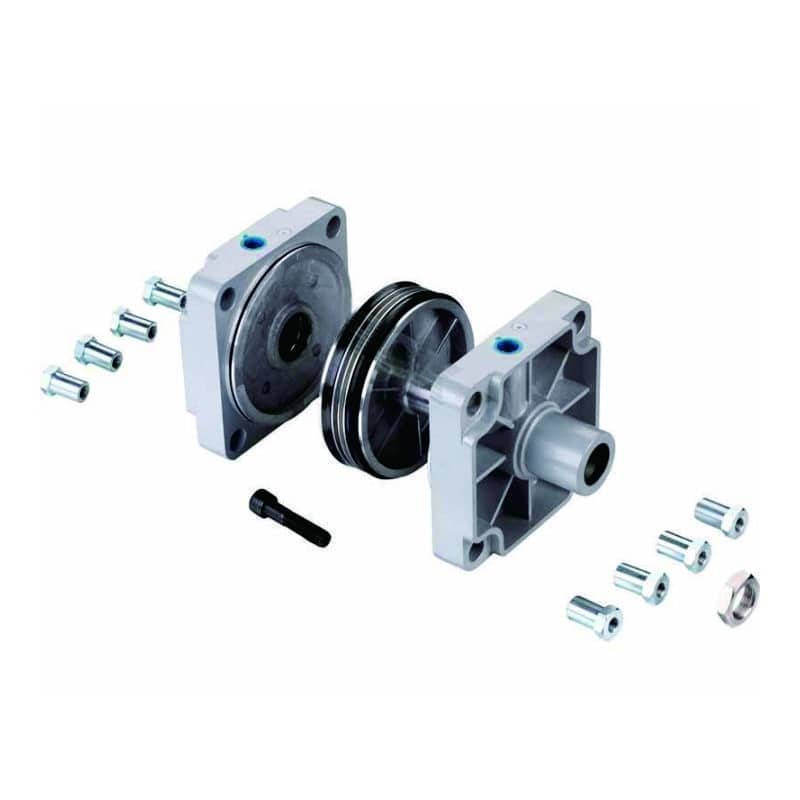
This separation prevents a common specification error. “NBR piston seal” is not enough for a replacement order. The RFQ should identify the cylinder series, bore, groove or service-kit code, motion, pressure, speed, temperature, lubricant, air condition, cleaning agents, and required compliance.
For a broad comparison of material families, use the pneumatic cylinder seal-material selection guide. This article stays with the mechanisms that make two compounds from the same family behave differently.
What Makes an Elastomer Seal and Recover?
A specific Parker Z5 piston seal in N3578 NBR is rated from -30 to +100 degrees Celsius, up to 16 bar and 1 m/s, while the Z5 family offers other compound-dependent limits (Parker Z5 N3578). One profile therefore has both a family envelope and a narrower configured-part rating.
Elastomers are viscoelastic. The polymer chains can deform under load and then move back toward their original arrangement when the load is removed. The “visco” part creates time-dependent loss and hysteresis; the “elastic” part supplies recovery and contact force. A piston seal needs both deformation and return.
At low temperature, molecular motion slows and the compound stiffens as it approaches its glass-transition region. The lip may no longer follow bore variation or reverse direction cleanly. At elevated temperature, the compound can soften, age, lose strength, or continue cross-linking. Neither transition occurs at one universal temperature for an entire polymer family.
Hardness is equally easy to misuse. A harder compound can resist extrusion and deformation, but it may need more pressure to conform at the sealing line. A softer compound can follow small irregularities more easily, yet may generate more adhesion or become vulnerable to damage. Shore hardness does not measure sealing life.
The practical property is not maximum hardness, elongation, or tensile strength. It is retained contact force after the actual combination of squeeze, dwell, cycling, temperature, media exposure, and surface interaction. Test each property as evidence, then reconnect it to the installed seal system.
How Do Compression Set and Stress Relaxation Create Leakage?
ASTM D395-18(2025) defines 3 compression-set methods: constant force in air, constant deflection in air, and constant deflection adjusted for material hardness. The standard says these tests mainly represent static compressive stresses, so a low laboratory result alone does not prove dynamic piston-seal durability (ASTM D395).
Compression set is the deformation that remains after a compressed specimen is released and allowed to recover. Under the common constant-deflection form, the result is:
Here, is compression set as a percentage of the original deflection, is original specimen thickness, is recovered thickness after the specified recovery period, and is spacer thickness during compression. Time, temperature, medium, specimen geometry, deflection, and recovery procedure must accompany the result.
Stress relaxation is the reduction in sealing force while the material remains at a fixed deformation. Parker notes that it depends on elastomer type, mixture, processing, deformation, thickness, time, temperature, and media, and that different test methods are comparable only under identical conditions (Parker O-Ring Handbook).
Why does this matter in a pneumatic cylinder? The seal must maintain enough radial contact to close leakage paths at low pressure and during direction changes. If contact force decays while the lip also wears or shrinks, internal bypass can begin before the seal looks dramatically damaged.
Do not rank compounds by a bare “compression set: 18%” line. Ask for the test method, temperature, duration, medium, original deflection, specimen type, recovery time, and whether the value came from a standard specimen or the finished part. Then compare only like with like.
Why Can Swelling Help Briefly and Still End in Failure?
Parker warns that more than 3% to 4% shrinkage can be serious for dynamic seals, because extraction and volume loss intensify the effect of compression set and can pull the material away from the mating surface (Parker O-Ring Handbook). Short-term swelling is not proof of long-term compatibility.
When a fluid enters an elastomer, the seal may increase in volume, soften, and change strength. Moderate swelling can temporarily increase contact, which can hide a developing compatibility problem. Excessive swelling raises friction, distorts the lip, closes needed groove space, or weakens the material. The cylinder may then move slowly or tear the seal during reversal.
Extraction moves in the opposite direction. Compressor oil, cleaning chemistry, process vapour, or an incompatible lubricant can remove plasticizers or other constituents. The seal may harden and shrink after exposure or after it dries. For instance, a leak appearing after washdown, a lubricant change, or a weekend shutdown deserves a media-history review.
Compatibility is also formulation-specific. EPDM is often selected for hot water, steam, ozone, and polar fluids, but it is generally a poor choice around petroleum oils. NBR is often useful with mineral oils, yet harsh cleaning regimes, ozone, and superheated steam may rule out a particular compound. FKM covers many oils and chemicals, but amines, bases, steam, low temperature, and special process fluids require the exact compound data.
For food and beverage machinery, do not accept “FDA-approved rubber” as a complete statement. Request the finished compound declaration, applicable regulation, extraction or migration test basis, intended food type, temperature, contact duration, cleaning chemistry, colour requirement, and traceability. Compliance belongs to a named material and use condition, not a polymer acronym.
How Do Friction, Lubrication, and Surface Finish Interact?
Trelleborg’s published pneumatic piston-seal range spans 4 to 250 mm, up to 1.6 MPa, -40 to +85 degrees Celsius, and 1 m/s for the listed polyurethane and FKM products (Trelleborg Product Range). Those limits apply to defined products, not every seal made from those polymers.
Dynamic sealing requires a controlled film between the seal and bore. Too little film increases adhesion, heat, and abrasive wear. Too much film can increase leakage or carry lubricant away from the interface. The seal lip, compound, bore finish, grease, pressure, speed, dwell, stroke, and reversal frequency all influence that balance.
Low friction does not automatically mean low wear. Unfilled PTFE has very low friction, but creep and limited elastic recovery may make it unsuitable as a standalone piston seal. Filled PTFE changes stiffness, wear, thermal expansion, and counterface interaction. An elastomer energizer can restore contact force, but the energizer introduces its own temperature and media limits.
Polyurethane often provides strong abrasion and tear resistance in compact pneumatic profiles. It is not one material, however. Thermoplastic polyurethane and cast or thermoset polyurethane can use different soft segments, hard segments, additives, and processing routes. Hydrolysis resistance, low-temperature flexibility, heat resistance, and lubricated friction must be checked at compound level.
Stick-slip is a system symptom. It can arise when static friction exceeds dynamic friction and the pneumatic compliance repeatedly stores and releases energy. Before changing the compound, check seal interference, lubricant condition, bore finish, pressure stability, flow controls, alignment, side load, speed, and dwell time. The low-speed cylinder stick-slip guide covers the motion-level diagnosis.
Comparing NBR, Polyurethane, FKM, and PTFE
Parker lists NBR, HNBR, and FKM options for its Z5 pneumatic piston-seal family, yet one configured N3578 NBR part is rated -30 to +100 degrees Celsius while the family page spans wider compound-dependent limits (Parker Z5 piston seal). Compare finished compounds and profiles, not headline polymer limits.
| Material system | Useful starting strengths | Limits that need verification | Common piston-seal role |
|---|---|---|---|
| NBR compound | Oil compatibility, established supply, balanced mechanical properties | Low-temperature recovery, heat aging, ozone, cleaner compatibility, compression set | General-purpose elastomer lip or compact seal in a qualified cylinder series |
| Polyurethane compound | Abrasion resistance, tear strength, compact lips, load-bearing capability | Hydrolysis, heat, low-temperature flexibility, dry-running friction, chemistry-specific behaviour | Wear-resistant U-cup or compact pneumatic piston seal |
| FKM compound | Elevated-temperature capability and resistance to many oils and chemicals | Low-temperature flexibility, steam, bases, amines, cure-system and grade differences | Special-temperature or chemical-service elastomer seal |
| EPDM compound | Hot water, steam, ozone, weathering, many polar fluids | Petroleum oils, greases, and application-specific cleaning chemistry | Special media or washdown service when lubrication is compatible |
| Silicone or VMQ compound | Low-temperature flexibility and selected high-temperature capability | Tear strength, abrasion, dynamic wear, permeability, installation damage | Special low-temperature or low-friction duties after profile validation |
| Filled PTFE plus energizer | Low sliding friction, broad chemical resistance, controlled extrusion | Creep, limited inherent recovery, filler wear, energizer limits, surface finish | Energized slipper seal for low-friction or special-media applications |
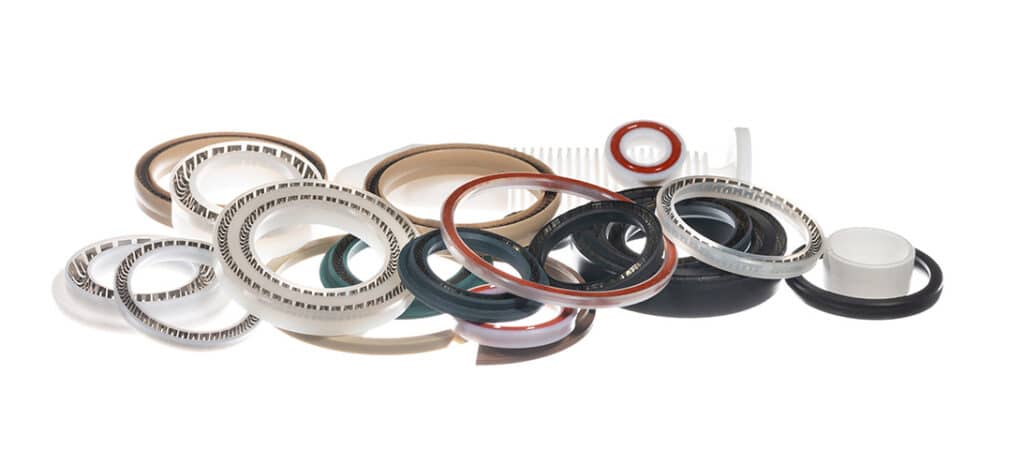
PEEK, nylon, and other engineering plastics belong in the discussion, but often as guide rings, wear rings, back-up rings, or structural elements. Their job may be to carry side load, control the extrusion gap, or prevent metal contact. Calling every polymer ring a piston seal erases the difference between guidance and pressure sealing.
Across the configured Parker and Trelleborg product data cited above, the same decision pattern appears: the useful rating attaches to a compound-profile combination. In our manufacturing work, we found that drawings which name only the polymer and nominal hardness leave too many uncontrolled variables for reliable substitution.
If the immediate task is choosing among material families, start with the seal-material application guide. If the issue is thermal exposure, use the temperature and seal-material guide. Neither should replace the configured product data.
What Do Fillers, Cure Systems, and Seal Geometry Change?
Parker’s O-Ring Selector searches a database of more than 2,500 materials and combines material selection with dimensions, tolerances, thermal expansion, and volume swelling (Parker O-Ring Selector). That scale explains why a four-row polymer chart cannot qualify a cylinder piston seal for an installed application.
Carbon black can reinforce elastomers and change modulus, hardness, electrical behaviour, wear, and processing. Silica, mineral fillers, fibres, pigments, plasticizers, lubricating additives, and stabilizers can shift other properties. In PTFE systems, glass, carbon, bronze, graphite, or polymeric fillers can alter wear, creep, conductivity, and counterface requirements.
Cure systems matter because they build the network that gives an elastomer its recovery. Cross-link density influences modulus, elongation, compression set, heat resistance, and chemical response. More cross-linking is not automatically better: it can improve some forms of dimensional stability while reducing flexibility or resistance to crack growth.
Geometry can outweigh a modest compound difference. Lip thickness controls flexibility. Initial interference affects breakaway friction and low-pressure sealing. Chamfers and radii affect installation damage. Groove volume must leave room for deformation and media-induced swell. The pressure direction decides whether the lip is energized or unloaded.
Seal interference is the intentional dimensional overlap that creates initial contact between the sealing lip and bore. Too little can impair low-pressure sealing. Too much can raise breakaway force, heat, and wear. From our analysis of seal and groove drawings, this interface is often more actionable than a generic hardness comparison.
Treat the chain as a traceability requirement. If a supplier cannot connect the finished seal code to the compound, profile drawing, groove, lubrication, and test conditions, the material name is descriptive but not sufficient for design approval.
Piston Seal Qualification Workflow
ISO 3601-2:2025 presents 2 design approaches: start with the O-ring and design the housing, or start with fixed bore or rod hardware and select a suitable O-ring. It also states that special-application housing dimensions should be agreed between manufacturer and user (ISO 3601-2:2025).
For a proprietary piston profile, apply the same discipline with product-specific data. Start with the operating envelope, then confirm the installed interface.
Qualification becomes unreliable when any of these traceability links is missing:
- A finished seal code connected to a controlled compound and profile drawing.
- A groove, bore finish, lubricant, and assembly method connected to that profile.
- Test conditions and acceptance limits connected to the real cylinder duty.
- Identify the hardware: Cylinder series, bore, stroke, piston construction, groove dimensions, extrusion gap, bore material and finish, ports, cushions, and guidance.
- Define motion: Speed range, cycle rate, dwell, reversal, stroke utilisation, acceleration, start-up after long stops, and required low-speed smoothness.
- Define load and pressure: Working and peak pressure, pressure direction, side load, moment, shock, and any pressure trapped during a stop.
- List every exposure: Compressed-air oil, grease, condensate, cleaning agents, process vapours, dust, ozone, UV, washdown, and temperature at the seal location.
- Specify acceptance: Permitted leakage, breakaway force, running friction, wear, dimensional change, compression set or force retention, cycle duration, and inspection interval.
- Control the part: Supplier, drawing revision, compound code, cure and production traceability, inspection method, storage, shelf life, and change-notification requirement.
Bench tests should reproduce the risk, not merely produce a large cycle count. A cold-start problem needs cold soak and realistic dwell. A washdown problem needs the real cleaner, concentration, temperature, exposure time, rinse, and drying sequence. A stick-slip problem needs the actual bore finish, grease, pressure, speed, side load, and stop duration. Do not qualify a seal by running it until it still moves. Define failure before testing: leakage rate, friction increase, visible wear, extrusion, dimensional change, cracking, loss of contact force, contamination, or inability to meet motion requirements. Record intermediate measurements so the failure trend is visible.
What Can a Failed Seal Reveal About the Root Cause?
ISO 8573-1 classifies compressed-air purity around 3 contaminant groups: particles, water, and oil. Those exposures can alter friction, lubrication, corrosion, and seal condition, but the standard does not prescribe one universal purity class for every cylinder (ISO 8573-1). Preserve operating evidence before cleaning the parts.
| Evidence | More consistent with | Confirmation needed |
|---|---|---|
| Uniform polished wear | Normal service wear, high friction, unsuitable compound, or poor lubrication | Cycles, speed, temperature, grease, bore finish, and leakage trend |
| Wear concentrated on one sector | Side load, misalignment, worn guide, or distorted piston | Matching guide wear, cylinder alignment, load direction, and bore marks |
| Hard, glazed, or cracked lip | Heat aging, cold flexing, ozone, chemical extraction, or excessive friction | Compound code, local temperature, exposure history, and laboratory comparison |
| Soft, swollen, or sticky material | Fluid absorption, cleaner incompatibility, wrong grease, or thermal degradation | Mass and volume change, media identity, hardness, and reference sample |
| Shrunken lip or loss of contact | Extraction, aging, stress relaxation, or wrong compound | Dimensional comparison, media history, retained-force or compression-set data |
| Parallel scratches or embedded particles | Abrasive contamination, damaged bore, or installation debris | Particle identification, filter history, bore inspection, and assembly record |
| Cut, nicked, or rolled lip | Sharp chamfer, wrong tool, incorrect orientation, twisting, or forced assembly | Groove edges, installation method, part identity, and first-leak timing |
| Extruded or nibbled edge | Excessive clearance, pressure, temperature, side load, or missing support | Measured gap, pressure history, guide condition, and approved profile limit |
Photograph the installed orientation and clock position before removing the seal. Keep the seal, guide ring, piston, bore evidence, lubricant residue, and debris connected to the same work order. A one-sided scar loses much of its meaning when its direction relative to the load and guide is forgotten.
The failed seal is a recorder, not always the initiating fault. A fresh seal may temporarily conform to a misaligned piston or damaged bore and appear to solve the leak. If the load path, surface, contamination source, or groove condition remains unchanged, the same wear signature will return.
The piston rod seal leak diagnosis explains how to separate symptoms from initiating causes. For internal bypass, use the pneumatic cylinder internal-leakage guide. The industrial seal-type guide helps distinguish piston seals, rod seals, wipers, static seals, and guide elements.
Cylinder Piston Seal Material FAQs
Parker’s online selector searches more than 2,500 materials, while ISO 3601-2:2025 covers 55 pages of housing dimensions. Those numbers show why material selection and interface design cannot be reduced to one polymer chart (Parker O-Ring Selector; ISO 3601-2:2025). These 5 answers define the minimum qualification boundary.
Is polyurethane always better than NBR for a pneumatic piston seal?
No. A qualified polyurethane profile may offer stronger abrasion and tear resistance, while a qualified NBR compound may better fit the cylinder’s lubricant, temperature, friction, cost, and service-kit requirements. Compare named compounds and profiles under the same pressure, speed, media, surface, and test conditions. Polymer labels alone cannot rank service life.
Can I use a polymer’s maximum temperature as the cylinder limit?
No. Raw-polymer capability ignores the compound, seal geometry, energizer, grease, guide, sensor, magnet, tube, end seals, dwell, pressure, speed, and exposure duration. Use the configured seal or cylinder rating. If temperature cycling or local frictional heat matters, validate the complete assembly at the seal location, not ambient temperature alone.
Does a low compression-set result guarantee low leakage?
No. ASTM D395 mainly evaluates rubber under static compressive stress, and results depend on the selected method and test conditions. A dynamic piston seal also depends on retained force, lip geometry, wear, lubricant film, bore finish, pressure cycling, direction reversal, temperature, media, and guidance. Compare compression-set values only under identical conditions.
Why does an FKM seal sometimes fail in a chemical application?
FKM is a family of fluoroelastomer compounds, not universal chemical protection. Cure system, fluorine content, formulation, temperature, pressure, time, and exposure to steam, amines, bases, oils, cleaners, or process fluids can change performance. Confirm the exact compound against every medium and validate combined exposures rather than checking chemicals one at a time.
What information should a piston-seal RFQ include?
Provide the cylinder manufacturer and series, bore, stroke, piston or service-kit code, groove drawing, pressure, speed, cycle rate, dwell, temperature, air quality, lubricant, cleaning chemicals, process media, bore material and finish, side load, leakage limit, compliance needs, expected quantity, and failed-part evidence. Request the proposed compound and profile codes in return.