

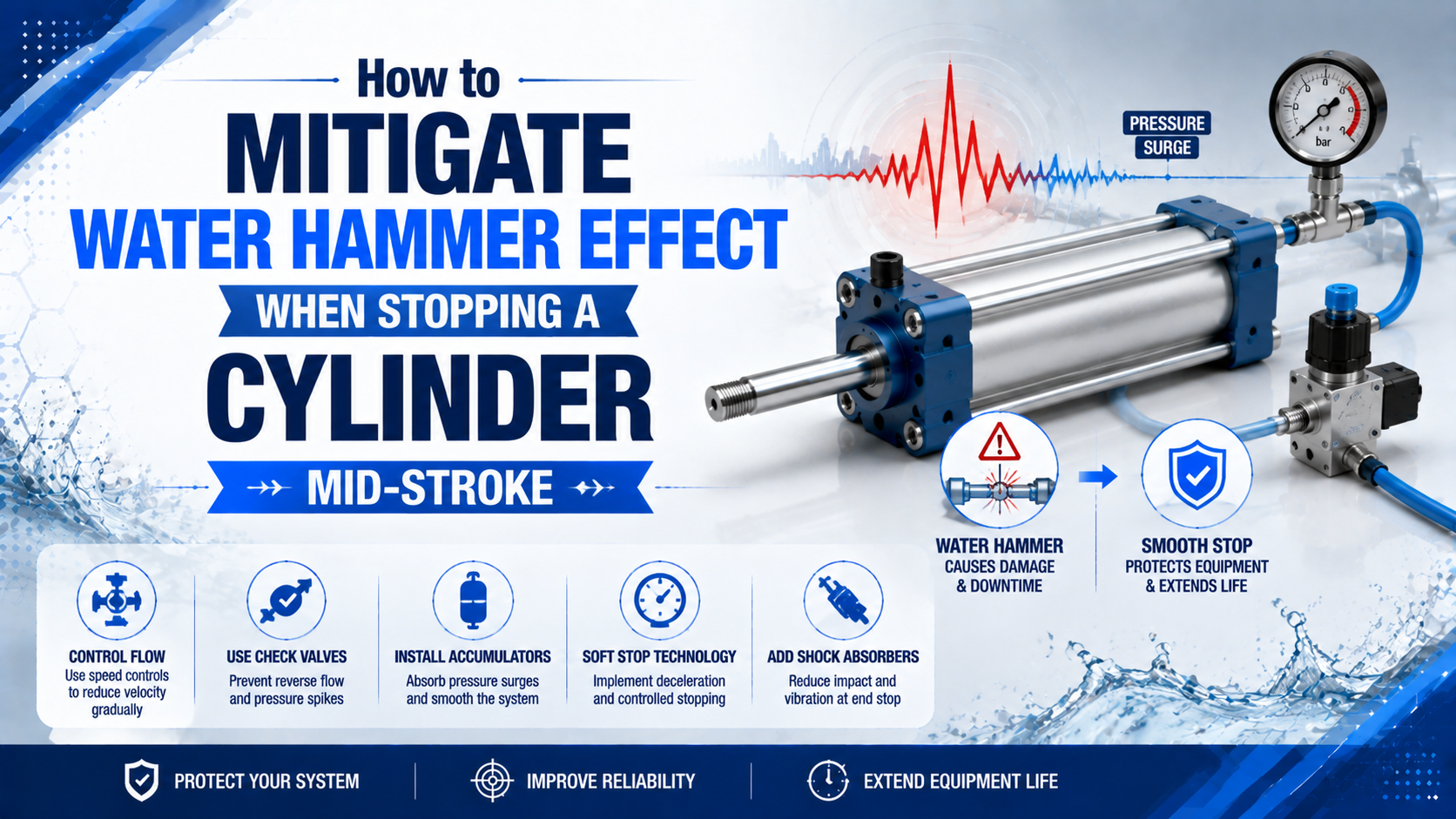
A pneumatic cylinder stopped mid-stroke is usually experiencing a motion-control transient, not classic liquid water hammer. Momentum remains in the moving load, compressed air behaves like a spring, and the directional valve determines whether each chamber fills, exhausts, or traps pressure. Safe mitigation must control all three. The practical goal isn’t merely to silence a bang. It is to slow the load within a known distance, reach a defined post-stop pressure state, prevent drift, and make any safety function independent of a normal PLC command. The related guide to water hammer in pneumatic valve systems covers broader valve, exhaust, end-impact, and condensate faults. This article stays focused on stopping a cylinder between its end positions.
That distinction changes the hardware decision.
Key Takeaways
- A 5/3 closed-center valve traps air but cannot guarantee accurate or long-term position holding.
- Stopping energy rises with the square of cylinder speed.
- End cushions do not protect an arbitrary mid-stroke stop.
- Emergency stopping, process stopping, and vertical load holding require different circuits and validation.
Is a Mid-Stroke Stop Really Water Hammer?
SMC warns that a cylinder stopped by a 3-position closed-center valve cannot match hydraulic stopping accuracy because air is compressible. Manufacturer guidance also notes that ordinary valves and cylinders aren’t guaranteed to have zero leakage (SMC NCQ8 catalog, 2026). This mechanism differs from classic liquid water hammer.
Pneumatic stopping shock is the combined pressure and mechanical transient produced when a moving pneumatic axis decelerates. In a dry circuit, an abrupt valve command can start that event: the load keeps moving, one chamber compresses, the other may exhaust or become trapped, and the structure reacts. There is no defensible universal multiplier such as “five times normal pressure.” Circuit volume, piston area, load, speed, valve state, tubing, and compliance all matter.
The word “water hammer” becomes literal only when liquid condensate has accumulated and moves as a slug. Otherwise, pneumatic stopping shock, chamber-pressure transient, or mid-stroke impact usually describes the event more accurately.
| What you observe | Likely mechanism | First useful measurement | Appropriate response |
|---|---|---|---|
| Bang immediately after valve changeover | load inertia plus rapid chamber pressure change | both cylinder-port pressures and position | add controlled deceleration and review valve center state |
| Cylinder rebounds or oscillates | trapped air acting as a spring | position and pressure on both sides of the piston | revise damping, dead volume, and stop sequence |
| Exhaust-side pressure rises during motion | restricted silencer, manifold, tube, or meter-out path | pressure at the cylinder exhaust port and valve exhaust | remove the restriction or resize the exhaust path |
| Axis creeps after stopping | internal leakage, seal bypass, or changing external load | position over time and chamber pressures | add a suitable holding device or feedback-controlled correction |
| Water appears at drains or exhausts | condensate accumulation | dew point, drain operation, and low-point inspection | correct air treatment and drainage before tuning motion |
Sound location isn’t necessarily the source. Machine frames can radiate noise far from the chamber where pressure first changed. Synchronizing valve command, position, and two pressure traces is more useful than following the bang.
Which Stop Function Does Your Machine Need?
ISO 13850:2015 defines emergency-stop principles independently of the machine’s energy type, but it does not by itself specify braking, reversing, or energy disconnection (ISO 13850, 2015). That boundary matters: a controlled production stop and a risk-reduction emergency stop aren’t interchangeable.
First, name the stop.
Write the required function before selecting a valve. What must the load do after the stop command?
| Required function | Intended result | Typical control approach | Main limitation to verify |
|---|---|---|---|
| Normal process stop | decelerate to a repeatable location | proportional valve, staged flow, or position-controlled pneumatic axis | tuning changes with load, pressure, friction, and temperature |
| Temporary pause | stop motion, then resume without high precision | suitable 5/3 center state with controlled approach speed | trapped air can compress, leak, and move under external force |
| Intermediate position hold | remain within a defined position window | feedback plus pilot checks, a rod lock, or a mechanical clamp | static holding and dynamic braking require different ratings |
| Emergency stop | reduce risk as quickly as the risk assessment requires | validated safety-related control function | a standard PLC output or ordinary solenoid isn’t enough |
| Vertical load retention | prevent a fall after pressure or power loss | spring-engaged brake, rod lock, or mechanical restraint | release sequencing, load capacity, stopping distance, and diagnostics |
End cushions solve another job. Cushioning dissipates energy only near the designed end-of-stroke zone. If the stop can occur anywhere along the stroke, the piston may never enter that zone. The pneumatic cylinder cushioning guide is useful for end impacts, but it doesn’t turn an ordinary cylinder into a mid-stroke brake.
How Should You Diagnose a Mid-Stroke Pressure Shock?
ISO 4414:2010 covers pneumatic-system design, installation, adjustment, operation, and maintenance hazards, and the edition was confirmed as current in 2021 (ISO 4414, 2021). A useful diagnosis therefore includes both the air circuit and the moving machine, not just the regulator gauge.
Capture motion and pressure together.
Record these five signals on one time base:
- Directional-valve command or spool feedback
- Cylinder position and calculated speed
- Cap-end pressure close to the cylinder port
- Rod-end pressure close to the cylinder port
- Exhaust-gallery pressure when a shared exhaust may be restrictive
Use transducers and fittings rated for the expected pressure and environment. Long diagnostic hoses add dead volume and can blur a short event. Before installing or relocating sensors, isolate the machine and control stored pneumatic and mechanical energy under the site’s energy-control procedure.
Start with the lowest speed and a representative load. Change one variable per run: approach speed, meter-out setting, valve center command, exhaust restriction, or external load. Don’t jump straight to a larger valve. More flow may shorten cycle time while increasing acceleration and stopping energy. If pressure rises in the nominally exhausting chamber, inspect the complete path from the cylinder port to atmosphere. That includes the flow controller, tube, directional valve, manifold gallery, silencer, and enclosure vent. The guide to pneumatic back pressure explains why a clean supply gauge can coexist with a restricted exhaust.
The timing of the first deviation separates several similar-sounding faults. A pressure change at the valve command points toward switching and chamber filling. A rise after deceleration begins points toward trapped volume or exhaust restriction. Position movement after pressures settle points toward leakage, compliance, or an external force.
Which Circuit Can Stop and Hold the Cylinder?
Festo identifies three common 5/3 center conditions: closed, pressurized, and exhausted. Closed-center geometry blocks supply and working ports, but Festo also notes that internal leakage can depressurize the cylinder over time (Festo pneumatic valve guide, 2026). Center symbols define the air state, not guaranteed position accuracy.
No single valve state solves every duty.
Closed-center 5/3 valve
Closed-center spools trap air in both cylinder chambers. Such a circuit can pause a lightly loaded horizontal axis, but the piston may move while the trapped air compresses. Leakage, temperature change, seal friction, rod-area difference, and an external load can shift the final position. Use it only when the permitted drift and stop distance are known.
Pressure-center and exhaust-center valves
Pressure-center spools supply both working ports. Because a single-rod cylinder has unequal effective areas, equal pressure doesn’t create equal force. Exhaust-center spools vent both chambers, which can remove drive pressure but also release the pneumatic support holding a vertical load. Neither center state should be called “fail-safe” without a machine-level analysis.
Meter-out flow control
Meter-out control restrains exhaust flow and often gives steadier speed than meter-in control for a resisting load. It doesn’t create a position command. An abrupt center command still changes the circuit state quickly, so deceleration must begin before the target or use a valve that can modulate flow. Compare the meter-out circuit guide with the broader meter-in versus meter-out decision before choosing orientation.
Pilot checks, double-check blocks, and rod locks
Pilot-operated checks and double-check blocks can hold chamber pressure longer than a standard spool valve. Both still depend on sealed air and correct pilot sequencing. SMC’s VQZ perfect-block instructions say piping leakage can prevent an extended stop and that excessive exhaust restriction reduces stopping accuracy (SMC VQZ catalog, 2026).
Mechanical rod locks and clamping units restrain the piston rod directly. This makes them useful for drift prevention and vertical load retention, but only after checking whether the device is rated for static holding, dynamic braking, or both. The rod-lock selection guide separates those duties.
Quick exhaust and relief devices
Quick-exhaust hardware shortens the exhaust route, but it can also increase cylinder speed. It is not a braking device. Measure the restriction first, then retest speed and stopping distance if one is installed. The quick-exhaust valve guide covers placement and pilot behavior. Relief valves limit pressure only after their cracking conditions are reached; they don’t automatically control the moving load or make the stop repeatable. Likewise, a receiver can buffer supply demand, but it isn’t a universal absorber for a local cylinder stop.
Choose the desired physical state after the stop: pressure trapped, pressure maintained, pressure exhausted, or rod mechanically restrained. Starting from that state exposes whether the circuit needs a different center valve, a feedback loop, a holding device, or a separate safety function.
Calculating Stopping Energy and Deceleration Distance
Festo describes its DNCKE-S clamping unit as a device that can brake motion and hold intermediate positions, while also requiring braking overtravel to be checked regularly (Festo DNCKE-S, 2026). That instruction reflects a basic fact: a moving load needs distance and a rated device to dissipate energy.
Speed is the expensive variable.
Start with the translational kinetic energy of the moving mass:
Here, is kinetic energy in joules, is the total moving mass in kilograms, and is speed in metres per second immediately before deceleration. Include the piston, tooling, workpiece, guided carriage, and any reflected moving mass that the cylinder must stop.
For example, a 25 kg assembly moving at 0.8 m/s has 8 J of kinetic energy. At 1.6 m/s, the same assembly has 32 J. Doubling speed quadruples kinetic energy. That is why a small speed increase can turn a stable stop into rebound, seal stress, or a damaged clamp.
A first estimate of average deceleration force is:
In this expression, is average force in newtons and is controlled stopping distance in metres. Dissipating 8 J over 20 mm gives an average inertial force of about 400 N. This simplified value excludes ongoing pneumatic drive force, friction variation, pressure dynamics, shock peaks, structural flexibility, and gravity.
Don’t use that estimate as a component rating. Compare the mass, speed, energy per stop, cycle rate, permitted overtravel, temperature, and installation orientation with the selected proportional valve, shock absorber, brake, or clamping-unit documentation. If supply pressure continues driving the piston during deceleration, include that work in the manufacturer’s specified selection method.
How Should Mid-Stroke Stops Be Integrated into Emergency-Stop Safety?
ISO 13849-1:2023 applies to safety-related control systems using electrical, hydraulic, pneumatic, and mechanical technologies, but it does not assign the required Performance Level for a particular machine (ISO 13849-1, 2023). The risk assessment must define the safety function, required response, diagnostics, and validation.
Write the function in measurable terms. For example: when the protective device is actuated, the axis must decelerate without ejecting the workpiece, stop before a defined hazard boundary, and remain within a permitted position window until a deliberate reset. A vertical axis may also need to remain supported after pneumatic energy is exhausted.
A safety-related stop may involve:
- A guard switch, light curtain, or emergency-stop device
- Safety relay or safety PLC logic
- Redundant or monitored valve architecture where required
- A safe exhaust function for the relevant pneumatic zone
- A dynamically rated brake or clamping unit
- Position, pressure, valve-state, or lock-state feedback
- Controlled reset and restart logic
The safety exhaust valve integration guide explains depressurization. Keep in mind that exhausting air and restraining a load are separate functions. Venting both cylinder chambers can make a vertical load fall unless a mechanical device supports it first. An ordinary PLC output is not a safety function merely because the program calls it an emergency stop. ISO 13850 also makes clear that the emergency-stop function is a complementary protective measure. It doesn’t replace guarding, prevention of unexpected startup, energy isolation for servicing, or a mechanical restraint when gravity remains hazardous.
Commissioning Checklist for a Stable Mid-Stroke Stop
OSHA 29 CFR 1910.147(d)(5) requires stored or residual energy to be relieved, disconnected, restrained, or otherwise rendered safe during servicing (OSHA 1910.147, 2026). Commissioning measurements and adjustments must therefore be planned around controlled isolation, not improvised access to a live axis.
Test the real operating envelope, not one unloaded demonstration:
- Verify component models, flow directions, valve center state, and tubing connections against the circuit drawing.
- Confirm the moving mass, load direction, center of gravity, guidance, and credible external forces.
- Begin at reduced speed and record valve command, position, speed, and both chamber pressures.
- Measure stopping distance, rebound, settling time, and final drift at minimum and maximum expected supply pressure.
- Repeat with minimum and maximum load, temperature range, and representative cycle rate.
- Test loss of electrical power, loss of air, blocked exhaust, sensor fault, and restart behavior as required by the risk assessment.
- Verify that a static lock engages only after motion stops, unless its documentation explicitly permits dynamic braking.
- Record accepted settings, traces, limits, inspection intervals, and safe recovery steps.
| Acceptance item | Record | Reject the setup when |
|---|---|---|
| Stop distance | worst measured travel after the stop request | the load crosses the defined safe boundary |
| Chamber pressure | peak, minimum, and settled values on both ports | a component rating or required holding pressure is exceeded or lost |
| Position stability | rebound and drift over the required hold time | the process or safety position window is violated |
| Brake or lock state | engagement time, feedback, and load result | motion continues outside the product’s permitted braking envelope |
| Restart | pressure build-up, release sequence, and first movement | the axis jumps, drops, or starts without the required reset |
Maintenance should trend the same variables used for acceptance. A growing stop distance can point to brake wear, a clogged exhaust, reduced supply pressure, changed load, loose guidance, or altered flow-control settings. Noise alone is a poor maintenance limit.
Pneumatic Cylinder Mid-Stroke Stop FAQs
SMC’s 3-position closed-center guidance identifies two persistent limits: air compressibility reduces stopping precision, and ordinary valve or cylinder leakage prevents guaranteed long-term holding (SMC NCQ8 catalog, 2026). These four answers address the circuit choices buyers most often confuse.
Can a 5/3 closed-center valve hold a cylinder accurately mid-stroke?
Trapped air can pause some loads, but it cannot guarantee high positioning accuracy or indefinite holding. Piston position may change as air compresses, leaks, or changes temperature. External load and single-rod area difference also matter. Use feedback or a mechanical holding device when the permitted position window is small.
Will a quick-exhaust valve eliminate mid-stroke pressure shock?
Not by itself. It can lower exhaust-path resistance, yet the resulting higher cylinder speed may increase kinetic energy and stopping distance. Measure exhaust pressure before changing hardware. After installation, retest speed, both chamber pressures, rebound, and end impact under the real load rather than judging the result from sound alone.
Can cylinder end cushioning protect an arbitrary mid-stroke stop?
No. Adjustable air cushions and elastomer bumpers act only near the cylinder’s designed end positions. A stop in the middle of the stroke does not enter that cushion zone. Use controlled deceleration, a correctly rated external device, or a braking and holding system designed for the required intermediate position.
Is a rod lock enough to create an emergency-stop function?
No. A rod lock can support a safety function only within its static or dynamic rating and specified control sequence. The complete function may also need safety logic, monitored valves, feedback, guarding, safe exhaust, reset control, and validation to the Performance Level established by the machine risk assessment.
Sources and technical references
- ISO 4414:2010, pneumatic-system safety scope and lifecycle status. Retrieved 2026-07-19.
- ISO 13850:2015, emergency-stop principles and scope. Retrieved 2026-07-19.
- ISO 13849-1:2023, safety-related control-system design methodology. Retrieved 2026-07-19.
- OSHA 29 CFR 1910.147, hazardous-energy control and stored-energy requirements. Retrieved 2026-07-19.
- SMC NCQ8 catalog, intermediate-stop limits caused by air compressibility and leakage. Retrieved 2026-07-19.
- SMC VQZ catalog, perfect-block circuit limitations and leakage cautions. Retrieved 2026-07-19.
- Festo pneumatic valve guide, 5/3 center-position behavior. Retrieved 2026-07-19.
- Festo DNCKE-S documentation, braking, holding, and overtravel requirements. Retrieved 2026-07-19.