

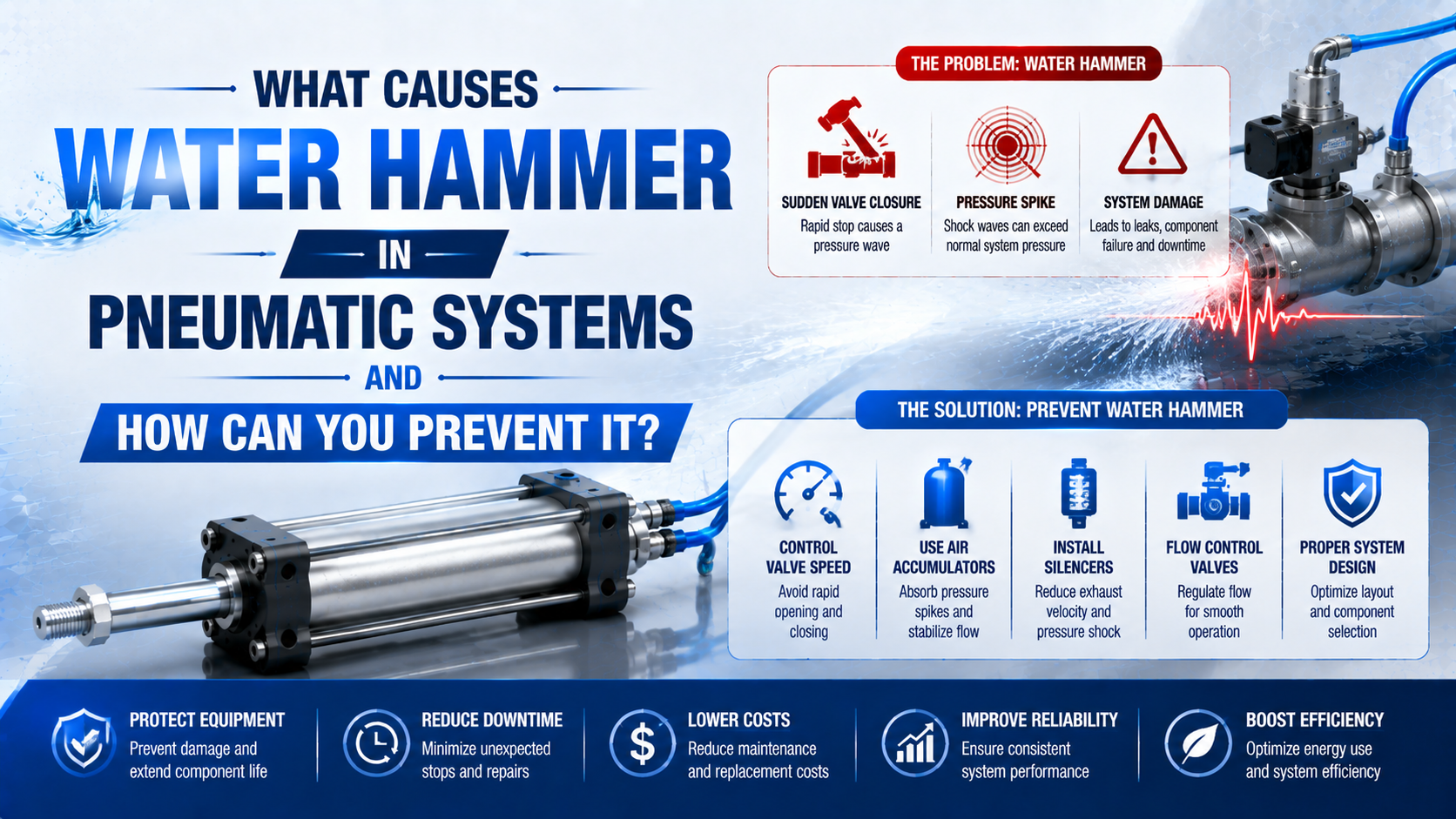
A bang in a pneumatic system isn’t one fault with one cure. It may be a dry-air pressure transient, a liquid condensate slug, abrupt repressurization, or a restriction that creates back pressure. Prevention starts by identifying which event occurs first, then correcting drainage, valve sequencing, line layout, or pressure build-up at that location.
This article focuses on plant compressed-air distribution and restart behavior. For machine-level valve switching, cylinder cushioning, and exhaust diagnosis, use the separate guide to mitigating water hammer in pneumatic valve systems.
Key Takeaways
- Separate four mechanisms before selecting hardware.
- Treat pooled condensate as a liquid-handling problem, not a flow-control setting.
- Record pressure before and after the suspected restriction during the event.
- Repressurize isolated branches deliberately and verify every automatic drain.
Is Pneumatic Water Hammer the Same as Hydraulic Water Hammer?
Not usually. Engineering references generally reserve water hammer for pressure surges in liquid-conveying pipelines, while ISO 8573-1 identifies water as one of three principal compressed-air contaminant groups (ScienceDirect; ISO 8573-1). A dry-air wave and a water slug therefore need different names and different remedies.
Classic hydraulic water hammer begins when the velocity of a liquid column changes rapidly. The resulting pressure wave reflects through the liquid-filled pipe. A dry compressed-air network is more compressible and contains changing storage volumes, regulators, check valves, dryers, receivers, branches, and demand events. Its transient response cannot be predicted by copying a liquid water-hammer percentage or table.
Plant teams still use “pneumatic water hammer” as a practical label for several bangs and pressure events. That’s acceptable during an initial report, but the work order should identify the actual mechanism before parts are purchased.
A pneumatic pressure transient is a time-varying pressure disturbance in compressed air. A condensate slug is a collected liquid volume driven along the pipe by the air stream. Rapid repressurization is the uncontrolled filling of an isolated downstream volume. These definitions keep unlike failure mechanisms from sharing one misleading diagnosis.
| Shop-floor description | More precise mechanism | First place to investigate |
|---|---|---|
| Bang immediately after opening an isolated branch | rapid repressurization or trapped-volume filling | isolation valve, regulator, soft-start device, downstream volume |
| Knock follows wet-air symptoms or drain failure | moving condensate slug | separator, dryer, receiver drain, low points, drop legs |
| Pressure falls during a large demand event | distribution pressure drop | header, branch diameter, filters, valves, point-of-use connections |
| Bang occurs at machine valve changeover | local pneumatic transient, exhaust restriction, or end impact | directional valve, actuator ports, exhaust, cylinder cushioning |
The loudest location isn’t necessarily the source. Pipe supports and panels can radiate sound far from the first pressure change. In our experience, asking “what happened first?” is more useful than starting with a replacement-parts list. Compare the noise with isolation-valve movement, compressor loading, drain operation, machine demand, and branch pressure.
What Events Cause Banging in a Compressed-Air Distribution System?
Four event families cover most useful first checks. The U.S. Department of Energy describes an industrial network as mains, branches, valves, and hoses, and recommends sloped piping with accessible drop legs and drain points (DOE sourcebook). Those details matter because layout, moisture, and demand interact.
Condensate collects and then moves
Air leaving a compressor contains water vapor. Cooling in an aftercooler, receiver, dryer, or distribution line can produce liquid water. If a separator or automatic drain stops working, liquid may collect in a receiver connection, low point, dead leg, filter bowl, or poorly pitched header.
When flow rises, compressed air can push that liquid along the pipe. A water slug striking a bend, valve, reduction, or closed end is a liquid-impact event. Experimental work on condensate impact used compressed air to propel a water slug and demonstrated that gas-driven liquid movement can impose severe local loads, although its test pressures must not be generalized to factory air systems (Owen, Amini, and Stephens, 1998).
An isolated volume is pressurized too quickly
Opening a full-bore isolation valve into a depressurized branch releases stored air into an empty volume. Regulators, check valves, and local receivers change the rate and shape of the pressure rise. Downstream actuators may also move before control pressure and mechanical restraint reach their intended state.
Don’t assume a slow hand motion produces a controlled fill. Valve flow area may rise sharply over a small part of its travel, and a ball valve can pass substantial flow well before it appears fully open.
Demand changes faster than the distribution system can respond
Several machines starting together can pull pressure down at a remote branch. Compressor or pressure-flow controls then respond, and the recovery may appear as an oscillation. This isn’t classic water hammer. It is a supply, storage, control, and distribution interaction that should be evaluated with time-aligned pressure and flow data.
A restriction creates local back pressure
Clogged filters, undersized connectors, partially open valves, frozen drains, and narrow branch lines can create a large dynamic pressure difference. The sound may occur when the restriction clears or demand stops. A normal compressor-room gauge doesn’t rule this out because it doesn’t show pressure at the affected branch.
The related guide to pressure fluctuations in pneumatic systems covers supply-demand instability in more detail.
A Safe Diagnostic Method
Start with safe, synchronized measurements. OSHA 29 CFR 1910.147 applies to pneumatic energy and requires hazardous stored or residual energy to be relieved, disconnected, restrained, or otherwise rendered safe before servicing (OSHA guidance). Sensor installation and drain inspection belong inside that energy-control procedure.
Once rated instruments have been installed safely, capture the event on one time base. Useful signals include:
- compressor discharge or receiver outlet pressure
- header pressure near the affected branch
- branch pressure upstream and downstream of the suspected restriction
- isolation-valve, drain, or machine-demand state
- dew point, separator status, or visible drain discharge when moisture is suspected
Put pressure transducers close to the test points. Long temporary hoses add volume and can soften or delay a fast signal. Select the transducer range, fittings, tubing, and sampling rate for the pressure and event duration you expect. There is no universal sampling rate that fits every plant.
Next, change one condition at a time. Sequence the high-demand machines, operate the branch from a lower upstream pressure where the approved procedure permits, inspect one drain, or temporarily compare pressures across one filter. If the event moves with the change, you’ve narrowed the mechanism.
| Measurement pattern | Likely diagnosis | Next controlled test |
|---|---|---|
| Upstream pressure stable, downstream pressure drops | local restriction or insufficient branch capacity | measure across filter, valve, hose, and connector |
| Both pressures fall during simultaneous demand | supply, storage, or header-capacity interaction | stagger loads and review compressor control response |
| Pressure rises sharply only during branch restart | repressurization transient | test an approved progressive-fill sequence |
| Event follows wet discharge or failed drain | condensate accumulation and movement | isolate, drain safely, and inspect low points |
For steady-state screening, the Compressed Air Pressure Drop Calculator can compare flow, length, inside diameter, and working pressure. It does not predict a transient peak.
How Do You Prevent Condensate Slugs?
Design the water out of the flow path. The DOE sourcebook recommends a loop distribution system, sloped headers, accessible low-point drains, and point-of-use connections from the top or side of the header rather than the bottom (DOE sourcebook). These measures reduce liquid carryover into branches.
Start at the compressor room and follow the air downstream:
- verify aftercooler and moisture-separator performance
- check receiver, separator, dryer, filter, and low-point drains
- confirm the dryer pressure dew point is suitable for the lowest downstream temperature
- inspect outdoor and cold-zone piping for freezing risk
- check header slope and identify undocumented dead legs
- connect production branches from the top or side of the main header
- provide accessible drop legs at locations where liquid can collect
ISO 8573-1 classifies compressed-air purity by particles, water, and oil, but it doesn’t select the required class for every process. Specify the water requirement at the point of use, then verify it under the coldest credible operating condition. The ISO compressed-air quality guide explains how to document that requirement.
An automatic drain isn’t proven healthy because its indicator is on. A timed drain may open too briefly to clear accumulated liquid, while a blocked strainer can prevent discharge. Confirm actual condensate removal and route the discharge according to local environmental requirements.
Recurring water downstream of a dryer may be a distribution-temperature problem rather than a failed dryer. Compare pressure dew point with the coldest pipe temperature. If the line cools below the relevant dew-point condition, water can appear far from the compressor room.
Controlled Repressurization of a Depressurized Branch
Use a defined pressure-build sequence, not a sudden valve opening. A Festo HEL soft-start valve raises downstream pressure gradually and opens its main seat at approximately 50% of inlet pressure for that product family (Festo HEL datasheet). The switching point and flow setting remain device-specific.
A safe restart sequence must consider more than the branch pressure gauge:
- confirm work is complete and guards, mounts, hoses, and fittings are restored
- verify drains are closed and downstream equipment is in its approved restart state
- isolate or restrain loads that could move during pressure build-up
- introduce pressure through the specified progressive-fill path
- monitor downstream pressure and unexpected motion
- allow the main flow path to open only at the documented condition
- test normal operation and the next depressurization cycle
Could an operator simply crack open a ball valve? That isn’t a repeatable control method. Valve position, operator speed, upstream pressure, downstream volume, and demand state all change the fill rate. A purpose-selected soft-start function provides a specified flow path, but it still needs commissioning with the actual system.
Do not set a relief device from a universal percentage above normal operating pressure. Confirm the maximum allowable pressure of every downstream component, applicable pressure-vessel and piping requirements, credible failure cases, relief capacity, discharge route, and the device manufacturer’s instructions.
Which Distribution Changes Reduce Pressure Instability?
Reduce restriction before raising compressor pressure. The DOE sourcebook states that a properly designed system should have pressure loss much less than 10% of compressor discharge pressure from receiver output to point of use (DOE sourcebook). Treat that as design guidance, not a transient-pressure limit.
Review the system in this order:
- Demand profile: Identify which machines start together and how long peak events last.
- Treatment pressure loss: Measure across aftercoolers, separators, dryers, and filters at peak flow.
- Header and branch capacity: Check actual inside diameter, length, fittings, loop connections, and future tie-ins.
- Point-of-use restrictions: Inspect FRLs, hoses, quick couplers, silencers, and machine isolation valves.
- Control response: Compare compressor loading, pressure-flow control, and branch demand on one time base.
- Storage location: Evaluate a receiver only after defining the required flow, duration, allowable pressure swing, and isolation arrangement.
A receiver can buffer a short demand event when correctly sized and located. It won’t drain a low point, clear a blocked filter, slow an unsafe branch restart, or absorb a cylinder’s end impact. It is also pressure equipment, so sizing is only one part of its design and compliance review.
For a local machine bang, follow the pneumatic back-pressure guide and the valve-system article linked in the introduction. That keeps distribution troubleshooting separate from actuator motion control.
What Is a Practical Prevention and Maintenance Workflow?
Use one documented seven-step loop. The DOE sourcebook separates pressure drop, system controls, storage, and maintenance into distinct performance topics, while OSHA requires pneumatic residual energy to be controlled before servicing (DOE; OSHA). Combining those disciplines prevents a noise-only repair.
- Describe the event. Record time, operating state, affected branch, weather or temperature, and whether the system was wet or recently isolated.
- Control hazardous energy. Follow the site procedure before installing instruments, opening drains, or disturbing piping.
- Capture dynamic data. Measure pressures across the suspected boundary and record valve, drain, compressor, and demand states.
- Classify the mechanism. Choose dry-air transient, liquid slug, rapid repressurization, distribution restriction, or a documented combination.
- Apply one targeted correction. Repair drainage, revise branch layout, change a restart sequence, remove a restriction, or adjust supply-demand control.
- Retest the operating envelope. Include normal demand, peak demand, cold conditions, restart, shutdown, and simultaneous machine operation.
- Freeze the accepted condition. Record pressure traces, drain intervals, valve settings, component models, inspection points, and acceptance criteria.
A quieter system isn’t automatically a safer system. The accepted result should show that the first abnormal pressure event, liquid movement, or uncontrolled motion has been removed. Sound level alone can hide a slower restriction, a failed drain, or stored pressure remaining behind an isolation point.
Pneumatic Water Hammer FAQs
These five answers preserve the essential diagnostic boundary. ISO 8573-1 treats particles, water, and oil as three principal compressed-air contaminant groups, while OSHA treats pneumatic energy as hazardous energy during servicing (ISO; OSHA). Moisture control and energy isolation therefore belong in the same prevention program.
Can water hammer occur when the compressed air is dry?
A dry pneumatic system can still produce pressure waves, rapid decompression, back pressure, and mechanical impacts. Those events are better described as pneumatic pressure transients or shock. Confirm whether liquid is present, then compare pressure timing with valve commands, compressor response, and machine motion before selecting a remedy.
How can I tell whether condensate is causing the bang?
Look for wet discharge, failed or blocked drains, freezing, corrosion, low points, and events that follow cold starts or long idle periods. Isolate the system before inspecting a drain or fitting. Confirm actual liquid removal and compare the dryer pressure dew point with the lowest downstream pipe temperature.
Will a larger pipe eliminate pneumatic water hammer?
A larger pipe may reduce steady pressure drop and flow velocity, but it won’t repair a failed drain or guarantee controlled repressurization. Measure the event first. Then check header slope, low points, branch connections, actual inside diameter, demand timing, and the pressure difference across restrictions before changing pipe size.
Can an air receiver act as a surge suppressor?
A receiver can buffer a defined short-duration demand when its volume, location, pressure range, controls, and isolation are correctly engineered. It isn’t a universal surge suppressor. It cannot remove condensate, correct an unsafe restart, clear a restriction, or replace the required pressure-vessel and relief-system review.
What should be checked after modifying the distribution system?
Retest normal demand, simultaneous peak demand, branch restart, shutdown, drainage, cold conditions, and residual-pressure isolation. Record pressures upstream and downstream of the change. Update piping drawings, valve identification, drain locations, restart instructions, inspection intervals, and the energy-control procedure before returning the system to routine service.
Sources and technical references
- ISO 8573-1:2010, Compressed air contaminants and purity classes
- U.S. Department of Energy, Improving Compressed Air System Performance: A Sourcebook for Industry
- OSHA 29 CFR 1910.147, Control of Hazardous Energy
- OSHA interpretive guidance for stored pneumatic energy and piping systems
- ISO 4414:2010, Pneumatic fluid power safety requirements for machinery systems
- Festo HEL soft-start valve technical data
- Owen, Amini, and Stephens, hydraulic impacts caused by condensate