

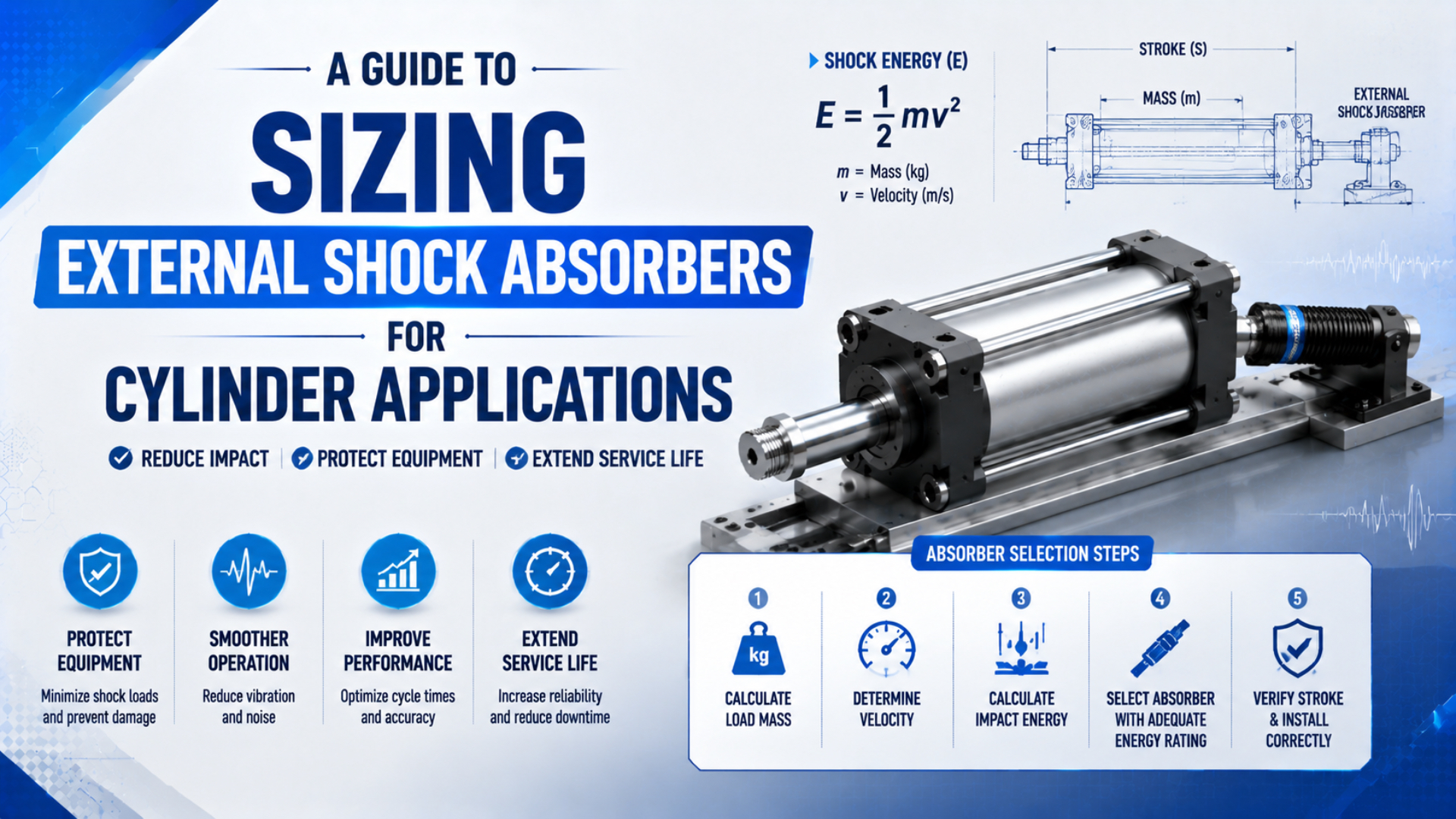
External shock absorber sizing is not complete when the unit can absorb the moving load’s kinetic energy once. A valid selection must also include cylinder thrust during deceleration, gravity where applicable, impacts per hour, impact velocity, effective mass, absorber stroke, return time, temperature, and the manufacturer’s mounting limits.
The practical method is to calculate energy per event and per hour, then screen a specific catalogue model against every remaining limit. The final check must use the installed machine at its worst credible load and speed. A shock absorber is part of the stopping system; it is not a substitute for safe controls, guarding, or a positive stop when the selected product requires one.
Key Takeaways
- Calculate both kinetic energy and the work done by forces that continue pushing during the absorber stroke.
- Check at least 6 catalogue limits: energy per event, energy per hour, impact velocity, effective mass, stroke, and return time.
- Confirm temperature, alignment, side load, mounting strength, adjustment, and any required positive stop before release.
What Inputs Are Required Before Sizing an External Shock Absorber?
ACE identifies kinetic energy per cycle, propelling energy, total energy per cycle, total energy per hour, effective mass, and absorber stroke as core industrial shock absorber selection quantities. That means a cylinder bore and pressure alone cannot define the absorber (ACE Controls, retrieved 2026).
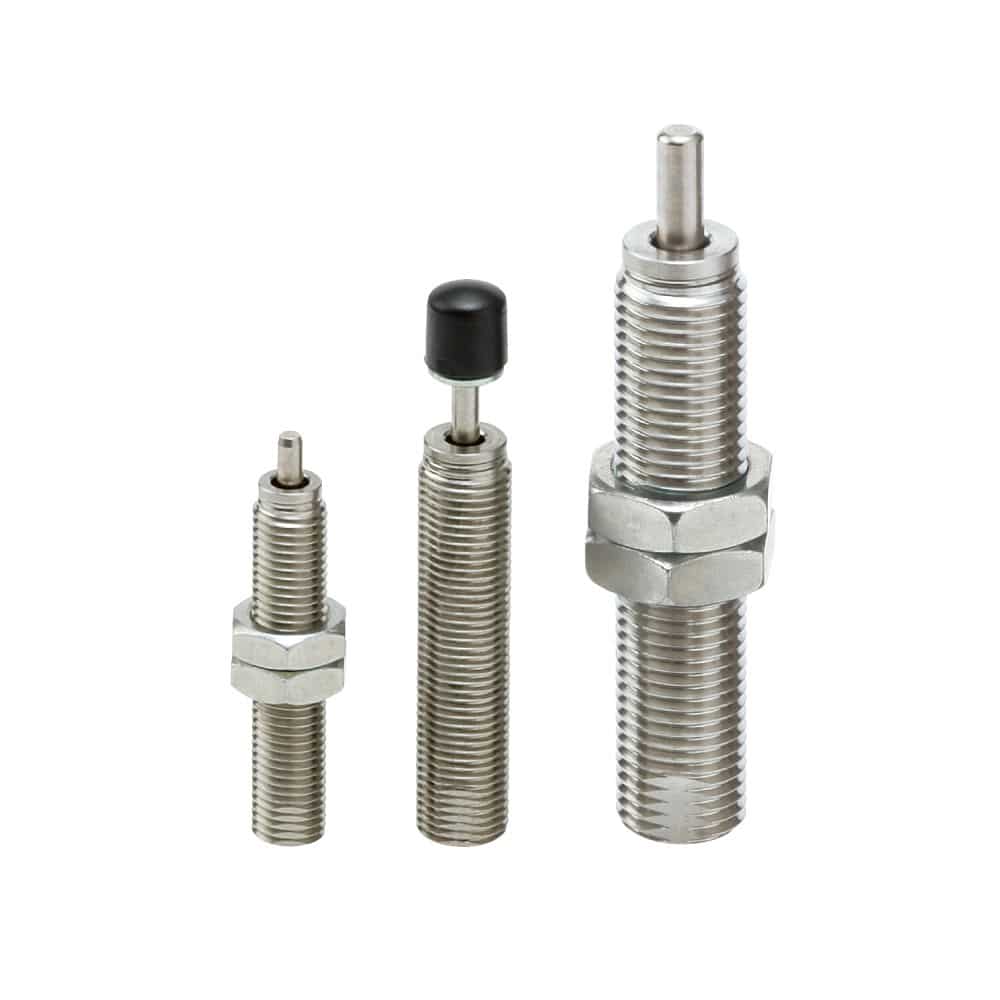
Create an input sheet before opening a catalogue:
| Input | Use in selection | What to verify |
|---|---|---|
| Moving mass, | Kinetic energy | Include load, carriage, tooling, brackets, and other translating mass |
| Impact velocity, | Kinetic energy and velocity limit | Measure near the contact point; do not substitute average full-stroke speed |
| Propelling force, | Work added during deceleration | Include cylinder thrust, springs, drives, and process forces that continue acting |
| Absorber stroke, | Propelling work and average-force estimate | Use the selected model’s usable stroke, not available machine clearance |
| Orientation, | Gravity work | State whether gravity assists or opposes motion |
| Events per hour, | Thermal-capacity check | Use the highest sustained production rate, including repeated strokes |
| Ambient and local temperature | Seal and heat limits | Include nearby ovens, washdown, enclosure heat, and restricted airflow |
| Load path and mounting space | Mechanical integration | Confirm axial contact, bracket stiffness, side load, service access, and stop position |
For accelerating mechanisms, impact velocity may exceed distance divided by time. ACE advises that final impact velocity can be 1.5 to 2 times average speed in some accelerating-motion calculations; use that only as manufacturer guidance when measured velocity is unavailable, not as a universal multiplier (ACE Controls, retrieved 2026).
The most important input is often not mass but the force that remains active after contact. If a pneumatic cylinder continues pushing throughout the absorber stroke, an energy calculation based only on can select a unit that passes the kinetic-energy check yet overheats or bottoms out in service.
If impact speed is still uncertain, first confirm the cylinder’s central travel speed and cushioning behavior using the high-speed cylinder specification checklist and the pneumatic cylinder velocity calculation guide.
How Do You Calculate Energy per Impact and per Hour?
Calculate 4 linked values: kinetic energy per cycle, propelling energy per cycle, their total per event, and total energy per hour. ACE uses that sequence before checking effective mass and stroke, so one-impact capacity must remain separate from sustained thermal capacity (ACE Controls, retrieved 2026).
Start with the translating kinetic energy at the instant the actuator contacts the shock absorber:
is kinetic energy in joules, is the total translating mass in kilograms, and is impact velocity in metres per second.
Next calculate the work added by the net propelling force during the absorber stroke:
is propelling work in joules, is the net force in newtons that continues driving the load into the absorber, and is absorber stroke in metres. For a pneumatic cylinder, do not automatically use theoretical bore-area force. Pressure at the active cylinder port can fall during motion, exhaust back pressure can oppose motion, and machine friction can act in either direction. Use a defensible worst-case force from the application and state the assumptions.
For an inclined or vertical linear move, represent the gravitational work over the stopping distance as:
is positive when gravity drives the load farther into the absorber and negative when gravity opposes that motion, is gravitational acceleration, and is the travel angle measured from horizontal.
The energy that one absorber event must dissipate is:
For sustained cycling, also calculate energy per hour:
is hourly energy in joules per hour and is the number of absorber events per hour. This thermal check is separate from the single-impact check: a unit may survive one impact but exceed its hourly heat-dissipation rating during production.
The effective mass used by shock absorber catalogues is:
is effective mass in kilograms. It can be greater than physical mass because the absorber must handle energy added by cylinder thrust or other propelling forces. Parker describes effective weight as a measure that incorporates the effect of the propelling force and uses it as a selection boundary alongside energy (Parker, retrieved 2026).
For a first-pass load-path check, average stopping force is:
is only an average over the absorber stroke. It is not peak force and must not be used by itself to size the mounting bracket, fasteners, machine frame, cylinder rod, or guided carriage. Use manufacturer reaction-force data and a structural analysis appropriate to the machine.
Worked Example: SMC’s 9.9 J Cylinder Stop
SMC’s shock absorber selection example uses a 20 kg load at 0.7 m/s, driven by a 40 mm bore cylinder at 0.5 MPa. It gives 4.9 J of kinetic energy and 5.0 J of cylinder-thrust energy, totaling 9.9 J. Effective mass is 40 kg (SMC, retrieved 2026).
The kinetic component can be checked directly:
After adding SMC’s stated 5.0 J of propelling work:
The effective-mass check becomes:
The small difference from the catalogue’s rounded 40 kg value comes from displaying intermediate values to one decimal place. This example demonstrates why selecting from the physical 20 kg load alone would miss the effect of continued cylinder thrust.
The calculation still does not name a valid product. SMC’s procedure next checks collision speed, operating frequency, ambient temperature, and atmosphere against the selected series and model. Its current web catalogue shows that energy and stroke ranges vary substantially across RB, RBL, and short-type RBQ families, so a family name is not a substitute for a model-level data sheet (SMC RB Series, retrieved 2026).
Why Can Effective Mass Reject an Energy-Matched Shock Absorber?
Effective mass can reject an energy-matched unit because Parker treats it as a separate catalogue range. Parker identifies 2 mismatch symptoms: too little effective weight can create high onset force, while too much can create high set-down force near the end of stroke (Parker, retrieved 2026).
Two mechanisms can have the same energy per event but very different force histories. A light, fast load concentrates energy at a high velocity; a heavier, slower load may be pushed by substantial cylinder force throughout the absorber stroke. The internal metering profile must suit both the energy and the effective-mass range.
Treat effective mass as a shape check, not another capacity value. Energy answers “how much must be dissipated”; effective mass helps the manufacturer determine “what deceleration profile must deliver it.” That is why a physically larger, higher-energy unit is not automatically a safer replacement.
For adjustable units, tuning symptoms provide useful evidence. Parker’s industrial shock absorber guidance distinguishes a hard impact near the start of stroke from a hard set-down at the end and directs the user to adjust in opposite directions. Follow the exact model procedure and lock the setting after commissioning; do not infer adjustment direction from another series (Parker, retrieved 2026).
How Do You Select the Exact Shock Absorber Model?
Select the exact model only after it passes 10 application checks covering energy, speed, effective mass, stroke, reset, temperature, load path, stop arrangement, and environment. An ACE model page publishes these limits separately, demonstrating why a product-family rating cannot validate one installed unit (ACE Controls A3X12, retrieved 2026).
Build a compliance table for each candidate. A model passes only when the application falls within every published limit under the same mounting and environmental assumptions.
| Catalogue check | Application value | Required decision |
|---|---|---|
| Energy per event | Must not exceed the model’s per-cycle capacity | |
| Energy per hour | Must not exceed the model’s sustained heat-dissipation capacity | |
| Impact velocity | Measured or defensibly calculated | Must be inside the stated minimum and maximum range |
| Effective mass | Calculated | Must be inside the model’s effective-mass range |
| Stroke | Selected model’s usable | Must fit the stopping-distance and machine-clearance requirements |
| Return time | Time before the next impact | Plunger must reset before it is struck again |
| Temperature | Worst local operating range | Must remain inside the model’s published limit |
| Side load and impact angle | Installed geometry | Must satisfy the model’s axial-loading or adapter requirements |
| Positive stop | Model-specific requirement | Set the stop position to the published dimension |
| Environment | Fluids, chips, dust, washdown | Select seals, materials, protection, or a different series as required |
An ACE A3X12 page, for example, publishes per-cycle and hourly energy limits, an effective-weight range, return time, impact-velocity range, temperature range, side-load allowance, and an external positive-stop instruction. Those figures apply to that model only; they illustrate the fields an engineer should expect to verify, not values that may be transferred to another unit (ACE Controls A3X12, retrieved 2026).
Avoid arbitrary “use only 70% of capacity” rules unless the manufacturer or your validated design standard requires one. A general multiplier cannot correct an omitted propelling force, the wrong impact velocity, excessive cycles per hour, or an effective-mass mismatch. If load and speed vary, calculate each credible combination and select against the worst result for each catalogue limit; the same operating point may not govern every row.
External shock absorber sizing is narrower than the complete end-of-stroke risk assessment. Use the end-of-stroke force and energy guide when comparing internal cushioning, external absorbers, bumpers, and mechanical stops across the whole machine.
What Do Mounting and Commissioning Require?
Mounting and commissioning require 8 controls, from rigid reaction structure through inspection access. ACE states that units used in parallel must be mounted exactly parallel, while Parker publishes model-specific stop and adjustment instructions; therefore, alignment and final setup remain product-level checks (ACE Controls, retrieved 2026; Parker, retrieved 2026).
The absorber should meet the moving member squarely, on a rigid load path, at the position used in the energy calculation. Misalignment creates side load on the plunger, while a flexible bracket adds uncontrolled travel and changes the actual deceleration profile. Check the selected manufacturer’s permissible impact angle and use an approved side-load adapter where required.
Mounting and release should include these controls:
- Rigid reaction structure: Design the bracket, fasteners, and frame for published reaction data and credible peak load, not only .
- Axial contact: Align the impact face with the absorber axis throughout the last part of travel. Correct carriage or cylinder side load rather than asking the absorber to guide the mechanism; see the linear-cylinder side-load guide.
- Defined contact point: Ensure the striker reaches the absorber under all tolerance, wear, and load conditions without colliding with the body or bracket.
- Positive stop where specified: Set the stop from the exact product drawing. Do not assume the shock absorber is intended to be the machine’s structural end stop.
- Reset verification: At maximum cycle rate, confirm the plunger fully returns before the next impact.
- Thermal verification: After sustained worst-case cycling, confirm the application remains within the manufacturer’s temperature and hourly-energy limits.
- Adjustment control: Follow the model’s commissioning sequence, approach the final production setting cautiously, lock it, and record it.
- Inspection access: Provide space to check leaks, damage, loose hardware, plunger return, alignment, and stop position.
ACE explains that industrial hydraulic shock absorbers force oil through metering orifices, converting kinetic energy into heat. It also warns that multiple units used in parallel must be mounted exactly parallel (ACE Controls, retrieved 2026).
Do not assume two absorbers will share load equally. Tolerance, bracket deflection, striker angle, and timing can make one contact first. ACE’s calculation method divides energy and effective mass by the number of parallel units only under its parallel-installation method; use the manufacturer’s approved arrangement and verify simultaneous, aligned contact (ACE Controls, retrieved 2026).
In our experience reviewing cylinder stop applications, the fastest commissioning record is a one-page sheet containing the measured impact velocity, actual moving mass, pressure or propelling-force assumption, model number, stop dimension, adjustment position, cycle rate, and final temperature observation. Without that record, later maintenance teams tend to treat adjustment as guesswork.
Internal air cushions may still be useful for routine cylinder deceleration, but their available energy absorption depends on the cylinder, cushion design, pressure, speed, and adjustment. The pneumatic cushioning guide and high-speed air-cushion guide explain that separate selection path.
External Shock Absorber Selection Workflow
Use 7 sequential gates from impact definition to documented release. SMC checks collision speed, cycle rate, ambient temperature, and atmosphere after calculating energy, while ACE adds effective mass and stroke. A candidate is therefore incomplete until both its catalogue limits and installed-machine behavior pass (SMC, retrieved 2026; ACE Controls, retrieved 2026).
A “no” at any catalogue or installation check means the candidate is not yet validated: recalculate the application, choose another model, increase controlled stopping distance, reduce speed or force, revise the mount, or obtain written guidance from the manufacturer.
Recheck the calculation whenever the moving load, cylinder pressure, speed setting, stroke position, cycle rate, mounting geometry, or shock absorber model changes. An emergency-only safety shock absorber is a different product class from a unit rated for continuous production cycling; do not interchange their duty assumptions (ACE Controls, retrieved 2026).
External Shock Absorber Sizing FAQs
SMC’s worked selection example checks more than joules, and Parker’s catalogue uses effective weight to control the deceleration profile. These boundaries are why the answers below distinguish a preliminary energy calculation from model selection and installed-machine validation (SMC, retrieved 2026; Parker, retrieved 2026).
What energy values must be checked when sizing an external shock absorber?
Check energy per event and energy per hour. Event energy includes the moving mass’s kinetic energy plus work added by cylinder thrust, gravity, springs, or other forces during deceleration. Hourly energy multiplies that result by sustained event count and screens the absorber’s ability to reject heat continuously.
Why is impact velocity more important than average cylinder speed?
Kinetic energy varies with the square of impact velocity, and a cylinder can accelerate over its stroke. Distance divided by total stroke time also includes acceleration and cushioning, so it may not represent velocity at contact. Measure near the absorber whenever possible and keep the operating point inside the selected model’s impact-velocity range.
Can a larger shock absorber always replace a smaller one?
No. A candidate needs enough energy capacity, but it must also match impact velocity, effective mass, stroke, return time, temperature, mounting, and environment. Parker notes that an effective-weight mismatch can cause high onset or set-down force, so a physically larger or higher-joule unit can still decelerate the load poorly.
Does every external shock absorber need a separate mechanical stop?
Not every design uses the same stop arrangement. Some models require an external positive stop at a specified dimension; others have different installation instructions. Follow the exact product drawing and manual. Never assume that the absorber’s internal end position is intended to carry the machine’s structural end-stop load.
Can two shock absorbers be mounted in parallel?
Yes, when the manufacturer permits it and the structure produces simultaneous, axial, equal contact. ACE divides application quantities between parallel units in its calculation method but requires exact parallel mounting. Do not assume equal sharing when bracket deflection, striker angle, tolerances, or timing allow one absorber to engage first.
Sources and technical references
- ACE Controls, Calculation Bases for Industrial Shock Absorbers, retrieved July 19, 2026.
- ACE Controls, Industrial Shock Absorbers, retrieved July 19, 2026.
- ACE Controls, A3X12 Model Data, retrieved July 19, 2026.
- Parker, Shock Absorber Engineering Catalogue AU08-1022-1, retrieved July 19, 2026.
- Parker, Industrial Shock Absorber Catalogue 0900P, retrieved July 19, 2026.
- SMC, Shock Absorber Model Selection Example, retrieved July 19, 2026.
- SMC, RB Series Web Catalogue, retrieved July 19, 2026.
- SMC, Shock Absorber Selection Software, retrieved July 19, 2026.