

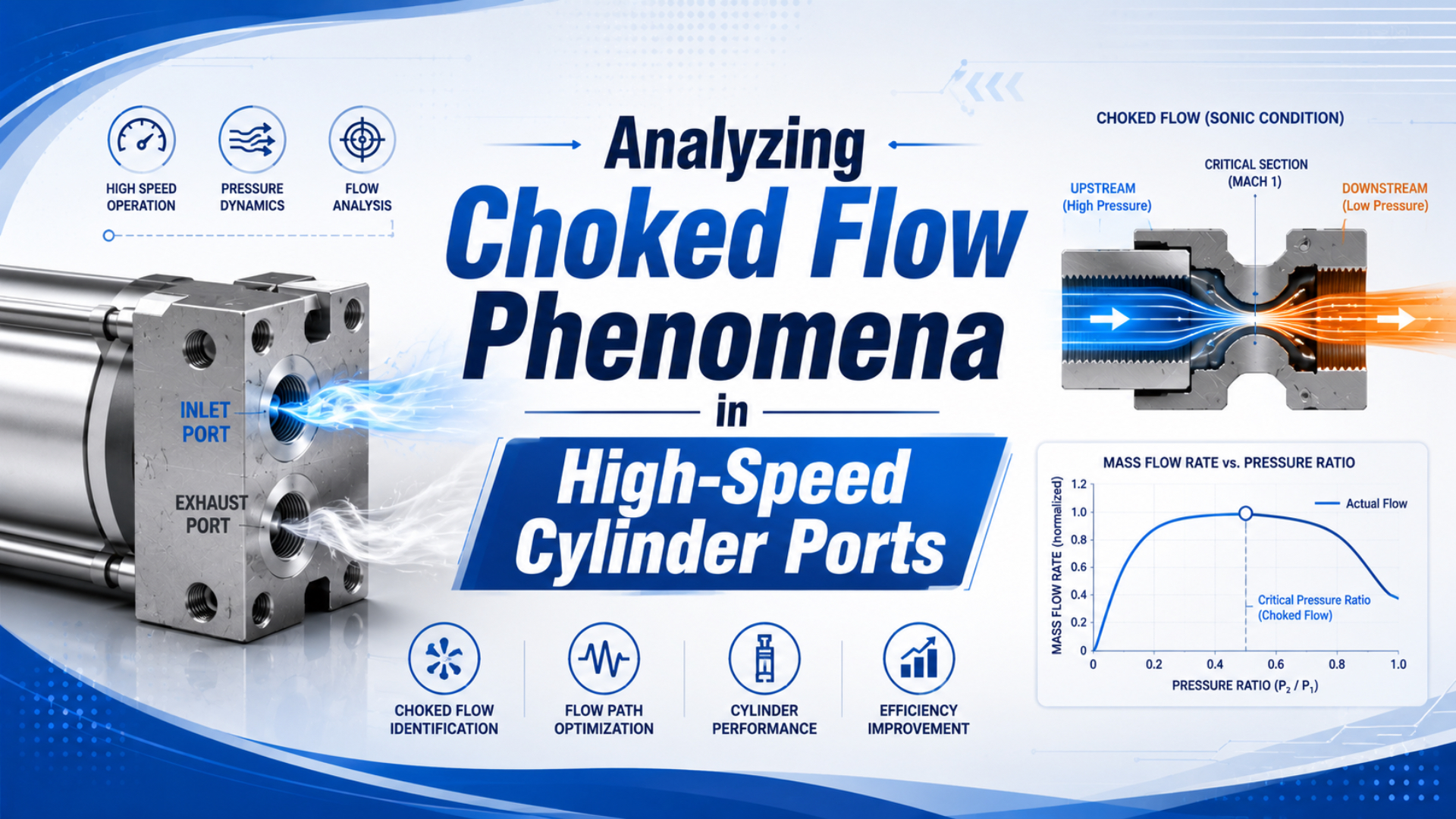
Choked flow in high-speed cylinder ports is a local mass-flow ceiling at the smallest effective passage in the active air path. It isn’t a permanent speed limit for the whole cylinder. During extension, the controlling throat might sit in the supply valve, fitting, speed controller, cylinder port, return path, or exhaust silencer. Its location can change during the stroke and with the active flow direction. Dynamic diagnosis therefore needs pressure at the relevant boundaries, not one static regulator reading. Assign upstream and downstream pressures to each restriction, convert both to absolute pressure, and compare measured stroke demand with tested flow data. This separates sonic choking from ordinary pressure loss, insufficient valve capacity, cushioning, and mechanical load.
Key Takeaways
- Ideal dry air reaches its sonic boundary near an absolute pressure ratio of 0.528.
- Lower downstream pressure cannot increase flow after choking, but higher upstream total pressure can.
- Port thread size does not reveal the smallest internal throat.
- Test supply and exhaust paths separately during the actual stroke.
Why Does a Cylinder Port Choke?
NASA’s compressible-flow derivation reaches maximum mass flow at Mach 1. With an ideal dry-air heat-capacity ratio of 1.4, the corresponding downstream-to-upstream absolute-pressure ratio is about 0.528 (NASA Glenn Research Center, 2021, accessed 2026). A port is only one possible controlling throat in the active path.
For an ideal gas, the sonic boundary is:
Here, is upstream absolute pressure, is downstream absolute pressure, and is the heat-capacity ratio. With , the result is approximately 0.528. The inverse statement, , is mathematically equivalent, but only when the same locations and absolute pressures are used.
Choking means that further lowering cannot increase mass flow through the same throat at the same upstream state. It does not mean upstream pressure has stopped mattering. NASA’s ideal choked-flow relation is:
is choked mass flow, is effective throat area, and are upstream total pressure and temperature, and is the gas constant. A real passage also needs a discharge or tested conductance correction. The equation shows why more upstream absolute pressure can raise choked mass flow, even though lower back pressure cannot.
ISO 6358-1 defines steady-state testing for pneumatic components with fixed or variable internal passages and specifies how their flow characteristics are reported. Complete cylinders are excluded (ISO 6358-1, 2013, confirmed 2022). Apply tested data to individual restrictions, then validate the moving assembly.
Why Doesn’t Port Thread Size Prove Flow Capacity?
SMC data lists the AS2000-02 and AS3000-02 speed controllers with a 1/4-inch port, yet their free-flow sonic conductance values are 0.94 and 2.3 dm³/(s·bar) (SMC Series AS, accessed 2026). The larger value is about 2.45 times the smaller one despite identical thread size.
Thread size describes the connection interface. Flow still crosses connector bores, elbows, needle gaps, check elements, valve windows, drilled galleries, and cylinder castings. Whichever passage has the smallest effective area controls the sonic limit. Installing larger tube cannot recover capacity lost at a smaller internal throat. Conductance can also differ by direction. SMC’s AS2000-02 representative data lists 0.94 dm³/(s·bar) for free flow and 0.7 dm³/(s·bar) for controlled flow. A meter-out circuit deliberately restricts exhaust while the check path allows freer inlet flow. Record both motion direction and active component direction.
How Much Flow Does Target Stroke Time Require?
Parker’s cylinder sizing tool calculates the flow needed for cylinder speed from actuator geometry and motion time (Parker Hannifin Cylinder Sizing Tools). Inputs are bore, rod diameter, and stroke. Directional timing completes the motion requirement. Establish demand before deciding whether a port or another air-path element is undersized.
Start with piston area and swept volume for cap-end extension:
denotes piston area. The bore is and stroke is ; dividing their swept volume by target time gives . This average excludes acceleration and cushion transients. Allow separately for leakage, valve timing, and changing chamber pressure.
Convert chamber flow to an approximate reference-air demand only after defining pressure and temperature:
is reference-condition flow. The pair and defines that reference state; chamber pressure remains absolute. Catalog reference atmospheres differ, so preserve the supplier’s units and stated conditions. A 63 mm bore moving 200 mm sweeps about 0.623 L. The 0.20 s target requires roughly 3.12 L/s of average chamber volume. At an assumed 7 bar absolute chamber pressure and equal reference temperature, the simplified reference-air demand is about 1,309 L/min. This is a demand example, not a valve approval. Use the Cylinder Flow Requirement Calculator to compare extension and retraction before selecting hardware.
How Do You Measure Choking During a High-Speed Stroke?
Published SMC limits are 750 to 2500 mm/s for the CM2-X3423 series and 500 to 2500 mm/s for CQ2-X3423, restricted to listed bores, strokes, loads, cushions, and operating conditions (SMC CM2/CQ2-X3423, accessed 2026). High speed is therefore a model-specific operating envelope, not a universal threshold.
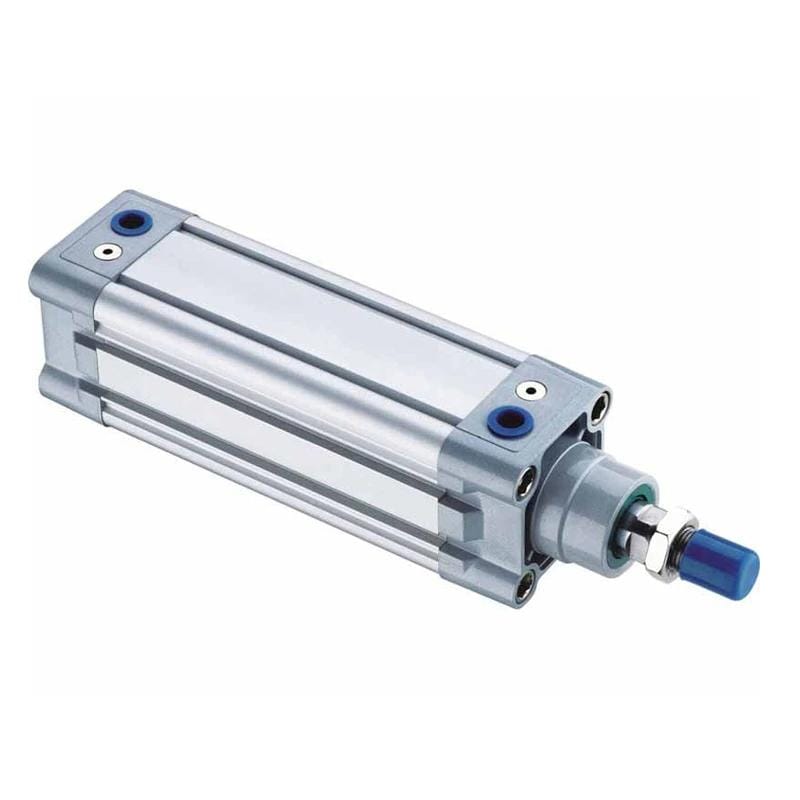
In our experience, the highest-signal test synchronizes valve-inlet pressure, both port pressures, valve command, and piston position on the same time base. A static gauge can remain steady while the active branch loses pressure for milliseconds. Match sensor response and sampling rate to the event.
Run the test in this order:
- Confirm the exact cylinder, valve, controller, fittings, tube, muffler, and mounting orientation.
- Measure supply pressure at the valve inlet during the worst credible shared load.
- Install pressure sensors close to both cylinder ports without creating a new restrictive branch.
- Capture the first cycle after the relevant hot or cold soak, then capture repeated production cycles.
- Record command timing and actual piston motion on the same time base.
- Convert every pressure used in a ratio to absolute units.
- Evaluate the supply and exhaust paths separately for extension and retraction.
Do not diagnose choking from noise alone. Ordinary throttling or leakage may hiss, and so can a muffler or intentionally adjusted speed controller. Likewise, a speed plateau can result from cushioning, insufficient force margin, side loading, valve switching delay, or control logic. Use the cylinder speed and choked-flow guide for the full demand-to-motion relationship.
Separating Supply and Exhaust Restrictions
ISO 6358-3 provides installed-assembly methods for estimating steady-state flow from known component and piping data (ISO 6358-3, 2014, confirmed 2025). It covers subsonic and choked behavior. That system view explains why a single pressure ratio cannot identify which element controls a moving cylinder.
Supply and exhaust paths operate simultaneously during extension. Upstream pressure sits before a supply restriction; downstream pressure sits after it. The cylinder chamber becomes the upstream point for an exhaust restriction, with the discharge outlet serving as downstream. Reverse those roles during retraction.
| Dynamic observation | Most likely branch | Next measurement |
|---|---|---|
| Valve-inlet pressure collapses during both directions | Shared supply, regulator, manifold, or header | Measure upstream of each shared element under load |
| Valve inlet stays stable but supply-side cylinder pressure rises slowly | Valve path, fitting, tube, controller, or cylinder inlet | Measure before and after each suspected restriction |
| Inlet chamber pressure is adequate but opposite chamber retains pressure | Exhaust valve path, controller, muffler, or clogged discharge | Measure chamber and exhaust pressures simultaneously |
| One direction is slow and the other is normal | Direction-specific valve path, check element, tube, or port | Compare the two active paths and component directions |
| Pressure trace is healthy but motion slows near the end | Cushion, load, alignment, or mechanical friction | Check cushion setting, force margin, guides, and side load |
Treat 0.528 as a screening ratio. It does not prove that a catalog component has that critical ratio. Use a supplier’s published values instead. They should state sonic conductance and critical pressure ratio , as explained in the sonic conductance guide. That guide also separates and from port thread and Cv.
Which Changes Actually Increase Cylinder Speed?
Choked mass flow scales with effective throat area and upstream total pressure. Total temperature works differently. Flow varies inversely with its square root (NASA Glenn Research Center, 2021). A modification only helps when it changes the controlling restriction or reduces the required flow for the motion.
Testing one change at a time preserves cause and effect.
| Change | When it can help | What must be rechecked |
|---|---|---|
| Higher-conductance valve or manifold | Valve path consumes the largest dynamic pressure drop | Switching time, exhaust capacity, voltage, fault state, and approvals |
| Larger or shorter tube | Tube and fittings dominate the loss | Bend radius, fitting bore, response volume, routing, and movement |
| Higher-flow speed controller | Controller is the controlling throat | Meter-out stability, load overrun, cushion energy, and safe speed |
| Clean or larger muffler | Exhaust back pressure rises during motion | Noise target, contamination source, discharge direction, and maintenance interval |
| Quick-exhaust valve near the cylinder | Long return path limits exhaust | Stop behavior, residual pressure, noise, guarding, and safe isolation |
| Larger cylinder-port option | Cylinder inlet gallery is proven limiting | Cylinder model, dimensions, strength, availability, and replacement code |
| Longer stroke time | Required flow exceeds practical component capacity | Production takt, force profile, control sequence, and heat load |
Increasing regulator pressure is not a neutral shortcut. It can increase choked mass flow, but it also changes cylinder force, stored energy, air consumption, seal load, and exhaust demand. Stay inside every component rating and revalidate the machine risk assessment.
A Port-Level Acceptance Test
A 2026 amendment to ISO 6358-1 specifically addresses evaluation of measurement uncertainty (ISO 6358-1:2013/Amd 2:2026, 2026). A machine acceptance record should likewise identify sensor range, accuracy, response, sample rate, locations, reference conditions, and calculated uncertainty instead of reporting one unqualified pressure ratio.
Use the matrix below at the expected production load:
| Test state | Electrical and pneumatic condition | Required evidence | Acceptance decision |
|---|---|---|---|
| Identity | Exact ordered cylinder, valve, controller, tube, fittings, and muffler | Part codes and current datasheets | Installed path matches approved design |
| Cold start | Minimum valid ambient and first command | Synchronized pressures, command, position, and stroke time | Complete stroke without unstable motion |
| Stabilized duty | Normal cycle rate after thermal stabilization | Repeatable pressure traces and temperatures | No progressive timing or pressure drift |
| Shared demand | Worst credible neighboring machine load | Valve-inlet and cylinder-port traces | Supply stays inside the approved boundary |
| Extension | Cap-end fill and rod-end exhaust | Local absolute-pressure ratios for each suspected restriction | Controlling branch identified or excluded |
| Retraction | Rod-end fill and cap-end exhaust | Same measurements with flow direction reversed | Direction-specific capacity verified |
| Exhaust challenge | Clean baseline and defined service condition | Muffler and exhaust back-pressure trace | Maintenance limit has measurable evidence |
| Repetition | Agreed cycle count and payload | Missed strokes, mean time, variation, and trace retention | Acceptance criteria remain satisfied |
Do not make “no choking anywhere” the acceptance target. A deliberately restricted meter-out path can operate near its flow boundary and still produce stable, safe motion. The useful requirement is that every active path delivers the specified stroke time, force margin, temperature, repeatability, and fault behavior within published ratings.
What Should a High-Speed Cylinder Port RFQ Include?
SMC lists Series AS models with representative capacity from 340 to 2,840 L/min (ANR) at the catalog’s stated conditions (SMC Series AS, accessed 2026). Several carry the same 1/4-inch port designation. An RFQ that gives only thread size leaves the decisive flow capacity undefined.
Send the supplier:
- complete cylinder code and bore;
- rod diameter, stroke, cushion type, mounting, orientation, payload, external guides, overhung-load geometry, expected acceleration, binding risk, and any vibration or repeatability concern that can change the motion trace;
- target directional times, dwell, and cycle rate;
- minimum dynamic valve-inlet pressure;
- maximum permitted pressure for every installed component;
- valve, manifold, controller, fitting, tube, and muffler codes, including active flow direction through each one;
- electrical command timing when valve response affects the result;
- required flow with reference units and atmosphere stated;
- synchronized extension and retraction traces for valve inlet, both ports, command, and position;
- ambient limits and air-quality requirements;
- bidirectional , , or equivalent tested flow data;
- allowable exhaust back pressure, noise, contamination exposure, and maintenance access;
- measurable limits for stroke time, variation, pressure, temperature, leakage, and fault behavior;
- applicable machine safety and environmental approvals.
Require exact ordered codes and document revisions. The return package must also identify test conditions, flow direction, reference atmosphere, and tolerance, then be compared with the pneumatic flow-control valve sizing guide and the flow-versus-pressure selection guide.
High-Speed Cylinder Port FAQs
NASA fixes ideal maximum mass flow at Mach 1. ISO 6358 separates tested component characteristics from complete-cylinder behavior. SMC data confirms that identical ports can have different conductance; these five answers therefore separate the ideal pressure-ratio shortcut from installed-path measurements and model-specific acceptance evidence.
Does choked flow stop all additional cylinder-port flow?
No. Choking stops lower downstream pressure from increasing flow through the same throat when its upstream state and effective area remain unchanged. Higher upstream total pressure or a larger effective area can still raise choked flow. Keep every change within validated component and machine-safety limits.
Should the 0.528 choked-flow ratio use gauge pressure?
No. Use absolute pressure across the restriction. Gauge readings omit atmospheric pressure and can misclassify the flow state. Treat 0.528 as a screen. For real components, use the manufacturer’s published critical-pressure-ratio data for the stated flow direction and test conditions.
Can I diagnose a restricted port from cylinder speed alone?
No. Speed can plateau because of limited valve capacity, exhaust back pressure, cushioning, poor force margin, friction, delayed switching, or control timing. Capture command, motion, and three pressure signals together. Compare local ratios and dynamic drops across the suspected restrictions.
Will a larger cylinder-port thread always increase speed?
No. Thread size identifies only the connection interface. Valve lands, controller needles, fitting bores, internal galleries, and mufflers can still form the smallest effective area in the active path. SMC lists different conductance values for the same port size, so compare bidirectional test data.
Is exhaust choking different from supply choking?
The physics is the same, but pressure locations differ. During extension, the rod-end chamber is upstream of its exhaust restrictions and the cap end is downstream of its supply path. Reverse those roles during retraction. Test both directions because only one path may be limiting.