

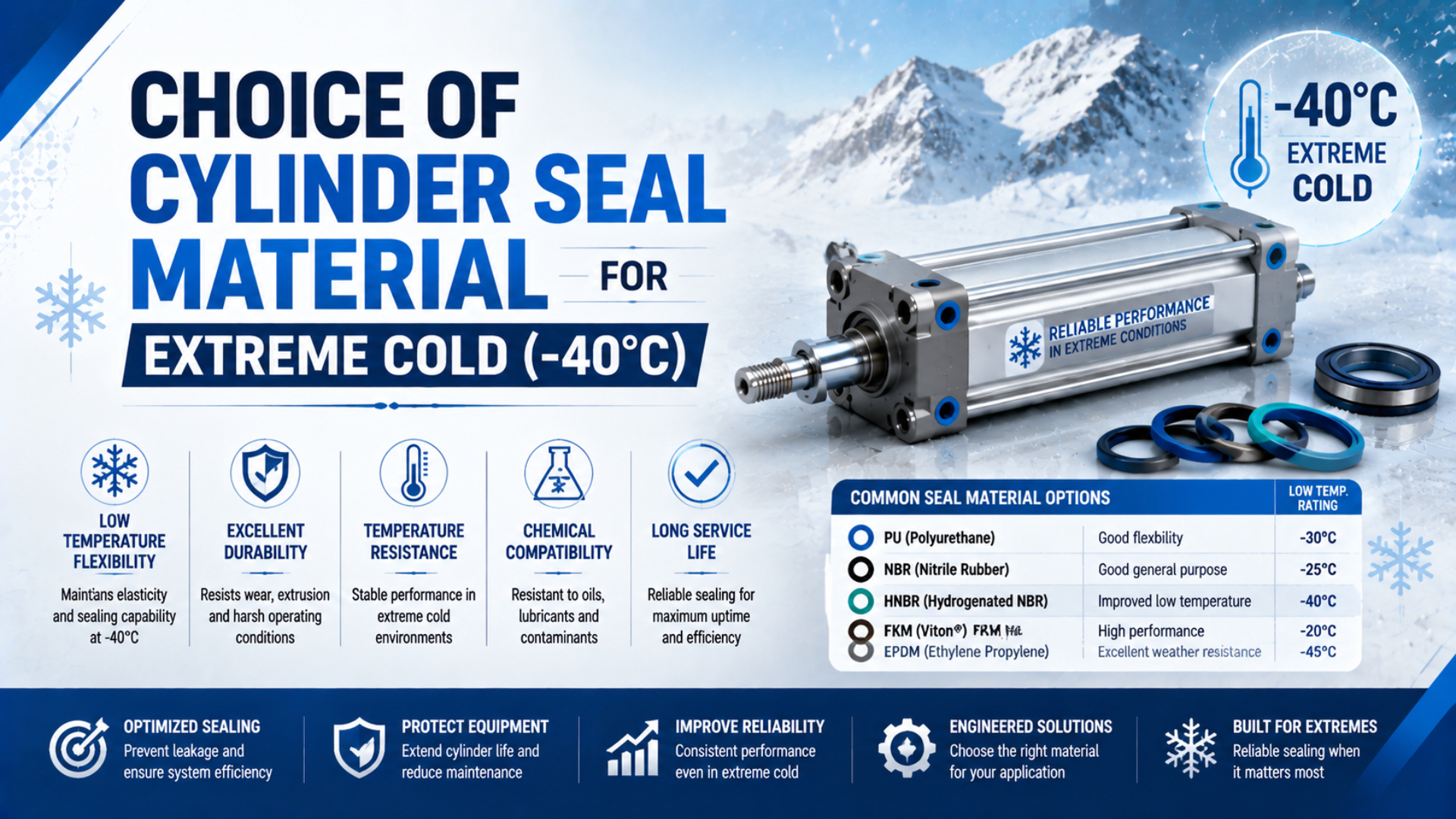
There is no universally best cylinder seal material for -40°C service. Approve an exact seal system instead: identified compounds, position-specific profiles, compatible grease, correct grooves and mating surfaces, plus cold-start evidence from the complete cylinder configuration.
This distinction prevents two common mistakes. One is rejecting every NBR or polyurethane seal from a generic material chart. Another is treating HNBR or PTFE as a drop-in cure for any cold cylinder. Both decisions ignore the formulation, sealing profile, lubricant, mating hardware, operating cycle, and option restrictions that govern cold-start behavior.
At -40°C, the practical purchasing question is not “Which polymer wins?” It is “Which documented seal configuration passes the required leakage and motion tests after cold soak?”
A cylinder seal system is the complete set of dynamic seals, static seals, wipers, energizers, lubricant, grooves, and mating surfaces used in one identified actuator configuration.
Key Takeaways
- A polymer-family name is a screening label, not a finished-cylinder temperature rating.
- Check every sealing position, including static O-rings, piston and rod seals, wipers, cushion seals, and any PTFE energizer.
- Use the cylinder manufacturer’s low-temperature option when one covers the required model and duty.
- Approve custom substitutions only after compatibility, geometry, installation, and cold-soak checks.
This article stays focused on the seal system. For complete-system coverage, the sub-zero pneumatic cylinder design guide covers dry air, sensors, tubing, mounting, and the rest of the assembly. For the underlying polymer tests, see the guide to glass transition temperature and low-temperature seal evidence.
What Does a -40°C Cylinder Rating Actually Approve?
A -40°C rating applies only to the product configuration and conditions identified by the manufacturer. It shouldn’t be reinterpreted as a rating for the metal body alone, nor transferred automatically to another seal kit, sensor option, lubricant, speed, or operating medium.
SMC’s C96-XB7 is a useful example. Its published cold-resistant configuration changes the seal material to low-temperature nitrile and the grease to a cold-resistant grade. That specification also calls for dry air, prohibits lubrication from a pneumatic-system lubricator, excludes the auto switch, and lists a minimum operating pressure for the applicable model (SMC C96-XB7, retrieved 2026-07-26).
Parker reaches -40°C through a different design. Its P1F low-temperature version uses validated Ultrathan TPU-PUR seal technology with specifically formulated grease. Parker describes the seals as developed and validated for continuous operation down to -40°C (Parker P1F ISO Cylinders, retrieved 2026-07-26).
Two reputable manufacturers therefore use different seal materials in product-specific -40°C solutions. What transfers between them is the validation method, not a universal polymer winner.
| Evidence presented | What it can support | What it cannot support |
|---|---|---|
| Generic polymer-family range | Initial shortlist for NBR, HNBR, FKM, polyurethane, or another family | Approval of an unidentified seal in a cylinder |
| Exact compound data | Screening for temperature, medium, hardness, recovery, and aging | Approval of a different compound with the same polymer name |
| Seal-profile specification | Review of lip geometry, energization, friction, and installation | Compatibility with an unverified cylinder groove or surface |
| OEM low-temperature cylinder option | Use within the listed model, options, media, and operating limits | Transfer of the rating to another model or modified assembly |
| Complete-cylinder cold-soak test | Evidence for the tested configuration and acceptance criteria | Unlimited service outside the tested duty |
Configuration code, not polymer family, is the useful approval unit. If changing the seal, grease, wiper, sensor, or cylinder series changes that configuration, the original -40°C evidence may no longer apply.
Why Are Material-Family Temperature Charts Insufficient?
Material-family charts are useful for rejecting obvious mismatches, but they can’t approve a dynamic cylinder seal. Even compounds sold under one family label can differ in acrylonitrile content, cure system, plasticizer, fillers, hardness, manufacturing controls, and intended seal duty. Those differences affect cold recovery, wear, chemical resistance, and compression behavior.
Parker’s O-Ring Handbook illustrates the variation. It lists approximate service ranges of -34°C to 121°C for general-service nitrile and -55°C to 107°C for low-temperature nitrile. Its chart also lists HNBR to approximately -32°C, polyurethane to -40°C, and standard fluorocarbon to -26°C. Parker warns that the medium and application can narrow these ranges (Parker O-Ring Handbook, retrieved 2026-07-26).
These are broad O-ring screening values. They aren’t interchangeable with a reciprocating lip-seal rating or an assembled-cylinder specification. In particular:
- “NBR” does not distinguish a general-purpose compound from a low-temperature formulation.
- “HNBR” proves neither -40°C dynamic recovery nor groove interchangeability.
- “Polyurethane” covers multiple chemistries and grades; the Parker P1F example shows why a blanket rejection at -40°C is unsafe.
- “FKM” calls for extra low-temperature scrutiny. Specialty formulations still need their own recovery, medium, and dynamic-seal evidence.
- “PTFE” identifies a thermoplastic family, not an elastomer. Its sealing element may rely on pressure, a metal spring, or an elastomeric energizer. That supporting element can set the installed design’s real temperature limit.
ISO 3601-5 specifies selected elastomeric materials for industrial O-rings, yet it still requires the equipment user and the seal supplier to agree on the required physical properties and test methods. This standard supports compound-level documentation rather than selection by family name alone (ISO 3601-5:2015, retrieved 2026-07-26).
For broader material selection, use the pneumatic cylinder seal material guide. It covers temperature, chemicals, wear, and compliance. This article asks a narrower question: can one documented seal system start and move without leaking at -40°C?
Candidate Seal Materials at -40°C
Several material families can enter a -40°C review. The shortlist may include NBR, HNBR, polyurethane, specialty FKM, and PTFE-based profiles. None should be approved from its family name. Evidence must identify the exact compound and profile, then explain how position, lubricant, pressure, speed, dwell, and cold-start duty were evaluated.
| Candidate | Why it may reach the shortlist | Evidence required before approval |
|---|---|---|
| Low-temperature NBR | Familiar elastic sealing behavior and compatibility with selected pneumatic lubricants | Exact compound designation, low-temperature test data, medium compatibility, and OEM or component validation |
| HNBR | Potential improvements in heat, aging, and mechanical properties over some NBR compounds | Compound-specific cold recovery, lubricant compatibility, hardness, groove fit, and dynamic test evidence |
| Low-temperature polyurethane | Wear-resistant dynamic profiles are available, including validated -40°C cylinder designs | Exact polyurethane grade, hydrolysis and media limits, grease, profile, surface, and cold-start test |
| Specialty low-temperature FKM | May be considered when chemical or high-temperature exposure also matters | Exact formulation, TR or comparable evidence, media data, and dynamic seal validation |
| PTFE-based energized seal | Low friction and broad media resistance can suit an engineered profile | PTFE compound, energizer material, leakage target, groove, surface specification, installation method, and cold test |
Glass transition temperature is only one screening result. ASTM D1329 describes temperature retraction as a comparative method for rubber and rubber-like materials and says it is useful when combined with other low-temperature tests. TR10 relates to recovery behavior; it doesn’t reproduce a lubricated seal lip moving against the actual rod or bore (ASTM D1329-16(2021), retrieved 2026-07-26).
Do not apply a fixed rule such as “the service limit is 10°C above Tg.” Service behavior depends on the test method, compound, and deformation rate. Seal duty, pressure, and geometry add separate constraints. Static sealing, first-motion friction, and repeated reciprocation can therefore produce different limits.
A lower laboratory transition value can improve the shortlist while the installed design still fails. Grease or the energizer may control. Excessive interference and a damaged wiper can do the same before the base polymer reaches its published limit.
How Should Each Seal Position Be Specified?
Specify each position separately because the piston seal, rod seal, wiper, static joints, and cushion components do different work. A single material for every item is convenient for purchasing, but it is not an engineering requirement.
| Seal-system position | Main cold-service duty | Questions to resolve |
|---|---|---|
| Piston seal | Maintain chamber separation while sliding in the bore | Bidirectional or single-acting profile, friction, bore condition, pressure, speed, and grease |
| Rod seal | Retain pressure around the moving rod | Rod finish, side load, alignment, breakaway friction, extrusion clearance, and lubricant film |
| Wiper or scraper | Exclude ice, water, dirt, and external contamination | Low-temperature flexibility, rod contact, abrasion, contamination type, and drainage |
| Static O-ring | Seal fixed end-cap, port, or adjustment joints | Compound recovery, squeeze, groove fill, pressure direction, and media |
| Cushion seal | Control end-of-stroke flow and survive repeated impact | Local pressure, cycle frequency, lubricant, temperature, and profile |
| PTFE energizer | Maintain contact force behind a PTFE sealing element | Spring alloy or elastomer compound, preload, media, temperature range, and installation |
The lubricant belongs in the same specification. “Low-temperature grease” is incomplete without its manufacturer and grade. The specification must also cover its temperature basis and media compatibility. Application quantity and change control matter too. Do not substitute another chemistry solely because a generic data sheet shows a low pour point. That warning applies equally to PFPE, PAO, and mineral grease.
Wipers follow the same rule. Include the part in the bill of materials and qualification test, but do not assume it is automatically the coldest or most important component. External contamination, rod exposure, seal profile, and the complete front-end design determine its risk.
What Must Be Checked Before Retrofitting a Seal Kit?
A replacement seal kit is acceptable only when its profiles, dimensions, materials, and installation method match the cylinder hardware and duty. Calling HNBR a direct NBR replacement or PTFE an upgrade skips that verification.
Start with the full cylinder identification. Series, bore, stroke, rod diameter, cushion option, magnet, revision, and existing seal-kit number can all affect the supplied parts. Inspect the dismantled cylinder as well. A cold-sensitive leak may come from a scored rod, worn guide, corroded bore, incorrect assembly, frozen moisture, or grease that has become too resistant to motion.
Review these interfaces before ordering:
- Groove and profile: Confirm cross-section, orientation, squeeze, stretch, groove fill, extrusion clearance, and pressure direction.
- Rod and bore: Use the surface-finish and hardness limits published for the exact seal profile. A universal Ra limit is not reliable enough.
- Guidance and alignment: Correct side load, eccentricity, worn bearings, and rod damage before judging a new compound.
- Media and lubrication: Include compressor lubricant, assembly grease, cleaning agents, process vapor, condensate, and any previous oil introduced through the air system.
- Installation path: Protect the seal from threads, ports, sharp edges, twisting, and excessive stretching. Follow the seal-kit manufacturer’s temperature and tooling instructions.
- Configuration restrictions: Check whether the cold option changes the magnet, sensor, bumper, cushion, allowable speed, minimum pressure, or maintenance interval.
PTFE-based profiles deserve special attention. PTFE has limited elastic recovery compared with rubber, so the profile may rely on pressure, a spring, or an elastomeric energizer to maintain contact. The correct installation cone, sizing step, groove design, and leakage expectation belong to that product’s instructions. Heating a seal to a generic temperature is not a substitute for those instructions.
Retrofitting changes the burden of proof. An OEM cold option arrives with a defined configuration. A custom material substitution makes the buyer responsible for proving groove fit, assembly integrity, and performance at the required temperature.
Cold-Soak Qualification Before Production
Cold-soak qualification should compare the complete cylinder’s warm baseline with its static sealing and first commanded motion at -40°C. Testing only after several warming strokes can hide the highest breakaway friction or the leakage that occurs before the assembly heats.
Write the duty and pass limits before the test. Include chamber temperature, soak duration, supply pressure, load, valve and flow-control settings, stroke, speed, dwell, cycles, lubricant, and allowed leakage. Place temperature sensors close enough to establish that the cylinder assembly, not just the chamber air, reached the target condition.
Use this sequence:
- Warm baseline: Measure leakage, pressure at motion onset, extend and retract time, speed stability, end-position behavior, and sensor operation.
- Cold soak: Condition the complete production configuration for the specified duration. Record body or end-cap temperatures at agreed locations.
- Static test before motion: Pressurize the required chamber or chambers and measure leakage after the defined dwell.
- First commanded movement: Record pressure, delay, travel time, velocity, stick-slip, position, and abnormal sound. Guard the machine because a high-friction cylinder can release suddenly.
- Representative cycling: Run the specified cycle count without silently changing pressure, flow controls, load, or lubricant.
- Inspection and warm retest: Examine the sealing edges, wiper, grease distribution, rod, bore, and guides. Repeat the baseline checks after recovery.
Acceptance criteria should distinguish safety from convenience. Define the maximum permitted leakage, minimum completed stroke, motion time or speed band, acceptable breakaway pressure, position requirement, and allowable damage. Record results for both pressure directions when the seal arrangement requires it.
Do not raise supply pressure simply to force a cold cylinder into motion. Movement can then be sudden. Extra pressure can also exceed the assumptions used for load, cushioning, and machine safety.
Even a passing seal does not qualify the rest of the pneumatic system. Moisture can freeze in a valve or line, grease can become limiting, and a sensor or tube may have a warmer minimum rating. Address those items with the cold-weather pneumatic failure guide and the broader -40°C material-selection guide.
What Belongs in a -40°C Seal RFQ?
A useful RFQ identifies the cylinder, each seal position, the complete operating duty, and the evidence required for acceptance. “HNBR seals for a 50 mm cylinder” is not enough to control the supplied configuration.
Provide:
- cylinder manufacturer, series, complete model code, revision, bore, stroke, rod diameter, current seal-kit number, and OEM assembly drawing;
- photographs showing every failed seal in position;
- minimum operating and startup temperature plus the required soak duration;
- normal and maximum pressure, load, speed, cycle rate, dwell, and cushion setting;
- air quality, pressure dew point requirement, compressor lubricant, assembly grease, and any airline oil;
- every cleaning agent, process vapor, liquid, or external contaminant that can reach the rod or wiper, with each product’s trade name, supplier, concentration, exposure route, duration, and temperature;
- groove dimensions and extrusion clearance together with rod, bore, guide, and surface-condition data;
- written acceptance limits for leakage, first motion, cycling, inspection, documentation, and traceability.
Ask the supplier to return the exact compound and profile for every position, the matching grease, the supported temperature basis, dimensional compatibility, installation instructions, configuration restrictions, and replacement part numbers. Keep those details under change control. A later kit with the same color or polymer abbreviation may not be equivalent.
One selection rule controls the decision: prefer a documented OEM low-temperature configuration when it meets the machine duty. If a custom replacement is necessary, qualify the exact seal system in the actual cylinder under the required pressure, load, soak, and motion cycle. Never approve NBR, HNBR, polyurethane, FKM, or PTFE from a family name alone.
Cylinder Seal Material FAQs
Does a -40°C cylinder catalog rating include the seals?
It includes only the seals and other components in the rated configuration under the manufacturer’s stated conditions. Options matter. Check the complete model code before approval. The specified grease and medium also remain part of the rating. Pressure, speed, sensor restrictions, and maintenance notes do too. Do not assume the rating belongs only to the metal body or transfers to a replacement kit.
Is PTFE always the best cylinder seal material for -40°C?
No. PTFE-based profiles can provide low friction and useful chemical resistance, but they require a compatible profile, energizer, groove, surface, installation method, and leakage target. SMC and Parker publish -40°C cylinder solutions based on low-temperature nitrile and TPU-PUR respectively, demonstrating that no universal polymer is required.
Can HNBR replace an NBR seal without changing the groove?
Not automatically. The proposed HNBR compound can have different hardness and dimensions. Squeeze response and friction may also change; so can recovery and lubricant compatibility. Confirm the exact profile and groove requirements with the seal or cylinder manufacturer, then validate the assembled cylinder at the required temperature.
Does a lower Tg prove that a seal will work at -40°C?
No. Tg is a method-dependent material result, not a finished-cylinder pass temperature. Review compound-specific recovery and stiffness evidence. Compression and brittleness results may also matter. Then cold-soak the complete configuration and test both static leakage and first commanded motion against written acceptance limits.
What should be measured during a -40°C cylinder test?
Measure the cylinder temperature, static leakage before motion, pressure and delay at motion onset, extend and retract time, velocity stability, stick-slip, completed stroke, end-position behavior, and sensor response. Repeat representative cycles. Inspect the seals and mating surfaces, then compare the results with a warm baseline and written acceptance limits.