

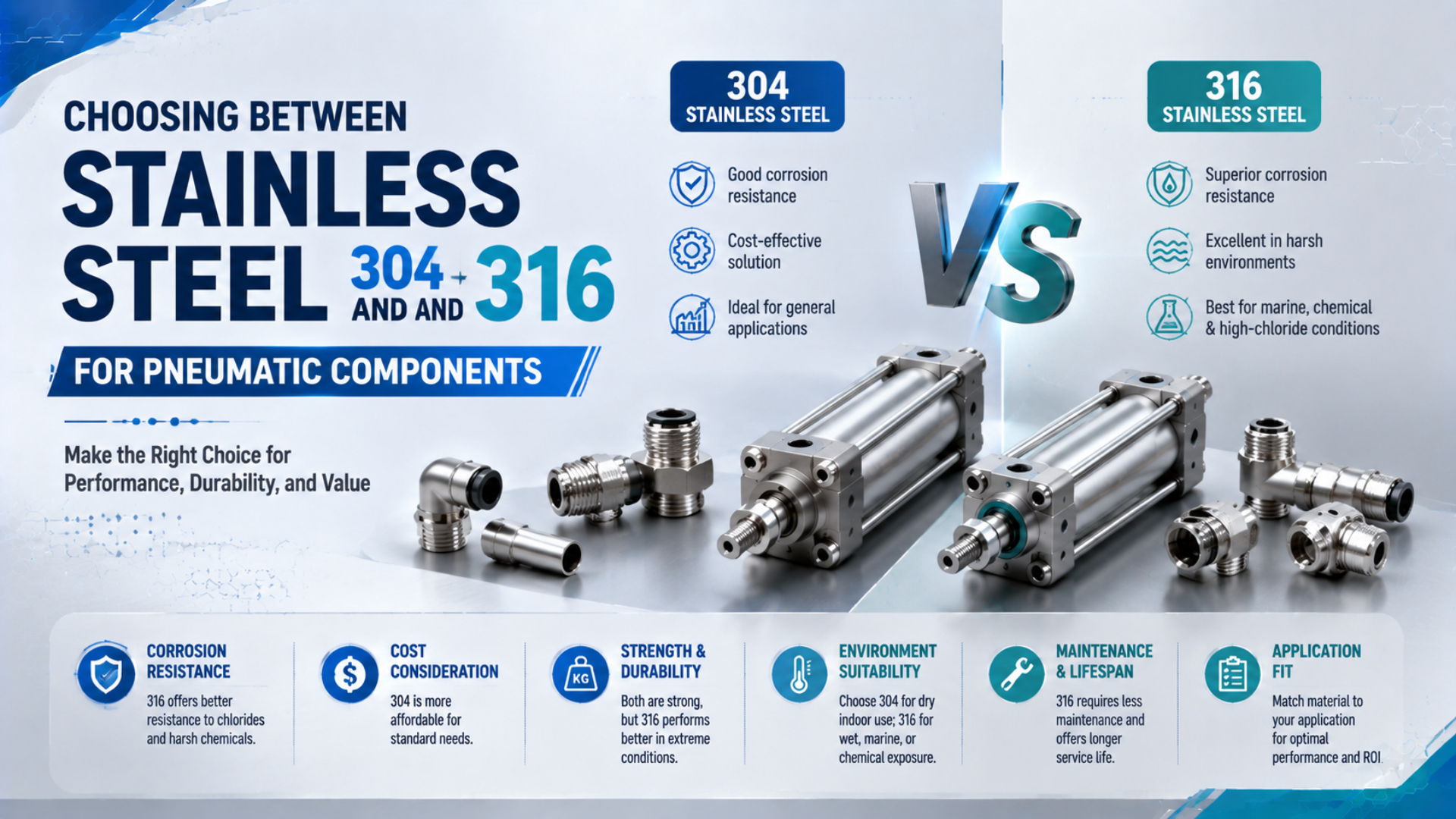
For stainless steel 304 and 316 pneumatic components, choose the alloy by matching it to the actual exposure, not by ranking one grade as universally better. Dry indoor service can often justify 304. Chloride-bearing washdown, coastal deposits, brine, and aggressive cleaners usually move the starting point toward 316 or 316L. Severe chemistry may require something more resistant than either.
The grade label is only one part of the decision. A pneumatic cylinder, valve, fitting, or filter-regulator can combine several metals, elastomers, lubricants, coatings, sensors, and threaded interfaces. The complete assembly must tolerate the environment while still meeting its pressure, temperature, leakage, cleanability, and documentation requirements.
Key Takeaways
- A representative Outokumpu 316L chemistry contains about 2.1% molybdenum; 304 contains no intentional molybdenum.
- 316 resists chloride pitting better than 304, but it is not immune.
- Verify every exposed and wetted material, then connect the certificate to the delivered parts.
Short Answer: Choose the Grade From Exposure and Evidence
Outokumpu lists about 2.1% molybdenum in its representative 316L/4404 chemistry and none in its 304 family, which explains 316L’s stronger starting position for chloride exposure (Outokumpu Supra; Outokumpu Core). It does not turn 316L into a universal corrosion guarantee.
Use 304 or 304L when the installation is dry, protected, and free from meaningful chloride or aggressive chemical exposure, provided the complete component meets its other requirements. Consider 316 or 316L when salt, chlorides, repeated wet cleaning, chemical deposits, or crevices make localized corrosion credible.
Then check whether 316 is enough. Stagnant seawater, hypochlorite, hydrochloric acid, high temperature, evaporation, and tight crevices can attack 316. A duplex, high-molybdenum alloy, nonmetallic design, coating, relocated actuator, or cleaner change may be the better answer. What matters is the defined service condition.
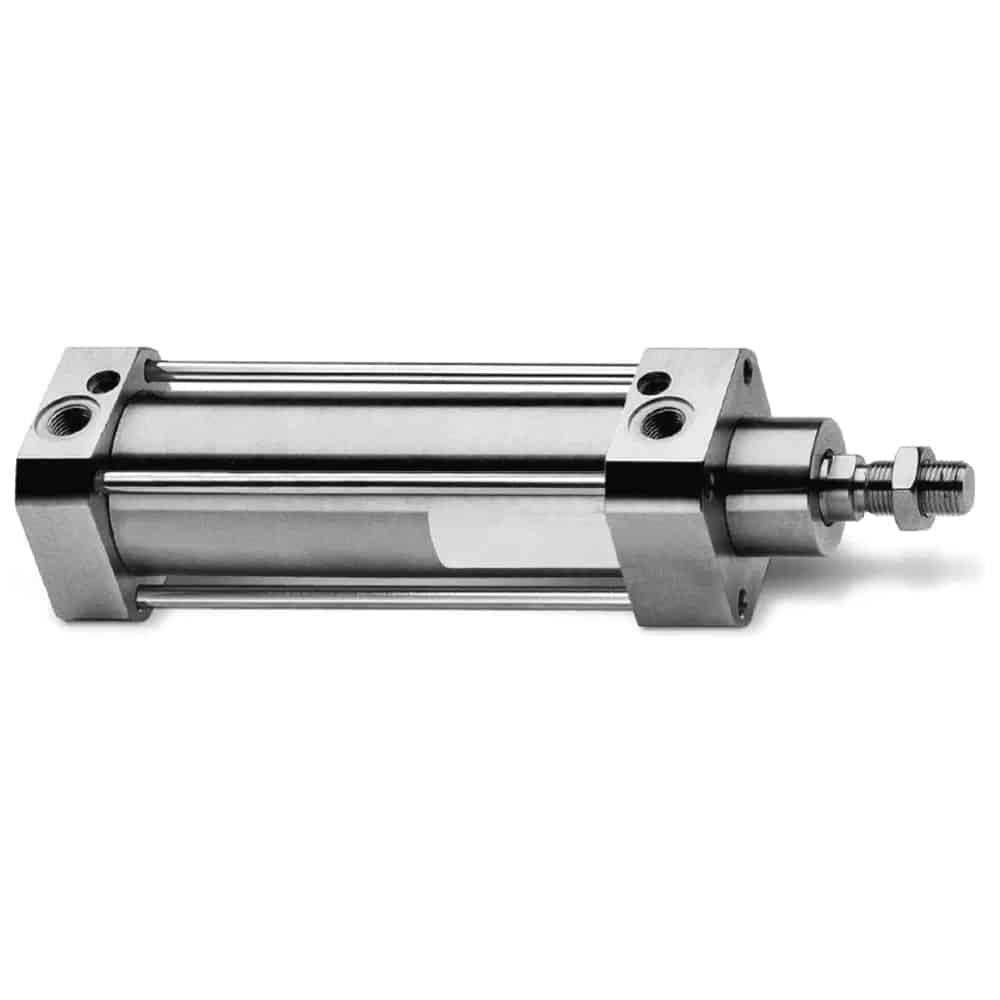
A polished stainless appearance cannot distinguish 304 from 316 or prove which grade was used for the barrel, end caps, rod, tie rods, fasteners, and fittings.
What Chemistry Separates 304, 304L, 316, and 316L?
The four common designations map to four UNS grades: S30400, S30403, S31600, and S31603. Outokumpu identifies 316/4401 as UNS S31600 and 316L/4404 as S31603; its representative 316L chemistry contains 17.2% chromium, 10.1% nickel, and 2.1% molybdenum (Outokumpu).
| Common name | UNS designation | Main selection distinction |
|---|---|---|
| 304 | S30400 | General-purpose chromium-nickel austenitic grade |
| 304L | S30403 | Lower-carbon 304 variant for better resistance to weld-related sensitization |
| 316 | S31600 | Molybdenum-bearing chromium-nickel grade with stronger localized-corrosion resistance |
| 316L | S31603 | Lower-carbon 316 variant, widely used when welding and corrosion evidence both matter |
Stainless steel 304 is a chromium-nickel austenitic grade commonly used for general corrosion resistance. Stainless steel 316 is its molybdenum-bearing counterpart, selected when the service requires a stronger margin against localized chloride attack.
The “L” means low carbon. It does not mean “low pressure,” “long life,” or automatically food grade. Outokumpu states that its 316L product can be welded in sections above roughly 5 to 6 mm without the same sensitivity to intergranular corrosion, but that product-form guidance should not be converted into a universal rule for every casting, bar, fitting, or finished pneumatic component.
Composition limits also depend on the named material specification and product form. Wrought sheet, bar, cast valve bodies, fasteners, and weld filler can use different designations and acceptance limits. Ask for the material standard, grade, heat number, product form, and certificate rather than accepting a purchase order that says only “stainless steel.”
Grade selection and pressure selection are separate decisions. The alloy helps answer whether a metal surface can tolerate an exposure. Geometry, wall thickness, seal design, manufacturing process, proof testing, and temperature determine whether the finished pneumatic component can safely carry pressure.
Why Does Molybdenum Help, and Where Does 316 Still Fail?
The Nickel Institute uses about 200 ppm chloride for 304 and 1,000 ppm for 316 as general water-service guides only within pH 6 to 8.5, then warns that pitting or crevice corrosion can still occur at lower concentrations (Nickel Institute). Those figures are not universal pneumatic-component limits.
Molybdenum helps stabilize the passive surface against localized chloride attack, so 316 normally has a higher pitting resistance equivalent number than 304. A common screening relationship is:
Here, Cr, Mo, and N are the mass percentages of chromium, molybdenum, and nitrogen in the actual chemistry. PREN compares alloy composition. It does not predict corrosion rate, pit depth, component life, cleaner compatibility, or a safe chloride threshold.
Why can 316 still pit? Chlorides can concentrate as water evaporates. Deposits create local chemistry different from the bulk solution. Gaskets, threads, bracket overlaps, and O-ring grooves restrict oxygen and form crevices. Higher temperature can accelerate attack. Surface roughness, embedded iron, weld heat tint, poor passivation, and stagnant liquid can further reduce the margin.
For a deeper mechanism review, see stress-corrosion cracking in stainless cylinders and galvanic corrosion between cylinder components.
Which Exposure Data Must Be Collected Before Choosing a Grade?
21 CFR 117.40 contains 7 equipment requirements under paragraph (a), including cleanability, corrosion resistance for food-contact surfaces, and resistance to the intended environment and cleaning procedures (US GovInfo). The engineering lesson extends beyond food plants: document the real exposure before naming an alloy.
Collect the following information for every exposed or wetted component:
| Exposure field | What to record | Why it changes the decision |
|---|---|---|
| Chemical identity | Product name, active ingredients, contaminants | “Cleaner” or “saltwater” is not a compatibility description |
| Concentration and pH | Normal, maximum, dosing tolerance | Bulk concentration can differ from residue in a crevice |
| Chloride source | Water, brine, product, sanitizer, coastal deposition | Identifies wetting and concentration mechanisms |
| Temperature | Fluid, surface, ambient, cleaning peak | Corrosion and elastomer behavior change with temperature |
| Time and frequency | Contact time, cycles, continuous or intermittent | Repetition and wet time affect accumulation |
| Rinse and drying | Rinse-water quality, drainage, drying interval | Residue can continue attacking after cleaning |
| Geometry | Threads, seals, overlaps, recesses, orientation | Locates crevices and stagnant pockets |
| Mechanical damage | Abrasion, impact, tool marks, maintenance access | Scratches and contamination can impair the passive surface |
Don’t select from bulk chloride concentration alone. Two machines using the same water can behave differently when one drains quickly and the other traps liquid beneath a bracket. Likewise, a lower nominal sanitizer concentration can become more aggressive when repeated drying concentrates residue.
The guide to protecting pneumatic cylinders in harsh washdown covers drainage, ingress, diagnosis, and maintenance. This article stays focused on the material-grade decision and its acceptance evidence.
In our experience reviewing applications, the sanitation or maintenance team often holds the missing data. Ask them for the exact product label, dilution setting, temperature, contact time, rinse step, and recent chemistry changes. A material decision made from “daily washdown” is no more reliable than a pressure selection made from “high pressure.”
Grade Selection Across Cylinders, Valves, Fittings, and FRLs
ISO 14743:2020 covers complete push-in connector assemblies with thermoplastic tube from 3 to 16 mm outside diameter, illustrating why a body-grade claim cannot establish complete-assembly suitability (ISO 14743). Apply the same assembly-level thinking to cylinders, valves, fittings, filters, regulators, drains, sensors, and mounting hardware.
| Component family | Materials to identify | Common hidden limit |
|---|---|---|
| Cylinder | Barrel, end caps, rod, tie rods, fasteners, mounts, wiper, seals, switch rail | Stainless barrel paired with plated fasteners or incompatible wiper |
| Directional valve | Body, spool or poppet, springs, seals, pilot parts, coil housing, connector | Corrosion-resistant body with an unsuitable electrical enclosure or pilot exhaust |
| Push-in fitting | Body, collet, release sleeve, O-ring, thread coating, tube | “316 body” with a different collet grade or incompatible tube |
| FRL unit | Head, bowl, guard, drain, diaphragm, spring, gauge, seals | Metal head paired with polymer bowl, zinc-plated spring, or exposed drain |
| Manifold | Block, inserts, plugs, fasteners, seals, connectors | Mixed metals and liquid trapped beneath modules |
For cylinders, determine what is exposed during extension and retraction. A rod can carry residue past the wiper, while tie rods and rear mounts may remain wet after the visible barrel dries. Stainless construction also doesn’t establish rod hardness, surface finish, load capacity, cushioning, or sensor compatibility.
For valves and FRLs, inspect low points and vents. Washdown liquid can collect around manual overrides, solenoid connectors, gauges, drains, and bowl guards. Internal compressed-air exposure is a different path from external cleaning exposure and may require separate material and air-quality evidence.
For fittings, specify the complete connection. The existing guide to stainless steel pneumatic fittings explains how body, collet, seal, tube, thread, and installation limits interact. A fitting is not acceptable simply because one catalog line says “316L.”
A selective-material strategy can be sound, but only when the exposure boundary is real. Using 316L outside and 304 inside does not help if washdown reaches the “protected” bracket, a piston rod transports residue inward, or a mixed-metal joint creates the first failure point. Draw the exposure path before dividing the bill of materials.
Do Food, Pharmaceutical, and Marine Rules Automatically Require 316L?
No. US food equipment rules require corrosion-resistant, cleanable surfaces that withstand intended food, cleaners, sanitizers, and procedures, but 21 CFR 117.40 does not prescribe 316L for every pneumatic component. EU Regulation 1935/2004 likewise sets safety and migration principles for food-contact materials without naming one universal stainless grade (EUR-Lex).
In food plants, first identify the installation zone and contamination path. A protected actuator outside the product area has different requirements from a fitting above exposed product or a cylinder receiving direct chemical washdown. Alloy grade, surface condition, drainage, seals, lubricant, and documentation must match that exact use.
Pharmaceutical rules also focus on suitability, cleaning, contamination control, and validated processes rather than turning 316L into a universal legal command. FDA notes that a cleaning procedure validated on one piece of 316 stainless equipment cannot automatically be transferred to different equipment or compounds; material, design, use, and contaminant all matter (FDA).
Marine service needs the same discipline. 316 is commonly preferred over 304 around salt, but stagnant seawater and chloride-filled crevices can pit 316. Use the dedicated marine corrosion-resistant cylinder guide when salt spray or seawater is the primary load.
For procurement evidence in food facilities, use the FDA-compliant pneumatics guide. It separates material evidence from complete-component approval, installation hygiene, and change control.
How Can MTRs and PMI Verify the Supplied Alloy?
BS EN 10204:2004 defines inspection-document types for metallic products, including documents based on specific inspection (BSI). A certificate helps only when its heat, product, grade, dimensions, and test results remain traceable to the delivered pneumatic parts. A generic sample certificate does not close that chain.
For critical orders, request:
- the material specification, grade, UNS or EN designation, and product form;
- the heat or cast number and certificate number;
- actual chemical results, not only maximum grade limits;
- mechanical results when required by the product specification;
- identification of which component parts the certificate covers;
- traceability from raw material through machining, assembly, and delivery;
- the inspection document type required by the purchase order;
- a process for substitutions, mixed heats, and supplier changes.
An EN 10204 type 3.1 certificate is validated by the manufacturer’s authorized inspection representative who is independent of the manufacturing department. Do not call it third-party certification. Type 3.2 adds validation by the purchaser’s representative or an official inspector designated by regulation, depending on the applicable arrangement.
Positive material identification provides a second evidence layer. Handheld XRF can usually distinguish 304 from 316 by measuring chromium, nickel, and molybdenum. Thermo Fisher states that XRF cannot measure the carbon needed to distinguish 316 from 316L or 316H; LIBS or OES is required when low-carbon verification matters (Thermo Fisher).
A molybdenum spot test can screen whether Mo is present, but it does not provide complete chemistry or establish an L grade. Likewise, one XRF reading on a barrel cannot prove the end caps, rod, fasteners, valve insert, or fittings. Define sample locations and failure disposition before inspection.
The guide to material traceability in pneumatics provides a broader document-control workflow.
A Practical Material Selection and RFQ Checklist
Outokumpu identifies 304, 304L, 316, and 316L as four different UNS grades, while BSI maintains EN 10204:2004 as the current inspection-document standard. A defensible RFQ therefore specifies both the required material identity and the evidence chain, then keeps corrosion suitability separate from pressure and performance acceptance.
- Define the operating zone. State whether the part is dry, protected, splashed, directly washed, product-contacting, coastal, marine, or chemically exposed.
- List every chemical. Include concentration, pH, temperature, contaminants, contact time, frequency, rinse, and drying.
- Map all exposure paths. Cover external spray, internal compressed air, rod movement, drains, vents, threads, crevices, and maintenance chemicals.
- Specify complete materials. Identify bodies, rods, fasteners, springs, fittings, seals, tubes, coatings, lubricants, sensors, and connectors.
- Choose a starting grade. Use 304/304L for controlled mild exposure and 316/316L when credible chloride or chemical exposure justifies the added pitting resistance.
- Check whether 316 is sufficient. Escalate severe seawater, hypochlorite, hydrochloric acid, high-temperature, or stagnant-crevice service for specialist review.
- Separate L-grade reasoning. State whether welding, heat input, corrosion requirements, or customer specifications make low carbon necessary.
- Request traceable documents. Name the material standard, UNS/EN grade, EN 10204 document type, heat traceability, and required actual results.
- Define PMI when needed. State instrument method, elements, carbon requirement, sample locations, calibration, acceptance criteria, and nonconformance action.
- Verify the component rating. Confirm pressure, temperature, leakage, flow, load, mounting, sensing, ingress, seal compatibility, and maintenance limits from the exact part number.
- Validate the installed system. Inspect after the real cleaning or exposure cycle and record corrosion, deposits, drainage, leakage, and any material substitution.
The strongest purchase description names the exposure and evidence instead of promising a universal service life. It allows suppliers to propose 304, 316L, a higher alloy, a coating, or a design change while making every deviation visible for engineering approval.
Stainless Steel Pneumatic Component FAQs: What Should Buyers Ask?
Outokumpu’s representative 316L chemistry contains 2.1% molybdenum, while Thermo Fisher confirms that XRF cannot verify the carbon difference between 316 and 316L. These FAQs address the practical boundary between alloy selection, regulatory suitability, certificate evidence, field testing, and direct replacement of a finished pneumatic component.
Is 316 always better than 304 for pneumatic components?
No. 316 normally provides stronger resistance to chloride pitting because it contains molybdenum, but 304 can be suitable in dry, protected, mildly cleaned installations. Compare actual exposure, complete assembly materials, pressure rating, seals, geometry, and documentation. Severe chloride or chemical service can also exceed 316’s capability and require a higher-alloy or redesigned solution.
Is 316L required for every food or pharmaceutical application?
No universal US or EU rule requires every pneumatic component to be 316L. Applicable rules focus on cleanability, corrosion resistance, contamination control, and suitability for intended conditions. The installation zone, product-contact path, cleaner, sanitizer, temperature, drainage, surface condition, seals, lubricant, and documentation determine whether 304, 316L, or another construction is acceptable.
Does an EN 10204 3.1 certificate prove the finished component is 316L?
Only when traceability is intact. A type 3.1 document reports specific inspection results and is validated by the manufacturer’s authorized inspection representative independent of manufacturing. Buyers must still connect its heat number, grade, product form, and results to the delivered barrel, body, rod, fasteners, or other named parts. A generic sample certificate proves nothing about one shipment.
Can handheld XRF distinguish 304 from 316 and 316L?
XRF can usually distinguish 304 from 316 by measuring chromium, nickel, and especially molybdenum. It cannot measure carbon, so it cannot confirm whether a 316 result is 316L or 316H. Use a carbon-capable method such as LIBS, OES, or suitable laboratory analysis when the low-carbon designation is part of the acceptance requirement.
Can a 304 component directly replace a 316 pneumatic part?
Dimensional interchangeability does not establish material equivalence. A 304 replacement may fit and operate yet reduce corrosion margin in chloride service. Compare alloy, every exposed and wetted material, pressure and temperature limits, port and mount dimensions, seals, flow, sensors, cleaning conditions, certificate scope, and failure behavior before approving any substitution.
Sources and technical references
- Outokumpu Supra range, representative 316/316L designations, chemistry, molybdenum content, applications, and low-carbon welding context. Retrieved 2026-07-26.
- Outokumpu Core range datasheet, 304/304L designations and material context. Retrieved 2026-07-26.
- Nickel Institute IGN 4-25-02, conditional chloride guidance for natural and potable water and its stated limitations. Retrieved 2026-07-26.
- 21 CFR 117.40, cleanability, corrosion resistance, intended-use environment, sanitation, and pneumatic-system requirements. Retrieved 2026-07-26.
- Regulation (EC) No 1935/2004, EU food-contact material safety principles. Retrieved 2026-07-26.
- FDA equipment cGMP questions and answers, equipment-specific cleaning validation and material-of-construction context. Retrieved 2026-07-26.
- BSI: BS EN 10204:2004, inspection documents for metallic products. Retrieved 2026-07-26.
- Thermo Fisher: XRF, LIBS, and OES for PMI, XRF alloy identification and carbon-measurement limitations. Retrieved 2026-07-26.
- ISO 14743:2020, complete push-in connector assemblies with thermoplastic tube. Retrieved 2026-07-26.