

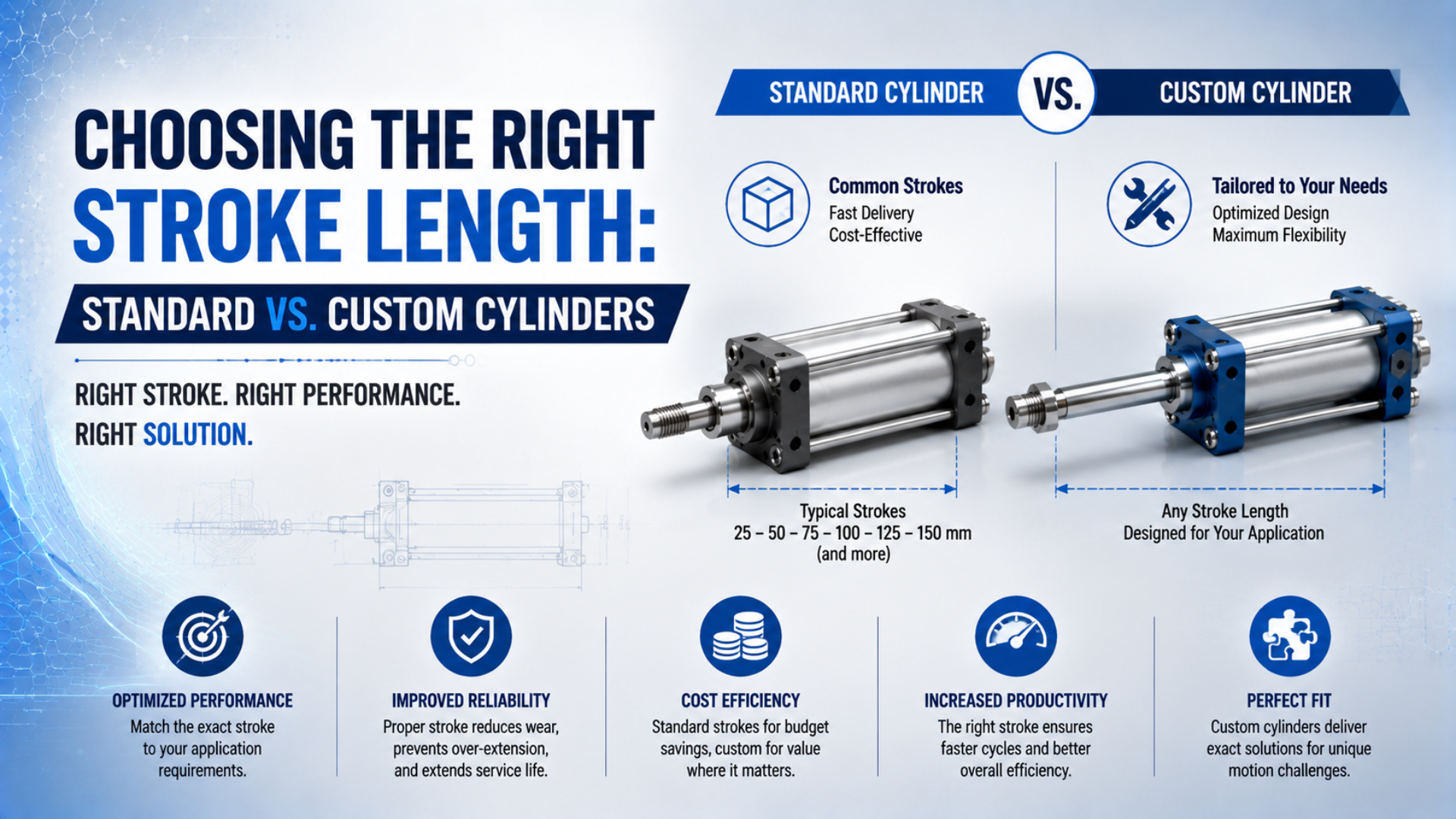
Choose a pneumatic cylinder stroke from the machine’s measured start and end datums, then verify the exact supplier configuration, stroke tolerance, installed envelope, cushioning, guidance, and rod stability. A catalog stroke is suitable only when its complete motion window fits the application. If it doesn’t, compare a configured stroke, a machine-interface change, and a true custom cylinder.
ISO 15552 helps standardize cylinder and mounting interfaces, but it doesn’t give every manufacturer one mandatory list of available strokes. That distinction matters. A 160 mm cylinder doesn’t have to travel 160 mm in every machine cycle, while a 125 mm cylinder can’t create 127 mm of travel through rod-end adjustment. Geometry decides first.
Key Takeaways
- ISO 15552 covers detachable-mounting cylinders from 32 to 320 mm bore, not a universal stroke series.
- Adjustable rod ends relocate a motion window; they don’t add travel.
- Check actual catalog tolerance, installed dimensions, cushioning, and rod buckling before approving a standard or custom stroke.
What Does Required Cylinder Stroke Actually Mean?
ISO 15552 applies to cylinders from 32 to 320 mm bore at a maximum rated pressure of 1,000 kPa, but its scope doesn’t define the two machine points your tooling must reach (ISO 15552:2018, confirmed current in 2025). Required stroke begins with those application datums.
Required cylinder stroke is the axial distance between the machine’s defined start and end process datums. Define one rigid reference for the retracted position and another for the extended position. Then measure both along the same motion axis. The minimum geometric travel is:
Here, is required travel in millimetres, while and are positions measured from the same machine datum. This relationship assumes both points lie on one motion axis. It doesn’t include clearance, stroke tolerance, fixture deflection, or a controlled deceleration zone.
The next question is often missed: what exactly are you measuring? Piston-rod travel, carriage travel, distance between tooling faces, sensor-switch separation, and part movement aren’t interchangeable. A compliant cylinder can still miss the process point if a bracket flexes or the tooling datum was measured from the wrong surface.
In our experience, stroke reviews become much clearer when the team labels four values separately instead of discussing one ambiguous “travel” number:
| Requirement | What it controls | Evidence needed |
|---|---|---|
| Process travel | Distance between required machine positions | Layout, CAD model, or physical datum survey |
| Nominal cylinder stroke | Ordered catalog or drawing value | Exact model code and supplier drawing |
| Actual stroke band | Permitted manufactured travel | Series-specific tolerance and exclusions |
| Process position tolerance | Acceptable tooling or part position | Machine specification and acceptance test |
The companion guide to cylinder stroke length tolerances explains why nominal stroke, actual travel, accuracy, and repeatability must remain separate. Don’t hide four requirements inside one rounded catalog number.
Treat stroke selection as interval matching, not nearest-number selection. The cylinder provides an actual travel interval, while the machine defines an allowable start-to-end interval. A candidate passes only when those intervals overlap after mounting tolerance, stroke tolerance, fixture deflection, and service adjustment are included.
Does ISO 15552 Define Standard Pneumatic Cylinder Strokes?
ISO 6431:1992 was withdrawn on February 20, 2004 and replaced by ISO 15552:2004 (ISO 6431). The current edition, ISO 15552:2018, standardizes basic, mounting, and accessory dimensions for interchangeability. It does not make one universal stroke table mandatory across every supplier and series.
That means “standard stroke” is a commercial and product-platform term. It may describe a stocked value, a configurable value made from standard components, or a catalog range that the supplier can build without a new design. Therefore, ask the supplier which meaning applies. The answer affects price, lead time, documentation, and replacement availability.
For example, Festo’s current DSBC ISO 15552 data sheet lists strokes from 1 to 2,800 mm for applicable configurations (Festo DSBC, retrieved 2026-07-26). That broad range doesn’t mean every bore, cushion, rod, mounting, sensor, or material option is available at every stroke. The configured part number and drawing still control.
What does ISO conformity give you? It gives a useful dimensional framework for comparing compatible cylinder families. What doesn’t it give you? It doesn’t guarantee identical overall length, rod thread, port orientation, stroke tolerance, cushioning, sensors, seals, rated load, or delivery status.
Before calling a cylinder interchangeable, follow the checks in the ISO 15552 interchangeability guide. Compare the complete configured drawing, not just bore and nominal stroke.
Can a Longer or Shorter Standard Stroke Fit the Machine?
Festo lists DSBC cushion lengths from 18 to 40 mm across the cited bore range, which shows that end-zone behaviour is model-specific rather than a universal allowance (Festo DSBC, retrieved 2026-07-26). A longer standard stroke can work only when the machine safely controls its unused travel and installed envelope.
A shorter cylinder is different. An adjustable rod end, clevis, bracket, or mounting slot can move the entire travel window, but it cannot widen that window. If the machine needs 127 mm between process datums, a cylinder whose minimum guaranteed travel is 125 mm cannot reach both endpoints through adjustment alone.
A longer cylinder isn’t automatically wasteful. If an external machine stop ends motion before the piston reaches its internal end position, the piston travels only to that stop. Air consumption and cycle time depend on actual chamber volume change and motion profile, not simply the nominal stroke printed on the label.
However, an intermediate stop changes the load path. Confirm whether the stop is intended for positioning, routine energy absorption, or emergency overtravel. Check trapped pressure and stored energy before allowing personnel near the mechanism. A stop bolt added after commissioning isn’t a substitute for a rated stopping system.
Use this pass/fail test:
| Candidate | When it can pass | Typical reason to reject it |
|---|---|---|
| Shorter standard stroke | Only if revised start and end datums both remain inside its guaranteed travel | Cannot reach both process positions |
| Longer standard stroke | Envelope fits and unused motion is safely controlled | Body length, rod extension, stop energy, or service clearance fails |
| Configured exact stroke | Supplier platform supports the value with controlled ratings and parts | Option combination unavailable or poorly documented |
| True custom cylinder | Hard requirement survives all standard and configured checks | Qualification or lifecycle ownership is incomplete |
How Do You Verify Retracted and Extended Installation Space?
ISO 15552 covers 32 to 320 mm bores, yet two compliant cylinders can still have different configured envelopes because accessories and options sit outside the standardized interfaces (ISO 15552:2018). Verify both end positions from the exact supplier drawing, including rod-end hardware, sensors, fittings, and service access.
Start with the retracted installation length. Measure between the actual machine mounting datums, not a bare-cylinder dimension copied from a generic CAD model. Add the rod-end joint, locknut engagement, mounting plate, spacer, sensor connector, tubing bend radius, and clearance needed to remove the cylinder.
Then model the extended position using the supplier’s maximum permitted actual stroke. This is where a positive-only stroke tolerance matters. If a nominal stroke can legally run long, designing the machine exactly to nominal may produce an interference even though the cylinder passes inspection.
Use two envelope checks:
The installed lengths include the complete configured cylinder, attachments, and tolerance stack. The available lengths come from the machine envelope in the same datum system. Both inequalities must pass under worst-case assembly and operating conditions.
CAD helps, but don’t stop there. Supplier CAD files can omit cable bends, adjustable screw projections, cushioning access, or wrench clearance. The guide to reviewing pneumatic cylinder CAD models provides a fuller model-review checklist.
A useful design review shows four overlays on one drawing: minimum retracted position, maximum extended position, service-removal path, and the load’s swept volume. This catches a common error where the cylinder fits during motion but can’t be installed, adjusted, or replaced without dismantling nearby equipment.
When Do Cushioning and External Stops Affect Stroke Selection?
SMC selection guidance compares load kinetic energy with the selected cylinder’s allowable cushion energy and lists a larger bore or external stopper as possible responses when the limit is exceeded (SMC Pneumatic Cylinder Model Selection, retrieved 2026-07-26). External stops aren’t inherently wrong; unverified energy is the problem.
Air cushioning slows the piston near the cylinder’s physical end position by restricting exhaust. It doesn’t reduce nominal stroke, and the cushion needle doesn’t define an exact process stopping point. Load mass, approach velocity, pressure, exhaust backpressure, cushion adjustment, orientation, and temperature all affect the result.
The first screening quantity is translational kinetic energy:
Here, is kinetic energy in joules, is moving mass in kilograms, and is velocity in metres per second immediately before deceleration. Use measured or defensibly predicted impact velocity. Average stroke speed can miss a higher local velocity because energy changes with the square of speed.
Kinetic energy may not be the complete stopping demand. Cylinder thrust, gravity, springs, or another drive can continue doing work while the stop or shock absorber compresses. The exact device-selection method must include those forces, absorber travel, event rate, effective mass, return time, temperature, and mounting instructions.
For an initial screen, use the pneumatic cylinder cushion energy calculator. If a separate absorber is required, continue with the external shock absorber sizing guide. Final approval must come from the exact cylinder or absorber catalog and the installed-machine test.
What if the longer standard cylinder uses an external stop before the built-in cushion engages? Then the external system owns the normal deceleration duty. Don’t count the internal cushion as available energy capacity unless the actual motion reaches and uses its documented cushion zone.
What Changes When the Selected Stroke Becomes Long?
Festo’s cited DSBC range reaches 2,800 mm for applicable configurations, but catalog availability alone doesn’t prove that an unsupported piston rod is stable under compression (Festo DSBC, retrieved 2026-07-26). Long-stroke selection must add rod buckling, sag, guidance, side load, flow, and dynamic checks.
A rod in compression can buckle before the cylinder reaches its theoretical thrust capacity. The screening calculation depends on rod diameter, unsupported length, elastic modulus, end conditions, safety factor, mounting alignment, and whether the rod extends or retracts under the critical load. A larger bore can make the buckling problem worse by increasing available thrust without changing rod stability proportionally.
Use the pneumatic cylinder rod buckling calculator for preliminary screening, then verify the supplier’s model-specific permissible stroke and load diagrams. The Euler buckling guide explains the assumptions and why an ideal-column result isn’t a product rating.
Longer stroke also magnifies alignment errors. A pneumatic cylinder should drive axially; it isn’t a linear guide. If the load can rotate, pitch, yaw, or impose an offset force, add external guidance or select a guided actuator. Rod bearings and seals shouldn’t be used to absorb a machine’s structural side load.
Flow can become the limiting factor too. Longer chamber volume takes more air to fill and exhaust, while undersized ports, tubing, valves, and silencers can delay pressure buildup. Size force from minimum dynamic pressure at the cylinder, then check speed from the complete flow path. Nominal supply pressure at the compressor isn’t enough.
The long-stroke decision is often architectural rather than dimensional. Once rod buckling, guide spacing, swept volume, and envelope are plotted together, a guided cylinder or rodless actuator may remove more risk than a larger custom rod cylinder. Compare architectures before customizing a weak load path.
How Should You Choose Between Standard, Configured, and Custom Stroke?
ISO 15552 gives a common dimensional framework across 32 to 320 mm bores, while the cited Festo platform demonstrates that supplier-configurable strokes may span 1 to 2,800 mm (ISO 15552; Festo DSBC). Search the exact platform before treating an uncommon value as a new custom design.
Use three categories. Each term needs a controlled meaning:
- A standard stroke is a listed, routinely ordered configuration that meets the motion window, envelope, tolerance, load, cushioning, environment, and service requirements.
- A configured stroke is a supplier-controlled variation built within an established platform, with documented ratings, drawings, part number, replacement parts, and repeat-order control.
- A true custom cylinder is a project-specific design that changes dimensions, materials, interfaces, construction, or qualification beyond the established platform.
The broad commercial and qualification questions belong in the guide to standard versus bespoke pneumatic cylinders. This article makes the earlier engineering decision: whether a candidate stroke and its installed motion window can satisfy the machine.
Don’t choose custom merely because the required value looks unusual. Likewise, don’t force a stock cylinder into the machine with an unreviewed stop, spacer, or bracket. Select the lowest-custom-content option that passes every hard requirement and leaves a controlled replacement path.
What Must the Stroke RFQ and Approval Drawing Contain?
ISO 15552 addresses interchangeability for 32 to 320 mm bore cylinders, but a supplier still needs application-specific stroke, interface, tolerance, and operating data to produce a controlled configuration (ISO 15552:2018). A complete RFQ lets standard, configured, and custom proposals be compared against one requirement.
Record these fields:
| RFQ block | Required information |
|---|---|
| Motion datums | Start and end reference surfaces, direction, nominal travel, and allowable overtravel |
| Stroke acceptance | Nominal stroke, lower and upper deviation, measurement state, instrument, and decision rule |
| Cylinder identity | Series, bore, rod diameter, action, mounting, port, cushion, bumper, seal, and sensor options |
| Installed geometry | Retracted and extended dimensions, rod-end stack, fittings, cable bends, swept volume, and service clearance |
| Load and dynamics | Moving mass, axial force, side load, moments, speed profile, cycle rate, dwell, and orientation |
| Stopping method | Internal cushion, elastomer bumper, machine stop, shock absorber, or controlled intermediate position |
| Environment | Temperature, contamination, washdown, chemicals, corrosion, outdoor exposure, and air quality |
| Lifecycle control | Drawing number, revision, complete order code, spare parts, approved substitutions, and change notification |
| Qualification | Dimensional report, leak and function test, load trial, machine acceptance limits, and required records |
Freeze the datums before requesting quotes. Otherwise, each supplier may interpret “127 mm stroke” differently. One may quote nominal piston travel, another may control distance between mounting faces, and a third may include an adjustable stop. Comparable proposals need a shared drawing and acceptance method.
For cross-brand replacement, never approve on bore, stroke, and ISO label alone. Confirm overall dimensions, rod thread and engagement, port locations, mounting hardware, cushion access, sensor compatibility, pressure and temperature ratings, allowable loads, seal package, and complete order code.
The most reusable procurement artifact isn’t the supplier quotation. It’s a machine-owned interface drawing that separates mandatory datums from supplier-selected construction. That drawing lets engineering approve an alternative without copying a worn cylinder or locking every internal part to one manufacturer.
FAQs About Standard and Custom Cylinder Stroke
Festo lists 1 to 2,800 mm strokes for applicable DSBC configurations, while ISO 15552 covers interface dimensions rather than one required stroke list (Festo DSBC; ISO 15552). These answers clearly keep catalog availability, machine travel, cushioning, and replacement control separate.
Does an adjustable rod end increase the available cylinder stroke?
No. A rod end, clevis, bracket, or mounting slot changes where the stroke window sits relative to the machine. It doesn’t increase the distance between the cylinder’s retracted and extended endpoints. Both required process positions must remain inside the cylinder’s guaranteed actual travel after the full tolerance stack is applied.
Does ISO 15552 define one universal list of standard strokes?
No. ISO 15552 standardizes basic, mounting, and accessory dimensions for detachable-mounting cylinders from 32 to 320 mm bore. Stroke availability is product- and configuration-specific. Check the current supplier catalog, configurator, complete model code, dimensional drawing, tolerance, and option restrictions before calling a value standard.
Can cushion adjustment shorten a pneumatic cylinder’s effective stroke?
No. Cushion adjustment changes exhaust restriction during the final part of travel; it doesn’t change the cylinder’s mechanical stroke. If tooling must stop before full extension, use a rated intermediate positioning or stopping method. Verify the remaining energy because the built-in end cushion may never engage.
When is an external stop acceptable with a longer standard stroke?
An external stop is acceptable when its load path, impact energy, continued drive work, permissible cycle rate, mounting, and failure consequence have been verified. The cylinder and circuit must also reach a safe state at the stop. Don’t treat an ordinary adjustment bolt as a rated production shock absorber.
What must be specified for a cross-brand custom-stroke replacement?
Specify the complete series or approved equivalent, bore, actual stroke band, rod diameter and thread, mounting datums, ports, cushioning, sensors, seals, pressure, temperature, loads, environment, acceptance test, drawing revision, and spare-parts requirements. An ISO 15552 label plus bore and nominal stroke doesn’t establish full interchangeability.
About the author: Jack Chen covers pneumatic cylinder sizing and load-path review for Bepto Pneumatic. The About Us page describes the engineering and manufacturing scope behind this technical library. Readers can submit source corrections or application details through Contact.
Sources and technical references
- ISO 15552:2018, Pneumatic fluid power cylinders, official scope and current-status record; retrieved 2026-07-26.
- ISO 6431:1992, official withdrawn-status record; retrieved 2026-07-26.
- Festo DSBC ISO 15552 data sheet, configured stroke range, dimensions, options, and cushion lengths; retrieved 2026-07-26.
- SMC Pneumatic Cylinder Model Selection, cushion-energy selection and external-stopper guidance; retrieved 2026-07-26.
- Parker Pneumatic Engineering Data, cushion-capacity dependence on cylinder configuration and backpressure; retrieved 2026-07-26.