

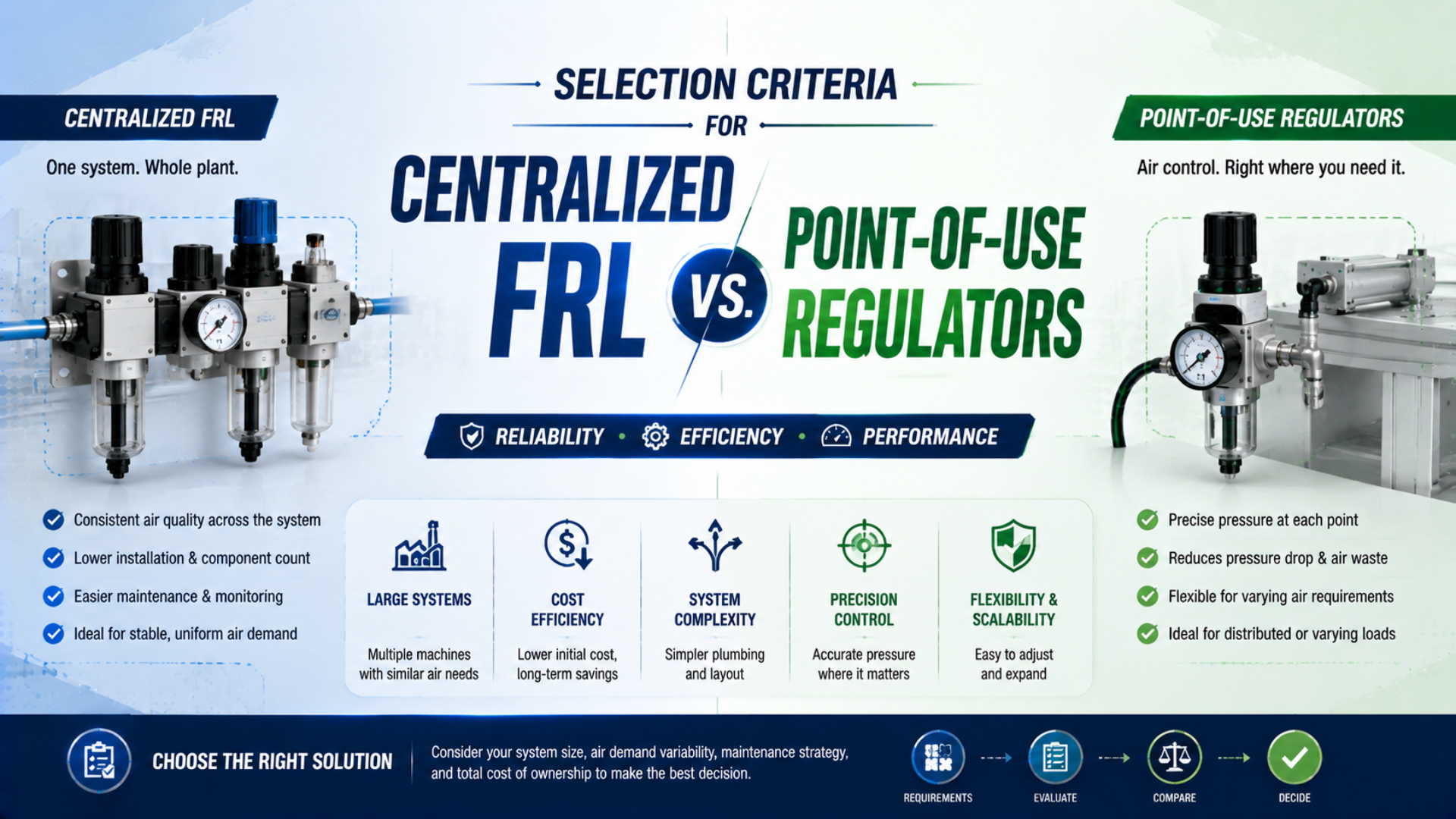
The practical choice is rarely centralized FRL or point-of-use regulation as mutually exclusive alternatives. Most machines still need a defined air-treatment and isolation point. The real decision is whether one regulator can serve every downstream load, or whether selected branches need their own lower setpoint, tighter control, or independent adjustment.
That distinction matters in commissioning.
Start with measurements and device requirements. Record the flowing supply pressure, peak branch demand, required device pressure, acceptable variation, air-quality class, and lubrication policy. A regulator beside the device cannot repair an undersized header, a blocked filter, or insufficient inlet pressure.
Key Takeaways
- CAGI recommends no more than 10% total pressure drop from compressor discharge to the point of use.
- Use one central regulator only when downstream pressure requirements and dynamic behavior are compatible.
- Add branch regulators selectively, then validate their inlet margin and outlet pressure during the real machine cycle.
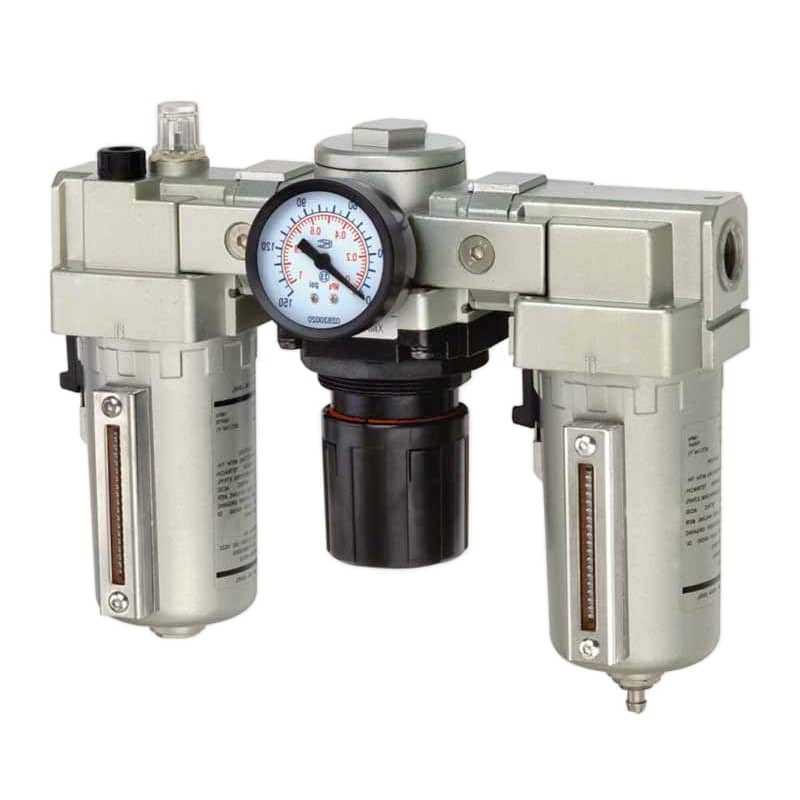
For the functions and maintenance requirements of each module, begin with the FRL air-source treatment guide. This article focuses on where regulation belongs after those functions have been defined.
What Is the Real Choice Between Centralized FRL and Point-of-Use Regulation?
ISO 6953-1:2024 applies to compressed-air regulators with rated inlet pressure up to 2,500 kPa and filter-regulators up to 1,600 kPa (ISO, 2024). The selection question is not component size alone. It is where pressure control must occur and which functions each location must perform.
Centralized FRL regulation means one machine-level regulator establishes the pressure for a manifold or group of downstream devices. Filtration, isolation, soft start, pressure indication, and optional lubrication may also be located at that machine entry.
Point-of-use regulation means a separate regulator establishes a branch or device pressure downstream of the main supply. It is useful when that branch requires a lower setpoint, a dedicated adjustment, or a regulator characteristic different from the machine-level unit.
A hybrid arrangement combines both. It may use centralized filtration and safe isolation, one machine supply pressure, and local regulators only on branches that need a lower pressure. This is often cleaner than installing a complete FRL at every actuator.
The location changes what can be controlled.
Draw the architecture by function, not by product name. A box labeled “FRL” can hide whether the assembly actually contains a lubricator, relieving regulator, soft-start valve, shut-off valve, drain, or pressure sensor. Those differences determine whether the assembly can safely serve several branches.
When Is One Centralized FRL Regulator Enough?
CAGI recommends limiting total operating pressure drop from compressor discharge to any point of use to 10% of compressor discharge pressure (CAGI, 2026). One centralized regulator can be sufficient when every connected load works within the resulting pressure band and no branch needs independent adjustment.
Use a single machine-level regulator when all of these statements are true:
- every downstream device has a compatible required pressure range;
- peak simultaneous flow stays within the filter and regulator flow curves;
- pressure at the furthest critical device remains acceptable during the actual cycle;
- one setpoint change is allowed to affect every connected branch;
- the same air-quality and lubrication policy is valid for every branch;
- maintenance access and machine isolation are practical at the central location.
Do not decide from static gauges. At zero or low flow, the pressure loss across tubing, fittings, filters, and regulators can be small. The same circuit may sag during a fast cylinder stroke, a clamp sequence, or a blow-off event. Compare the central regulator outlet with the furthest critical device during that event. If both move together, the cause may be upstream capacity or storage. If only the remote point falls, isolate the distribution path before changing the regulator architecture. Keep the machine state, recipe, load, and measurement timing consistent so the traces describe the same pneumatic event. The goal is not a perfectly flat trace; it is a documented pressure band that satisfies every connected device throughout its required operating cycle.
The pressure fluctuation guide explains why simultaneous demand and compressor controls can move the whole machine supply. If every branch changes together, a larger central regulator may not be the answer; the dominant restriction may be farther upstream.
Centralized regulation also simplifies setpoint control. One lockable adjustment and one calibrated gauge can be easier to manage than several local knobs. That benefit disappears if operators must repeatedly change the central setpoint to satisfy different devices.
Can one gauge prove that? No.
When Does a Branch Need a Point-of-Use Regulator?
At roughly 100 psig, the U.S. Department of Energy gives a rule of thumb that each unnecessary 2 psi increase in compressor discharge pressure raises full-flow energy use by about 1% (DOE, 2003). A local regulator can avoid exposing a lower-pressure branch to the machine’s highest required pressure.
A branch regulator is justified when one or more of these conditions apply:
| Branch requirement | Why local regulation helps | Evidence to verify |
|---|---|---|
| Lower operating pressure | Keeps that branch below the machine supply | Device manual and loaded outlet measurement |
| Independent setup adjustment | Prevents one recipe change from moving other branches | Approved setpoint range and lock method |
| Different regulator characteristic | Allows a precision, pilot-operated, or relieving model | Supplier flow and pressure characteristics |
| Process pressure must be measured locally | Places indication and control near the acceptance point | Gauge or sensor range and calibration |
| Pressure must be limited before a low-rated device | Adds a controlled reduction stage | Maximum working pressure and fault review |
Typical candidates include regulated clamps, proportional valves with a defined supply range, air-driven dosing equipment, vacuum ejectors whose performance curve specifies supply pressure, and test fixtures with an approved pressure setpoint. The component manual remains controlling.
A local regulator does not always need its own filter. Add local filtration only when the branch cleanliness requirement, contamination risk, or regulator design demands it. Multiple unnecessary filters increase maintenance points, leak paths, bowl inspections, replacement inventory, and pressure drop. When a fine branch filter is justified, document its initial and service-limit differential pressure. Otherwise, a pressure problem caused by a loaded element can be mistaken for regulator undersizing. Record the filter grade and measurement point as well, because a nominal element rating alone does not establish the delivered ISO 8573-1 class. Include the added element in the peak-flow pressure budget and give maintenance staff a visible service trigger.
For proportional control, separate the mechanical supply regulator from the commanded pressure device. The proportional-valve hysteresis guide explains why repeatability, hysteresis, flow capacity, and upstream stability must be reviewed together.
The branch must justify the extra hardware.
Why Can’t a Point-of-Use Regulator Hide a Weak Supply?
SMC shows an AR30 regulator set to 0.4 MPa at zero flow falling to 0.35 MPa at 1,000 L/min with 0.7 MPa inlet pressure (SMC, 2024). The 0.05 MPa droop demonstrates that local placement cannot eliminate the regulator’s own flow characteristic.
The available pressure during flow can be represented as:
Here, is the measured supply pressure during the demand event. The three pressure-loss terms cover air-treatment components, the branch path, and the selected regulator at that flow. All pressures must use the same gauge or absolute reference.
A reducing regulator needs adequate inlet pressure:
In this relationship, is the lowest regulator inlet pressure during the real cycle, is the desired outlet setting, and is the product-specific differential needed to deliver the target flow. Read that differential from the supplier curve or application data, not a universal rule.
When inlet pressure approaches the setpoint, the regulator loses authority and behaves increasingly like a restriction. Outlet pressure then falls with demand. A booster may be needed when a branch must exceed the available supply, but that is a separate pressure-generation and safety decision.
Headroom is not optional.
Location removes only the losses downstream of the sensing and control point. A regulator mounted beside the device can reduce the effect of tubing after the regulator, but it cannot recover pressure already lost in the header, filter, manifold, upstream hose, or regulator itself.
Measure Dynamic Pressure Before Changing the Architecture
CAGI’s 10% guidance covers the complete path from compressor discharge to the point of use, so one gauge cannot identify the responsible segment (CAGI, 2026). Record synchronized pressure at several points while the machine reproduces the event that causes weak force, unstable tooling, or slow response.
Use four measurement points when practical:
- central FRL or machine-isolation inlet;
- central regulator outlet or manifold inlet;
- candidate local-regulator inlet;
- device inlet or local-regulator outlet.
For each segment:
Both readings must represent the same time window and production event. Otherwise, the subtraction mixes different system states.
Timing matters.
If P1 and P2 fall together, investigate the upstream plant system, receiver behavior, compressor controls, or simultaneous demand. If P1 holds while P2 falls, the central treatment assembly is the dominant suspect. If P2 holds and P3 falls, inspect the manifold, fittings, couplers, and branch tube. If P3 remains stable while P4 falls, review the local regulator curve, outlet setpoint, downstream flow, and gauge response. Repeat the same cycle after one controlled change.
Use the Pressure Drop Calculator to screen straight pipe and fitting losses, then compare the estimate with live measurements and manufacturer curves. The calculator cannot model every regulator, filter element, hose, or transient event.
What Should Remain Centralized, and What Belongs on a Branch?
ISO 8573-1:2010 defines compressed-air purity classes for three principal contaminant categories: particles, water, and oil, independent of where the requirement is specified or measured (ISO, 2010). Pressure zoning does not replace the need to define air quality at each relevant point of use.
Keep functions centralized when they protect or control every downstream branch:
- machine isolation and stored-energy release;
- bulk liquid separation and drainage;
- filtration required by all connected loads;
- soft-start or dump functions defined by the safety design;
- common pressure monitoring;
- a machine-level regulator when all branches share its pressure range.
Move a function to a branch when only that branch needs it:
- a lower pressure setpoint;
- finer filtration for a sensitive device;
- a dedicated non-relieving, relieving, precision, or pilot-operated regulator;
- local pressure sensing used for process acceptance;
- a separate lubrication policy.
Do not assume a filter bowl controls water vapor. A dryer is required when the application specifies pressure dew point. The pressure dew point guide separates vapor control from bulk-liquid removal.
Lubrication deserves its own branch review. A centralized lubricator is appropriate only when all downstream manuals permit the same oil and oil-mist delivery. Check whether the oil can reach the device at the actual flow and distance, whether exhaust oil can contaminate the product, and whether prior lubrication has already changed maintenance requirements. If one branch serves electronics, paint, clean processing, or factory-lubricated components that prohibit added oil, split the lubrication function rather than feeding the whole manifold through it.
FRL is a functional label, not a mandate.
General industrial FRL equipment must not be treated as breathing-air preparation. OSHA 1910.134 requires compressed breathing air to meet Grade D specifications and imposes additional source, filtration, maintenance, alarm, and respiratory-program controls (OSHA).
How Should Energy Savings Be Evaluated?
DOE states that at about 100 psig, each unnecessary 2 psi increase in compressor discharge pressure raises full-flow energy use by roughly 1%; unregulated demand can add further consumption (DOE, 2003). This supports pressure reduction, but it does not prove a universal saving from every local regulator.
Separate three possible benefits:
- Lower branch consumption: an unregulated nozzle, ejector, or tool may use less air at a lower approved pressure.
- Lower plant pressure: removing restrictions or excessive local setpoints may allow the compressor header setpoint to fall.
- Avoided process loss: stable, approved device pressure may reduce measured scrap, rework, or downtime.
Do not count the same benefit twice. A local regulator that lowers one branch but leaves plant discharge pressure unchanged may reduce branch demand without producing the full compressor-level saving implied by the 2 psi rule. A plant-pressure reduction may affect compressor power, unregulated demand, and leakage, but only when controls respond as expected. Compressor type, storage, unloaded power, leakage, pressure bands, and production duty all affect the result. State which boundary was measured, which controls changed, and whether production output remained equivalent during the comparison. Pressure readings without corresponding flow, power, and production data cannot establish an energy saving.
Build the estimate from measured branch flow, duty cycle, operating hours, compressor specific power, and electricity price. The Compressed Air Energy Cost Calculator can organize those inputs, but acceptance should use site meter data when the investment depends on a guaranteed saving.
There is no universal percentage.
Treat pressure stability and energy as separate acceptance tests. The architecture can improve a process without lowering plant energy, or save branch air without meeting a tight process tolerance. Combining both into one claimed percentage hides which outcome was actually measured.
A Selection and Commissioning Checklist
ISO 4414:2010 remains the published third edition for pneumatic system safety and addresses design, installation, adjustment, reliable operation, maintenance, energy efficiency, and environmental considerations (ISO, confirmed 2021). A regulator-location decision should therefore end with documented commissioning evidence, not a schematic preference.
Use this sequence:
The release record should answer six questions.
| Decision gate | Central regulator may be enough when | Add branch regulation when |
|---|---|---|
| Required pressure | All loads share an acceptable range | One branch needs a lower or independent setpoint |
| Dynamic flow | Central pressure remains acceptable at peak demand | The branch needs a different regulator characteristic |
| Inlet margin | Every load remains supplied through the cycle | Local regulator inlet stays above its product requirement |
| Air quality | One treatment train satisfies every branch | A branch needs finer or different treatment |
| Lubrication | Every branch permits the same oil policy | Oil requirements differ between branches |
| Change control | One setpoint can govern the whole machine | Local adjustment must be locked, labeled, and controlled |
Before release:
- record the approved setpoints and allowable ranges;
- verify component maximum working pressures;
- capture P1 through P4 during the worst expected simultaneous demand;
- test start-up, normal running, blocked flow, shutdown, and restart behavior;
- lock or guard adjustments that affect quality or safety;
- label filter, regulator, gauge, and drain service requirements;
- retain supplier flow and pressure curves with the machine documentation;
- repeat the dynamic test after filter service or architecture changes.
The FRL reliability guide covers shared fault patterns and maintenance triggers. Use the pressure-drop troubleshooting guide when measurements show that the problem is upstream or distributed rather than local to one regulator.
FRL and Point-of-Use Regulator FAQs
ISO 6953-1 was updated to its fourth edition in January 2024, reinforcing the need to compare supplier characteristics rather than relying on generic regulator labels (ISO, 2024). These answers address the most common architecture questions while keeping final limits tied to the selected component and measured machine cycle.
Can a point-of-use regulator increase pressure above the machine supply?
No. A standard reducing regulator cannot create pressure above its inlet. It also needs sufficient inlet pressure while air is flowing. If a branch genuinely requires higher pressure, review a dedicated booster, separate pressure source, storage arrangement, component ratings, and safety controls rather than turning up the whole machine without an engineering assessment.
Does a point-of-use regulator eliminate upstream pressure fluctuations?
No. It can reduce the effect of inlet variation only within its published pressure characteristic and while adequate inlet margin remains. Outlet pressure can still change with inlet pressure, flow demand, hysteresis, and droop. Verify the exact model from its curves, then measure inlet and outlet simultaneously during the worst production event.
Should every device receive its own filter-regulator?
No. Multiple filter-regulators add cost, leak paths, maintenance points, and pressure drop. Centralize treatment that every branch needs. Add a local filter or regulator only when that branch has a distinct cleanliness, pressure, adjustment, contamination, or regulator-performance requirement that cannot be met by the shared machine-level assembly.
Where should pressure be measured when validating the design?
Measure at the central assembly inlet and outlet, at the local-regulator inlet, and at the device or local-regulator outlet. Record all points during the same demand event. Static readings alone cannot show flow-related loss. The synchronized traces identify whether the dominant pressure change occurs upstream, across treatment, along the branch, or across the local regulator.
Is a centralized lubricator compatible with a hybrid pressure architecture?
Only when every downstream device and process permits the same lubricant and oil-mist delivery. Otherwise, separate the lubricated branch or omit centralized lubrication according to component manuals. A pressure architecture can be hybrid while its filtration and lubrication architecture follows different boundaries. Document each function independently instead of treating FRL as an inseparable block.
Sources and technical references
- ISO 6953-1:2024, compressed-air regulator and filter-regulator supplier characteristics; published January 2024, retrieved 2026-07-26.
- ISO 4414:2010, pneumatic system safety and reliable-operation principles; confirmed 2021, retrieved 2026-07-26.
- ISO 8573-1:2010, compressed-air contaminants and purity classes; retrieved 2026-07-26.
- CAGI Working With Compressed Air, system pressure-drop guidance; retrieved 2026-07-26.
- CAGI Technical Brief on Pressure Drop, pressure-drop causes and corrective actions; retrieved 2026-07-26.
- SMC FRL Selection Guide, regulator flow-rate and pressure characteristics; retrieved 2026-07-26.
- U.S. Department of Energy, Improving Compressed Air System Performance, pressure and energy guidance; retrieved 2026-07-26.
- OSHA 29 CFR 1910.134, breathing-air quality and respiratory protection requirements; retrieved 2026-07-26.