

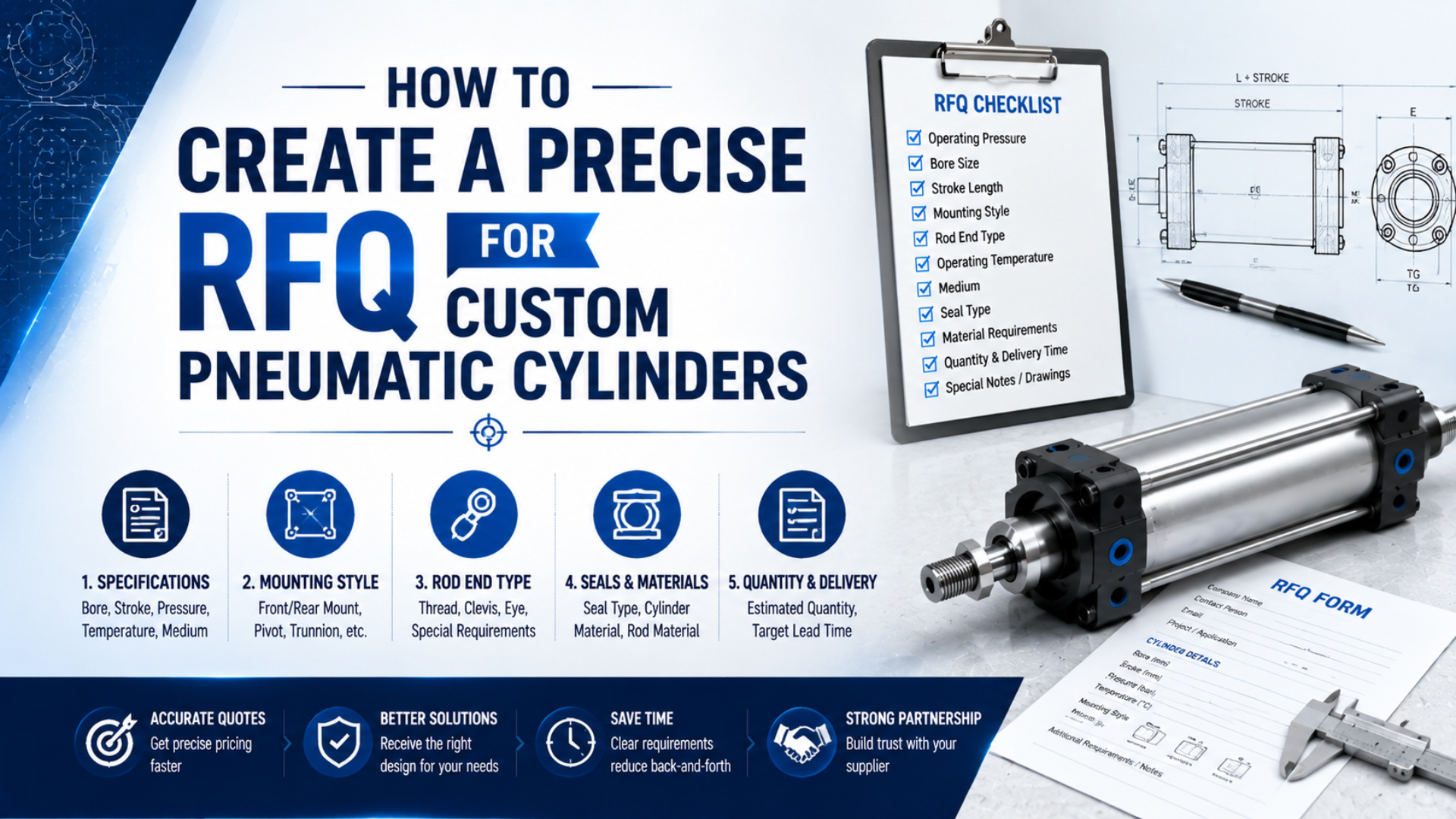
A precise RFQ for custom pneumatic cylinders is a controlled engineering package, not a list containing only bore, stroke, pressure, and quantity. It tells every supplier what the cylinder must do, which interfaces must fit, what conditions it must survive, how compliance will be demonstrated, and which assumptions or deviations must be returned with the quotation.
The most reliable format separates four blocks: application duty, mechanical and pneumatic interfaces, environment and safety, and acceptance plus commercial terms. Blank fields are marked unknown, not applicable, or supplier to propose. This prevents an empty cell from being mistaken for permission to choose any convenient value.
Key Takeaways
- ISO 15552 covers a 32-320 mm rod-cylinder dimensional series, not every custom design.
- State the required duty before asking for a bore.
- Control drawings by revision and datum.
- Require suppliers to disclose assumptions and deviations.
- Make acceptance evidence part of the quotation.
The useful test is simple: could a second engineer reproduce the selection and acceptance decision from the RFQ package without calling the original author? If not, the package still depends on undocumented knowledge.
What Makes an RFQ Package Reproducible?
ISO 4414:2010 applies to pneumatic-system design, construction, assembly, installation, adjustment, operation, maintenance, cleaning, reliability, energy efficiency, and environment. Our comparison of this scope with RFQ practice shows that a precise RFQ must describe the cylinder’s installed duty and evidence requirements, not only its catalog-style dimensions (ISO 4414).
A request for quotation (RFQ) is the buyer’s controlled request for a technical and commercial offer. It should let suppliers quote the same duty and identify where their proposed solution differs.
Use four controlled blocks:
| RFQ block | Buyer-controlled information | Supplier response |
|---|---|---|
| Application duty | Function, motion, loads, pressure, cycle, life target, fault behavior | Selected construction, sizing assumptions, calculated limits |
| Interfaces | Envelope, mounts, rod end, ports, sensors, datums, tolerances | Proposal drawing, part number, accessories, deviations |
| Environment and safety | Temperature, media, particles, chemicals, washdown, hazardous area, safe state | Material evidence, ratings, restrictions, maintenance conditions |
| Acceptance and commercial | Inspection, tests, documents, quantity, delivery, trade term, warranty | Test plan, document list, lead-time gates, pricing breakdown |
Assign an owner and revision to the package. Put the same RFQ number, revision, date, and project name on the duty sheet, drawings, photos, interface schedule, and commercial form. Suppliers should quote against that revision and list every later clarification that changed their offer.
Do not hide mandatory requirements in an email thread. If a clarification affects fit, function, safety, price, lead time, test evidence, or serviceability, add it to the controlled package and issue a revision.
The ISO 15552 procurement checklist covers standard dimensional-series purchases. This article stays with custom cylinders, supplier assumptions, and acceptance evidence.
How Do You Specify Duty Without Prematurely Choosing a Bore?
ISO 4414:2010 requires pneumatic-system hazards to be addressed for intended use and reasonably foreseeable conditions. The buyer should therefore state motion, load, pressure, environment, operation, maintenance, and fault behavior before asking a supplier to choose the custom cylinder’s bore or construction (ISO 4414).
Start with the machine function:
- What moves, clamps, lifts, rotates, pushes, indexes, tensions, or stops?
- Which stroke direction performs useful work?
- Can gravity, a spring, product contact, or another axis drive the load?
- What happens if the cylinder stops midway?
- What happens after air loss, power loss, guard opening, emergency stop, or a jam?
Then provide the complete load case:
| Duty field | Required entry |
|---|---|
| Required output | Force at the load, not only a guessed bore |
| Load direction | Opposing, assisting, vertical, horizontal, inclined, reversing |
| Moving mass | Tooling, rod attachment, carriage, product, cable carrier, hoses |
| Load geometry | Axial load plus every offset that creates a moment or side reaction |
| External guide | Type, spacing, alignment method, connection detail |
| Stroke | Useful travel, adjustment allowance, overtravel, stop location |
| Motion profile | Target stroke time, speed, acceleration, deceleration, dwell, return |
| Duty | Cycles per minute or hour, operating hours, days per year, expected travel |
| Pressure | Static supply and minimum dynamic pressure at the cylinder during motion |
| Stop method | Internal cushion, bumper, shock absorber, mechanical stop, lock, brake |
| Acceptance margin | Project-specific force, timing, energy, or life margin and its basis |
If the buyer already calculated a bore, send both the result and the inputs. The supplier needs to see required force, pressure basis, friction or efficiency allowance, safety factor, direction, and rod area. A bore without the load case is a conclusion without evidence.
The Cylinder Force Calculator can document preliminary push and pull assumptions. Keep the calculation separate from the contractual requirement: the RFQ states the force the machine needs, while the supplier states the configuration and conditions that deliver it.
For high-speed or long-stroke duties, include moving mass, speed at the start of cushioning, stopping distance, and external-guide geometry. These inputs decide whether the proposed cylinder, cushion, shock absorber, rod, carriage, mounting, and frame remain inside their declared limits.
Which Interfaces Must Be Controlled by Drawing?
ISO 15552:2018 defines interchangeability dimensions for specified single- or double-rod cylinders from 32 to 320 mm bore at a maximum rated pressure of 1,000 kPa. A custom RFQ must state whether that standard applies, then control every interface outside its scope with drawings and tolerances (ISO 15552).
Never write a mounting code such as FA, CB, or LB without the manufacturer, series, applicable standard, or a drawing. Ordering codes are not automatically universal.
Attach a dimensioned interface drawing containing:
- Overall retracted and extended envelope.
- Mounting-hole pattern, hole type, thread, depth, and locating features.
- Cylinder centerline relative to machine datums.
- Rod-end thread, shoulder, wrench flats, and usable engagement.
- Clevis or pin diameter, width, retention, and allowed articulation.
- Port thread, sealing method, size, orientation, and access envelope.
- Cushion-adjuster, flow-control, sensor, connector, and cable access.
- Required stroke, adjustment range, overtravel, and stop reference.
- Maximum permitted mass and location of accessories attached to the cylinder.
- Critical dimensions and tolerances that will be inspected.
A datum is the defined reference used to locate and inspect other features. Without a datum scheme, two suppliers can interpret the same collection of dimensions differently.
Distinguish three kinds of dimensions:
- Mandatory interface dimensions: the machine will not assemble or align if they change.
- Functional dimensions: the design may vary, but the result must meet stroke, strength, access, and performance requirements.
- Reference dimensions: useful for orientation but not separately toleranced or accepted.
Specify port identity completely. G1/4, R1/4, 1/4 NPT, and a metric thread are not interchangeable descriptions. State the thread designation, sealing face or taper, allowable adapter, clocking, usable tool access, and whether fittings are included. The cylinder-port thread guide explains the sealing boundaries.
Photos help identify installed constraints, but they do not replace a controlled drawing. Include a scale, photograph the label and every interface, and mark dimensions that were measured from worn parts or estimated because access was limited.
How Should Unknown Environmental Inputs Be Declared?
ISO 4414:2010 includes reliable operation, maintenance, cleaning, energy efficiency, and environment within its pneumatic-system scope. That makes temperature, media, air quality, chemicals, particles, washdown, duty, lubrication, and service access engineering inputs rather than optional comments at the end of the RFQ (ISO 4414).
State normal, minimum, maximum, and transient conditions where they differ:
| Condition | Describe |
|---|---|
| Pressure | Supply range, regulator setting, minimum dynamic port pressure, exhaust back pressure |
| Medium | Compressed air, inert gas, or another approved medium; lubricant presence |
| Air quality | Particle, water, and oil requirements at the point of use |
| Temperature | Ambient, medium, nearby heat source, cold start, cleaning temperature |
| Contamination | Dust type, particle size if known, chips, fibres, oil mist, slurry |
| Cleaning | Chemical names, concentration, temperature, pressure, frequency, rinse and dry method |
| Corrosion | Salt, chloride, acid, alkali, humidity, condensation, outdoor exposure |
| Duty | Frequency, dwell, continuous run, warm-up, planned maintenance |
| Access | Guard removal, adjustment access, lockout and stored-energy release |
| Noise and exhaust | Muffler requirement, exhaust routing, permitted release area |
Do not select a seal compound from a generic “NBR versus FKM” rule. Give the supplier the exact medium, cleaner, concentration, temperature, exposure duration, pressure, lubrication, and required life. Ask for the compound identity or controlled material specification, the compatibility basis, and any restriction on grease, cleaning, storage, or assembly.
Compliance requests must also be scoped:
- ISO 9001 concerns the supplier’s quality management system, not automatic certification of the cylinder product. ISO and IAF explicitly distinguish QMS certification from product conformity (ISO/IAF).
- RoHS restricts ten substances in applicable electrical and electronic equipment. Determine whether sensors, connectors, or the complete supplied assembly fall within the applicable scope before requesting evidence (European Commission).
- CE marking, hazardous-area conformity, food-contact evidence, cleanroom data, and pressure-equipment obligations depend on product scope, market, intended use, and supplied configuration. Name the applicable legislation or standard and the document expected.
Write not applicable when a requirement was reviewed and excluded. That is better than leaving a blank that later becomes an argument about whether the supplier was expected to include it.
Custom Design and Replacement RFQs Need Different Evidence
ISO 15552:2018 standardizes selected rod-cylinder dimensions but does not standardize every seal, sensor, cushion, port, material, tolerance, or performance characteristic. A cross-brand replacement RFQ must therefore distinguish dimensional fit, pneumatic function, installed performance, safety behavior, and documentation rather than relying on one old part number (ISO 15552).
A custom design starts from required function and interfaces. A replacement starts with two evidence sets:
| Replacement evidence | Purpose |
|---|---|
| Original label and complete part number | Identifies the nominal configuration and options |
| Original manufacturer drawing or catalog | Provides documented interfaces and limits |
| Measured installed part | Detects machine-specific modifications and unavailable dimensions |
| Machine drawing and bill of materials | Establishes the approved interface and revision |
| Photos of all sides and connections | Records orientation, accessories, clearances, and condition |
| Failure description | Prevents copying the feature that caused the problem |
| Current duty and settings | Shows whether the old selection still matches the machine |
| Allowed modifications | Defines whether adapters, new fittings, brackets, or software changes are acceptable |
Do not ask for a “drop-in equivalent” without defining the boundary. A mechanically fitting cylinder can still have a different port thread, switch output, magnet position, cushion adjustment, minimum pressure, speed limit, grease, seal material, safe-state response, or maintenance access.
Treat the old part number as evidence, not as the complete specification. Obsolete or damaged hardware may contain undocumented substitutions, wear, repair parts, or machine modifications. The replacement release should be based on the machine requirement plus a documented deviation review.
Use the compatible pneumatic-parts guide for functional-equivalence evidence. Keep the RFQ focused on what every bidder must return for the same replacement boundary.
How Do You Force Assumptions and Deviations Into the Quote?
ISO 9001 defines requirements for a quality management system, but ISO and IAF state that certification does not mean the product itself is certified or that every unit will always conform. The RFQ must therefore request product-specific technical evidence and supplier declarations in addition to a QMS certificate (ISO/IAF).
Require each quotation to return:
- Proposed manufacturer and complete part number.
- Proposal drawing with revision, dimensions, tolerances, datums, ports, mounts, sensors, and accessories.
- Selected bore, rod, construction, materials, seals, grease, coatings, and surface treatments.
- Sizing inputs, calculations, assumptions, applicable catalog limits, and derating.
- Declared operating-pressure, temperature, speed, load, moment, energy, and environment limits.
- List of buyer requirements met without deviation.
- Separate deviation and exception schedule.
- List of buyer-supplied information still missing.
- Required maintenance, lubrication, inspection, adjustment, and storage conditions.
- Proposed inspection and test plan.
- Documents supplied with samples and production units.
- Design-life or reliability statement with conditions and failure criteria, when requested.
- Warranty boundary and excluded conditions.
- Engineering change and obsolescence-notification process.
Use a compliance matrix:
| RFQ requirement ID | Buyer requirement | Supplier response | Status | Evidence reference |
|---|---|---|---|---|
| DUTY-01 | Required force and direction | Supplier enters offered capacity and conditions | Comply / deviate / clarify | Calculation or catalog page |
| INT-03 | Port thread and orientation | Supplier enters proposed interface | Comply / deviate / clarify | Drawing zone |
| ENV-04 | Cleaning exposure | Supplier states material restrictions | Comply / deviate / clarify | Compatibility statement |
| TEST-02 | External leakage limit and test condition | Supplier proposes method and limit | Comply / deviate / clarify | Test-plan clause |
Do not accept “complies” without an evidence reference when the requirement is critical. The reference may be a proposal-drawing zone, calculation, certificate, catalog page, test-plan clause, or signed declaration.
Which Acceptance Criteria Belong Before Design Freeze?
ISO 4414:2010 covers pneumatic-system construction, installation, adjustment, operation, maintenance, and cleaning. Acceptance evidence should therefore verify the custom cylinder’s declared interfaces and performance under stated conditions, not rely on a generic “pressure tested” line without pressure, duration, medium, temperature, or acceptance limits (ISO 4414).
Write each acceptance requirement using five fields:
- Characteristic: what is being checked.
- Method: instrument, setup, sequence, and reference.
- Condition: pressure, temperature, load, speed, orientation, and medium.
- Limit: measurable pass/fail value.
- Record: document, data, photo, certificate, or serial-number trace.
Typical custom-cylinder checks include:
| Check | RFQ must define |
|---|---|
| Dimensional inspection | Controlled drawing revision, characteristics, sampling, gauge or method |
| External leakage | Test pressure, medium, stabilization, duration, detection method, limit |
| Internal bypass | Piston position, pressure differential, duration, measurement method, limit |
| Proof or pressure test | Applicable requirement, pressure, duration, fluid, safety controls, acceptance |
| Stroke and endpoint | Reference surfaces, load, pressure, approach direction, tolerance |
| Breakaway and running behavior | Orientation, load, pressure ramp, speed controls, acceptance |
| Cushion or stop | Moving mass, impact speed, adjustment, rebound, noise or energy criterion |
| Sensor operation | Supply, output type, target, switch position, repeatability, connector and pinout |
| Coating and materials | Specification, thickness or grade where relevant, traceability |
| Cleanliness | Particle, oil, moisture, packaging, preservation, and handling requirement |
A first article is not just an early production unit. Define which design revision it represents, which characteristics receive full inspection, which tests are destructive, which deviations are allowed, and who approves the result. State whether production can begin before approval and how a later design change affects first-article status.
For a critical or novel design, separate sample evaluation from production acceptance. The sample may verify fit and function on the machine. Production acceptance controls repeatable characteristics, documentation, traceability, and change notification.
How Do You Compare Bids Without Hiding Scope Differences?
Incoterms® 2020 contains 11 rules that allocate costs, risks, and obligations between seller and buyer. A usable RFQ names the chosen rule and place, then separately controls quantity, tooling, samples, packaging, payment, delivery gates, documents, warranty, and change charges (ICC).
Request pricing as a controlled breakdown:
| Commercial field | Required supplier response |
|---|---|
| Prototype or sample quantity | Quantity, unit price, NRE, tooling, test and document charges |
| Production quantity tiers | Unit price at the exact requested breaks |
| Forecast | Non-binding estimate, unless the contract states otherwise |
| MOQ | Minimum order under the offered configuration and price |
| Tooling ownership | Owner, location, maintenance, life, storage, transfer, replacement |
| Delivery | Lead-time definition, approval gates, partial shipments, expedited option |
| Trade term | Named rule, named place, Incoterms® 2020 |
| Packaging | Unit protection, preservation, labels, carton, pallet, export packaging |
| Currency and payment | Currency, tax treatment, deposit, milestone, credit terms |
| Quote validity | Valid-through date and conditions that reopen price |
| Warranty | Start event, duration, remedy, exclusions, freight and labour boundary |
| Change control | Cost and schedule treatment after drawing or sample approval |
Do not compare only unit prices. Normalize what is included: mounts, sensors, fittings, brackets, documentation, inspection, packaging, tooling, freight, duties, taxes, spare seals, and engineering support.
The delivery clock also needs a start event. A supplier may count from purchase order, deposit, final drawing approval, material release, sample approval, or receipt of missing data. The custom-cylinder lead-time guide explains those gates. The MOQ guide separates prototype, order, release, annual, and commitment quantities.
Copyable Four-Block Custom Cylinder RFQ Template
Incoterms® 2020 supplies 11 commercial rules, while ISO 4414:2010 covers the pneumatic system across design, operation, maintenance, cleaning, and environment. The template below combines those boundaries into four controlled blocks so suppliers quote one declared duty and return comparable technical evidence (ICC; ISO 4414).
Copy this structure into the project form:
Document control
- RFQ number:
- RFQ revision and date:
- Project and machine:
- Buyer technical contact:
- Buyer commercial contact:
- Quotation due date:
- Confidentiality or data-handling requirement:
- List of controlled attachments and revisions:
Application duty
- Function and required motion:
- Required force by direction:
- Moving mass and load geometry:
- Stroke and orientation:
- Target stroke time, speed, acceleration, deceleration, and dwell:
- Cycle definition and duty:
- Static supply and minimum dynamic port pressure:
- Valve, tube, fitting, and exhaust information:
- Cushion, shock absorber, stop, lock, or brake:
- Safe state and restart behavior:
- Required life or reliability target, conditions, and failure criteria:
Mechanical and pneumatic interfaces
- Applicable standard, existing series, or custom design:
- Controlled envelope and interface drawing:
- Datum scheme and critical tolerances:
- Mounting interface:
- Rod end, clevis, flange, carriage, or load connection:
- Port thread, seal method, size, orientation, and access:
- Sensor type, output, connector, pinout, cable, and target position:
- Included mounts, fittings, accessories, and spares:
Environment and evidence
- Medium and point-of-use air quality:
- Ambient and medium temperature:
- Dust, water, chemicals, cleaning, corrosion, and outdoor exposure:
- Hazardous-area, food-contact, clean-production, or market requirements:
- Materials, seals, grease, coating, and traceability requirements:
- Dimensional, leakage, pressure, functional, cushion, and sensor tests:
- First-article, sample, and production inspection requirements:
- Required proposal and production documents:
- Supplier assumptions, deviations, and missing data:
- Engineering change and obsolescence notification:
Commercial response
- Prototype and production quantities:
- Annual forecast and MOQ:
- Unit-price tiers:
- NRE, tooling, inspection, test, and documentation charges:
- Currency and payment:
- Named Incoterms® 2020 rule and place:
- Packaging, labels, preservation, and shipping documents:
- Lead-time definition and approval gates:
- Quote validity:
- Warranty and remedy:
- Partial-shipment and expedited-delivery options:
Before release, route the technical sections through engineering, maintenance, machine safety, quality, and the operating department as applicable. Route the commercial sections through purchasing, logistics, finance, and legal where required. One owner then issues the consolidated revision.
The final comparison should show compliance, deviations, evidence, total included scope, approval gates, and landed commercial boundary. Price belongs in that comparison, but it should not conceal a different design assumption.
Custom Pneumatic Cylinder RFQ FAQs
ISO 15552:2018 covers a 32-320 mm, 1,000 kPa dimensional series for specified rod cylinders, while ISO 4414:2010 addresses pneumatic-system safety and lifecycle conditions. These five answers clarify what a custom RFQ needs beyond nominal dimensions, an old part number, or a supplier certificate (ISO 15552; ISO 4414).
Are bore, stroke, pressure, and mounting enough for a precise RFQ?
No. Those fields cannot establish load direction, moving mass, speed, cycle, dynamic pressure, stopping energy, environment, safety state, interfaces, tolerances, or acceptance evidence. Provide the complete duty and controlled drawings, then require the supplier to disclose sizing assumptions, limits, deviations, tests, and included accessories.
Should the buyer specify the bore or state the required load?
State the required force, direction, pressure basis, motion, load geometry, and margin even when a preliminary bore has already been calculated. The supplier can then confirm or challenge the bore using its construction, friction, rod area, speed, guide, cushion, and environmental limits without losing the buyer’s original requirement.
Can an old part number prove drop-in compatibility?
No. It identifies useful source information, but it does not prove the installed machine, repaired cylinder, or proposed replacement still shares every dimension, port, sensor, cushion, material, limit, and safe-state behavior. Supply the old documentation, measurements, photos, current duty, and an explicit deviation boundary.
What documents should the supplier return with the quotation?
Request a complete part number, proposal drawing, compliance matrix, assumptions, calculations, declared limits, material and seal details, deviation schedule, test plan, maintenance conditions, document list, warranty boundary, and lead-time gates. Critical “complies” responses should point to a drawing zone, calculation, certificate, catalog page, or test clause.
When should custom-cylinder lead time begin?
Define the start event in the quotation and order. Depending on the project, it may be purchase-order receipt, deposit, receipt of complete data, final drawing approval, material release, or sample approval. Also identify which buyer or supplier delay pauses the clock and how engineering changes reset the schedule.
Sources and technical references
- ISO 4414:2010. General rules and safety requirements for pneumatic fluid-power systems and components. ISO official page. Retrieved July 26, 2026.
- ISO 15552:2018. Basic, mounting, and accessory dimensions for the specified detachable-mounting rod-cylinder series. ISO official page. Retrieved July 26, 2026.
- ISO and IAF. Expected outcomes of accredited ISO 9001 certification and the distinction between QMS and product conformity. Official guidance. Retrieved July 26, 2026.
- ICC Incoterms® 2020. Eleven trade rules and guidance on allocation of cost, risk, and obligations. ICC official page. Retrieved July 26, 2026.
- European Commission RoHS. Scope and ten restricted substances for applicable electrical and electronic equipment. European Commission. Retrieved July 26, 2026.