
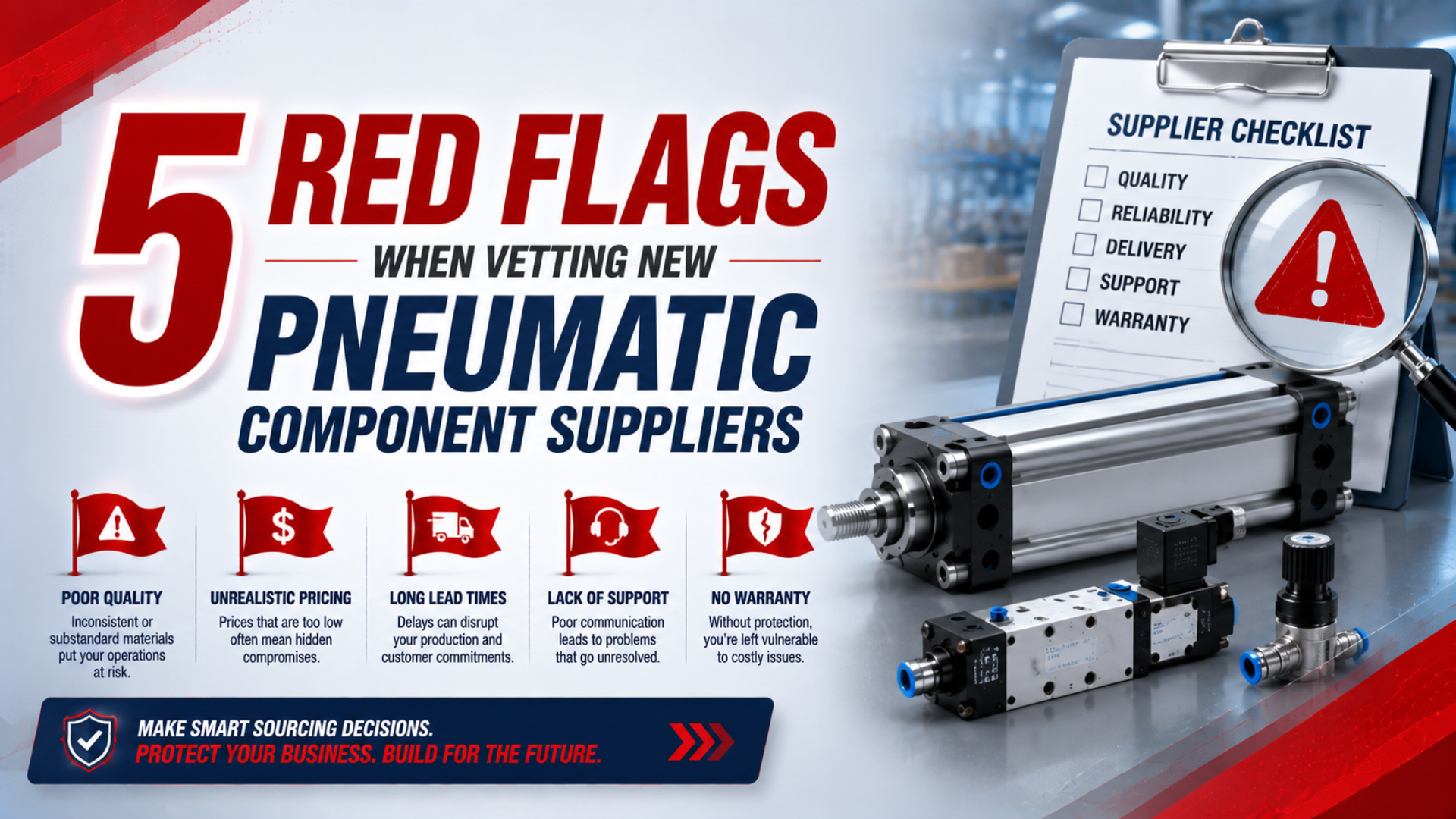
A pneumatic supplier red flag is a failure to support an important claim with connected evidence. These five pneumatic component supplier red flags concern company identity, product definition, quality records, engineering response, and quotation scope. Any one can justify pausing approval. None should be replaced by a simple rule such as “low price means low quality.”
A polished website or quick quotation can support an initial review; so can a valid management-system certificate. None of these signals proves that the quoted component will meet your requirements. Supplier qualification works when every important promise leads to a named document or test and to a responsible entity or contractual control.
Key Takeaways
- Treat a contradiction as a finding to close, not a detail to overlook.
- Verify the legal entity, manufacturing site, certificate scope, and payment beneficiary separately.
- Freeze the offered component before evaluating samples, test reports, or price.
- Ask for records that connect requirements, methods, equipment, results, and release decisions.
- Compare normalized quotations; no universal discount percentage identifies a bad supplier.
In this guide
- Red Flag 1: Company and certification details do not connect
- Red Flag 2: The component specification cannot be frozen
- Red Flag 3: Quality claims cannot be reconstructed from records
- Red Flag 4: Engineering support does not close application risks
- Red Flag 5: The quotation cannot be normalized
- How should you act on a supplier red flag?
- From document screening to supplier approval
- Pneumatic supplier vetting FAQs
Red Flag 1: Company and Certification Details Do Not Connect
A supplier becomes difficult to hold accountable when its commercial and manufacturing records point to different organizations without explanation. Compare the quotation, contract, invoice, certificate, site, export documents, and bank beneficiary. Multiple companies are not automatically improper. A factory may use a trading or export entity. The problem is an undisclosed role or a contradiction that remains unresolved.
Start by recording each entity and its function:
| Evidence | What to match | Finding that requires action |
|---|---|---|
| Business registration | Legal name, registration number, address, status | The named seller cannot be verified |
| Quotation and contract | Seller, product, currency, governing terms | The contracting party changes without explanation |
| Manufacturing evidence | Site name, address, process performed | The claimed factory is outside the approved chain |
| Bank instructions | Beneficiary and account-change controls | Payment is redirected to an unrelated entity |
| Management-system certificate | Entity, site, edition, dates, scope, certification chain | The certificate covers another company, site, or activity |
An ISO 9001 certificate is one layer of evidence. It concerns a quality management system; it does not certify the conformity of an individual pneumatic component or shipment. As of July 2026, ISO lists ISO 9001:2015 with Amendment 1:2024 as the current published edition. The next edition is under publication (ISO). A proper review begins with the legal entity and site. It then checks the edition, dates, status, certification body, accreditation chain, and scope. The separate guide to verifying supplier certifications covers that chain in detail.
Do not treat CE marking as a universal pneumatic-component certificate. The European Commission states that CE marking is required only where applicable harmonized EU rules mandate it. The manufacturer identifies those requirements and prepares technical documentation; it then completes the required conformity procedure and signs the EU Declaration of Conformity. There is no central EU body that simply issues permission to use the mark (European Commission).
Pause approval if the supplier refuses to identify the parties or if a document appears altered. An incomplete chain can instead receive a written deadline and an exact evidence request; an incomplete packet and a falsified packet are not the same risk.
Red Flag 2: The Component Specification Cannot Be Frozen
Terms such as “Parker equivalent,” “standard cylinder,” or “same as the sample” do not define a product. They leave basic dimensions and interfaces open. Materials, lubrication, cushioning, sensing, surface treatment, allowable loads, and accessories can also change. If the supplier cannot state exactly what it is offering, neither price nor quality records have a stable reference.
Build a requirement-to-offer matrix before comparing candidates. For a pneumatic cylinder, the controlled fields may include:
- drawing or model revision;
- bore, stroke, rod size, mounting interface, and critical dimensions;
- port standard, thread, location, and fitting compatibility;
- working-pressure and temperature ranges;
- load direction, speed, cycle profile, and end-of-stroke energy;
- seal and lubricant compatibility with the medium and environment;
- cushioning, sensing, corrosion protection, and required accessories;
- inspection, functional-test, documentation, packaging, and marking requirements.
Valves, grippers, fittings, and air-preparation components need their own fields because a copied cylinder checklist is not enough. A valve RFQ must resolve its function and flow definition as well as pressure range and electrical interface; response expectations and the manual override also matter. Finish with the environmental limits and connector configuration.
Standards also need to be applied narrowly. ISO 15552:2018 establishes basic dimensions for a defined family of detachable-mount pneumatic cylinders. It also covers mounting and accessory dimensions. ISO 6432:2015 and ISO 21287:2004 address other dimensional platforms. These standards support interchangeability within their scope. They do not prove seal life, leakage performance, material quality, or suitability for a particular machine (ISO 15552, ISO 6432, ISO 21287).
Look for how the supplier handles deviations. A capable response identifies each exception and proposes an alternative before returning a controlled drawing or compliance matrix. Silence is not acceptance. A passed sample should not silently authorize later changes to material or site; tooling and sub-supplier changes also need control.
Red Flag 3: Quality Claims Cannot Be Reconstructed from Records
“Every unit is tested” sounds reassuring until the buyer requests the method and conditions. The equipment, acceptance limit, recorded value, and release decision must also be clear because a quality claim becomes useful only when another competent person can follow the record and understand the decision.
A representative completed inspection or test record should connect:
- the product, drawing revision, lot, or serial identity;
- the characteristic or function being verified;
- the test method and operating conditions;
- the equipment identifier and relevant calibration status;
- the acceptance limit and recorded result;
- any nonconformity, retest, concession, or rework;
- the final disposition and authorized release.
The supplier may reasonably redact customer names, prices, or unrelated proprietary details. It should still demonstrate controlled forms and methods while keeping equipment control and release responsibilities visible.
Pressure and leakage testing illustrate why a universal promise is unsafe. “Tested at 1.5 times working pressure” is not a complete requirement. First define the applicable product specification and the meaning of the stated pressure; then state the medium and temperature together with stabilization and hold times. The method still needs a leakage limit and sample scope plus a post-test acceptance rule. A supplier should follow the agreed requirement rather than a percentage copied from an unrelated product.
Measurement confidence also needs evidence. ISO 10012:2026 addresses measurement-management systems. ISO/IEC 17025:2017 sets competence requirements for testing and calibration laboratories (ISO 10012, ISO/IEC 17025). Not every factory laboratory must be accredited. The buyer should still distinguish internal from outsourced work and identify the methods used. When an external laboratory is involved, check whether its accredited scope covers the reported test.
Do not confuse development samples with production-lot control. ISO 2859-1:2026 provides AQL-indexed sampling schemes for lot-by-lot inspection by attributes; it does not make two or three hand-selected samples representative of future production (ISO). Use the dedicated pneumatic cylinder sample validation guide to separate engineering samples, pilot lots, and production acceptance.
Red Flag 4: Engineering Support Does Not Close Application Risks
Engineering support is not proven by a job title or a promise of “24-hour service.” Test it with a bounded application question. Give the supplier enough information to reason about the component, then inspect whether the response identifies assumptions, limitations, and missing data.
For a cylinder application, a useful request starts with the required motion and load direction. Add the stroke, speed, cycle profile, and pressure available at the actuator before describing mounting and external guidance. The environment and end-of-stroke behavior complete the operating picture; so does the consequence of failure. A credible answer should connect those conditions to a proposed configuration and show what remains unresolved.
Watch for these response patterns:
- the proposed model changes but no revised drawing or bill of materials is issued;
- a catalog maximum is repeated without checking the actual load case;
- a material is described as “chemical resistant” without naming the medium, concentration, temperature, or exposure;
- a long-stroke rod cylinder is recommended without asking about compression loading, alignment, or guidance;
- the supplier claims interchangeability but does not compare mounting, port, sensor, and accessory interfaces;
- a safety-related application is accepted without identifying system-level responsibilities.
Slow communication is not automatically a technical failure. Translation, time zones, and the need to consult a specialist can add time. The stronger warning is an answer that arrives quickly but evades the engineering question, conceals uncertainty, or refuses to document the selected configuration.
Apply an evidence-recovery test: choose one important claim from the quotation and ask the supplier to recover its requirement and reasoning. Then ask for the source record, responsible role, and resulting product revision. This small exercise shows whether commercial and technical teams share one controlled definition. It also exposes whether a later corrective action could reconstruct what happened.
Engineering support must continue into change control. The purchase agreement should identify which product changes require notice or approval. Materials, lubricants, sensors, and software may be critical; so may a different extrusion source or casting. Site, tooling, test-method, and sub-tier changes also need defined treatment. Without that control, a successful sample can become unrelated to the product delivered later.
Red Flag 5: The Quotation Cannot Be Normalized
A price difference is a prompt to investigate rather than proof of poor quality. Suppliers may use different distribution structures or levels of automation; capacity and tooling ownership can also affect cost. The same is true of materials, volume, warranty, and logistics. A percentage threshold cannot determine whether those differences are legitimate.
Normalize each quotation before comparing unit prices:
| Scope field | Questions to close |
|---|---|
| Product identity | Is the same model, drawing revision, material, seal, sensor, mounting, and accessory set included? |
| Quantity basis | Are sample, pilot, annual volume, minimum order, and price-validity assumptions stated? |
| Quality evidence | Which inspections, tests, records, certificates, and third-party work are included? |
| Tooling and changes | Who owns tooling, and what happens after design or process changes? |
| Packaging and logistics | What packing, Incoterms rule, exact named place, freight scope, and export documentation apply? |
| Commercial protection | What are the payment milestones, warranty boundaries, claim process, and remedies? |
| Delivery | Does lead time begin at order, drawing approval, deposit, material receipt, or another event? |
A supplier may legitimately remove cost through a standard configuration or a combined production run. Packaging changes and optional documentation can also affect the quote; record these as alternatives rather than allowing the low price to remain ambiguous.
The serious red flags are different: exclusions appear only after the purchase order; the material or factory is changed to defend the quoted price; the supplier refuses to identify the delivered configuration; the bank beneficiary changes through an unverified email; or warranty and corrective-action responsibilities disappear when questioned.
Total cost still matters, but it should be calculated for the buyer’s scenario. Start with landed purchase cost, validation, and installation before adding planned maintenance and expected spares. Inventory belongs in the same model; the consequence of a defined failure mode should remain a separate scenario. Do not publish a universal downtime value or product-life ratio and present it as market evidence. For a full commercial comparison, use the guide to negotiating with pneumatic suppliers.
How Should You Act on a Supplier Red Flag?
Not every missing document should produce the same decision. Separate deliberate deception, unresolved uncertainty, and acceptable evidence.
| Decision | Typical condition | Required action |
|---|---|---|
| Stop | Falsified or altered evidence; undisclosed entity or site; unexplained beneficiary change; unauthorized product substitution | Block approval and preserve the finding |
| Verify | Missing field, unclear scope, database coverage gap, unusual price, or a technical exception that may have a valid explanation | Request named evidence, owner, and closure date |
| Continue with conditions | Evidence is consistent, but samples, pilot-lot results, capacity, or long-term performance remain unproven | State residual risk and limit the approval scope |
| Approve | Critical gates are closed, configuration is controlled, and required validation is accepted | Record exactly which entity, site, product, and revision are approved |
Absence from a search database is an example of a verification finding, not automatic proof of a fake certificate. Confirm coverage, then check with the certification body and accreditation body. Conversely, a searchable certificate does not close product-specific questions.
Use non-negotiable gates before a weighted scorecard. A high score for communication or price must not offset a failed legal-identity, safety, configuration, or change-control requirement. Scores are useful only after every candidate has passed the critical gates.
From Document Screening to Supplier Approval
Supplier screening should become progressively more expensive only as evidence improves.
Define the purchasing decision
Write the component requirement and application boundaries first. Identify critical characteristics and any regulatory or customer obligations. Then define the required records, volume assumptions, and failure consequence. Without this baseline, the same supplier can appear suitable for one buyer and unsuitable for another without either assessment being wrong.
Request a small, exact evidence packet
Ask for documents by name rather than requesting “all certificates.” Begin with the business identity plus a site and role map; then add the controlled offer or drawing and the relevant certificate. A compliance matrix and representative inspection record should show how the system operates. Request the change-notification process, quotation scope, and warranty terms as separate items.
Record discrepancies instead of discussing them informally
Assign each issue an owner and evidence request. Add a due date, risk class, and closure decision. Keep the original and revised documents. This prevents a corrected sales email from erasing an earlier disagreement among the quotation, certificate, and drawing.
Escalate qualified candidates
Move from document review to a remote process review according to risk. Samples, pilot production, or an on-site audit may follow. ISO 19011:2026 provides current guidance for management-system auditing, but the audit criteria still need to reflect the product and purchasing decision (ISO). The guide to evaluating cylinder factory capabilities explains how to follow one order through its process route. It covers machining, inspection, assembly, testing, traceability, and delivery.
Approve a defined scope
Name the legal seller and manufacturing site. Record the product family plus the approved configuration or drawing revision. The approval should also state its process, certificate, and validation boundaries. List open conditions explicitly. After release, monitor delivery and nonconformities. Corrective actions, changes, and certificate status need their own review. For cross-border programs, the broader China pneumatic cylinder sourcing strategy adds legal-entity, export, payment, and contract controls.
Pneumatic Supplier Vetting FAQs
Is ISO 9001 certification enough to approve a pneumatic component supplier?
No. ISO 9001 certification supports confidence in a supplier’s quality management system within its stated entity, site, and scope. Product approval still requires a controlled specification and process evidence. Add inspection results, traceability, change control, and order-specific acceptance.
Do all pneumatic components sold in Europe require CE marking?
No. CE marking applies only when the product is covered by EU legislation that specifically requires it. Determine the role and intended use of the component. Then identify the applicable legislation. Review the technical documentation and EU Declaration of Conformity where required. A generic “CE certificate” request can be misleading.
How far below the market price should trigger automatic rejection?
There is no universal percentage. First normalize the product configuration and quantity; then compare inspection and documentation with packaging and delivery terms. Warranty, tooling, and payment scope also belong in the comparison. Reject or pause the supplier when important exclusions remain concealed, including hidden substitutions or responsibilities.
Is a certificate fake if it is not found in IAF CertSearch?
Not necessarily. Database participation and coverage must be checked before verifying the certificate with the issuing certification body and its accreditation body. Match the legal entity and site first; then check the dates, edition, status, and scope. Treat an unresolved contradiction or an unverifiable issuer as a serious finding.
How many samples should a new pneumatic supplier provide?
Choose the quantity from the decision and test allocation. Product risk, lot size, defect classes, and the applicable sampling method also matter. Development samples can confirm configuration and stated performance under defined conditions; they cannot establish the defect rate or consistency of future production lots.
Sources and Technical References
- ISO 9001:2015, quality management system requirements and current edition status
- European Commission CE marking guidance, applicability, conformity assessment, technical documentation, and declaration responsibilities
- ISO 19011:2026, guidelines for auditing management systems
- ISO 2859-1:2026, lot-by-lot acceptance sampling by attributes
- ISO 10012:2026, requirements for measurement management systems
- ISO/IEC 17025:2017, competence of testing and calibration laboratories
- ISO 15552:2018, detachable-mount pneumatic cylinder dimensions
- ISO 6432:2015, small-bore pneumatic cylinder mounting dimensions
- ISO 21287:2004, compact pneumatic cylinder dimensional series