

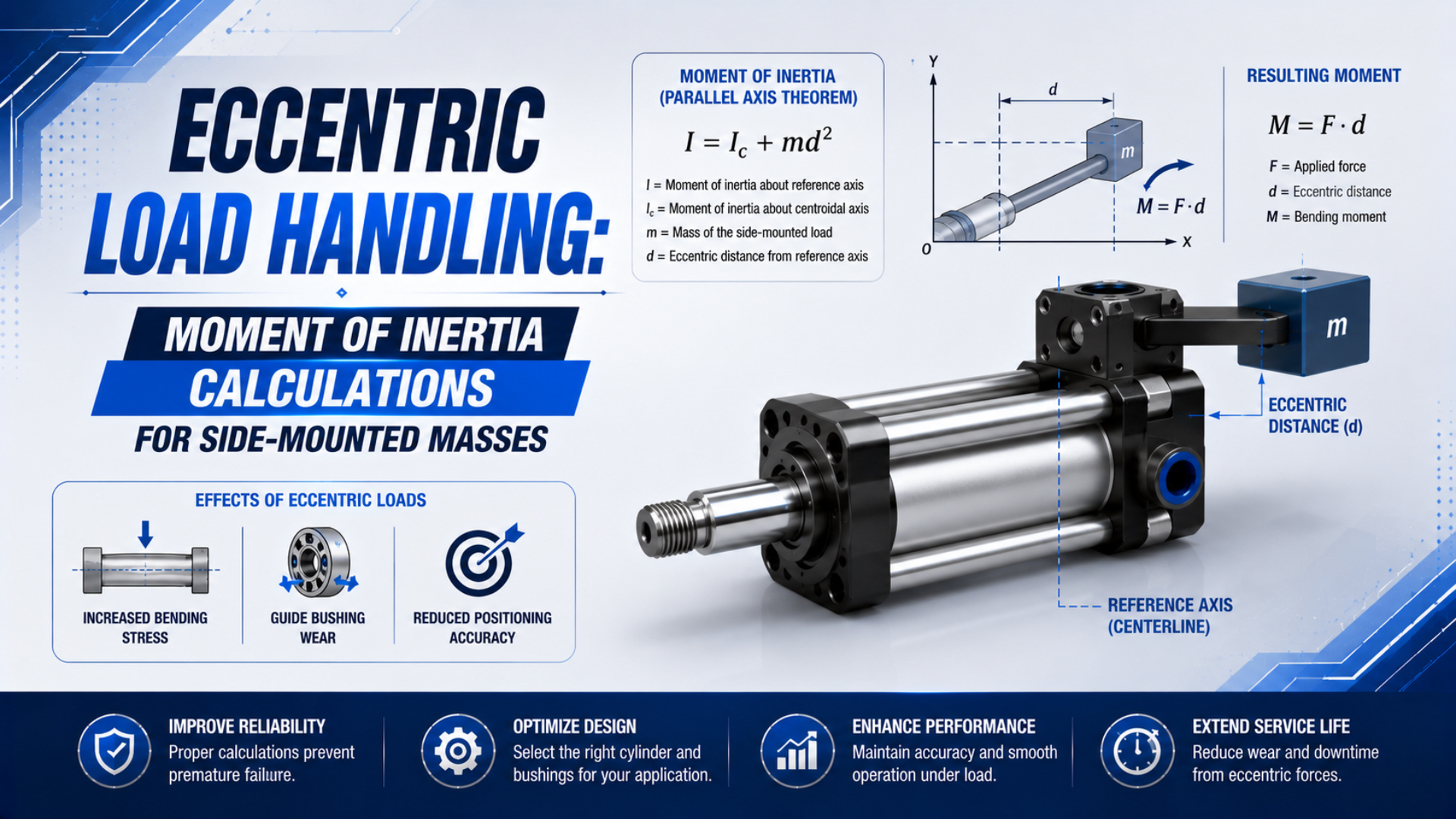
A side-mounted mass does not automatically require a moment-of-inertia calculation. If the carriage translates without rotating, its guide moments come from forces acting at offsets: weight, linear inertia, process reactions, hose pull, and stopper impact. Use mass moment of inertia only when the payload actually has angular acceleration about a defined axis.
That distinction prevents a common sizing error. Converting linear acceleration into an invented angular acceleration with can produce a plausible-looking torque that does not represent the guide reaction. Start with a free-body diagram, retain signs, and compare each resulting force and moment with the exact actuator or guide catalog.
Key Takeaways
- Calculate static and translational inertial moments with .
- Use only for actual rotation about a defined axis.
- Keep opposing moment signs until each load case is complete.
- Verify every force and moment against the selected guide model, speed, and combined-load rule.
Eccentric load means that a force line of action does not pass through the guide’s reference point or axis. Mass moment of inertia describes resistance to angular acceleration. Guide moment is the external pitch, yaw, or roll load that the carriage bearings must react. They are related only when the machine’s actual motion connects them.
What Does Eccentric Load Handling Actually Calculate?
Parker lists separate maximum , , and values for its basic OSP-P rodless cylinders; for the OSP-P25, the table gives 1.5, 15, and 3 N·m respectively under its stated conditions (Parker OSP-P catalog, 2025). Eccentric-load handling therefore starts with axis-specific reactions, not one payload rating.
A correct calculation answers four questions:
- Which force acts on the moving assembly?
- Where is that force’s line of action relative to the catalog reference point?
- Which roll, pitch, or yaw axis receives the resulting moment?
- Does the chosen model permit that simultaneous combination of forces and moments?
The calculation path depends on the motion:
This article concentrates on side-mounted masses carried by a linear carriage. The related guide to maximum rodless-cylinder roll moments covers catalog roll capacity in more depth, while the cylinder side-loading guide follows the wear path in conventional rod cylinders.
Start With a Coordinate System and Signed Load Cases
Parker’s heavy-duty OSP-P guide evaluates five simultaneous terms: , , , , and , and requires their normalized sum to remain at or below 1 for that product family (Parker OSP-P catalog, 2025). A usable worksheet must preserve axes and signs before applying any catalog limit.
Use the manufacturer’s axis diagram. This article uses:
- : carriage travel direction
- : lateral direction across the carriage
- : vertical direction
- : roll about the travel axis
- : pitch about the lateral axis
- : yaw about the vertical axis
Another manufacturer may label the same physical directions differently. Copy the selected catalog’s diagram and datum rather than assuming the letters are universal.
Build separate rows for dwell, acceleration, constant-speed travel, deceleration, process contact, normal stopping, and emergency stopping. A part pickup or release can change both mass and center of gravity, so it may require another row.
How Do You Calculate Static Moment From Side-Mounted Masses?
SMC defines static moment in its MY1 selection procedure as moment caused by the load while the cylinder is at rest, and it evaluates that moment separately from stopper-impact moment (SMC MY1 catalog, retrieved 2026). Calculate each stationary force about the catalog reference point before comparing it with an allowable value.
For a component of mass , its weight is:
The moment about reference point is:
Here, runs from to the force application point, and is the signed force vector. In Cartesian components:
Use metres and newtons to obtain newton-metres. Include gravity, process reactions, vacuum-cup contact forces, cable-chain pull, hose drag, spring forces, and direct applied torques that occur in the selected load case.
For several components:
Signs prevent false overloads and false cancellations. Two equal masses positioned at $+y$ and $-y$ create opposite roll moments under vertical gravity. Their roll contributions cancel if the geometry and forces are truly symmetric, but their direct vertical loads add. Summing both moment magnitudes would double-count roll; ignoring the vertical force would miss guide load.
This is why a centered 60 kg mass is not “equivalent” to a 20 kg mass mounted 150 mm off center. The centered mass can create zero static moment about a chosen axis while still imposing three times the direct weight. Each quantity needs its own catalog check.
How Does Linear Acceleration Change the Guide Moments?
THK states that applied guide load depends on center-of-gravity position, thrust position, inertia from acceleration or deceleration, and external forces such as cutting resistance (THK applied-load guidance, retrieved 2026). For a carriage that remains parallel to its rail, represent acceleration through a translational inertial force at the center of mass.
Using a carriage-fixed free-body calculation, the inertial force is:
Its moment about the guide reference point is:
Suppose the carriage accelerates in $+x$. The inertial force acts in $-x$. A center of mass above the reference point produces pitch moment, while a lateral offset also produces yaw moment. Acceleration along the rail does not automatically create roll ; the cross product decides which components appear.
Do not substitute unless a mechanical constraint actually converts the translation into rotation about the stated axis. Radius, linear acceleration, and angular acceleration are linked in circular motion, not in unrestricted linear translation.
Use distinct operating cases:
| Load case | Include | Separate check |
|---|---|---|
| Dwell | Weight and steady process force | Static permissible moment |
| Normal acceleration | Weight, , process force | Dynamic catalog conditions |
| Normal deceleration | Reversed inertial force | Opposite bearing load distribution |
| Part pickup or release | New mass and center of gravity | Before and after geometry |
| Process contact | Contact force and direct torque | Peak and sustained values |
| End stop or emergency stop | Measured or specified stopping reaction | Cushion, stopper, shock absorber, frame |
Stopper impact is not just “more acceleration” guessed from cycle time. SMC’s MY1 procedure uses a product-specific equivalent impact load and evaluates its load factor separately. Follow that procedure for the selected series. Use the moving-cylinder-load kinetic-energy guide and high-mass deceleration guide for the energy side of the stop.
When Does Moment of Inertia Belong in the Calculation?
MIT’s fixed-axis mechanics notes give the parallel-axis relation for a body rotating about an axis offset from its center of mass (MIT OpenCourseWare, 2016). The relation belongs when angular motion is real and the rotation axis is defined.
For actual rotation:
The acceleration torque for pure rotation about that fixed axis is:
is the mass moment of inertia about a parallel axis through the center of mass, is the perpendicular distance between axes, and is angular acceleration. A point-mass approximation omits the body’s own centroidal inertia and can be unsuitable for wide tooling or a large workpiece.
Use rotational inertia in these cases:
- A rotary actuator or wrist mounted on the linear carriage indexes a tool.
- A pivoted arm is driven through a defined angular profile.
- A rotating spindle, gripper, or part applies reaction torque to the carriage.
- The complete mechanism has coupled translation and rotation described by known kinematics.
Do not use it merely because a mass is off center. A rigid tool plate bolted to a linear carriage can remain at zero angular acceleration while its guide reacts substantial pitch, yaw, and roll moments.
For a rotating wrist carried by a rodless axis, two calculations coexist. The wrist drive needs torque for , gravity, and friction. The linear guide needs the equal-and-opposite drive reaction torque plus moments from weight and translational inertia. Passing the wrist torque calculation does not prove the carriage guide is acceptable.
Worked Example: A Side-Mounted Tool on a Translating Carriage
THK’s guide examples calculate changing block loads for acceleration and deceleration rather than replacing linear motion with a rotary model (THK nominal-life example, retrieved 2026). This hypothetical worksheet follows the same physical boundary: it calculates signed applied loads only and does not select a product.
Assume a rodless carriage travels along $+x$ and carries three components. Gravity acts in $-z$, and the worst normal acceleration is . All component centers are taken at for this simplified instant.
| Component | Mass, | Lateral offset, | Height, |
|---|---|---|---|
| Main tool | 8.0 kg | +0.12 m | +0.08 m |
| Side sensor | 1.5 kg | -0.18 m | +0.10 m |
| Adapter bracket | 2.5 kg | +0.04 m | +0.03 m |
The direct vertical load is:
Static roll moment from gravity is:
The side sensor partly balances the main tool because its signed roll moment is opposite. It does not remove the direct vertical load.
During acceleration in $+x$, the total inertial force is:
The component heights create pitch moment:
Their lateral offsets create yaw moment:
The load case therefore contains at least , , , , and . Add other simultaneous reactions before checking the catalog.
On deceleration, , , and reverse sign. That reversal matters for bearing contact and for any process force that either reinforces or opposes the inertial load. Evaluate both directions instead of multiplying the static moment by an arbitrary dynamic factor.
How Do You Check the Calculated Loads Against a Catalog?
Parker rates the standard OSP-P25 at 1.5 N·m maximum , while its HD25 guided version lists 260 N·m for , a difference of more than 170 times within the same nominal drive size (Parker OSP-P catalog, 2025). Bore alone cannot establish guide-moment capacity.
For Parker’s cited heavy-duty guide, the published interaction rule is:
Here, is combined utilization for that specific catalog rule. Do not copy this equation to a product that uses curves, equivalent loads, speed-dependent limits, or another interaction method. SMC MY1, for example, combines maximum load mass, static moment, and stopper-impact moment through its own guide-load-factor procedure.
Check these items before accepting a result:
| Catalog item | Required question |
|---|---|
| Full model and guide option | Is the rating for the exact carriage and guide, not only the bore? |
| Axis diagram and reference point | Do the worksheet axes and offsets match the catalog? |
| Static or dynamic rating | Which operating state does the number cover? |
| Speed and shock condition | Is the application inside the stated speed and impact assumptions? |
| Simultaneous-load rule | Must force and moment terms be combined? |
| Stroke and profile support | Does the extrusion need intermediate support? |
| Stop arrangement | Is impact carried by the cylinder cushion, external stop, or shock absorber? |
| Bearing-life method | Does the selected guide publish enough data for a life calculation? |
ISO 14728-1:2017 defines rating-life methods for qualifying linear-motion rolling bearings of conventional design, with explicit applicability boundaries (ISO 14728-1:2017, confirmed 2022). It does not create a universal life equation for every rodless-cylinder carriage, plain bearing, seal, rail, or proprietary guide. Use the guide manufacturer’s method when life data is published.
Design Changes That Reduce Eccentric Guide Load
SMC requires MY1 users to check allowable load and moment graphs against piston speed as well as the maximum values, so reducing speed or changing guide style can alter the permitted operating envelope (SMC MY1 catalog, retrieved 2026). Geometry changes should still come before relying on a larger drive.
Use the failed load component to choose the correction:
-
Move the center of mass. Shorten the bracket or place heavy valves, sensors, and tooling closer to the guide reference plane.
-
Balance a signed moment. A counterweight can oppose one gravity moment, but its mass increases direct guide load, acceleration force, and stopping energy.
-
Add a correctly sized external guide. Calculate load distribution from rail spacing, block spacing, mounting stiffness, and alignment. Do not assume a fixed percentage of load transfer.
-
Increase bearing span or use two carriages. Wider support can improve moment capacity, but the exact guide arrangement controls load sharing.
-
Reduce acceleration and jerk. This directly lowers translational inertial force, although cycle time and valve control may change.
-
Move the stop reaction into the machine frame. External stops or shock absorbers can keep severe deceleration out of the cylinder end cap, provided their alignment and energy ratings are correct.
-
Separate linear and rotary functions. Support a rotary wrist or process spindle through a guide designed for its reaction torque.
Two parallel cylinders do not automatically share moment equally. Frame deflection, mounting tolerance, valve timing, and mechanical coupling can concentrate load on one carriage. Use a deterministic guide arrangement or a manufacturer-approved synchronized axis design.
For retrofit diagnosis, see how to mitigate side-load issues. For new rodless axes, the rodless-cylinder mounting guide covers profile support and alignment.
What Should Go Into an Eccentric-Load RFQ?
SMC’s guide-load procedure evaluates three separate contributions before selection: load mass, static moment, and dynamic stopper-impact moment (SMC MY1 catalog, retrieved 2026). An RFQ should provide enough geometry and duty data to reproduce every relevant contribution, not just payload kilograms and stroke.
Provide:
- Full moving-parts list with mass and center-of-gravity coordinates.
- Dimensioned drawing showing the proposed cylinder and guide reference axes.
- Mounting orientation, stroke, travel direction, and profile support locations.
- Normal and maximum speed, acceleration, deceleration, and motion profile.
- Part pickup and release states when mass or center of gravity changes.
- Process forces, direct torques, hose pull, cable-chain drag, and external reactions.
- Normal stop, emergency stop, cushion, stopper, and shock-absorber arrangement.
- Required repeatability, stiffness, service life, duty cycle, and environment.
- Candidate manufacturer, complete model number, guide option, and carriage count.
In our experience, a coordinate table is more useful than “12 kg mounted to the side.” Record , , and for every carried component, then attach the worst operating cases. That lets the supplier reproduce the calculation and identify a wrong axis or reference point before hardware is ordered.
Eccentric Load Handling FAQs
Parker’s OSP-P tables separate three moment axes from direct load, while SMC’s MY1 procedure separately checks load mass, static moment, and stopper-impact moment. Those two catalogs demonstrate the central FAQ rule: no single “eccentric load capacity” number can replace the exact model’s complete selection method.
Is an eccentric load the same as a side load?
Not always. A side load is a force component perpendicular to the intended travel direction. An eccentric load is any force whose line of action is offset from the selected reference point or axis, creating a moment. One offset vertical weight can create roll moment without being described as a horizontal side force.
Should I use a force-offset moment or a rotational-inertia torque?
Use for weight, translational inertia, and process forces acting at offsets. Use when a body actually rotates about a defined axis. A linear carriage carrying an offset but non-rotating tool normally needs the first calculation, not an invented angular acceleration.
Do equal masses on opposite sides always cancel?
Their moments cancel only when the force vectors, perpendicular offsets, and operating instant are truly symmetric. Their direct loads still add. Acceleration, hose routing, process contact, or unequal heights can break the symmetry and introduce another moment axis, so retain signed component calculations for each load case.
Can a larger cylinder bore solve an eccentric-load problem?
A larger bore increases pneumatic thrust, but guide capacity comes from the carriage, bearing arrangement, guide option, and catalog conditions. Parker’s standard and HD25 configurations have dramatically different ratings despite sharing a 25 mm drive size. Select thrust and guide reactions as separate gates.
Can I estimate guide life with the rolling-bearing cubic rule?
Only when the selected rolling guide’s documentation supplies the required rating, equivalent-load method, exponent, and applicability conditions. ISO 281 applies to qualifying conventional rolling bearings and excludes wear, corrosion, and electrical erosion. ISO 14728-1 addresses qualifying linear-motion rolling bearings. Neither standard justifies applying one cubic rule to every cylinder carriage or seal.
Sources and technical references
-
SMC, Mechanically Jointed Rodless Cylinder MY1 Series, allowable load, static moment, dynamic stopper-impact moment, speed graphs, and guide-load-factor selection; retrieved 2026-07-26.
-
Parker, OSP-P Pneumatic Rodless Cylinders and Linear Guides, basic-cylinder force, load, moment, speed, and shock-free operating conditions; 2025, retrieved 2026-07-26.
-
Parker, Rodless Pneumatic Cylinders OSP-P Heavy Duty Guide, axis ratings and five-term combined-load equation; 2025, retrieved 2026-07-26.
-
THK, Applied Load: LM Guide Selection Criteria, center-of-gravity, acceleration, thrust-position, and external-force inputs; retrieved 2026-07-26.
-
THK, Static Safety Factor: LM Guide Actuator, overhang moment, sudden starting, stopping, and model-specific safety-factor framework; retrieved 2026-07-26.
-
MIT OpenCourseWare, Rotational Kinetic Energy and Moment of Inertia, fixed-axis rotation and parallel-axis theorem; 2016, retrieved 2026-07-26.
-
ISO 14728-1:2017, dynamic load ratings and rating life for qualifying linear-motion rolling bearings; confirmed 2022, retrieved 2026-07-26.
-
ISO 281:2007, dynamic load ratings, rating life, reliability, and scope exclusions for qualifying rolling bearings; confirmed 2021, retrieved 2026-07-26.