

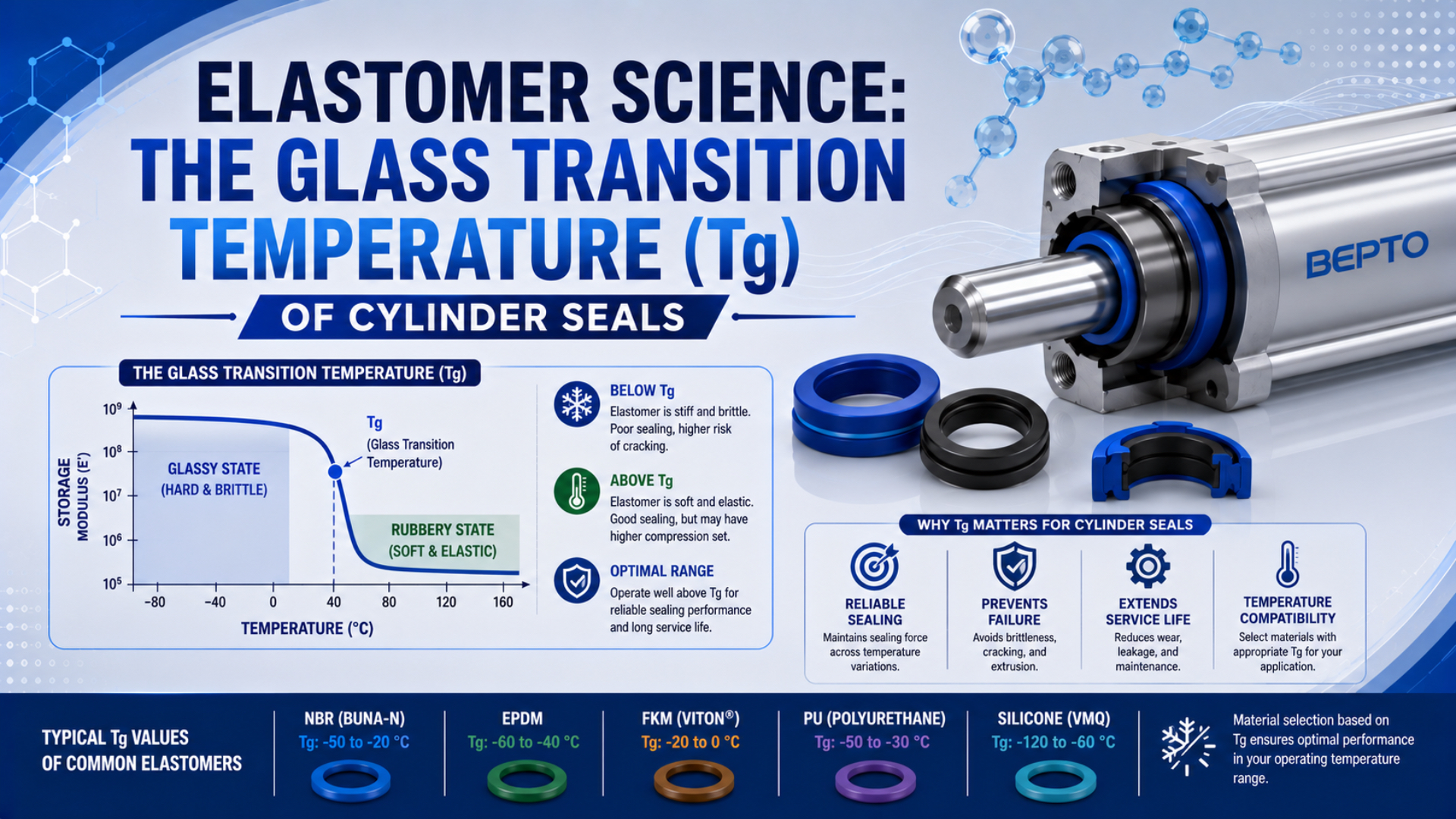
Glass transition temperature helps engineers characterize how an elastomer stiffens as it gets colder, but it isn’t a universal seal-failure temperature. A reported Tg belongs to a particular compound, specimen, test method, frequency, heating rate, and reporting convention. It does not, by itself, establish whether a pneumatic cylinder will seal during a cold start.
That distinction changes the selection process. Instead of comparing generic NBR, polyurethane, FKM, or silicone temperature charts, specify the exact compound and ask what evidence supports its minimum service rating. Then test the assembled cylinder at the real pressure, dwell time, lubrication condition, and motion profile.
Key Takeaways
- ISO 4664-3 treats DMA-derived Tg as guidance, not a complete service limit.
- Tg, TR10, Gehman stiffness, and brittleness answer different questions.
- Approve the exact seal compound only after representative cold-soak leakage, breakaway, and cycling tests.
What Does Glass Transition Temperature Actually Tell You About a Cylinder Seal?
ISO 4664-3 covers vulcanized rubbers from 30 to 80 IRHD and determines Tg from the tan delta peak during a temperature sweep at defined strain and frequency. It describes that value as service-temperature guidance, not a pass/fail temperature for a finished seal (ISO 4664-3:2021).
Glass transition temperature (Tg) is a method-defined point within the region where an amorphous polymer’s molecular mobility and mechanical response change markedly with temperature. An elastomer contains polymer-chain segments that can rearrange when thermal energy and time allow. As temperature falls, those motions slow, storage modulus rises, and damping changes.
Which point gets reported matters. A DMA report might use the onset of the storage-modulus change, the loss-modulus peak, or the tan delta peak. Those points don’t occur at the same temperature. ISO 4664-3 removes some ambiguity by specifying the tan delta peak for its method, but a value from another method may use a different definition.
Tg therefore answers a narrow question: under the stated laboratory conditions, where did the measured viscoelastic response reach the method’s defined transition point? It doesn’t directly answer these application questions:
- Will the seal lip maintain contact after an eight-hour cold soak?
- What pressure is required to start the cylinder?
- Will the grease still reach the sliding interface?
- Does the seal recover quickly enough at the commanded speed?
- Will the assembly meet its leakage limit after repeated cold starts?
A cylinder seal can stiffen enough to affect friction or recovery before a reported Tg. A static seal may also retain pressure at conditions where a dynamic seal cannot follow the moving surface. Geometry, squeeze, pressure energization, surface finish, clearance, lubricant, and motion rate all influence that difference.
The useful engineering question isn’t “What is the polymer’s Tg?” It is “Which measured property becomes limiting in this seal design, at this temperature and deformation rate?” Tg helps locate the transition region. It doesn’t identify the limiting mechanism on its own.
For broader material selection across both hot and cold conditions, see how temperature affects cylinder seals. The present guide stays focused on how low-temperature evidence should be interpreted.
Why Can the Same Elastomer Have More Than One Reported Tg?
TA Instruments identifies three common DMA results, storage-modulus onset, loss-modulus peak, and tan delta peak, and shows that measured transition temperature shifts with deformation frequency. A Tg number is therefore incomplete unless the test method and evaluation point accompany it (TA Instruments).
DSC and DMA don’t observe the same physical signal. Differential scanning calorimetry detects a change in heat capacity. Dynamic mechanical analysis measures changes in stiffness and damping under oscillating deformation. Even within DMA, test frequency changes how much time the polymer chains have to respond.
Higher frequency usually moves a DMA transition to a higher reported temperature because the molecular response must occur within a shorter cycle. Heating rate, specimen shape, strain amplitude, thermal history, cure state, plasticizer content, fillers, and absorbed fluid can also affect the result or its interpretation.
| Reported result | What the instrument observes | Information that must accompany the value | Main limitation for seal selection |
|---|---|---|---|
| DSC Tg | Heat-capacity step | Standard, heating rate, thermal history, onset or midpoint | Does not measure contact-force recovery or sliding friction |
| DMA Tg | Storage modulus, loss modulus, and phase response | Standard, frequency, strain, fixture, selected curve feature | Result depends on time scale and the chosen evaluation point |
| Supplier Tg without a method | Unknown | Full test report needed | Not suitable for direct compound comparison |
| Minimum service temperature | Product or compound rating | Exact compound, medium, static or dynamic duty, qualification basis | May not transfer to another seal geometry or application |
ISO 22768 covers DSC determination of Tg for raw rubber and rubber latex, while ISO 4664-3 addresses vulcanized rubber through dynamic testing. That scope difference is important. A raw-polymer DSC value should not be presented as if it were a finished pneumatic seal’s tested operating limit (ISO 22768:2020).
If two supplier data sheets list different Tg values, don’t immediately conclude that one compound has better cold sealing. First compare polymer formulation, cure condition, test standard, evaluation point, frequency or heating rate, conditioning, and test medium. Only like-for-like data support a meaningful ranking.
Low-Temperature Tests to Use Alongside Tg
ISO 2921 measures temperature retraction after a stretched rubber specimen is frozen and warmed, while ISO 1432 measures relative stiffness from room temperature to approximately -120°C. Together they add two views, recovery and stiffening, that Tg alone cannot quantify for seal qualification (ISO 2921; ISO 1432).
No single coupon test reproduces a lubricated seal lip sliding against a honed tube or piston rod. A defensible qualification package combines several measurements, each selected for the failure mode it can reveal.
Tg by dynamic mechanical analysis
DMA is useful for comparing the transition behavior of identified compounds when the same standard, frequency, strain, and evaluation point are used. It helps explain why stiffness and damping change rapidly in a certain temperature region. It still doesn’t simulate seal squeeze, pressure energization, or sliding contact.
Temperature retraction
The TR test stretches a specimen, freezes it, releases it, and records recovery as temperature rises. TR10 is the temperature at which the specimen has retracted 10% from its frozen extension. Parker describes TR10 as a useful indicator for dynamic seals and static seals exposed to pulsating pressure, while also distinguishing static steady-pressure behavior (Parker O-Ring Handbook).
TR10 isn’t an interchangeable substitute for Tg. ASTM D1329 describes the TR test as a comparative method used with other low-temperature tests and notes relationships to low-temperature flexibility and crystallization behavior (ASTM D1329).
Gehman stiffness
Gehman testing compares torsional stiffness at low temperature with stiffness at a reference temperature. It is useful when a design depends on flexibility rather than impact survival. The result remains a specimen property; it doesn’t include seal-lip contact stress or assembly tolerances.
Low-temperature brittleness
ISO 812 evaluates brittle failure under specified impact conditions. The standard explicitly warns that the result is not necessarily the lowest temperature at which a material can be used. A seal can pass a no-impact storage condition yet lack the recovery needed for dynamic sealing, or it can fail an impact test that doesn’t resemble its actual deformation.
Compression stress relaxation and component leakage
ISO 3384-2 measures the counterforce retained by a compressed rubber specimen during temperature cycling. That can support designs where contact-force retention matters, but the specimen still isn’t a complete cylinder seal. Final evidence should include leakage and motion measurements on the real assembly (ISO 3384-2:2019).
Why Are Generic NBR, FKM, Polyurethane, and Silicone Temperature Charts Unsafe?
Parker lists general-service nitrile down to -34°C and a low-temperature nitrile family down to -55°C, a 21°C difference within one polymer family. The same handbook warns that media and application conditions can change usable ranges and calls for actual-service testing (Parker O-Ring Handbook).
“NBR” describes a polymer family, not a finished recipe. Acrylonitrile content, plasticizer, filler, cure system, hardness, and processing all affect low-temperature response. The seal profile then adds another layer: two compounds with similar laboratory data may generate different lip force or friction in different geometries.
FKM makes the same point. Trelleborg publishes TR10 values from -30°C to -45°C for its XLT FKM family. Those values belong to identified low-temperature formulations and cannot be assigned to every FKM seal (Trelleborg Sealing Solutions).
Polyurethane is especially difficult to generalize because “PU” can refer to different chemistries, hardnesses, additives, and processing routes. A generic statement that polyurethane always has better cold flexibility than NBR or FKM isn’t defensible. Request data for the supplied grade.
Silicone often retains flexibility at lower temperatures than many hydrocarbon elastomers, but that doesn’t automatically make it the best dynamic cylinder-seal material. Wear, tear resistance, extrusion resistance, lubricant compatibility, pressure, surface finish, and cycle demand may eliminate an otherwise attractive compound.
When reviewing a supplier proposal, require this minimum identity:
| Required item | Why it matters |
|---|---|
| Manufacturer and compound designation | Prevents a polymer-family name from substituting for a controlled material |
| Polymer and cure system | Helps explain chemical and thermal behavior |
| Hardness and specimen condition | Affects comparison with laboratory reports |
| Tg or TR result with method | Makes the reported temperature interpretable |
| Minimum service rating and its basis | Separates a product claim from a raw material value |
| Approved lubricant and media | Accounts for extraction, swelling, viscosity, and chemical compatibility |
| Static or dynamic application | Prevents a static O-ring limit from being applied to a reciprocating seal |
In our application reviews, the most useful supplier report is rarely the one with the lowest temperature printed on its cover. It is the report that clearly identifies the compound, method, conditioning, medium, specimen, and intended seal duty, because those details let the engineering team judge whether the evidence transfers.
A lower Tg is not a quality ranking. It is one design attribute. Choosing a compound solely because it has the lowest reported Tg can trade away wear resistance, fluid compatibility, extrusion resistance, manufacturability, or high-temperature stability that the cylinder also needs.
See the broader seal-material selection guide when chemical exposure and wear are as important as cold response.
Establishing the Seal’s Real Minimum Operating Temperature
Parker distinguishes dynamic behavior near TR10 from static steady-pressure sealing that may extend about 8°C lower for some O-ring applications. That conditional difference shows why a universal ambient-temperature deduction is unsafe. Determine the seal minimum from measurements or a validated model of the actual machine (Parker O-Ring Handbook).
Compressed air can cool during expansion and exhaust, but the temperature at a seal depends on more than inlet pressure. Pressure ratio, valve and exhaust restriction, tubing volume, cycle rate, dwell, heat transfer, cylinder mass, moisture, and sensor location all matter. A fixed “ambient minus 25°C” calculation hides those variables.
Instrument the application before specifying a critical low-temperature limit. Place a suitable contact sensor close to the seal region when the design allows it. An infrared reading from a shiny cylinder surface can be misleading because emissivity and line of sight affect the result.
Record at least these conditions:
- Lowest ambient temperature and cold-soak duration
- Supply pressure at the machine, not only at the compressor room
- Cycle rate, stroke, speed, dwell, and load
- Valve, tubing, flow-control, and exhaust configuration
- Tube or end-cap temperature close to the relevant seal
- Compressed-air dew point and any evidence of moisture or icing
- Lubricant grade and its stated low-temperature properties
In our experience, a synchronized record of local temperature, chamber pressure, and motion onset resolves cold-start disputes faster than separate spot checks. It shows whether the seal was actually cold when friction or leakage changed and whether a pressure or flow problem occurred at the same time.
The coldest instantaneous reading isn’t always the only design point. A seal may tolerate a short transient but fail to recover after a long dwell. Conversely, a cylinder can warm during repeated cycling. Test both the cold first motion and the stabilized operating condition.
For systems that remain below freezing, the complete cylinder needs attention. Air quality, condensate, grease, sensors, tubing, cushioning, mounting, and material contraction can become limiting before the seal compound does. Use the sub-zero pneumatic cylinder design guide for that system-level review.
Do Cold-Start Leakage, Stick-Slip, or Cracks Prove the Seal Crossed Tg?
ISO 812 supports two result types, the lowest temperature without brittle failure and the temperature at which 50% of specimens fail. It also says neither is necessarily the lowest usable temperature. Cold-start leakage or damage therefore cannot prove that a seal crossed Tg (ISO 812:2017).
A stiff seal can increase breakaway pressure and stick-slip. Yet thickened grease can do the same. Reduced point-of-use pressure, restricted exhaust, side loading, moisture icing, contamination, surface damage, and dimensional contraction can also produce cold-sensitive symptoms.
| Observation | Tg-related possibility | Other checks before assigning cause |
|---|---|---|
| Leakage after a long cold soak | Reduced recovery or contact force | Seal damage, contraction, pressure, bore condition, assembly tolerance |
| High first-motion pressure | Increased seal stiffness | Grease viscosity, misalignment, side load, guide friction, low supply pressure |
| Jerky initial motion | Stick-slip at the sealing interface | Meter-out setting, valve response, load change, guide binding |
| Leakage that falls after cycling | Assembly warms and material response improves | Ice clears, grease redistributes, supply pressure recovers |
| Cracking or chipped edges | Brittle deformation may have occurred | Ozone, chemical attack, installation cuts, fatigue, extrusion |
| Permanent shape change | Poor recovery or compression behavior | Swell, thermal ageing, over-compression, incompatible lubricant |
Start with a controlled comparison. Measure warm and cold leakage, first-motion pressure, velocity, and temperature using the same load and valve settings. Inspect the seal and mating surfaces after testing. If possible, repeat the test with a known reference compound while holding the rest of the cylinder constant.
Don’t use a warm-up period as proof of suitability. If the machine must move safely at the minimum specified temperature, the first commanded motion is part of the acceptance test. Raising pressure to force a cold cylinder to move can create unexpected acceleration once friction drops.
For damage patterns unrelated to temperature, compare the observations with the industrial cylinder seal type and failure guide.
Rubber brittleness testing should also be kept separate from metallic impact testing. The polar-grade cylinder brittleness guide explains why a Charpy result for a metal specimen cannot certify a complete cold-service cylinder.
How Should a Low-Temperature Seal Be Qualified Before Production?
ISO 3384-2 specifies two temperature-cycling methods for measuring compression stress relaxation, yet neither is a complete-cylinder leakage test. Qualification should combine controlled material data with cold-soak testing of the exact cylinder, compound, lubricant, pressure, and motion cycle (ISO 3384-2:2019).
Begin with a written duty profile. Define the minimum ambient and component temperatures, soak duration, operating pressure, load, stroke, speed, dwell, cycle count, air quality, lubricant, and allowed leakage. Without acceptance limits, a cold-chamber run produces observations but no objective approval decision.
1. Review traceable material evidence
Ask for the exact compound designation and the reports behind its low-temperature rating. Record the standard, specimen condition, test medium, result definition, and date. A data sheet that says only “low-temperature NBR” is not enough for a critical application.
2. Establish a warm baseline
Measure leakage, breakaway pressure, extend and retract time, speed stability, cushioning behavior, and position repeatability at the reference temperature. The warm test confirms that the assembly is sound before cold exposure and provides a baseline for comparison.
3. Cold-soak the complete assembly
Soak long enough for the cylinder body, end caps, seals, lubricant, and internal hardware to approach the target condition. Record temperatures at defined locations. Don’t assume chamber-air temperature equals seal temperature.
4. Test static sealing before motion
Pressurize the specified chamber or chambers and measure leakage after the required dwell. Test both pressure directions when the seal arrangement requires it. Static leakage should be assessed before frictional heating changes the assembly temperature.
5. Test the first commanded movement
Record the pressure at motion onset, travel time, velocity profile, stick-slip, position, and any abnormal sound. Use appropriate guarding and reduced-risk procedures because a cold cylinder can break free suddenly.
6. Repeat representative cycles
Run the specified duty and track how temperature, leakage, and friction change. Include relevant pauses and restarts. A continuous cycling test can miss the long-dwell cold start that causes the real problem.
7. Inspect and retest
Inspect seal lips, contact surfaces, lubricant distribution, and any evidence of cracking, abrasion, extrusion, or permanent deformation. Repeat leakage and motion tests after the defined number of cycles. For a production release, document what constitutes a failure and whether disassembly itself invalidates further comparison.
Change control is part of qualification. If the approved compound, cure, lubricant, seal geometry, surface finish, or supplier changes, the earlier cold test may no longer support the assembly. The purchasing specification should identify which changes trigger review or requalification.
Cylinder Seal Tg FAQs
ISO 4664-3, ISO 2921, ISO 1432, and ISO 812 provide four distinct views of low-temperature behavior: dynamic transition, recovery, stiffness, and brittle impact response. Their results are complementary, so an engineering decision should not treat any one test as a universal minimum service temperature.
Is Tg the minimum operating temperature of a pneumatic cylinder seal?
No. ISO 4664-3 describes its DMA-derived Tg as a guideline to service temperature. A finished seal’s minimum operating temperature also depends on compound formulation, geometry, squeeze, lubricant, pressure, motion rate, dwell, surfaces, and leakage limits. Use Tg for screening, then qualify the assembled cylinder.
Is TR10 more useful than Tg for dynamic seals?
TR10 directly evaluates recovery during controlled warming and is often useful for comparing low-temperature rubber compounds. It still isn’t a complete dynamic-seal test. Confirm the exact compound and method, then measure leakage, breakaway pressure, friction, and motion on the intended seal geometry and lubricant system.
Can I use a generic Tg table to compare NBR, FKM, and polyurethane?
Not safely. Parker publishes a 21°C difference between its general-service and low-temperature nitrile ranges, showing how much formulation matters within one family. Compare identified compounds using consistent test methods, media, hardness, and application type instead of assigning one Tg or service limit to each polymer name.
Does temporary leakage during a cold start prove that the seal became glassy?
No. Reduced elastomer recovery is one possible cause, but cold grease, moisture or ice, low point-of-use pressure, restricted flow, side loading, dimensional contraction, or existing surface damage can produce similar behavior. Compare controlled warm and cold measurements before assigning the failure to glass transition.
What should a supplier provide for a low-temperature seal proposal?
Request the compound designation, polymer and cure system, hardness, low-temperature test method and report, minimum-service-rating basis, compatible lubricant and media, and static or dynamic duty. For production approval, also require cold-soak leakage and first-motion results from a representative cylinder assembly with written acceptance limits.
Sources and technical references
- ISO 4664-3:2021, determination of Tg for vulcanized or thermoplastic rubber
- ISO 2921:2019, temperature-retraction testing
- ISO 1432:2021, Gehman low-temperature stiffening
- ISO 812:2017, low-temperature brittleness
- ISO 3384-2:2019, compression stress relaxation with temperature cycling
- ASTM D1329-16(2021), temperature-retraction test
- Parker O-Ring Handbook
- TA Instruments, frequency dependence of glass transition temperatures
- Trelleborg Sealing Solutions, low-temperature FKM material data