

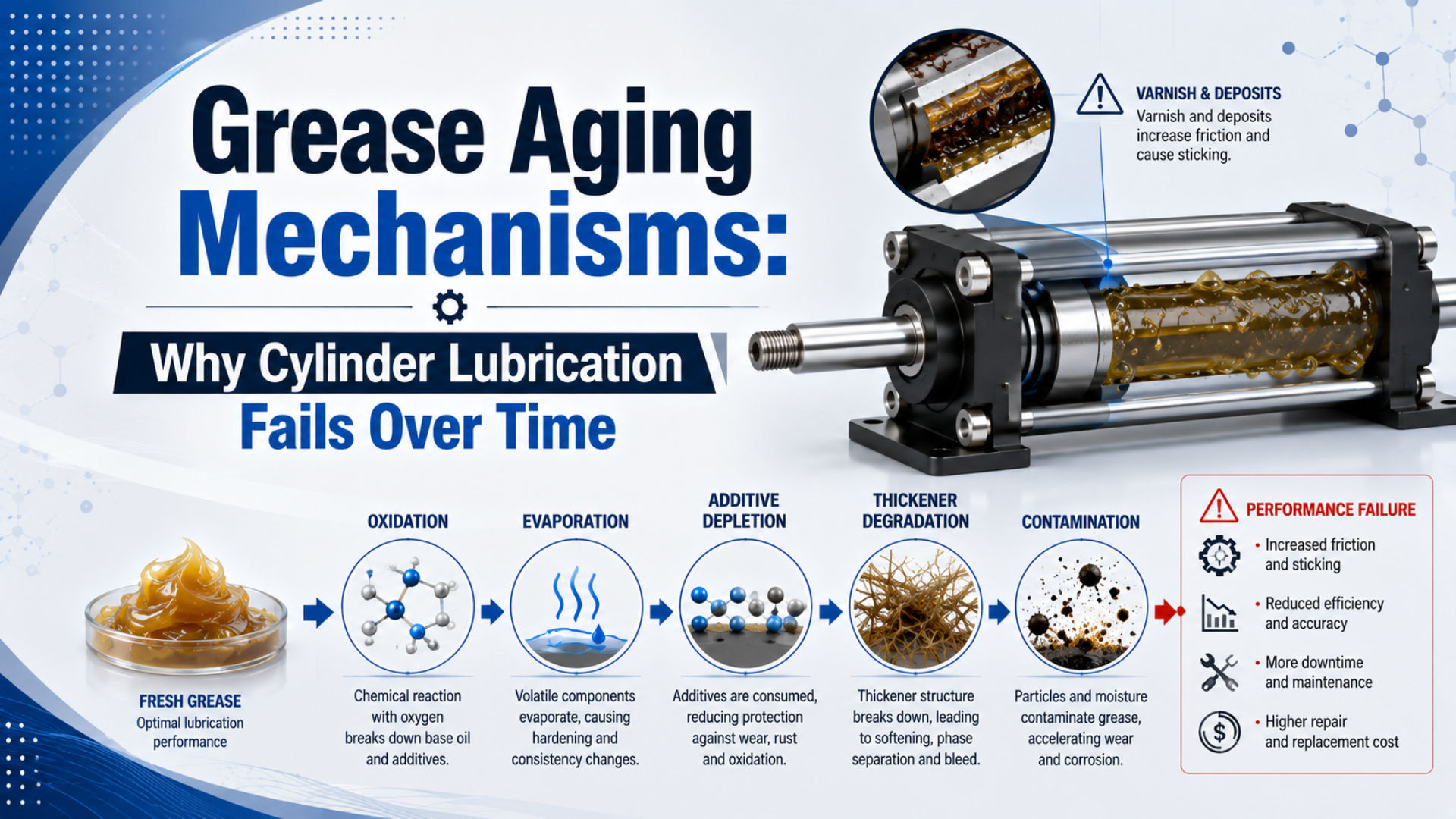
Pneumatic cylinder grease can fail because its chemistry changes, its thickener structure changes, contaminants enter it, or the lubricant simply moves away from the sliding contact. Those mechanisms can produce similar symptoms, including rising breakaway pressure, stick-slip, leakage, noise, and seal wear. A calendar interval alone cannot identify which mechanism is active.
That distinction matters in factory-lubricated cylinders. A product sold as non-lube may still depend on grease installed during assembly, while airline oil creates a different lubrication regime. The guide to air lubrication and cylinder seal materials explains that boundary in more detail.
Key Takeaways
- ASTM D942 measures static oxidation in a sealed oxygen vessel but does not predict dynamic service life.
- Dark grease, friction, or leakage is evidence to investigate, not proof of oxidation.
- Use the exact cylinder model, original grease, seal compound, duty, and trend data to decide maintenance.
What Does Grease Aging Mean in a Pneumatic Cylinder?
ASTM D942 measures grease oxidation under static, elevated-temperature conditions in a sealed oxygen system, yet the standard explicitly says it does not predict stability in dynamic service (ASTM D942-25, 2025). Cylinder grease aging therefore means a verified loss of required function, not merely elapsed time or darker color.
Lubricating grease is a semi-solid system in which base oil is retained by a thickener and supported by an additive package. Each part can change differently. Oxidation can consume antioxidants and create acidic or varnish-like products. Heat can increase evaporation or reaction rates. Mechanical working can alter consistency. Water, particles, cleaner, or another lubricant can change the mixture.
The cylinder adds another complication: lubricant distribution. Seals wipe and redistribute a very small grease charge along the bore or rod. Short repetitive strokes can leave part of the travel poorly replenished. Long dwell periods can change breakaway behavior. Cleaning or an unintended oil mist can remove or dilute the original film without the grease itself being chemically exhausted. Lubricant application during assembly is covered separately in the pre-lube grease and cylinder break-in guide.
Grease aging in a pneumatic cylinder is the chemical, physical, or contaminant-driven change that prevents the original lubricant system from maintaining acceptable friction, sealing, wear control, and corrosion protection under the cylinder’s specified duty.
This definition keeps the diagnosis tied to function. It also prevents a common mistake: treating every sticky cylinder as a lubrication problem. Restricted airflow, low dynamic pressure, side loading, a damaged bore, incorrect cushioning, or a swollen seal can create much the same motion. Check side loading and guide wear before adding lubricant to a cylinder that binds at one position.
The Four Failure Paths Inside a Cylinder
NLGI lists oxidation, loss of base oil, and contamination among the conditions that in-service grease analysis can detect, and recommends comparison with an unused-grease baseline rather than a universal limit (NLGI Technical FAQs, accessed 2026). In cylinders, lubricant redistribution or loss forms a fourth path that laboratory chemistry alone may miss.
| Failure path | What changes | Typical evidence | What it does not prove |
|---|---|---|---|
| Chemical aging | Base oil and additives oxidize or react | Darkening, deposits, odor change, oxidation trend in FTIR | That oxidation caused the motion fault |
| Structural or physical change | Consistency, oil release, evaporation, or thickener structure changes | Hard or soft deposits, separated oil, altered penetration | A fixed remaining-life percentage |
| Contamination or incompatibility | Water, particles, cleaner, compressor oil, or another grease enters | Milky appearance, debris, corrosion, abrupt consistency change | Which contaminant entered or where it came from |
| Distribution or lubricant loss | Grease migrates, is wiped away, or no longer reaches the contact | Dry wear track, local scoring, position-dependent friction | That the remaining grease is chemically aged |
Chemical and physical paths often overlap. Oxidation products can change consistency. Heat can accelerate chemical reactions while also increasing oil loss. Particles can damage sealing surfaces and mix with lubricant into an abrasive paste. The failure investigation should record these interactions instead of forcing every sample into a single cause.
A useful root-cause question is: did the lubricant change, or did its location change? Chemical tests can describe the material in the sample bottle. They may not reveal that a short-stroke application has pushed grease outside the active seal path, or that one side of the bore is dry because an external moment has tilted the piston.
Which Operating Conditions Accelerate Grease Failure?
SKF’s bearing guidance halves a calculated relubrication interval for each 15°C rise above 70°C, but only within its bearing-specific model and below the grease’s high-temperature limit (SKF Lubrication Basics, accessed 2026). It is not a universal 10°C rule for pneumatic cylinders.
Temperature still matters. It can accelerate oxidation, reduce base-oil viscosity, increase evaporation, change seal behavior, and alter how grease releases oil. The actual cylinder temperature is more useful than room temperature. Measure the body near the active seal path after the machine reaches a stable duty cycle, then compare it with the cylinder and grease limits.
Moisture needs similar care. Water may enter through poor air treatment, washdown, condensation, damaged wipers, or maintenance. Its effect depends on amount, grease formulation, seal design, corrosion protection, and residence time. ASTM D1264 evaluates water washout from a ball bearing at 38°C and 79°C and states that no correlation with field service has been established (ASTM D1264-24, 2024). A D1264 result cannot predict cylinder life.
Mechanical duty changes both grease and distribution. Record stroke length, cycles, speed, load, dwell, orientation, side load, and temperature. A high-cycle short stroke can work one narrow section repeatedly, while a rarely operated cylinder can show high restart friction after a long dwell. Neither condition is represented by a generic monthly replacement table.
Air quality is part of the exposure record, too. Particles, liquid water, compressor-oil carryover, and cleaning chemicals can reach or disturb the lubricant system. Use the compressed-air quality standards guide to document the supply, but remember that an ISO 8573-1 class does not approve a grease or seal compound.
How Can You Distinguish Grease Aging From Other Cylinder Faults?
ISO 19973-3 expresses pneumatic-cylinder reliability in two service measures, cycles or accumulated kilometres, and requires stated test conditions and failure thresholds (ISO 19973-3:2015, 2015). A symptom observed after a certain number of months is therefore incomplete evidence unless the duty and failure criterion are also known.
Start with the symptom pattern. Friction that rises uniformly after warm-up points in a different direction from a cylinder that binds at one location. Leakage after a cleaning change deserves a different investigation from gradual seal wear. Compare affected and unaffected cylinders on the same machine whenever possible.
| Observation | Lubricant-related possibilities | Competing causes to exclude | Useful next evidence |
|---|---|---|---|
| High breakaway after dwell | Oil migration, stiffened grease, altered seal film | Seal compression set, low pilot pressure, valve leakage | Breakaway pressure at controlled dwell periods |
| Jerky low-speed motion | Film loss, contamination, incompatible grease | Metering method, side load, rough bore, oversized seal friction | Dynamic pressure, speed trace, wear pattern |
| Position-dependent drag | Local lubricant starvation or debris | Misalignment, dented tube, guide moment, mounting distortion | Force or pressure versus stroke position |
| New external leakage | Grease or fluid compatibility change | Damaged lip, scored rod, wrong seal, loose joint | Seal dimensions, hardness, surface inspection |
| Dark or hardened residue | Oxidation, heat exposure, base-oil loss | Process dust, cleaner residue, transferred seal material | Used and unused sample comparison |
| Grease or oil at exhaust | Excess lubricant, migration, airline oil | Compressor carryover, lubricated shared branch | Upstream and downstream oil check |
Color is a screening clue, not a verdict. NLGI notes that thermal degradation, oxidation, contamination, dye fading, water, and grease mixing can all change appearance (NLGI Technical FAQs, accessed 2026). Preserve the sample before cleaning the cylinder, photograph where it was found, and label the stroke position and seal orientation.
In our experience, the fastest investigations begin with three comparisons: failed versus healthy cylinder, used versus unused grease, and the symptom before versus after the last maintenance change. Those comparisons often expose a branch-level oil change, cleaning event, alignment problem, or substitute seal before laboratory testing begins.
What Can Laboratory Grease Tests Actually Prove?
ASTM D4289 immerses elastomer coupons in grease or fluid for 70 hours, commonly at 100°C or 150°C, then measures volume and hardness change (ASTM D4289-24a, 2024). The standard warns that these changes do not duplicate service behavior, so coupon compatibility is a screening result, not complete cylinder approval.
Choose tests to answer a defined question. Don’t order a broad lubricant panel and then search for any number outside a generic limit.
| Test or inspection | Question it can help answer | Main limitation |
|---|---|---|
| ASTM D942 oxidation stability | Did this formulation resist oxidation under the specified static oxygen-vessel conditions? | Does not predict dynamic service, storage life, or grease-film life |
| ASTM D5483 PDSC | What oxidation induction time was measured at 3.5 MPa oxygen and 155°C to 210°C? | ASTM states no correlation with service performance has been determined |
| ASTM D217 cone penetration | Has grease consistency changed relative to a controlled baseline? | ASTM states no field-service correlation has been developed |
| ASTM D6185 compatibility | Do binary grease mixtures retain dropping point, worked penetration, and storage stability? | Applies to tested products and ratios; composition alone cannot predict compatibility |
| ASTM D4289 elastomer compatibility | How did specified elastomer coupons change in volume and hardness? | Dynamic sealing, surface finish, flexing, pressure, and wear remain untested |
| FTIR and elemental analysis | Is there a trend consistent with oxidation, contamination, base-oil loss, additives, or wear metals? | Interpretation needs unused grease, sampling context, and formulation knowledge |
ASTM D6185 uses three primary property checks and evaluates defined binary mixtures because even greases with similar thickener types can be incompatible (ASTM D6185-24, 2024). A compatibility chart is only an initial screen. When a lubricant change is unavoidable, test the exact old and new products, then qualify the assembled cylinder.
The most defensible alarm limit is usually a trend limit tied to an unused sample and a functional change. A single acid number, penetration value, or FTIR index transferred from another grease can misclassify a healthy formulation because fresh additive chemistry and test methods differ.
Model-Specific Maintenance Comes First
SMC’s CYB rodless-cylinder manual states that the product operates on its initial factory lubrication and specifies ISO VG32 turbine oil if additional airline lubrication is introduced (SMC CYB Operation Manual, accessed 2026). It also requires factory relubrication before returning to non-lubricated operation, showing why maintenance rules are model-specific.
Before opening or lubricating a cylinder, isolate hazardous pneumatic and mechanical energy according to the machine’s approved procedure. Restrain gravity loads and moving assemblies, exhaust stored pressure, and verify the safe state. Lubrication work never justifies bypassing lockout.
Use this maintenance sequence:
- Identify the product. Record the complete cylinder model, revision, seal kit, mounting, load, stroke, speed, environment, and manufacturer instructions.
- Identify the lubricant system. Record the original grease, any replacement grease, airline oil, compressor carryover, cleaning chemicals, and the date each changed.
- Preserve evidence. Photograph deposits and wear tracks. Keep used grease and removed seals in clean, labeled containers. Retain an unused-grease sample when possible.
- Exclude mechanical and pneumatic causes. Check alignment, guidance, surface condition, dynamic pressure, valve flow, cushioning, and exhaust restriction.
- Select a supported action. Follow the model manual for grease quantity, application points, cleaning, seal replacement, or return-to-factory service.
- Commission against a baseline. Record leakage, breakaway pressure, stroke time, motion, temperature, cushioning, and sensor operation under representative load.
Adding more grease is not a neutral experiment. Excess grease can increase drag, block small passages, migrate to exhaust, or contaminate a clean process. Mixing products can soften, harden, or separate the grease. If the existing lubricant cannot be identified, obtain written guidance from the cylinder supplier before flushing or substitution.
A non-lube cylinder can still contain factory grease. The self-lubricating seal guide explains how seal compounds and transferred films contribute, while the dry-air cylinder guide covers supply-air effects. Solid-film coatings are a separate technology addressed in the MoS2 cylinder coating guide.
A Practical Grease-Aging Inspection Record
ISO 19973-3 applies a three-point moving-average method to the first failure in its cylinder reliability procedure, excluding repairs and outliers under defined rules (ISO 19973-3:2015, 2015). Plant maintenance need not reproduce that laboratory method, but it should use the same discipline: define the metric, baseline, threshold, and duty before judging a trend.
Record enough context for another engineer to reproduce the decision:
| Record group | Minimum fields |
|---|---|
| Identity | Cylinder model, serial or asset number, seal-kit code, grease product and batch |
| Duty | Pressure at the cylinder, speed, stroke, load, orientation, cycles or travel, dwell |
| Environment | Cylinder-body temperature, air-quality record, washdown, dust, process chemicals |
| Symptom | Direction, stroke position, cold or hot state, breakaway, stroke time, leakage |
| Inspection | Grease location and appearance, wear track, seal dimensions, rod or bore condition |
| Analysis | Sample location, unused baseline, test method, result, laboratory interpretation |
| Action | Cleaning, approved grease and quantity, replaced parts, approver, acceptance result |
| Follow-up | Next inspection trigger in cycles, travel, hours, condition trend, or event |
Don’t convert this record into a universal month count. Use it to build evidence for one cylinder family and one duty. If several identical assets share the same grease, seals, load, environment, and failure definition, their histories can support a local maintenance interval. Change any of those inputs and review the interval again.
Grease Aging FAQs: What Should Maintenance Teams Ask?
ASTM D217 covers grease consistency numbers from NLGI 000 through NLGI 6, yet it also states that cone penetration has no established correlation with field service (ASTM D217-21a, 2021). These answers therefore use model instructions and comparative evidence rather than assigning universal replacement limits.
How long does grease last in a pneumatic cylinder?
There is no defensible universal month count. Life depends on the exact grease, seal system, temperature, stroke, cycles, travel, load, dwell, contamination, and lubricant distribution. Use the cylinder manufacturer’s instructions and a documented baseline. ISO 19973-3 reports cylinder reliability in cycles or kilometres, not calendar age alone.
Does dark grease prove that oxidation caused the failure?
No. NLGI notes that grease color can change because of thermal degradation, oxidation, contamination, dye fading, water, or mixing. Compare the used sample with unused grease and inspect where it was collected. Then relate the laboratory trend to friction, leakage, wear, temperature, and the maintenance history.
Can fresh grease be added on top of the old grease?
Only when the model instructions and lubricant compatibility evidence permit it. ASTM D6185 shows that binary mixtures can soften, harden, or separate, and compatibility cannot be predicted reliably from thickener type alone. Identify both products, test the actual mixture when needed, and follow the manufacturer’s cleaning and application procedure.
Does a better ASTM D942 result mean longer cylinder life?
No. ASTM D942 measures oxidation resistance under static oxygen-vessel conditions and explicitly says it does not predict dynamic service stability or grease-film life. Use it for formulation control or comparison within its scope. Cylinder life still requires representative seals, surfaces, load, speed, stroke, atmosphere, and failure criteria.
Should a sticky cylinder be lubricated immediately?
Not before basic diagnosis. Record dynamic pressure, stroke position, direction, temperature, leakage, alignment, side load, valve flow, and surface condition. If the manual allows service lubrication, use only the specified product and quantity. Otherwise, added oil or grease can mask the fault, disturb factory lubrication, or damage seals.
Sources and technical references
- ASTM D942-25, Oxidation Stability of Lubricating Greases by the Oxygen Pressure Vessel Method. Retrieved 2026-07-22.
- ASTM D1264-24, Water Washout Characteristics of Lubricating Greases. Retrieved 2026-07-22.
- ASTM D217-21a, Cone Penetration of Lubricating Grease. Retrieved 2026-07-22.
- ASTM D4289-24a, Elastomer Compatibility of Lubricating Greases and Fluids. Retrieved 2026-07-22.
- ASTM D5483-21, Oxidation Induction Time by Pressure Differential Scanning Calorimetry. Retrieved 2026-07-22.
- ASTM D6185-24, Compatibility of Binary Mixtures of Lubricating Greases. Retrieved 2026-07-22.
- ISO 19973-3:2015, Assessment of Pneumatic Cylinder Reliability by Testing. Retrieved 2026-07-22.
- NLGI Technical FAQs. Retrieved 2026-07-22.
- SMC CYB Rodless Cylinder Operation Manual. Retrieved 2026-07-22.
- SKF Lubrication Basics. Retrieved 2026-07-22.