

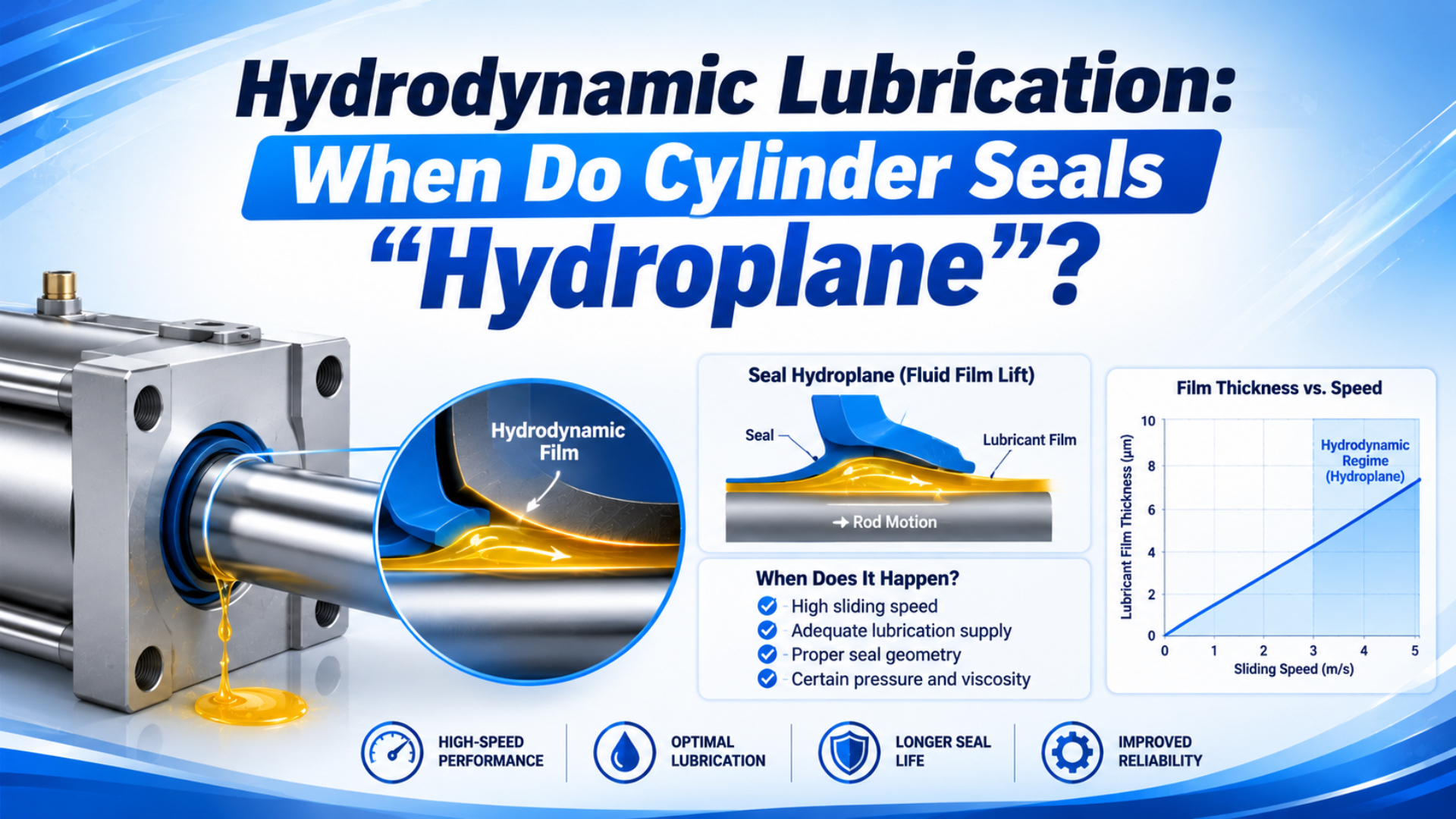
Hydrodynamic lubrication can develop locally in a moving seal contact when lubricant is dragged into a converging gap and carries part of the load. In a pneumatic cylinder, however, “hydroplaning” is only an analogy. It is not a universal failure that begins at one speed, nor does a fluid film automatically lift the entire seal lip away from the bore. Pneumatic seals are deformable, pressure-energized components working with limited factory grease, changing direction, surface texture, and sometimes direct asperity contact. Their behaviour is better described as boundary, mixed, or locally full-film lubrication. Diagnosis must still separate film effects from damaged seals, poor alignment, contamination, bore defects, pressure variation, and valve leakage. That distinction is essential when a leakage diagnosis begins.
The analogy is useful only when its limits stay visible.
Key Takeaways
- In one commercial-cylinder study, piston seals produced about 90% of measured friction, and pressure affected friction more than velocity (Tribology International).
- No universal speed predicts seal “hydroplaning.”
- Confirm a speed-related pattern with controlled pressure, leakage, temperature, direction, and lubrication tests.
What Does “Hydroplane” Mean for a Pneumatic Cylinder Seal?
One experimental study of commercial pneumatic cylinders found that piston seals produced about 90% of measured friction and that pressure had a greater effect than velocity in the tested configurations (Tribology International, 2019). Speed alone therefore cannot define when a seal begins to “hydroplane.”
Cylinder seal hydroplaning is an informal description for a condition in which lubricant-generated pressure reduces direct contact across part of a moving seal interface. Tribology literature usually calls this mixed lubrication, elastohydrodynamic lubrication, or local full-film lubrication. Those terms describe load sharing and film formation more accurately than the tyre analogy. Pressure energizes a pneumatic piston or rod seal against the bore or rod while sliding entrains grease or oil into the contact. Lip geometry, elastic deformation, surface roughness, temperature, viscosity, direction, and lubricant supply determine whether the film carries a meaningful portion of the contact load.
Local separation is not automatically a sealing failure. A designed lubricant-retaining lip may preserve a thin film to reduce friction and wear while maintaining the pressure barrier. Leakage becomes a concern when film transport, seal deformation, damage, or an unintended clearance creates a continuous path across the sealing zone.
Film support is not the same as bypass.
Keep one boundary clear: “fluid film present” and “gas bypass present” are different observations. A seal can have a lubricating film without measurable internal leakage, and a cylinder can leak badly because of a cut seal or scored bore without any hydrodynamic lift.
Low-speed friction is covered separately in the guide to stick-slip motion in pneumatic cylinders.
Lubrication Regimes Inside a Reciprocating Seal Contact
One mixed-lubrication model for reciprocating seals reduced average prediction error to 10.5% in its test set, compared with 62.6% for a full-film model (Lubrication Science, 2018). Although that work concerns hydraulic seals, it demonstrates why complete surface separation should not be assumed in a deformable reciprocating contact.
Mixed lubrication is a regime in which lubricant pressure and contacting surface asperities share the load. Three regimes can exist at different positions or times within the same seal:
| Regime | How load is supported | Likely friction behaviour | What it means for sealing |
|---|---|---|---|
| Boundary lubrication | Mostly by contacting asperities and boundary films | Higher friction and sensitivity to material chemistry | Lubricant may be insufficient, displaced, or unavailable after dwell |
| Mixed lubrication | By lubricant pressure and asperity contact together | Friction depends on both shear and solid contact | Common working description for many reciprocating seals |
| Local full film | Mainly by fluid pressure over part of the contact | Solid-contact friction can fall while viscous shear remains | Does not prove a continuous leakage path across the entire lip |
Reciprocation makes the problem transient. At stroke reversal, sliding velocity passes through zero and entrainment collapses. The seal then accelerates in the opposite direction, and its pressure distribution, film shape, and lubricant transport change. Dwell time can allow grease to redistribute or squeeze out of a highly loaded zone. Return and working strokes may not behave alike. Hydraulic rod-seal studies show that film thickness and pumping direction depend on lip geometry and stroke direction. Pneumatic seals use a different medium and much smaller lubricant inventory, so hydraulic results explain mechanisms but cannot supply a universal pneumatic threshold.
An experimental pneumatic-seal study evaluated dry, boundary-lubricated, and fluid-lubricated conditions while varying velocity and supply pressure (Tribology International, 1997). That is the right experimental mindset: treat lubrication state as one variable among several, not as a label inferred from speed.
When Can a Fluid Film Affect Seal Friction or Leakage?
Parker rates one E4 pneumatic piston-seal configuration for a maximum surface speed of 1 m/s and 16 bar, with initial assembly lubrication even in oil-free air (Parker E4). Those model-specific limits show why 0.5 m/s cannot serve as a general hydroplaning threshold.
Film formation becomes more plausible when sliding speed or lubricant viscosity rises, the lip presents a converging inlet geometry, the lubricant supply is adequate, and contact pressure is low enough for the fluid to carry some load. Yet each variable interacts with the others. Higher pneumatic pressure may increase lip contact pressure and friction even while velocity encourages entrainment. Seal geometry matters just as much. Lip angle, contact width, preload, groove fill, material modulus, pressure-energizing features, surface texture, and wear change the gap that generates hydrodynamic pressure. A rounded lubricant-retaining lip does not behave like a sharp scraper edge or an energized PTFE ring.
No single speed closes that system.
Temperature changes viscosity and elastomer stiffness at the same time. Cold grease may resist motion and raise breakaway force; heat can lower viscosity while softening the seal or accelerating lubricant loss. Calling either effect “hydroplaning” before measuring the actual symptom hides more information than it reveals.
Stroke length and reversal frequency also matter. Short, rapid reciprocation may repeatedly traverse the same lubricant inventory, while a long stroke can expose different surface conditions. Neither duty can be reduced to average piston speed alone.
Use published speeds only for the exact seal and cylinder configuration. Trelleborg, for example, lists one APDF pneumatic piston seal for speeds up to 1 m/s, pressure to 1.6 MPa, and oil-free air with initial grease lubrication (Trelleborg Pneumatic Seals). That rating is evidence for that design, not a generic tribology boundary.
What Can the Film Thickness Ratio Tell You?
Published in 2021, a review describes the conventional Lambda parameter as minimum film thickness divided by composite RMS roughness, but warns that this simplified value can predict lubrication state incorrectly because it misses micro-EHL effects and surface structure (Tribology Letters). Use it as a descriptor, not a cylinder-selection formula.
The conventional Lambda ratio is a dimensionless film-thickness descriptor:
Here, is the dimensionless film ratio, is the estimated minimum lubricant-film thickness, is composite RMS roughness, and and are RMS roughness values for the two contacting surfaces. Every length must use the same unit.
Lambda is a ratio, not a leak rate.
This relationship compares two measured or modeled quantities. It does not calculate . Obtaining minimum film thickness for a reciprocating elastomeric seal requires a model or experiment that includes lubricant rheology, transient velocity, seal deformation, contact pressure, lip geometry, surface texture, cavitation or starvation assumptions, temperature, and boundary conditions.
Traditional Lambda ranges such as “greater than 3 means full film” came from other tribological contacts and remain debated. A multi-lip hydraulic-seal simulation found different regimes at different lips under the same operating condition, including local full film at two lips while the main lip remained mixed (Machines, 2022).
Applied to a pneumatic cylinder, the Lambda ratio is most useful after a problem has been narrowed to the seal interface and the film thickness has credible model or test support. It cannot convert a catalogue speed, grease grade, or bore roughness into a leakage prediction by itself.
How Can You Diagnose a Suspected Fluid-Film Effect?
Parker’s OSP-P instructions treat speeds below 0.2 m/s as a possible slow-speed-grease issue for that rodless-cylinder family, while separately listing defective seals, contamination, low pressure, and poor lubrication as causes of jerky motion (Parker OSP-P Instructions). Diagnosis therefore needs competing hypotheses.
Start by defining the symptom precisely:
| Symptom boundary | What must be confirmed |
|---|---|
| Internal bypass | Pressure moves between cylinder chambers across the piston seal |
| External leakage | Air escapes at the rod seal, end cap, tube joint, or rodless-cylinder sealing band |
| Friction change | Breakaway pressure, running force, temperature, noise, or low-speed stability changes without confirmed leakage |
| Circuit leakage | Valves, fittings, tubes, cushions, flow controls, or exhaust devices lose air outside the cylinder seal interface |
Leak location comes before mechanism.
Judge the evidence in steps:
- Weak: leakage appears at a high speed.
- Useful: the same cylinder shows a repeatable speed or direction pattern while load, temperature, dynamic port pressure, and leakage boundary remain controlled.
- Strong: the pattern survives repeated trials, ordinary mechanical and circuit faults have been excluded, and a model-specific inspection or validated film/contact measurement supports the proposed mechanism.
Then compare repeatable operating points. Hold the load, mounting, cushioning, air quality, temperature, valve command, and measurement method constant. Test several speeds in both directions and record dynamic pressure at both cylinder ports, stroke time, breakaway pressure, steady running behaviour, leakage location, surface temperature, and lubricant history.
Suspected film effects should change systematically with a controlled variable and reverse when that variable is restored. If leakage rises only in one direction, inspect asymmetric lip damage, surface lead, port pressure, or rodless-cylinder band geometry. If leakage remains after stopping, film formation is less persuasive than permanent damage or contamination.
Isolation methods appear in the guide to cylinder drift caused by internal seal bypass. If scoring or abrasive wear is visible, follow the separate boundary-lubrication failure guide.
Lubrication Changes and Maintenance Rules
SMC specifies ISO VG32 turbine oil without additives when certain non-lube cylinders receive additional airline lubrication, and warns that lubrication must continue once started because the new oil displaces the original lubricant (SMC Guided Cylinder Manual). It gives no universal drops-per-cycle schedule.
A non-lube cylinder is intended to operate without routine airline oil inside its specified envelope, relying on lubricant applied during manufacture. Grease type, quantity, placement, seal material, bore finish, and lip geometry belong to the qualified design. Adding a lubricator changes that system and can affect compatibility, particle retention, exhaust cleanliness, and low-speed friction. Do not respond to suspected hydroplaning by automatically reducing oil or installing a harder seal. Too little lubricant can increase friction, wear, and stick-slip; greater seal hardness or interference can raise friction and damage the counterface. Any change needs approval for the exact cylinder and duty.
Use a controlled maintenance sequence:
- Record the cylinder, seal kit, original grease, added oil, filter state, air quality, cleaning agents, temperature, speed, load, and cycle history.
- Confirm the supplier’s permitted lubrication state and approved lubricant.
- Inspect the seal lips, bore or rod, guides, bands, grooves, contamination, and grease distribution.
- Replace damaged components and restore the documented assembly process.
- Repeat the same leakage and friction measurements used before the intervention.
Change one variable at a time.
Lubricant quantity is not a stand-alone control variable. The same added oil can reduce friction in a starved contact, alter factory grease in another cylinder, or carry contamination into a seal track. Maintenance records should preserve the complete lubrication state, not just the lubricator dial position.
Material compatibility and lubricant chemistry are covered in air lubrication and cylinder seal materials and the guide to pre-lube grease during cylinder break-in.
What Should the Seal Supplier and RFQ Specify?
Trelleborg’s APDF example binds four limits to one seal design: 1.6 MPa pressure, 1 m/s speed, -35°C to 85°C temperature, and oil-free air only with initial grease (Trelleborg Pneumatic Seals). This model-specific context belongs in the RFQ for that exact seal.
Request these inputs before comparing seal behaviour:
| RFQ block | Required information |
|---|---|
| Cylinder | Type, bore, stroke, rod or band construction, mounting, guide system, cushioning |
| Motion | Minimum, nominal, and maximum speed; acceleration; direction; dwell; cycle rate; accumulated travel |
| Pressure | Supply, exhaust, dynamic port traces, differential pressure, pressure reversals |
| Contact | Seal profile, compound, hardness, interference, groove, bore or rod material, finish, lead, roundness |
| Lubrication | Factory grease, quantity rule, application location, added oil, viscosity, compatibility, replenishment policy |
| Environment | Temperature, humidity, particles, washdown chemistry, cleanroom or food requirements |
| Acceptance | Breakaway pressure, running friction, internal and external leakage, temperature, wear, test duration, failure criterion |
A catalogue speed is only one boundary.
Ask the supplier how leakage was measured and whether the stated speed is continuous, intermittent, or limited by cushioning and moving mass. A catalogue maximum does not prove that one lubrication regime exists across the full stroke. For a numerical film model, request its geometry, material law, viscosity model, surface data, lubricant-supply assumption, cavitation boundary, pressure and velocity history, thermal treatment, and experimental validation. Reject critical-speed equations that omit seal geometry and contact mechanics.
Any defensible answer to the title question is conditional: a seal may develop local fluid-film support when its speed, lubricant, geometry, deformation, pressure, surface texture, and temperature combine to carry load through the film. Only the exact seal system and a controlled test can show whether that condition contributes to leakage.
Seal-material requirements are covered in the material science of cylinder piston seals.
Cylinder Seal Hydroplaning FAQs
In one pneumatic-cylinder experiment, pressure influenced friction more than velocity, while piston seals accounted for about 90% of measured friction in the tested assemblies (Tribology International, 2019). These questions keep diagnosis tied to measurements instead of a universal speed threshold.
Is 0.5 m/s a universal hydroplaning speed for cylinder seals?
No. Published pneumatic seals have model-specific ratings that can reach 1 m/s, while their materials, lip geometry, pressure, temperature, and lubrication requirements differ. Treat speed as one test variable. Use the exact cylinder data and compare leakage and friction at controlled pressures, directions, temperatures, loads, and lubrication states.
Does lower seal friction prove full-film lubrication?
No. Friction can fall because of lubricant redistribution, warming, seal wear, lower contact pressure, material behaviour, or surface conditioning. Full-film lubrication requires credible film or contact evidence. A friction trace is useful, but it must be interpreted with leakage, dynamic port pressure, temperature, direction, dwell, and inspection results.
Can adding more oil stop speed-related leakage?
Not reliably. Added oil may reduce a starved contact’s friction, but it can also change the factory grease, collect contamination, affect exhaust cleanliness, or alter seal behaviour. Follow the cylinder manufacturer’s lubricant specification. If airline lubrication begins, some manufacturers require it to continue because the added oil displaces the original lubricant.
How should a suspected fluid-film effect be tested?
First isolate internal bypass from external and circuit leakage. Then run the same cylinder at several speeds in both directions while holding load, pressure, temperature, mounting, and cushioning constant. Record dynamic port pressures, stroke time, friction indicators, leakage location, temperature, dwell response, and lubricant history before changing components.
Sources and technical references
Experimental Study of Friction in Pneumatic Seals; Experimental and Numerical Study of a Pneumatic Cylinder Seal; Reciprocating-Seal Mixed Lubrication Model; New Film Parameter for Rough EHL Contacts; Parker E4 Pneumatic Piston Seal; Trelleborg Pneumatic Seals; and SMC Guided Cylinder Manual.